


The Benefits of Recycling Used Cooking Oil for Your Business
The benefits of recycling used cooking oil include direct rebates from collection companies, fewer drain clogs and plumbing emergencies, easier compliance with local grease-disposal rules, and a measurable sustainability story. Recycled fryer oil becomes biodiesel and renewable diesel, so every gallon your kitchen diverts earns money instead of costing fines.
Every fryer in your kitchen produces two things: food and used oil. The food pays the bills — and if you handle it correctly, the oil can too. The benefits of recycling used cooking oil go far beyond feeling good about sustainability: recycling turns a liability (clogged drains, grease-trap violations, disposal fees) into an asset (rebates, cleaner operations, marketing proof points). In 15+ years supplying 40,000+ foodservice operations, we've watched used cooking oil flip from a waste line-item to a revenue line-item for operators who set up a simple program. This guide breaks down the benefits of recycling, how oil becomes renewable fuel, what grease rules require, and exactly how to build the workflow in your kitchen.

TL;DR — The Benefits of Recycling Used Cooking Oil at a Glance
- Revenue: Collection companies often pay rebates for used cooking oil ("yellow grease") because it is a valued biodiesel and renewable diesel feedstock.
- Fewer plumbing disasters: Oil that never enters your drains can't clog them. Blockages are a leading cause of the 23,000–75,000 sanitary sewer overflows the EPA estimates occur in the U.S. each year.
- Compliance: Most municipalities prohibit pouring fats, oils, and grease (FOG) down drains. A documented recycling program is your paper trail.
- Fuel with a future: Used restaurant oil is a major U.S. biodiesel feedstock per the U.S. Energy Information Administration (EIA), and renewable diesel capacity has grown to billions of gallons per year.
- Brand equity: Verifiable recycling gives you a sustainability claim you can actually back up.
| Benefit | What It Means for Your Business | Verified Source |
|---|---|---|
| Rebates & free haul-away | Collectors pay for or haul yellow grease at no charge — waste becomes income | EIA (used cooking oil = major biodiesel feedstock) |
| Plumbing protection | Keeps FOG out of drains, grease traps, and sewer laterals | EPA (blockages cause sanitary sewer overflows) |
| Regulatory compliance | Manifests from licensed haulers document lawful disposal | Local FOG ordinances; EPA NPDES program |
| Environmental impact | Feeds renewable fuel production instead of landfills and sewers | EIA; U.S. Department of Energy AFDC |
| Economic contribution | Recycling activity supports 681,000 U.S. jobs and $37.8B in wages annually | EPA Recycling Economic Information Study |
What Is Used Cooking Oil Recycling?
Used cooking oil recycling is the collection and processing of spent fryer oil and other waste kitchen fats into new products — primarily biodiesel and renewable diesel fuel, plus animal feed ingredients and oleochemicals. In the industry, recovered fryer oil is called yellow grease, and it is a commodity with real market value. A licensed collector places a sealed container at your restaurant, your team empties fryers into it, and the collector hauls the oil to a rendering or fuel facility on a set schedule.
This is different from grease-trap waste ("brown grease"), which is pumped from your grease interceptor and has far lower value. The oil you capture before it hits a drain is the oil that pays. That single distinction drives most of the benefits of recycling for foodservice operators: clean, source-separated oil is worth money; oil mixed into wastewater is a cost.
According to the U.S. Energy Information Administration, used (recycled) cooking oil and yellow grease from restaurants are among the major feedstocks for U.S. biodiesel production, alongside soybean oil and animal fats. Your fryer is, quite literally, part of the American fuel supply chain. (Current as of July 2026.)
What Are the Benefits of Recycling Used Cooking Oil?
The benefits of recycling used cooking oil fall into five categories: direct revenue, avoided costs, compliance, environmental impact, and brand value. Here is what each one looks like in a working kitchen.
1. Direct revenue: your waste oil has a buyer
Because yellow grease feeds biodiesel and renewable diesel production, collection companies compete for it. Depending on your volume and regional fuel markets, that means free haul-away at minimum and per-gallon rebates for higher-volume operations. A busy fried-chicken concept or food hall can generate hundreds of gallons a month — oil that once cost money to dispose of now offsets supply costs. Our foodservice customers consistently tell us the rebate itself is modest, but pairing it with eliminated disposal fees and fewer plumbing calls is where the math gets compelling.
2. Avoided costs: fewer clogs, backups, and emergency plumber visits
Fats, oils, and grease (FOG) solidify in pipes. Blockages are a leading cause of sanitary sewer overflows, and the U.S. Environmental Protection Agency estimates at least 23,000–75,000 sanitary sewer overflows occur per year in the United States — not counting sewage backups into buildings. When a backup happens inside your building, you're looking at closure hours, remediation costs, and a health-inspection headache. Capturing oil at the fryer, before it ever reaches a drain, is the cheapest plumbing insurance you can buy. (Current as of July 2026.)
3. Compliance: grease disposal rules are local, real, and enforced
Most cities and sewer districts have FOG ordinances that prohibit discharging cooking oil to the sanitary sewer and require grease interceptors plus documented disposal. Sanitary sewer overflows that reach U.S. waters are prohibited point-source discharges under the EPA's NPDES permit program, which is why municipalities lean hard on restaurants — the biggest commercial FOG source — with inspections and fines. A recycling contract with a licensed hauler gives you dated pickup manifests: exactly the paper trail an inspector wants to see.
4. Environmental and economic impact you can quantify
Recycling used cooking oil keeps a contaminating waste out of sewers and landfills and turns it into lower-carbon fuel. Zoom out and the economics are significant: the EPA's Recycling Economic Information (REI) Study found that recycling and reuse activities in the United States account for 681,000 jobs, $37.8 billion in wages, and $5.5 billion in tax revenues in a single year — about 1.17 jobs for every 1,000 tons of material recycled. Your oil program is a small but genuine piece of that economy. (Current as of July 2026.)
5. Brand value: a sustainability claim you can prove
"We recycle 100% of our fryer oil into renewable fuel" is specific, checkable, and more persuasive than vague green language. Print it on menus, post the collector's certificate by the host stand, and include it in catering bids. With 7 in 10 U.S. restaurants being single-unit operations per the National Restaurant Association, independents rarely have a corporate ESG report — an oil recycling program is a concrete sustainability story sized for any operation. (Current as of July 2026.)
How Does Used Cooking Oil Become Renewable Fuel?
Used cooking oil becomes fuel through two main pathways: biodiesel (made by transesterification, meeting ASTM D6751 for blending with petroleum diesel) and renewable diesel (made by hydrotreating, chemically equivalent to petroleum diesel and meeting ASTM D975 as a "drop-in" fuel). The EIA notes renewable diesel can be transported in existing petroleum pipelines and used in engines without blending limits.
The demand side is growing fast. Per the EIA's renewable diesel supply data, as of January 1, 2023 the U.S. had 17 operating renewable diesel plants across 12 states with roughly 3 billion gallons per year of combined capacity — and 2022 U.S. renewable diesel production of about 1.5 billion gallons, with consumption around 1.7 billion gallons. Renewable diesel is now the second-most consumed U.S. biofuel after ethanol. Every one of those gallons needs feedstock, and restaurant yellow grease is one of the most sought-after inputs — which is precisely why collectors pay for your oil. (Current as of July 2026.)
There's a safety footnote worth knowing, too: the U.S. Department of Energy's Alternative Fuels Data Center reports biodiesel is less combustible than petroleum diesel, with a flashpoint above 130°C versus about 52°C — the fuel made from your fryer oil is safer to handle, store, and transport than the diesel it displaces.
| Biodiesel | Renewable Diesel | |
|---|---|---|
| Process | Transesterification | Hydrotreating (hydrogenation) |
| Standard | ASTM D6751 (blendstock) | ASTM D975 (drop-in, same spec as petroleum diesel) |
| Use | Blended (e.g., B20) | Pure (R100) or any blend; pipeline-compatible |
| Restaurant oil's role | Major feedstock (EIA) | Feedstock via same triglyceride inputs (EIA) |
What Do Grease Disposal Rules Require From Restaurants?
Grease disposal rules require three things almost everywhere in the U.S.: keep FOG out of drains, maintain your grease interceptor, and document disposal through licensed haulers. The specifics — interceptor sizing, cleaning frequency, record retention — are set by your city or sewer district, so always confirm locally. The federal backdrop is the EPA's NPDES program: sewer overflows are prohibited discharges, and municipalities facing enforcement pass the pressure downstream to FOG generators, i.e., restaurants.
Practical rules of thumb we see across jurisdictions:
- Never pour fryer oil into sinks, floor drains, storm drains, or dumpsters. Storm drains are the fastest route to a water-pollution citation because they often discharge untreated.
- Use a licensed used-oil collector and keep every pickup manifest for at least three years (many districts require records on demand).
- Keep outdoor oil containers sealed and secured. Rainwater contamination lowers oil value; spills around the container invite both vermin and violations.
- Train and post. Most FOG violations trace back to one undertrained closer with a full fryer and a floor drain. A laminated sign above the mop sink is cheap compliance.
How Do You Set Up a Used Cooking Oil Recycling Program?
Setting up a used cooking oil recycling program takes five steps, and most operators complete them in under two weeks:
- Audit your volume. Track how many gallons of oil you dispose of weekly for two weeks. This number drives collector pricing — and often reveals you're changing oil too early or too late.
- Choose a licensed collector. Compare rebate rates, pickup frequency, container type (indoor caddy vs. outdoor tank), and whether they provide manifests automatically. Verify licensing with your municipality.
- Set up safe transfer equipment. Filter machines or shuttle caddies move 350°F-capable oil without burns or spills. Never carry open stockpots of hot oil across a kitchen — this is the single most preventable back-of-house burn scenario we hear about. Let oil cool below 140°F before transfer whenever your workflow allows.
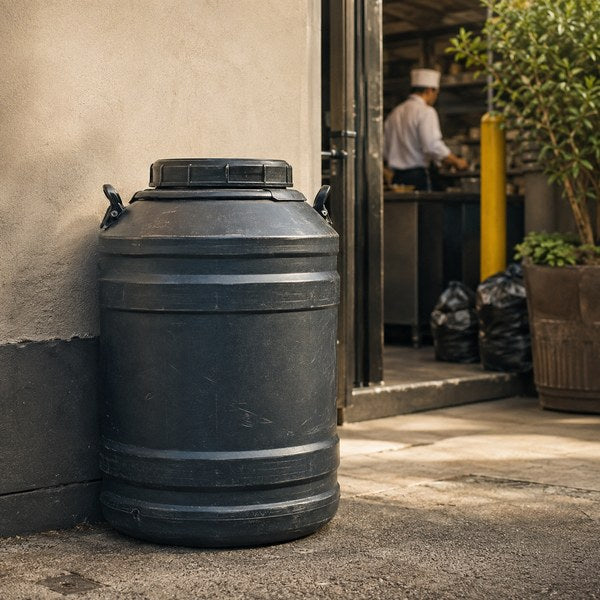
- Position collection points sensibly. The transfer container belongs near the fryer line; the bulk tank belongs on a level, paved area away from storm drains, alongside your trash cans & recycling bins so staff treat oil as one more sorted stream, not a special chore.
- Document and train. Add oil handling to closing checklists, keep manifests with your HACCP-adjacent records, and brief every new hire during onboarding.
Which supplies support an oil recycling workflow?
Having supplied 40,000+ foodservice operations, we've noticed a pattern: programs fail on equipment, not intent. Staff will recycle oil when the tools make it the easy path. The essentials:
- Fryers with drain valves and filtration: modern commercial fryers with built-in filtration extend oil life (less waste to begin with) and make end-of-life draining a controlled, valve-driven task instead of a lift-and-pour risk.
- Sealed transfer and storage vessels: heat-safe food storage containers and dedicated oil caddies keep cooling oil covered, labeled, and away from prep areas until pickup day.
- Spill and cleanup gear: absorbents, degreasers, caution signage, and nitrile gloves from our janitorial supplies line handle the inevitable drips before they become slip hazards or drain contamination.
- Supporting line tools: fine-mesh skimmers, thermometers, and filter cones from our cooking equipment collection extend oil life during service, which means better food and fewer gallons to recycle.
One concrete observation from our customer base: operations that give oil handling a dedicated, labeled container — rather than "whatever bucket is free" — report dramatically fewer spills and near-zero drain incidents. The container is the program.
How Does Oil Recycling Fit a Bigger Recycling Program?
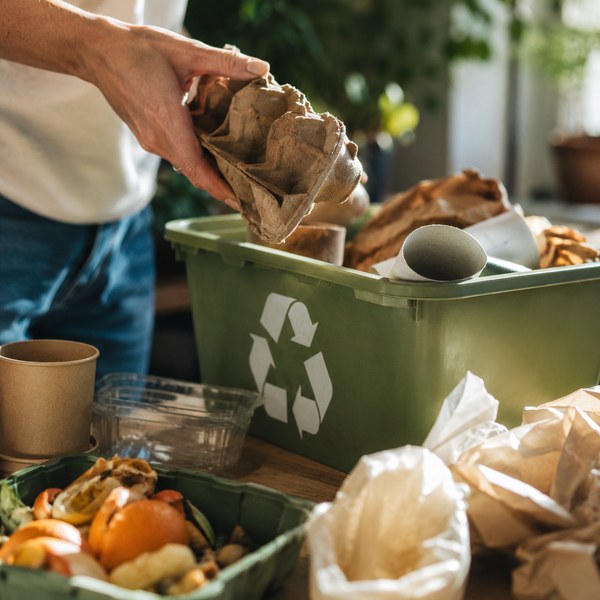
Used cooking oil is usually the highest-value recycling stream in a restaurant, which makes it the perfect anchor for a full back-of-house program. Once staff are sorting oil, adding cardboard, glass, metals, and rigid plastics is a training tweak, not a culture change. If you're building out the rest of the system, start with our guide to implementing a successful recycling program in your kitchen, then go deeper on individual streams: what plastic recycling symbols mean, recycling metals, and choosing packaging with our compostable vs. recyclable guide for foodservice businesses. For the broader case, see embracing recycling for a sustainable future.
The benefits from recycling compound across streams: lower dumpster-haul frequency, cleaner storage areas, and one coherent sustainability story instead of scattered gestures.
Frequently Asked Questions
What are the 5 benefits of recycling?
The five core benefits of recycling are: (1) conserving natural resources, (2) saving energy, (3) reducing waste sent to landfills and pollution, (4) supporting jobs and economic activity — 681,000 U.S. jobs per the EPA's REI Study — and (5) for businesses, cutting disposal costs. For restaurants, used cooking oil adds a sixth: direct rebates, because recycled oil becomes renewable fuel.
Is there a benefit to recycling?
Yes. Recycling delivers documented environmental, economic, and operational benefits. The EPA reports that recycling conserves resources and energy — recycling just 10 plastic bottles saves enough energy to power a laptop for more than 25 hours — while recycling and reuse activity generates $37.8 billion in U.S. wages annually. For a restaurant, recycling used cooking oil specifically prevents drain clogs, satisfies grease-disposal ordinances, and can produce rebate income.
What are 5 facts about recycling?
Five verifiable recycling facts: (1) U.S. recycling and reuse account for 681,000 jobs (EPA REI Study); (2) every 1,000 tons recycled supports about 1.17 jobs (EPA); (3) used restaurant cooking oil is a major U.S. biodiesel feedstock (EIA); (4) U.S. renewable diesel capacity reached roughly 3 billion gallons per year across 17 plants as of January 2023 (EIA); and (5) EPA's waste hierarchy ranks reducing and reusing above recycling — so extending fryer-oil life comes before recycling it.
What are 5 positive impacts of recycling plastic in foodservice?
Recycling plastic in a foodservice setting (1) diverts packaging from landfills, (2) reduces demand for virgin resin, (3) lowers waste-hauling volume and cost, (4) keeps you ahead of local packaging ordinances, and (5) reinforces the sorting habits that make your oil program stick. Start by learning which resins your hauler accepts — our plastic recycling symbols guide (linked above) breaks down codes 1–7.
Conclusion: Turn Your Fryer Oil Into an Asset
The benefits of recycling used cooking oil are unusually concrete for a sustainability initiative: money in, fines and plumbers out, and a claim your guests can verify. Audit your volume, sign a licensed collector, equip the line so the right move is the easy move, and fold oil into a broader sorting program. Whether you're one of the 7-in-10 single-unit operations or a multi-site group, the playbook is the same — and it starts with the right equipment. Explore our commercial fryers with built-in filtration and outfit your collection points from our trash cans & recycling bins collection to get your program pouring in the right direction today.


1 comment
Managing a fleet maintenance shop requires a reliable solution for antifreeze disposal near me to handle the heavy-duty glycol waste we generate monthly. Most people don’t realize how toxic used coolant can be to local wildlife if not handled by a licensed facility. I always check the ‘About’ section of an environmental company to verify their credentials and commitment to sustainable practices. In 2026, we need more than just a pickup service; we need a partner that acts as a shield against owner liability and environmental mismanagement.