Foodservice Industry Trends 2026: 5 Eco-Friendly Shifts Reshaping Operations
The top foodservice industry trends for 2026 are five eco-friendly operational shifts: compostable and fiber-based packaging, food waste reduction, shorter and more transparent supply chains, energy- and water-efficient equipment, and reusable service systems. Operators who adopt these practices cut costs, meet tightening regulations, and win increasingly selective customers.
Foodservice industry trends in 2026 point in one clear direction: sustainability has moved from the marketing page to the operations manual. The National Restaurant Association projects total restaurant and foodservice sales will reach $1.55 trillion in 2026, with employment climbing to 15.8 million jobs — yet more than 9 in 10 operators cite food, labor, insurance, energy, and swipe fees as significant cost challenges. That squeeze is exactly why eco-friendly practices are accelerating: the same shifts that shrink an operation's environmental footprint also shrink its waste bill, its energy bill, and its exposure to packaging regulations.
In 15+ years supplying 40,000+ foodservice operations at Restaurantware, we've watched sustainability evolve from a niche request into the default expectation on purchase orders. This guide breaks down the five eco-friendly shifts defining the future of foodservice — and what each one means for your kitchen, your supply chain, and your bottom line.

TL;DR — The 5 Eco-Friendly Shifts at a Glance
- Shift 1 — Compostable & fiber-based packaging: plant-based containers replace single-use plastic and foam as bans expand and the sustainable packaging market grows at a 7.6% CAGR.
- Shift 2 — Food waste reduction: U.S. foodservice generated 12.5 million tons of surplus food in 2024 (ReFED) — tracking, portioning, and composting claw that money back.
- Shift 3 — Shorter, transparent supply chains: local sourcing and consolidated ordering cut transport emissions and stockout risk.
- Shift 4 — Energy & water efficiency: restaurants use 5–7x more energy per square foot than other commercial buildings (ENERGY STAR) — efficient equipment is the fastest payback in the building.
- Shift 5 — Reusables & circular systems: durable serviceware, reuse programs, and recyclable mono-material packaging close the loop.
| Eco-Friendly Shift | Primary Cost Lever | Regulatory Pressure | Typical First Step |
|---|---|---|---|
| Compostable packaging | Avoids ban-related repurchasing | High — foam/plastic bans expanding | Swap foam and PET to-go containers for fiber |
| Food waste reduction | Food cost (waste ≈ 14% of foodservice sales value) | Medium — organics landfill bans in several states | Waste audit + portion standardization |
| Shorter supply chains | Freight + shrink | Low–medium | Consolidate suppliers; add local produce contracts |
| Energy & water efficiency | Utilities (5–7x other buildings) | Medium — appliance standards | ENERGY STAR equipment on replacement cycle |
| Reusables & circularity | Disposables spend | Medium — reuse mandates emerging | Durable serviceware for dine-in; mono-material to-go |
What Are the Top Foodservice Industry Trends for 2026?
The top foodservice industry trends for 2026 are eco-friendly operational shifts — packaging, waste, sourcing, energy, and reusables — driven by cost pressure, regulation, and customer selectivity. Datassential's 2026 industry data shows the U.S. now has nearly 859,000 active restaurants, with over 70% of operators naming food costs their top operational challenge and 72% of consumers reporting they've become more selective about where they spend food dollars. In that environment, sustainability isn't a luxury program; it's a margin strategy.
Deloitte's Future of Restaurants research reaches the same conclusion from the boardroom side. In its survey of 150 restaurant executives, operational efficiency ranked among the top areas of increasing investment, and "serve up a sustainable future" appears as one of Deloitte's five strategic imperatives — because consumers gravitate toward brands with strong reputations for operating sustainably. The future of foodservice belongs to operators who treat eco-friendly restaurant practices as operations, not decoration. Here are the five shifts, one by one.
Shift 1: How Is Sustainability Changing Foodservice Packaging?
Sustainable packaging is changing foodservice by replacing single-use plastic and foam with compostable, fiber-based, and recyclable alternatives across takeout, delivery, and catering-style service. The global sustainable packaging market is projected to grow at a 7.6% CAGR from 2024 to 2030, reaching $448.5 billion, according to Grand View Research — and foodservice disposables are one of the fastest-moving segments inside that number. (Current as of August 2026.)
Three forces are pushing the packaging shift from optional to mandatory:
- Regulation: polystyrene foam bans and single-use plastic restrictions keep expanding across U.S. states and cities. Operators who standardize on compliant materials once avoid re-sourcing every time a new ordinance lands.
- Customer perception: the container is the brand for off-premises orders. A molded-fiber hinged box says something different about your operation than a foam clamshell — and off-premises is where Gen Z and millennial growth is concentrated, per the NRA's 2026 report.
- Waste-stream economics: commercial composting programs increasingly accept certified compostable packaging alongside food scraps, letting operators consolidate two waste streams into one lower-cost pickup.
What we see across our customer base: operators who switch to eco friendly disposables rarely switch back. The unit economics have converged — bagasse, PLA, bamboo, and kraft options now price within range of conventional plastic — and the operational risk now runs the other way, toward being caught holding non-compliant inventory when a ban takes effect. Start with your highest-volume SKU (usually the entrée to-go container), validate performance for heat, grease, and steam over a two-week service test, then roll through the rest of the line.
Shift 2: Why Is Food Waste Reduction a Top Operational Priority?
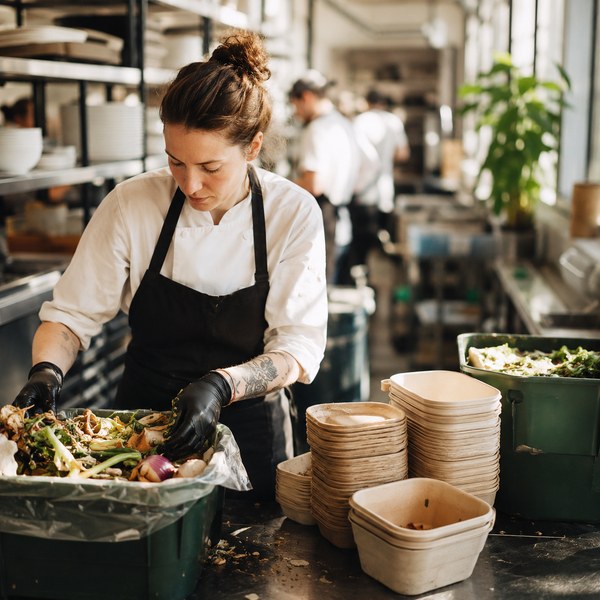
Food waste reduction is a top 2026 priority because surplus food is one of the largest controllable costs in foodservice. ReFED's 2026 U.S. Food Waste Report data shows the foodservice sector generated 12.5 million tons of surplus food in 2024, valued at $157 billion — the equivalent of 14% of foodservice sales — and 78.4% of that waste went to landfill. The environmental math is just as stark: the EPA estimates that 24% of material in municipal solid waste landfills is food, where it generates methane, making landfills the third-largest source of human-caused methane emissions in the United States. (Figures current as of August 2026.)
The operational playbook for 2026 has four steps, in order of payback:
- Measure first. Run a two-week waste audit — separate prep waste, plate waste, and spoilage. Most kitchens find prepared foods dominate (ReFED puts prepared foods at 11.2 million tons of foodservice waste, far ahead of any other category).
- Standardize portions. Portion scoops, scaled recipes, and batch-cooking to forecasted demand attack plate waste and overproduction at the source.
- Recover, don't discard. Donation partnerships and staff-meal programs move edible surplus up the EPA's Wasted Food Scale before it ever hits a bin.
- Compost the rest. Pair organics pickup with certified compostable packaging (Shift 1) so back-of-house sorting stays simple enough to survive a Friday rush.
Our foodservice customers consistently tell us the waste audit is the step that changes minds: once the walk-in shrink and over-prepped pans get a dollar figure attached, food waste stops being a sustainability line item and becomes a food-cost line item — the challenge over 70% of operators already rank first.
Shift 3: How Are Supply Chains Getting Shorter and More Transparent?
Foodservice supply chains are getting shorter and more transparent as operators trade sprawling vendor lists for consolidated, traceable sourcing. The pandemic-era disruptions taught the industry a permanent lesson — resilience beats rock-bottom unit price — and 2026's cost environment reinforces it: with the NRA reporting that 42% of operators said their restaurant was not profitable last year, every freight surcharge, stockout substitution, and spoiled delivery matters.
The eco-friendly dimension of supply chain reform shows up in three places:
- Fewer, fuller trucks. Consolidating orders with fewer suppliers cuts delivery frequency, which cuts transport emissions and receiving labor simultaneously.
- Local and regional sourcing. Shorter farm-to-kitchen distances reduce cold-chain energy and shrink, and give menus a provenance story customers verify with one question to a server.
- Traceability as a standard. Operators increasingly ask suppliers the same questions their customers ask them: where was this made, from what material, under what certifications? Documentation (BPI certification for compostables, FSC for paper, FDA food-contact compliance) is becoming a purchase-order prerequisite rather than a nice-to-have.
Technology is the quiet enabler here. AI-driven demand forecasting and inventory tools help operators order what they'll actually use — the same systems we covered in selecting the best AI tools for your foodservice operation, and the innovation direction firms like Mattson are pushing with AI-driven foodservice R&D tools. Better forecasts mean less over-ordering, which loops directly back into Shift 2's waste reduction.
Shift 4: What Do Energy and Water Efficiency Look Like in a 2026 Kitchen?
Energy and water efficiency in a 2026 kitchen means replacing equipment on an ENERGY STAR cycle, fixing the low-cost leaks first, and treating utilities as a managed food-cost category. The scale of the opportunity is unusual: ENERGY STAR reports that restaurants use about 5 to 7 times more energy per square foot than other commercial buildings, and high-volume quick-service restaurants can use up to 10 times more. No other building type on the block has that much headroom. (Current as of August 2026.)
With more than 9 in 10 operators naming energy among their significant cost challenges in the NRA's 2026 State of the Restaurant Industry report, the efficiency checklist is straightforward:
- Replacement-cycle upgrades: when a fryer, dishwasher, ice machine, or reach-in dies, replace with ENERGY STAR-certified equipment — the premium typically pays back through utility savings well within the unit's service life.
- Low-cost wins first: LED retrofits, door gaskets on refrigeration, low-flow pre-rinse spray valves, and strike-plate maintenance on combi ovens deliver savings without capital approval.
- Behavioral standards: startup/shutdown schedules for hood fans and cooklines routinely trim 10–20% of kitchen energy use with zero equipment spend.
- Water discipline: dish machines and pre-rinse stations are the big users; efficient valves and full-rack policies compound daily.
This is the least visible of the five shifts — no customer ever compliments your door gaskets — but it's frequently the fastest payback, which is why Deloitte's executive survey found efficiency improvements among the top areas of increasing investment across restaurant companies.
Shift 5: Why Are Reusables and Circular Systems Gaining Ground?
Reusables and circular systems are gaining ground because they attack the disposables line item at its root: the best packaging waste is the packaging you never buy twice. In 2026 this shift shows up at three levels of commitment:
- Durable serviceware for dine-in. Operators moving from disposables to washable eco friendly dinnerware for on-premises service eliminate a recurring purchase entirely — the greenest disposable is the one replaced by a plate that survives 1,000 cycles.
- Returnable container programs. Campus dining, corporate cafeterias, and fast casuals are piloting deposit-based reusable cup and container systems, often nudged by local reuse ordinances.
- Mono-material and recyclable to-go. Where reuse isn't practical, circularity means choosing packaging that recycling and composting streams actually accept — single-material kraft, fiber, or certified-compostable formats instead of mixed-material laminates that contaminate every bin they enter.
The through-line is lifecycle thinking: buy less, buy better, and make sure the end-of-life pathway you're paying for (compost, recycling, reuse) actually exists in your municipality. It's the same post-disruption operational rethink we chronicled in the future of catering post-COVID — service models get redesigned when the old defaults stop making economic sense.
How Should Operators Choose Where to Start? (Buying Considerations)
Operators should start with the shift that touches their largest controllable spend — usually packaging or food waste — and sequence the rest over 12–18 months. Use this decision framework:
| If your biggest pain is… | Start with… | First purchase / action |
|---|---|---|
| High off-premises volume, ban exposure | Shift 1 (packaging) | Compostable to-go containers for top-3 SKUs |
| Food cost over 32–34% | Shift 2 (waste) | Two-week waste audit + portion tools |
| Stockouts, freight surcharges | Shift 3 (supply chain) | Vendor consolidation review |
| Utility bills climbing faster than sales | Shift 4 (energy/water) | ENERGY STAR replacement policy + LED/valve retrofit |
| Heavy dine-in with disposables spend | Shift 5 (reusables) | Durable dinnerware program |
Three buying rules apply across all five shifts. First, demand certifications, not adjectives — "green" on a sell sheet means nothing; BPI-certified compostable, FSC-certified paper, and ENERGY STAR ratings mean something auditable. Second, test before you standardize — every compostable container should survive your actual sauces, hold times, and delivery radius before it earns a spot on the order guide. Third, price the system, not the unit — a container that costs three cents more but consolidates your waste hauling into a single organics stream can be the cheaper choice at the month level.
Putting the Trends to Work: Eco-Friendly Products in a Real Operation
Here's how the five shifts translate into an actual order guide — the operator's view we've built over 15+ years supplying 40,000+ foodservice operations:
- Off-premises program: bagasse and kraft eco-friendly to-go containers handle hot, greasy, and saucy items while keeping your takeout stream compostable end-to-end (Shifts 1 and 2).
- Events and high-volume service: palm-leaf and bamboo eco friendly plates deliver presentation-grade service without the dish pit — and without foam (Shifts 1 and 5).
- Dine-in circularity: durable, washable eco-friendly dinnerware converts a recurring disposables spend into a one-time purchase amortized over thousands of covers (Shift 5).
- Waste-stream simplification: when plates, containers, and cutlery are all certified compostable, back-of-house sorting collapses into one bin — which is what makes organics pickup contracts pencil out (Shift 2).
One pattern worth naming: the operators who succeed treat these as one integrated program, not five separate projects. The compostable container only pays off if the composting pickup exists; the waste audit only sticks if portion tools follow it; the energy policy only compounds if it's written into the replacement cycle. Sustainability in 2026 is systems work — the same discipline the industry is applying to automation, as we covered in 10 ways AI is changing the food industry.
Frequently Asked Questions
What are the top foodservice industry trends for 2026?
The top foodservice industry trends for 2026 are five eco-friendly operational shifts: compostable and fiber-based packaging, food waste reduction, shorter and more transparent supply chains, energy- and water-efficient equipment, and reusable or circular service systems. They're driven by cost pressure (industry sales of $1.55 trillion against thin margins), expanding packaging regulation, and consumers who are more selective about where they spend.
Which eco-friendly shifts matter most to operators?
Packaging and food waste matter most for the typical operator because they touch the largest controllable spend. Surplus food equals roughly 14% of foodservice sales value (ReFED, 2024 data), and packaging is both a daily cost and a compliance risk as foam and single-use plastic bans expand. Energy efficiency delivers the fastest payback for equipment-heavy, high-volume kitchens.
How is sustainability changing foodservice packaging?
Sustainability is changing foodservice packaging by making compostable and fiber-based materials the default replacement for plastic and foam. The sustainable packaging market is growing at a 7.6% CAGR toward $448.5 billion by 2030 (Grand View Research), regulation keeps removing conventional options, and certified-compostable formats let operators merge packaging and food scraps into a single organics waste stream.
How do 2026 trends affect operator purchasing decisions?
The 2026 trends push purchasing toward certified, system-level buying: BPI-certified compostables, FSC paper, and ENERGY STAR equipment specified on the replacement cycle. Operators increasingly price the whole system — container cost plus waste hauling plus compliance risk — instead of the per-unit price, and they consolidate suppliers to cut freight, emissions, and stockout exposure.
Conclusion: The Future of Foodservice Is Operational
The future of foodservice won't be decided by slogans — it's being decided in order guides, waste contracts, and equipment replacement policies. The five eco-friendly shifts above are where the foodservice industry trends of 2026 become line-item decisions: swap the container, audit the waste, shorten the supply chain, spec the efficient equipment, close the loop. Each one pays for itself; together they compound.
Ready to put the first shift into practice? Explore Restaurantware's full range of eco-friendly disposables — compostable containers, plates, and serviceware built for real commercial volume — and make your next order the one that moves your operation forward.