Natural Food Dyes: What the FDA's Approval & Synthetic Phase-Out Means for Your Business
Natural food dyes are colorants derived from plants, algae, and minerals — including Galdieria extract blue, butterfly pea flower extract, gardenia (genipin) blue, and calcium phosphate — that the FDA approved in 2025 as replacements for petroleum-based synthetic dyes like Red 40, which U.S. regulators and food manufacturers are phasing out of the food supply.
Natural food dyes have moved from a niche clean-label talking point to the center of U.S. food policy. Between January 2025 and today, the FDA revoked one synthetic dye outright, approved four new colors from natural sources, and asked the entire food industry to abandon petroleum-based dyes voluntarily. If you run a restaurant, bakery, ghost kitchen, or food brand, the colors on your menu — and on your ingredient labels — are changing whether you planned for it or not. This guide breaks down exactly what the FDA did, what is legally required versus voluntary, and how foodservice operators can make the switch without sacrificing visual appeal.

TL;DR — The 2025–2026 Food Dye Shake-Up at a Glance
- FD&C Red No. 3 is revoked. The FDA banned it from food (deadline: January 15, 2027) and ingested drugs (January 18, 2028) — the only synthetic dye with a formal revocation so far.
- Six more dyes are being phased out voluntarily — Red 40, Yellow 5, Yellow 6, Blue 1, Blue 2, and Green 3. This is an industry commitment the FDA is coordinating, not a legal ban.
- Four natural colors won FDA approval in 2025: Galdieria extract blue, expanded uses for butterfly pea flower extract, calcium phosphate (white), and gardenia (genipin) blue.
- The timeline has shifted. The original target was end of 2026; as of mid-2026, most major manufacturers' pledges on the FDA's public tracker now run through the end of 2027.
- Operators should act now: audit dyed ingredients, test natural swaps for heat and pH stability, and update sourcing before reformulated supply chains tighten.
| Date | FDA / HHS Action | Binding? |
|---|---|---|
| Jan 15, 2025 | FD&C Red No. 3 authorization revoked for food and ingested drugs | Yes — formal regulation |
| Apr 22, 2025 | HHS/FDA announce phase-out of six petroleum-based dyes; begin revocation process for Citrus Red No. 2 and Orange B | Voluntary (six dyes); revocations initiated |
| May 9, 2025 | Three natural color additives approved: Galdieria extract blue, butterfly pea flower extract (expanded uses), calcium phosphate | Yes — approvals effective |
| Jul 14, 2025 | Gardenia (genipin) blue approved; FDA reports ~40% of industry committed to phase-out | Yes — approval effective |
| 2026 (current) | FDA publicly tracks company pledges; most large-manufacturer deadlines now end of 2027 | Voluntary pledges |
What Are Natural Food Dyes?
Natural food dyes are color additives derived from plant, mineral, algal, or other natural sources rather than synthesized from petroleum. Common examples include beet juice (red-pink), turmeric (yellow), annatto (orange), spirulina and butterfly pea flower extract (blue), paprika oleoresin (red-orange), and caramel color (brown). Under U.S. law, they are typically "exempt from certification" — unlike FD&C synthetic dyes, each batch does not require FDA certification before sale.
The FDA expanded this palette significantly in 2025. According to the agency's May 9, 2025 announcement, three petitions were granted in a single day:
- Galdieria extract blue — a blue pigment from the unicellular red algae Galdieria sulphuraria, approved for beverages, smoothies, yogurt drinks, cereal coatings, candy, frostings, ice cream, popsicles, puddings, and whipped toppings.
- Butterfly pea flower extract — already approved for drinks, teas, candy, and ice cream, its uses were expanded to ready-to-eat cereals, crackers, snack mixes, pretzels, potato chips, corn chips, and tortilla chips. It produces bright blues, intense purples, and natural greens depending on pH.
- Calcium phosphate — a natural white color approved for ready-to-eat chicken products, white candy melts, doughnut sugar, and coated-candy sugar.
Two months later, on July 14, 2025, the FDA approved gardenia (genipin) blue — derived from gardenia fruit — for sports drinks, enhanced waters, fruit drinks, ready-to-drink teas, and hard and soft candy. That made four natural color approvals in roughly two months, the fastest expansion of the natural palette in the agency's modern history.
Once the FDA approves a color additive petition, any manufacturer may use that coloring for the approved uses — so these approvals immediately widen the toolkit for every bakery, beverage program, and commissary kitchen in the country.
Why Is the FDA Phasing Out Synthetic Food Dyes?
The FDA is phasing out synthetic food dyes as part of a coordinated federal push, announced April 22, 2025, to remove petroleum-based colorants from the U.S. food supply over concerns about their role in children's health. The sequence matters, because each action carries different legal weight.
January 2025: FD&C Red No. 3 revoked — the only formal ban
On January 15, 2025, the FDA revoked authorization for FD&C Red No. 3 in food and ingested drugs under the Delaney Clause of the Federal Food, Drug, and Cosmetic Act, which prohibits any color additive shown to cause cancer in humans or animals. Two studies showed cancer in male rats exposed to high levels of the dye. Manufacturers have until January 15, 2027 to remove Red 3 from food, and until January 18, 2028 for ingested drugs. Red 3 was used mainly in candy, cakes, cookies, frozen desserts, and frostings — categories that sit squarely in bakery and dessert programs.
April 2025: the six-dye phase-out announcement
On April 22, 2025, HHS and the FDA announced a plan to phase out all petroleum-based synthetic dyes from the food supply. The plan: establish a national standard and timeline for transitioning to natural alternatives, initiate revocation of two little-used colors (Citrus Red No. 2 and Orange B), work with industry to eliminate the six remaining synthetic dyes — FD&C Green No. 3, Red No. 40, Yellow No. 5, Yellow No. 6, Blue No. 1, and Blue No. 2 — fast-track natural alternatives, and ask companies to drop Red 3 ahead of its legal deadline.
Here is the distinction every operator should understand: the six-dye phase-out is voluntary. The FDA has not revoked authorization for Red 40, the Yellows, the Blues, or Green 3 — they remain legal to use. The agency is instead securing public commitments from manufacturers and tracking them openly.
2026 status: pledges in progress, timeline stretched to 2027
The original target was to clear the six dyes from the food supply by the end of 2026. As of mid-2026, the practical timeline has slipped. The FDA's own industry pledge tracker shows most major manufacturers — Kraft Heinz, General Mills, Hershey, Kellanova, J.M. Smucker, Conagra, McKee Foods — committing to full removal by the end of 2027, with school-food deadlines landing earlier (the 2026–27 school year). Some companies have already finished: Tyson Foods, Nestlé USA, Target's store-brand cereal, Sam's Club's Member's Mark line, PIM Brands (Welch's Fruit Snacks), and In-N-Out's shakes and pink lemonade are marked "Complete." By July 2025, the FDA reported that roughly 40% of the food industry had committed to the voluntary phase-out; the tracker has grown since.
An April 2026 review by Consumer Reports confirmed the same picture: real progress, uneven commitments, and no formal ban on the six dyes. Its March 2026 nationally representative survey found 72% of U.S. adults are at least somewhat concerned about synthetic dyes in food, and 66% believe companies should be required to phase them out. Consumer sentiment, in other words, is running ahead of the regulation — a dynamic we've covered before in our report on consumer confidence in the food supply.
Figures current as of July 2026 — verify deadlines against the FDA tracker before making compliance decisions.
Natural vs. Synthetic Food Dyes: How Do They Compare?
Natural food dyes behave differently from synthetics in a working kitchen. Synthetic dyes were popular for a reason: they are cheap, intensely concentrated, and nearly indestructible under heat and pH swings. Natural food coloring asks more of your technique. Here is the honest comparison:
| Factor | Natural Food Dyes | Synthetic (FD&C) Dyes |
|---|---|---|
| Source | Plants, algae, minerals, fruits (beet, turmeric, spirulina, gardenia) | Petroleum-derived chemical synthesis |
| Color intensity | Softer, muted; higher usage rates needed for bold shades | Vivid, saturated at tiny doses |
| Heat stability | Variable — betanin (beet) fades above ~140°F; curcumin and annatto tolerate baking better | Highly stable through baking and frying |
| pH sensitivity | Often dramatic — butterfly pea flower shifts blue→purple→pink as acidity rises | Largely pH-stable |
| Light/shelf stability | Many fade with light exposure over weeks | Months to years of color hold |
| Cost | Higher per unit of color delivered | Lowest cost per unit of color |
| Flavor impact | Possible at high doses (beet earthiness, turmeric bitterness) | Effectively none |
| Labeling | Named ingredient (e.g., "beet juice color"); generally exempt from batch certification | Must be declared by FD&C name; batch-certified |
| 2026 regulatory outlook | Expanding — four new approvals in 2025, more petitions fast-tracked | Contracting — Red 3 revoked; six dyes under voluntary phase-out |
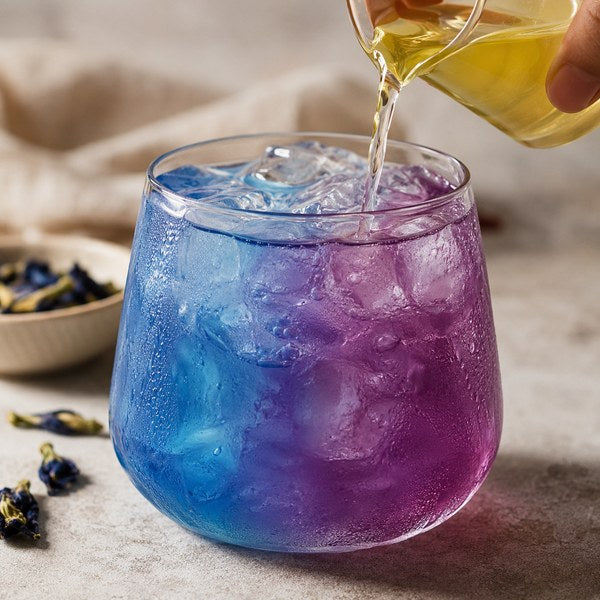
The pH behavior is worth dwelling on, because it's a feature as much as a bug. Butterfly pea flower extract is the classic example: steep it blue, add lemon and it turns violet-pink in front of the guest. Beverage programs have built entire signature drink menus around that color change.
How Should Operators Choose Natural Food Dyes? A Buying Checklist
Choosing natural food dyes comes down to matching the pigment to the application. In 15+ years supplying more than 40,000 foodservice operations, we've watched plenty of kitchens buy a single "natural red" and get frustrated when it worked in buttercream but vanished in a baked sponge. Use this framework instead:
- Match pigment to process temperature. For baked goods, favor heat-tolerant pigments (curcumin/turmeric for yellow, annatto for orange, carotenes). Save beet and anthocyanin reds for no-bake applications: frostings, glazes, macarons, beverages, and cold desserts.
- Check your pH before you buy. Anthocyanin-based colors (berry, purple sweet potato, red cabbage, butterfly pea) swing shades with acidity. Test in the actual recipe, not in water.
- Buy concentrated formats for bold shades. Gel and powdered natural food coloring delivers more pigment with less added moisture than liquid drops — critical in macaron shells, meringues, and chocolate work where water is the enemy.
- Plan for dosage cost, not unit cost. A natural color may cost more per bottle and require a higher usage rate. Cost it per finished batch and price menu items accordingly.
- Verify the label claim. "Dye-free food coloring" and "plant-based food dye" are marketing terms — confirm the actual ingredient list (e.g., "fruit juice color," "spirulina extract") so your menu claims hold up.
- Watch shelf life and storage. Natural pigments degrade faster in light and heat. Store cool and dark, rotate stock, and order in quantities you'll use within the supplier's stated window.
- Confirm allergen and dietary status. Carmine (cochineal red) is natural but insect-derived — a problem for vegan, kosher, and halal menus. Annatto is a rare but documented allergen.
Our foodservice customers consistently tell us the transition is smoothest when they run natural and synthetic options in parallel for one menu cycle, photograph the results side by side, and let the culinary team pick the winning formulation before committing to volume orders.
Putting Natural Food Dyes to Work in a Commercial Kitchen
Here's where the regulation meets the plate. The operators winning on this shift aren't just swapping ingredients — they're merchandising the change. "Colored naturally with beet and turmeric" is a menu line that sells, especially to the 72% of consumers already wary of synthetics.
Bakery and dessert programs. This is ground zero: Red 3's legal deadline (January 2027) hits frostings, icings, candy decorations, and frozen desserts first. Audit every decorated SKU now. Stock plant-based food coloring in gels and powders for buttercream, macarons, and glazes, and pair them with clean-label baking ingredients so the whole build supports the claim. If you use pre-blended bases, check whether your baking mixes contain FD&C colors — many legacy mixes do, and reformulated versions are rolling out through 2027.
Beverage programs. The 2025 approvals were beverage-heavy by design: Galdieria extract blue and gardenia blue are both cleared for juices, smoothies, teas, and sports-drink-style applications. Color-changing butterfly pea lattes, lemonades, and cocktails deliver the visual pop synthetic dyes used to provide — with a story attached.
Catering and K-12/institutional accounts. If you supply schools, your deadline is effectively the 2026–27 school year, when major manufacturers and the dairy industry have pledged to pull certified colors from school-channel products. Get ahead of district RFPs by documenting your dye-free formulations now.
Menu development. Natural color pairs naturally with the broader better-for-you shift — the same consumer demand driving plant-based eating in the 2025 Dietary Guidelines and the ingredient-transparency trends we flagged in our menu planning trends report. Treat the reformulation as a marketing moment, not a compliance chore.
One pattern we've seen across the 40,000+ operations we supply: kitchens that switched early on high-visibility items — a signature pink dessert, a blue house lemonade — earned the clean-label credibility without reformulating the entire menu at once. Start where guests are looking.
Frequently Asked Questions About Natural Food Dyes
Does ketchup have dye in it?
Major U.S. ketchup brands do not use synthetic dyes — the red color comes from ripe tomatoes and tomato paste. Always check the ingredient statement on value or imported brands, but for mainstream ketchup, added color is not part of the recipe.
What is considered the most unhealthy food dye?
FD&C Red No. 3 is the synthetic dye with the strongest regulatory case against it: the FDA revoked its authorization in January 2025 under the Delaney Clause after studies showed it caused cancer in male rats at high doses. The other six FD&C dyes remain FDA-authorized, though they are the subject of the voluntary phase-out over concerns about children's health and behavior.
What food coloring is good without Red 40?
The best Red 40 alternatives are natural reds: beet juice or beet powder (betanin) for pinks and reds in cold applications, paprika oleoresin and lycopene (tomato) for warm red-oranges, anthocyanins from radish or purple sweet potato for berry reds, and carmine for a vivid, heat-stable red where insect-derived ingredients are acceptable.
What is a natural alternative to red food coloring?
Beet juice concentrate is the most versatile natural alternative to red food coloring for frostings, batters, and beverages. For baked applications where beet fades, use anthocyanin-rich options tested at your oven temperature, or shift the shade warm with paprika extract. Expect softer, berry-toned reds rather than the neon cherry of synthetics.
Is the synthetic food dye ban mandatory?
Only partially. The Red 3 revocation is mandatory, with deadlines of January 15, 2027 (food) and January 18, 2028 (ingested drugs). The phase-out of Red 40, Yellow 5, Yellow 6, Blue 1, Blue 2, and Green 3 is a voluntary industry commitment coordinated and publicly tracked by the FDA — those six dyes remain legal today.
When will synthetic dyes actually be out of the U.S. food supply?
Realistically, between now and the end of 2027. Some manufacturers (Tyson, Nestlé USA, PIM Brands) have already finished; most large companies on the FDA's pledge tracker have committed to full removal by the end of 2027, with school-food products converting by the 2026–27 school year.
The Bottom Line for Foodservice Operators
Natural food dyes are no longer the alternative — they are the direction of the entire U.S. food system. The FDA has formally banned Red 3 with a January 2027 food deadline, approved four new natural colors, and enlisted much of the industry in a voluntary phase-out of the remaining six synthetics that will largely conclude by the end of 2027. Operators who audit their dyed SKUs now, test natural swaps against real recipes, and merchandise the change on the menu will turn a compliance deadline into a selling point.
Ready to make the switch? Explore Restaurantware's full range of natural and plant-based food coloring — gels, powders, and liquids stocked for commercial volume — plus the baking ingredients to build a clean-label pastry program from the ground up.