Edible Food Packaging: Innovations Changing How We Pack & Eat
Edible food packaging is packaging made from food-grade materials — such as seaweed, alginate, starch, or milk-protein films — that consumers can safely eat along with the product. It reduces single-use plastic waste, and innovations like Notpla's Ooho pods and WikiCell wrappers are moving edible food packaging from labs into real foodservice operations.
Containers and packaging represent the single largest category of municipal solid waste in the United States — 82.2 million tons in 2018, or 28.1% of everything Americans throw away, according to the U.S. EPA. Edible food packaging attacks that number at its root: if the wrapper is food, there is nothing left to landfill. In 15+ years supplying 40,000+ foodservice operations, we've watched this category evolve from a TED-talk curiosity into a real — if still niche — option for events, QSRs, and delivery programs. This guide covers the leading edible packaging examples, the honest disadvantages, and what operators can actually buy today.

TL;DR — Edible Food Packaging at a Glance
- Edible food packaging is made from FDA-recognized food ingredients (seaweed/alginate, starch, casein) and is designed to be eaten or composted, not discarded.
- The global edible packaging market was valued at $920.78 million in 2022 and is projected to reach $1,416.77 million by 2030 (5.7% CAGR), per Grand View Research. Current as of July 2026.
- Best current uses: single-serve liquids (sauce/drink pods), produce coatings, and inner-layer films — not primary takeout containers.
- Main barriers: cost per unit, short shelf life, hygiene (the outside of the package gets handled), and durability in transit.
| Criteria | Edible films & pods | Certified compostable packaging | Conventional plastic |
|---|---|---|---|
| End of life | Eaten or home-composts in weeks | Commercial or home compost | Landfill/recycling stream |
| Unit cost | Highest (limited production scale) | Moderate | Lowest |
| Shelf life | Days to weeks; moisture-sensitive | Months | Years |
| Hygiene | Needs an outer wrap or controlled service | Standard | Standard |
| Best fit | Events, sampling, single-serve sauces & drinks | Everyday takeout & delivery | Being phased out by regulation |
What Is Edible Food Packaging?
Edible food packaging is defined as a film, coating, pod, or wrapper made entirely from food-grade ingredients that can be safely consumed with the product it protects. Instead of polyethylene or PET, manufacturers form these barriers from three main material families:
- Seaweed and alginate films. Seaweed edible packaging uses alginate — a gelling polysaccharide extracted from brown seaweed — to form flexible membranes and pods. Seaweed grows quickly without farmland, fertilizer, or fresh water, which is why it anchors the most commercially advanced edible packaging for food today.
- Starch-based edible films. Starch-based edible films from potato, corn, rice, or cassava can be molded into rigid shapes (like potato-starch cups and trays) or cast as clear, dissolvable sheets.
- Milk-protein (casein) films. USDA Agricultural Research Service scientists developed an edible casein film that is up to 500 times better than conventional plastic at blocking oxygen — the main driver of food spoilage — according to USDA ARS.
Regulation matters here: in the U.S., FDA GRAS edible film ingredients (Generally Recognized As Safe, under the Federal Food, Drug, and Cosmetic Act) are the gatekeeper for anything sold as eat-the-wrapper packaging. Alginate, casein, and food starches all have established GRAS status — see the FDA's GRAS overview.
What Are the Leading Edible Packaging Innovations & Examples?
The leading edible packaging examples are Notpla's Ooho seaweed pods, WikiCell fruit-skin wrappers, Apeel's plant-based produce coatings, potato-starch cups, and USDA's casein films. Here is where each stands commercially:
Notpla Ooho — seaweed/alginate edible films
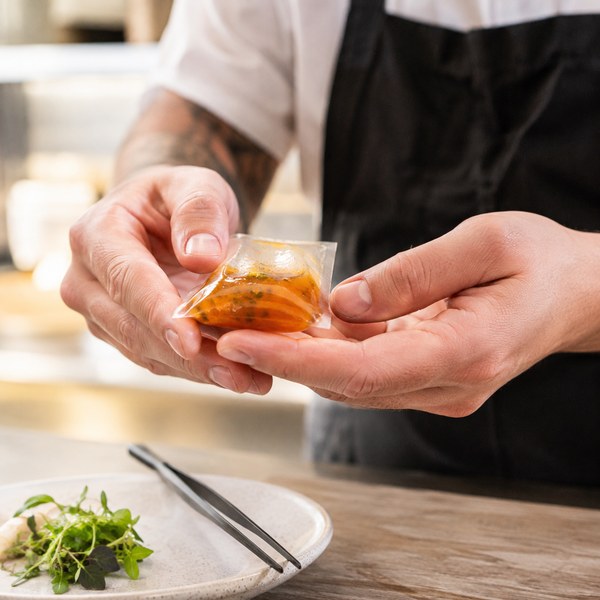
Ooho is an edible, plastic-free pod made from seaweed that holds water, sports drinks, sauces, and cocktails. Its breakout moment came at the 2019 London Marathon, where organizers handed runners more than 30,000 edible Ooho capsules in place of plastic bottles — the largest trial of the technology to date, as reported by Dezeen. Maker Notpla went on to win the 2022 Earthshot Prize in the "Build a Waste-Free World" category, and now supplies pods and seaweed-coated takeaway boxes for stadiums and event caterers in Europe.
WikiCell — the grape-skin wrapper
WikiCell edible packaging, invented by Harvard bioengineer David Edwards in 2012, encloses yogurt, ice cream, cheese, and beverages in a soft, washable skin made of food particles bound by nutritive ions — modeled directly on how a grape skin protects a grape (Sustainable America). WikiCell proved the biomimicry concept and reached retail pilots as WikiPearl frozen-yogurt bites, though it remains a specialty format rather than a mainstream package.
Edible coatings — Apeel and the invisible package
Not all edible packaging looks like packaging. Apeel Sciences applies an invisible, plant-based edible coating to produce that slows moisture loss and oxidation, extending shelf life — in some categories roughly doubling it — without any wrapper at all. For operators, coated produce means less shrink in walk-ins and fewer plastic clamshells upstream.
Starch cups and casein films
Potato-starch cups and trays (popularized in European QSR trials) handle dry and short-hold foods, while USDA's casein-based milk-protein film is being developed for cheese wraps, dissolvable soup sachets, and pizza-box liners where its oxygen barrier outperforms plastic. Neither is stocked at foodservice distributors in meaningful volume yet — which is exactly the gap operators need to plan around.
What Are the Disadvantages of Edible Food Packaging?
The disadvantages of edible food packaging are higher cost, short shelf life, hygiene concerns, and low durability. Any operator evaluating the category should weigh all four:
- Cost. Limited production scale keeps per-unit prices well above plastic or even premium compostables. The entire global market — $920.78 million in 2022 (Grand View Research) — is a rounding error next to conventional packaging, so economies of scale haven't arrived.
- Shelf life. Films built from seaweed, starch, or milk protein are hygroscopic — they absorb moisture, soften, and degrade in days to weeks. That's a feature at the end of life and a liability in a stockroom.
- Hygiene. If guests eat the package, everything the package touched matters. Edible packaging needs a secondary outer wrapper or tightly controlled service (events, in-house sampling), which can erase part of the waste savings.
- Durability & allergens. Edible films can't survive a 30-minute delivery ride the way a rigid container can, and milk-protein films introduce dairy allergen labeling obligations.
Our foodservice customers consistently tell us the same thing: they love the story, but the package has to survive the pass, the drive, and the doorstep first. That's why most operators deploy edible formats as an experience layer, not their core packaging program.
How Can Foodservice Operators Adopt Edible Packaging Today?
Operators can adopt edible food packaging today by starting narrow — single-serve pods at events, coated produce in purchasing, edible films for sauces — while running proven sustainable disposables everywhere else. A practical playbook:
- Pilot at events first. Sauce or drink pods at a festival, stadium, or catering activation deliver the wow factor with controlled handling and no shelf-life risk.
- Buy the invisible wins. Ask produce suppliers about edible-coated avocados, citrus, and cucumbers — sustainability gains with zero workflow change.
- Cover the other 95% with proven eco formats. While edible packaging scales, guest-facing sustainability lives in what you hand across the counter every day: our eco-friendly disposables collection, plant-fiber take-out containers and to-go boxes, paper take-out boxes, and compostable food packaging wrap. Our eco-friendly packaging guide walks through material-by-material choices.
- Watch the demand signal. In McKinsey's 2025 global packaging survey, a majority of consumers said they are willing to pay more for sustainable packaging — the tailwind that will pull edible formats down the cost curve.
In 15+ years outfitting operations from food trucks to hotel groups, we've seen sustainability programs succeed when they pair one memorable innovation with dependable everyday packaging — the same conclusion we reached about edible cutlery and plates in our companion piece, Edible Serveware: Gimmick or the Future of Sustainable Dining? (that article covers tableware; this one stays on packaging). For everything you box, wrap, and bag, browse our full disposable food packaging supplies.
Frequently Asked Questions
Does edible food packaging exist?
Yes — edible food packaging exists and is in commercial use. Notpla's seaweed Ooho pods have been served at marathons, stadiums, and festivals since 2019, Apeel's edible coatings are on supermarket produce, and starch and casein films are in active pilots with food manufacturers.
What is edible packaging?
Edible packaging is packaging made entirely from food-grade ingredients — such as seaweed alginate, plant starch, or milk protein — that can be safely eaten with the food it contains, or composted if the diner skips it. Ingredients must meet FDA GRAS (Generally Recognized As Safe) standards in the U.S.
What is an example of edible packaging?
The best-known example of edible packaging is the Ooho pod by Notpla: a seaweed-based membrane filled with water, sports drink, or sauce that you pop in your mouth whole. Other examples include WikiCell fruit-skin wrappers, potato-starch cups, edible produce coatings, and dissolvable starch sachets.
What are the disadvantages of edible food packaging?
The main disadvantages of edible food packaging are high unit cost, short shelf life (films absorb moisture and degrade), hygiene concerns that often require a secondary outer wrapper, limited durability for delivery, and potential allergens such as dairy in casein-based films.
Conclusion: Pack Smart Now, Eat the Package Later
Edible packaging is real, growing at 5.7% annually, and genuinely smart for single-serve liquids, coatings, and event moments — but it is not ready to replace your takeout container wall. The winning move in 2026 is a portfolio: pilot an edible format where it shines, and run certified compostable and recyclable packaging everywhere else. Ready to build that program? Shop our eco-friendly disposables and take-out containers — in stock and ready to ship today.