Eco-Friendly Packaging
Eco-friendly packaging is packaging made from renewable, recyclable, or compostable materials — such as bagasse, PLA, kraft paper, and bamboo — designed to minimize waste and environmental impact. For foodservice operators, it spans takeout containers, bags, wraps, and cutlery; this guide covers materials, certifications, regulations, and transition steps.
TL;DR: Eco-Friendly Packaging at a Glance
- Eco-friendly packaging means packaging that reduces environmental impact across its life cycle — renewable sourcing, lower-impact manufacturing, and a real end-of-life pathway (recycling or composting).
- Containers and packaging generated 82.2 million tons of U.S. municipal solid waste in 2018 — 28.1% of the total, per the EPA. Packaging choices matter at scale.
- The four workhorse materials for foodservice are bagasse, PLA, kraft paper, and bamboo — compared in the table below.
- "Compostable" is a regulated claim: in the U.S. it means certified to ASTM D6400 or D6868, verified by a third party such as BPI.
- California's AB 1201 (labeling) and SB 54 (producer responsibility) are reshaping what can be sold and how it must be labeled — current deadlines are summarized below, verified as of July 2026.
- Demand is real: the National Restaurant Association found 70% of millennials and 72% of Gen Z adults will pay extra for to-go orders to cover upgraded packaging.
Eco-Friendly Packaging Materials Compared: Bagasse vs. PLA vs. Kraft vs. Bamboo
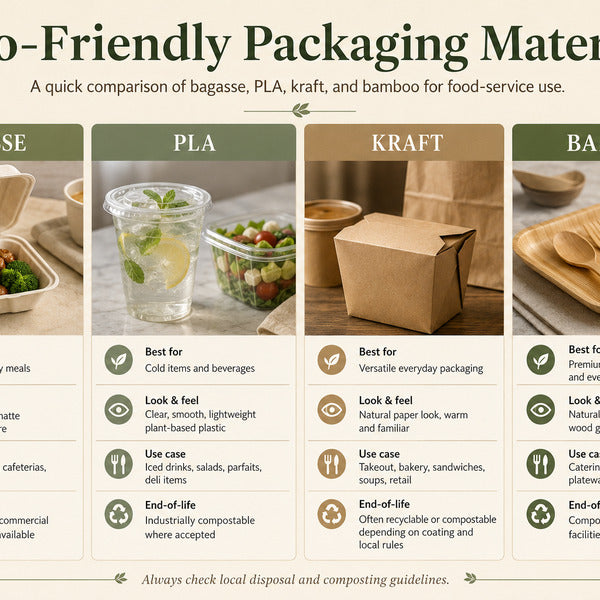
Eco-friendly packaging materials fall into four main categories for foodservice: bagasse (sugarcane fiber), PLA (plant-based bioplastic), kraft paper, and bamboo. Each has different heat tolerance, cost, and end-of-life requirements, so most operations use a mix rather than a single material.
| Material | What it is | Best for | Heat / microwave | End of life | Relative cost |
|---|---|---|---|---|---|
| Bagasse (molded fiber) | Sugarcane pulp left after juice extraction, molded into rigid containers | Clamshells, plates, bowls, hot entrées | Handles hot food; generally microwave-safe for reheating | Commercially compostable (ASTM D6868 for lined items); some unlined items home-compostable | $–$$ |
| PLA / CPLA | Polylactic acid bioplastic fermented from corn or sugarcane starch | Cold cups, lids, deli containers, cutlery (CPLA for heat) | Standard PLA deforms with heat and is not microwave-safe; crystallized CPLA tolerates roughly 185°F | Commercially compostable only (ASTM D6400); not home-compostable, not recyclable curbside | $$ |
| Kraft paper | Unbleached wood-pulp paperboard, often with a PLA or water-based lining for grease resistance | Takeout boxes, bags, wraps, trays | Good for warm food; microwave briefly if unlined or PLA-lined per manufacturer guidance | Unlined: recyclable and compostable. Lined: compostable only if certified (D6868) | $ |
| Bamboo | Fast-growing grass, regenerates without replanting; used as fiber, sheet, or veneer | Plates, boats, picks, cutlery, premium presentation | Naturally heat-tolerant | Unlined bamboo fiber items are compostable; many are home-compostable | $$–$$$ |
For a deeper dive into material selection, see our guide to navigating the world of eco-friendly packaging materials.
What Is Eco-Friendly Packaging?
Eco-friendly packaging is defined as packaging designed to reduce environmental impact across its entire life cycle — from renewable or recycled raw materials, through lower-impact manufacturing, to an end-of-life pathway that diverts it from landfill. In practice, eco-friendly packaging breaks down into three families:
- Recyclable packaging — materials with established recovery streams, such as unlined paperboard, aluminum, and certain rigid plastics. Container and packaging products are among the most frequently recycled: the EPA reports a 53.9% recycling rate for the category in 2018.
- Compostable packaging — items certified to break down into soil-safe components in a composting environment, such as bagasse clamshells and PLA cold cups. "Compostable" is a certified, testable claim, not a marketing adjective.
- Reduced or renewable packaging — right-sized designs, recycled content, and rapidly renewable inputs like bamboo and sugarcane that lower the footprint even when the item is not compostable.
The scale of the problem is why this category exists: the EPA reports that containers and packaging accounted for 82.2 million tons of U.S. municipal solid waste in 2018 — 28.1% of everything Americans threw away that year. Foodservice packaging is a meaningful slice of that stream, and it is the slice operators directly control.
This guide consolidates everything we previously published on compostable and sustainable packaging — home-compostable buying advice, California regulations, restaurant transition planning, packaging R&D, certifications, and market data — into one hub.
What Is Home Compostable Packaging?
Home compostable packaging is packaging that breaks down in a backyard compost pile at ambient temperatures, without the sustained 130–160°F heat of an industrial composting facility. That distinction matters more than any other label on the box: most "compostable" foodservice packaging in the U.S. is certified for commercial composting only.
- Commercially (industrially) compostable — certified to ASTM D6400 (compostable plastics like PLA) or ASTM D6868 (fiber items with biopolymer linings). These need an industrial facility to fully break down.
- Home compostable (backyard compostable) — there is no U.S. ASTM standard for home composting. The most widely recognized certification is TÜV Austria's OK compost HOME mark, which tests degradation at ambient temperatures.
Materials that commonly earn home-compostable status include unlined bagasse, unlined kraft paper, cellulose films, and bamboo — unlined molded bamboo fiber packaging is one of the few rigid formats regularly certified for backyard composting. PLA is the notable exception: it is never home-compostable, because it needs industrial heat to biodegrade.
What does "biodegradable" actually mean?
"Biodegradable" means a material can be broken down by microorganisms — but the term carries no timeframe, no test standard, and no guarantee about what residues remain. Everything from a banana peel (weeks) to some plastics (centuries) is technically biodegradable. "Compostable" is the stronger claim: it requires certified breakdown within a defined window, leaving no toxic residue. California goes further — under its truth-in-labeling laws (summarized by CalRecycle), selling plastic products labeled "biodegradable" is prohibited outright because the claim is considered inherently misleading. When you evaluate suppliers, treat "biodegradable" as a red flag and "certified compostable" as the real signal.
Are bread bags compostable?
Most bread bags are not compostable — standard bread bags are low-density polyethylene (LDPE) plastic film, which belongs in store drop-off film recycling, not compost. The exceptions are bags made from certified compostable films such as cellulose or PLA-blend materials; look for the BPI mark (commercial) or OK compost HOME mark (backyard) printed on the bag itself before composting it.
Home Compostable Packaging: A Buying Guide
Buying home compostable and commercially compostable packaging comes down to answering four questions operators and consumers ask us constantly. Here are the direct answers.
Are compostable containers microwavable?
Many compostable containers are microwavable, but it depends entirely on the material. Bagasse (molded sugarcane fiber) containers are generally microwave-safe for reheating food. Standard PLA containers and cold cups are not microwave-safe — PLA softens and deforms at low heat. Heat-treated CPLA (crystallized PLA) cutlery and lids tolerate roughly 185°F. Unlined and PLA-lined kraft boxes can usually take a short reheat, but always confirm the manufacturer's stated heat rating before putting any container in a microwave.
Are cardboard food containers compostable?
Clean, unlined cardboard and kraft food containers are compostable — and grease-stained cardboard (like a used pizza box) is actually better composted than recycled, since grease contaminates paper recycling streams. The complication is linings: many cardboard food containers carry a thin plastic (polyethylene) coating for leak resistance, which makes them neither compostable nor easily recyclable. Containers lined with PLA instead of polyethylene can be certified compostable under ASTM D6868. Check for a certification mark; if there is none and the box has a glossy interior, assume it is landfill-bound.
Are Chinese takeout containers compostable?
Traditional folded paper takeout pails are usually not compostable: the classic design pairs a polyethylene-lined paperboard body with a metal wire handle, and both disqualify it from compost and most paper recycling. Modern compostable versions do exist — kraft paper pails with PLA linings and no wire handle can be certified to ASTM D6868 and composted commercially. If sustainability matters to your operation, source pails specifically listed as compostable rather than assuming the format qualifies.
Is "biodegradable" packaging always compostable?
No — biodegradable packaging is not always compostable. Compostability is a subset of biodegradability with strict requirements: certified compostable items must disintegrate within a defined timeframe in a composting environment and leave no toxic residue, per ASTM D6400/D6868 testing. A product marketed only as "biodegradable" may take decades to break down and may leave microplastic or heavy-metal residues. Buy on certifications, not adjectives.
Compostable Packaging Certifications and End-of-Life Guidelines in the U.S.
Compostable packaging claims in the U.S. are verified through third-party certification against ASTM standards. Here is the system, current as of July 2026:
- ASTM D6400 — the specification for compostable plastics (PLA cups, compostable film, CPLA cutlery) in industrial composting facilities.
- ASTM D6868 — the specification for products that combine biopolymers with substrates like paper or molded fiber (PLA-lined kraft boxes, lined bagasse containers).
- BPI (Biodegradable Products Institute) — North America's leading certifier. BPI uses ASTM D6400 as the base standard for all certified items, with D6868 assessment for eligible lined products. BPI certification also enforces limits on total fluorine, which effectively screens out intentionally added PFAS ("forever chemicals"), and requires the BPI Certification Mark on the product.
- TÜV Austria OK compost HOME — the de facto certification for backyard compostability, since no U.S. standard exists for home composting.
Food packaging end of life: where it actually goes
A compostable container only delivers its environmental benefit if it reaches a composting facility. End-of-life planning means matching your packaging to the infrastructure your customers can actually access:
- Commercial composting access — check whether your municipality offers curbside organics collection or commercial compost hauling. If it does, certified compostable packaging closes the loop and diverts food-soiled packaging that recycling can never accept.
- No composting access — prioritize recyclable formats (unlined kraft, aluminum) and home-compostable items, since commercially compostable packaging sent to landfill behaves much like conventional waste.
- Never mix streams — compostable plastics like PLA contaminate PET recycling, and conventional plastics contaminate compost. Clear front-of-house signage matters as much as the packaging itself.
Compostable Packaging Regulations: What's Current as of July 2026
Regulatory status below verified against CalRecycle and primary legal sources in July 2026. Rules evolve — confirm details with your state agency before making compliance decisions.
Compostable packaging regulations in the U.S. are being driven by California, whose labeling and producer-responsibility laws effectively set national product standards because suppliers rarely build California-only lines.
AB 1201: California's compostable labeling law
AB 1201 requires that any product sold in California and labeled "compostable" actually meet ASTM compostability standards (D6400 or D6868) and carry certification from a third-party certifier approved by CalRecycle — in practice, BPI. The law also prohibits labeling products "compostable" if they contain intentionally added PFAS.
The deadline that matters now: AB 1201 also requires that compostable products qualify as allowable agricultural organic inputs under the USDA National Organic Program. Because federal USDA alignment was still pending, CalRecycle granted a two-year extension in June 2025, giving companies until June 30, 2027 to meet that requirement. For foodservice operators, the practical takeaway is unchanged: buy BPI-certified, PFAS-free packaging and you are positioned for where the law is headed.
SB 54: packaging producer responsibility
SB 54, the Plastic Pollution Prevention and Packaging Producer Responsibility Act, shifts the cost of packaging waste onto producers. Its final regulations took effect May 1, 2026, and CalRecycle set a June 1, 2026 deadline for producers to register or join the state's producer responsibility organization; producers that fail to comply cannot sell covered packaging in California starting January 1, 2027. By statute, covered single-use packaging must be recyclable or compostable by 2032, alongside source-reduction and recycling-rate targets.
Most restaurants are not "producers" under SB 54 — the obligation generally sits with brand owners and packaging manufacturers — but the law is already reshaping what suppliers offer. Expect conventional plastic formats to get more expensive and scarcer as producers redesign toward recyclable and compostable alternatives.
Beyond California
Oregon, Colorado, Maine, and Minnesota have enacted their own packaging EPR laws, and more than a dozen states restrict PFAS in food packaging. The direction of travel is uniform: certified compostable or genuinely recyclable packaging is becoming the compliance baseline, not the premium option.
How to Transition to Compostable Packaging in Your Restaurant
Transitioning a restaurant to compostable foodservice packaging works best as a staged swap, not a single overnight changeover. In 15+ years supplying 40,000+ foodservice operations, we've watched the operators who succeed follow the same five steps:
- Audit what you use. List every disposable touching food: to-go containers, cups, lids, cutlery, bags, wraps, portion cups. Rank by volume — your top five items usually represent 80% of spend and waste.
- Match materials to menu. Hot, wet, and greasy items need bagasse or lined kraft; cold drinks suit PLA; dry items work in unlined paper. Our foodservice customers consistently tell us the make-or-break test is whether a compostable to-go container survives steam, grease, and a 20-minute delivery ride — bagasse clamshells and PLA-lined kraft boxes are the formats that reliably do.
- Check your end-of-life reality. If commercial composting exists in your area, go certified compostable across the board and add sorting signage. If not, blend home-compostable and recyclable formats.
- Pilot before you commit. Run one station or one delivery platform on the new packaging for two weeks. Test microwaving, stacking, condensation, and leakage with your actual menu items.
- Switch, then tell your customers. Print or badge the change on menus and delivery listings. Sustainability sells: the National Restaurant Association's State of the Restaurant Industry research ranked sustainable packaging the #1 food and menu trend, and found 70% of millennials and 72% of Gen Z adults willing to pay extra for to-go orders to cover upgraded packaging.
Cost is the most common objection, and it is smaller than most operators expect once waste-hauling savings and per-unit price convergence are counted — we break the numbers down in our cost-benefit analysis of switching to green packaging.
Packaging R&D: The Innovation Driving the Shift Away From Plastic
Packaging research and development is moving faster than at any point in the industry's history, because regulation (SB 54, EU packaging rules) and consumer demand are pulling in the same direction. The R&D areas most likely to reach your supply chain next:
- Seaweed and algae materials — edible films and coatings that replace plastic wraps and sachets, grown without farmland or freshwater.
- Mycelium (mushroom-root) packaging — molded protective packaging grown in days and home-compostable in weeks, already replacing foam in shipping applications.
- PHA bioplastics — polyhydroxyalkanoates, produced by bacterial fermentation, which biodegrade in soil and marine environments where PLA cannot — a candidate to replace PLA linings and films.
- PFAS-free grease barriers — the R&D race with the most immediate foodservice impact: water-based and biopolymer coatings that deliver grease resistance without fluorochemicals, driven by state PFAS bans and BPI's fluorine limits.
- Fiber innovation — bagasse, bamboo, wheat straw, and other agricultural residues being pressed into ever more capable formats: cutlery, cup lids, and even corner-store staples like spreads and deli tubs that were plastic-only five years ago.
For operators, the practical takeaway from packaging R&D is simple: capabilities that were premium in 2020 — home-compostable rigid containers, PFAS-free grease resistance — are standard catalog items in 2026, and the price gap versus plastic keeps narrowing. Edible serveware is probing the same frontier — see our look at edible cutlery and whether it’s a gimmick or the future of sustainable dining.
Compostable Packaging Market: Growth and Foodservice Opportunities
The compostable packaging market is growing steadily on both regulatory push and consumer pull. Grand View Research values the global compostable packaging market at $74.01 billion in 2023, projected to reach $113.88 billion by 2030 — a 6.5% compound annual growth rate. The broader sustainable packaging market is larger still, at roughly $272.9 billion in 2023 by the same firm's estimate.
For foodservice, three forces make the compostable food service disposable market grow faster than packaging overall:
- Regulation — EPR laws and foam bans keep removing conventional options from the shelf.
- Off-premises volume — delivery and takeout put more packaging in more customers' hands than ever, making packaging a visible brand statement.
- Willingness to pay — the NRA data above shows a majority of younger diners will absorb the cost difference themselves.
The opportunity for operators is to treat packaging as marketing, not overhead: a certified compostable container is one of the few sustainability investments customers physically hold in their hands. Some operators extend that story beyond the container itself — learn what Trees for the Future is and how reforestation partnerships work.
Eco-Friendly Packaging in Practice: What Foodservice Operations Actually Use
Serving 40,000+ foodservice operations has given us a clear picture of which eco-friendly packaging formats earn permanent spots on reorder lists. These are the categories to start with:
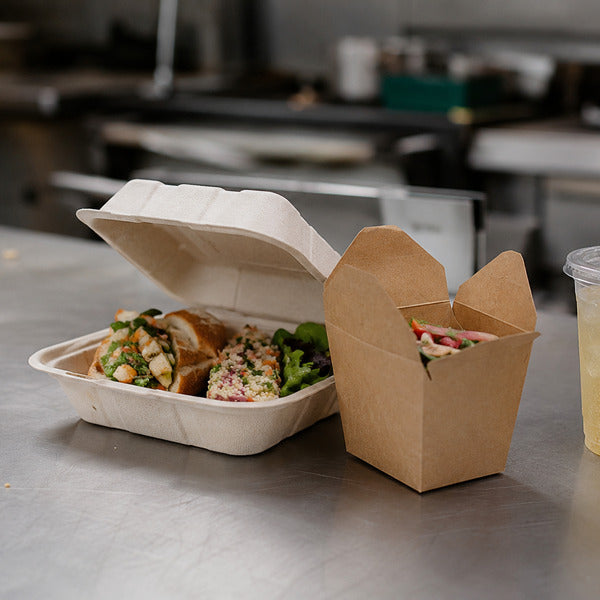
- Bagasse clamshells and hinged containers — the default swap for foam clamshells: rigid, grease-resistant, microwave-friendly, and commercially compostable. The workhorses of our eco-friendly to-go containers collection.
- Kraft take-out boxes — fold-top boxes for noodles, bowls, and entrées; PLA-lined versions hold saucy dishes without leaking and stay compostable.
- PLA-lined soup containers and cold cups — clear PLA cups showcase cold drinks while staying plant-based; lined paper soup cups handle hot liquids.
- Recycled and recyclable paper bags — green paper bags replace single-use plastic carryout bags, which are now banned in twelve-plus states.
- Compostable wraps and papers — grease-resistant food packaging wrap for sandwiches, burgers, and baskets, replacing foil-lined and wax-coated sheets that can't be composted or recycled.
- Compostable cutlery — CPLA or bamboo utensils that finish the package; pair with "cutlery on request" defaults to cut waste further.
Frequently Asked Questions About Eco-Friendly Packaging
What is eco-friendly packaging?
Eco-friendly packaging is packaging designed to minimize environmental impact through renewable or recycled materials, lower-impact production, and a viable end-of-life pathway such as composting or recycling. In foodservice, it includes bagasse containers, PLA cups, kraft boxes, bamboo serveware, paper bags, and compostable wraps.
What type of packaging is most environmentally friendly?
The most environmentally friendly packaging is no packaging, followed by reusables — but among single-use options, unlined fiber packaging (bagasse, kraft paper, bamboo) with certified compostability performs best, because it is renewable, breaks down in compost, and doesn't depend on plastic recycling streams. The right answer also depends on local infrastructure: a recyclable container beats a compostable one in a city with no composting access.
What is the most eco-friendly food packaging?
For food specifically, bagasse (sugarcane fiber) containers are the strongest all-around choice: they're made from an agricultural byproduct, handle hot and greasy food, are microwave-friendly, and are certified commercially compostable — with unlined versions often home-compostable. Kraft-paper formats with PLA linings are a close second for saucy and liquid items.
What is the most wasteful packaging?
Expanded polystyrene foam (Styrofoam) is widely considered the most wasteful common food packaging: it is made from fossil fuels, is virtually never recycled, breaks into persistent microplastic fragments, and is now banned for foodservice use in eleven-plus states. Multi-layer plastic-laminated packaging is a close second, since mixed layers can't be separated for recycling.
What is the best eco-friendly packaging?
The best eco-friendly packaging is the option that matches your food, your customer experience, and your local waste infrastructure: bagasse for hot entrées, PLA for cold drinks, lined kraft for saucy dishes, bamboo for premium presentation — all carrying BPI or OK compost HOME certification so the sustainability claim is verified rather than assumed.
What is sustainable packaging? Give 5 examples.
Sustainable packaging is packaging produced and disposed of in ways that can continue indefinitely without depleting resources or accumulating waste. Five examples: (1) bagasse clamshell containers, (2) PLA cold cups made from corn starch, (3) unbleached kraft paper takeout boxes, (4) bamboo fiber plates and cutlery, and (5) recycled-content paper carryout bags.
What can be used instead of plastic bags?
Instead of plastic bags, foodservice operations use recycled kraft paper bags, reusable totes, and certified compostable bags made from PLA blends or cellulose. Paper bags with handles are the standard takeout and delivery swap — recyclable, compostable when food-soiled, and compliant in every state with a plastic-bag ban.
Conclusion: Make the Switch Count
Eco-friendly packaging has moved from differentiator to expectation. The materials are proven, the certifications make claims verifiable, regulations are converging on compostable and recyclable formats, and a majority of younger diners will pay for the upgrade themselves. Start with your highest-volume containers, buy certified, match end-of-life to your local infrastructure, and tell your customers what you changed.
Ready to upgrade? Browse our full collection of eco-friendly to-go containers — bagasse clamshells, kraft take-out boxes, PLA-lined soup containers, and more, in stock and ready to ship.