Espresso Drinks
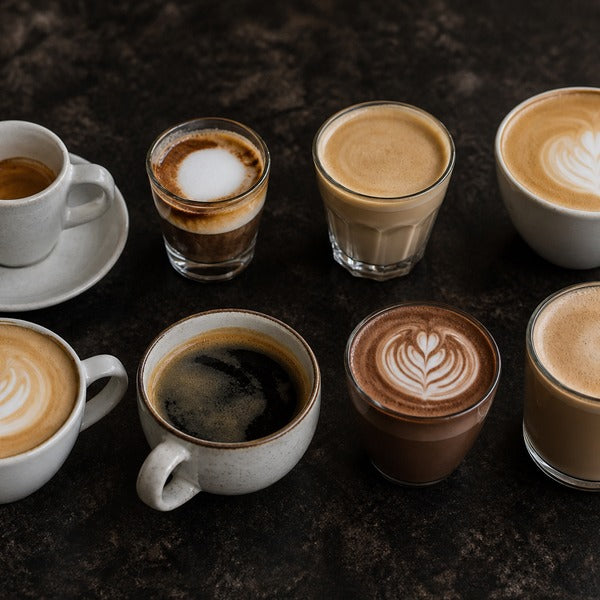
Espresso drinks are coffee beverages built on one or more espresso shots, combined with water, steamed milk, or foam in set ratios. Core types include the espresso shot, ristretto, lungo, americano, macchiato, cortado, flat white, cappuccino, latte, and mocha. This guide compares every major espresso drink, plus nitro and seasonal coffees.
Espresso drinks now anchor the American coffee order. According to the National Coffee Association's Spring 2025 National Coffee Data Trends report, 28% of American adults drank an espresso-based beverage in the past day — up 17% since 2020. For cafe operators, that growth is the whole business case: guests who once ordered "a coffee" now order a cortado, a flat white, or an iced shaken espresso, and they expect each one built to spec. In 15+ years supplying 40,000+ foodservice operations at Restaurantware, we've watched the menus that win treat every espresso drink as a defined recipe — exact shot count, exact milk build, exact cup — not a loose suggestion.
TL;DR — Espresso drinks at a glance:
- Every espresso drink starts with a shot: about 1 oz of concentrated coffee extracted under roughly 9 bars of pressure in 25–30 seconds.
- Three levers separate the 15 classic drinks: shot style (ristretto, single, doppio, lungo), what dilutes it (water, steamed milk, foam, cream, or ice cream), and the ratio.
- Water-based builds: americano, lungo, red eye. Milk-based builds: macchiato, cortado, flat white, cappuccino, latte, mocha. Dessert builds: affogato, con panna.
- Cup size is part of the recipe — a cappuccino in a 12 oz mug or a cortado in a 4.5 oz glass is a ratio decision, not a garnish.
- Nitro cold brew and seasonal espresso drinks are the fastest-moving add-ons to a core espresso menu.
What Are Espresso Drinks and How Does the Category Break Down?
Espresso drinks are defined as beverages built on espresso — coffee brewed by forcing hot water (about 190–200°F) through finely ground, compacted coffee at roughly 9 bars of pressure. That pressure extracts a concentrated 1–2 oz shot topped with crema, the amber foam of emulsified coffee oils that signals a fresh, properly pulled shot.
The category breaks down into four families, and every drink on a cafe menu fits one of them:
- Straight shots — espresso, ristretto, lungo, doppio. Nothing added; the variable is water volume and extraction time.
- Espresso + water — americano and red eye. Dilution stretches the shot into a longer, drip-strength cup.
- Espresso + milk — macchiato, cortado, flat white, cappuccino, latte, latte macchiato, and mocha. The variable is the milk-to-espresso ratio and how much of that milk is foam.
- Espresso + dessert elements — affogato (ice cream) and espresso con panna (whipped cream).
The espresso drinks chart below compares all 15 drinks by shot count, build, ratio, and the cup size each drink is designed around.
Espresso Drinks Chart: 15 Types Compared
| Espresso Drink | Espresso Base | What's Added | Approx. Ratio (espresso : addition) | Typical Cup Size |
|---|---|---|---|---|
| Espresso (solo) | 1 shot (~1 oz) | Nothing | — | 2–3 oz demitasse |
| Doppio | 2 shots (~2 oz) | Nothing | — | 3 oz demitasse |
| Ristretto | 1 "restricted" shot (~0.75 oz) | Nothing (less water in the shot) | — | 2–3 oz demitasse |
| Lungo | 1 "long" shot (~2–3 oz) | Nothing (more water through the puck) | — | 3–4 oz cup |
| Americano | 1–2 shots | Hot water | 1 : 2 to 1 : 4 | 6–12 oz cup |
| Red Eye | 1 shot | Drip coffee | 1 : 6 to 1 : 8 | 10–12 oz cup |
| Espresso Macchiato | 1–2 shots | Dollop of milk foam | ~4 : 1 | 3 oz demitasse |
| Cortado | 2 shots | Lightly steamed milk | 1 : 1 | 4–4.5 oz glass |
| Flat White | 2 shots | Thin microfoam milk | 1 : 2 | 5–6 oz cup |
| Cappuccino | 1–2 shots | Steamed milk + deep foam cap | 1 : 1 : 1 (espresso/milk/foam) | 5–6 oz cup |
| Latte | 1–2 shots | Steamed milk + thin foam | 1 : 3 to 1 : 5 | 8–16 oz cup |
| Latte Macchiato | 1 shot, poured last | Steamed milk + foam | 1 : 4, layered | 10–12 oz glass |
| Mocha | 1–2 shots | Chocolate + steamed milk | 1 : 3 + 1 oz chocolate | 8–12 oz cup |
| Affogato | 1–2 shots | Scoop of gelato or vanilla ice cream | Shot poured over scoop | 4–6 oz dessert cup |
| Espresso Con Panna | 1–2 shots | Whipped cream | Shot + cream cap | 3–4 oz demitasse |
How Is Espresso Different From Other Coffee Brewing Methods?
Espresso differs from other coffee brewing methods in pressure, grind, and speed: it forces water through fine grounds at ~9 bars in under 30 seconds, while drip, pour-over, French press, and cold brew rely on gravity or immersion over minutes or hours. That pressure is what produces crema and the concentration that lets one shot carry a 12 oz latte.
The practical differences for anyone comparing ways to make coffee:
- Drip and pour-over use gravity and a paper or metal filter over 3–5 minutes, producing a clean, lighter-bodied cup.
- French press is full immersion for about 4 minutes, pressed through a metal mesh for a heavier, oil-rich body.
- Cold brew steeps coarse grounds in cold water for 12–24 hours, yielding a smooth, low-acid concentrate.
- Espresso is the only method that uses mechanical pressure — which is why it is the only base concentrated enough to build the 15 drinks in this guide.
For a full breakdown of each method — equipment, grind sizes, brew times, and which cup profile each produces — see our standalone guide to the types of coffee brewing methods.
What Are the 15 Types of Espresso Drinks?
The 15 types of espresso drinks are the espresso shot, doppio, ristretto, lungo, americano, red eye, espresso macchiato, cortado, flat white, cappuccino, latte, latte macchiato, mocha, affogato, and espresso con panna. Each is defined by a fixed ratio of espresso to water, milk, or dessert elements.
1. Espresso (Solo)
An espresso is a ~1 oz shot of coffee extracted from 7–9 grams of finely ground coffee in 25–30 seconds. It is the foundation of every drink in this guide and carries about 63 mg of caffeine per shot, per USDA FoodData Central. Serve it immediately in a warmed 2–3 oz demitasse — crema dissipates within a couple of minutes, and guests judge the shot by it.
2. Doppio
A doppio is a double espresso: 14–18 grams of coffee extracted into roughly 2 oz. It is the default shot in most American specialty cafes — when a menu says "espresso," a doppio is usually what the bar pulls. A 3 oz cup leaves room for crema without making the pour look lost.
3. Ristretto
A ristretto is a "restricted" shot: the same dose of coffee extracted with roughly half to three-quarters the water, producing ~0.75 oz that is sweeter, thicker, and less bitter. Ristretto shots shine in milk drinks — a flat white built on ristretto shots punches through milk with more syrupy intensity.
4. Lungo
A lungo is a "long" shot: the same dose extracted with two to three times the water, yielding 2–3 oz. The extra water pulls more of the coffee's bitter compounds, so a lungo tastes bigger but more bitter than an americano of equal volume — the difference is that a lungo's extra water passes through the coffee, while an americano's is added after.
5. Americano
An americano is one or two espresso shots topped with hot water at a 1:2 to 1:4 ratio. It mimics the strength of drip coffee while keeping espresso's flavor profile, and it is the easiest espresso drink to size up — a 12 oz americano just takes more water, not more coffee. Pour water first, then shots, if you want the crema to survive on top.
6. Red Eye
A red eye is a cup of drip coffee with a shot of espresso added. It exists for one reason: maximum caffeine with minimum ceremony. Variations stack more shots — a "black eye" carries two. It is a strong seller in drive-thru and commuter-heavy operations where the order is about function.
7. Espresso Macchiato
An espresso macchiato is a shot "marked" (macchiato in Italian) with a spoonful of milk foam. Total volume stays under 3 oz, so it drinks like an espresso with the edges rounded off. Note the distinction guests often miss: the classic macchiato is this tiny drink, not the caramel-layered 16 oz beverage popularized by chains.
8. Cortado
A cortado is equal parts espresso and lightly steamed milk — typically a double shot "cut" (cortado in Spanish) with 2 oz of milk, served in a 4–4.5 oz glass. Minimal foam, no latte art theatrics, just balance. The cortado has moved from insider order to mainstream menu staple, and its signature Gibraltar-style glass is part of its identity.
9. Flat White
A flat white is a double shot under 4–5 oz of thin, velvety microfoam, served at 5–6 oz. Born in Australia and New Zealand, it sits between the cortado and the latte: stronger and smaller than a latte, milkier than a cortado. The microfoam should be paint-smooth — a flat white with a stiff foam cap is a small cappuccino wearing the wrong name.
10. Cappuccino
A cappuccino is the classic thirds build: one part espresso, one part steamed milk, one part deep milk foam, traditionally in a 5–6 oz cup. The foam cap insulates the drink and delivers that first airy sip. A dusting of cocoa or cinnamon from a shaker is the traditional finish. Oversizing is the most common cappuccino failure — at 12 oz the thirds ratio collapses into a foamy latte.
11. Latte
A latte is one or two espresso shots under 6–14 oz of steamed milk with a thin (~1 cm) layer of foam. It is the best-selling espresso drink in most American cafes and the canvas for nearly every flavored and seasonal variation. Because milk dominates the ratio, milk quality and steaming technique matter more here than in any other drink on this list.
12. Latte Macchiato
A latte macchiato inverts the latte: steamed milk goes into the glass first, and the espresso shot is poured through it last, "marking" the milk and creating visible layers. It is served in a tall 10–12 oz glass to show off the strata. The flavor is milk-forward — the espresso stains rather than saturates.
13. Mocha
A mocha (caffè mocha) is a latte with chocolate: espresso, about an ounce of chocolate sauce or ganache, and steamed milk, often finished with whipped cream. It is the crossover drink that converts dessert customers into coffee customers, and it is the base for the peppermint and white-chocolate variations that dominate winter seasonal menus.
14. Affogato
An affogato is a scoop of vanilla gelato or ice cream "drowned" (affogato in Italian) in a hot double shot of espresso. It is equal parts dessert and coffee course, and it is one of the highest-margin items an espresso bar can serve — one shot, one scoop, dramatic presentation.
Affogato cups deserve their own decision. The vessel needs to be wide enough for a scoop, deep enough to catch the espresso, and presentable tableside — standard mugs bury the visual. Purpose-built glass affogato cups, such as our double-wall Forma Professional 3 oz glass espresso dessert cup, suspend the scoop visually while the double wall keeps the outside cool to the touch as the hot shot hits the ice cream.
15. Espresso Con Panna
An espresso con panna is a shot of espresso capped with whipped cream — "with cream" in Italian. It is the fastest dessert drink on the menu: the cold cream tempers the shot's heat and adds sweetness without syrup. Serve it in a 3–4 oz demitasse or small glass so the cream cap reads clearly.
Building out your espresso program? Every drink above depends on the right vessel. Browse Restaurantware's espresso cups collection for demitasse, double-wall glass, and shot-style cups sized to these exact builds.
What Other Types of Coffee Drinks Should You Know?
Beyond espresso drinks, the core types of coffee drinks are drip coffee, pour-over, French press, cold brew, iced coffee, nitro coffee, café au lait, Turkish coffee, and frappé-style blended drinks. Knowing all the coffee names lets your staff translate any order into a build.
- Drip coffee — filter-brewed batch coffee; the American baseline cup.
- Pour-over — single-cup filter brewing (V60, Chemex) with controlled pours; clean and aromatic.
- French press — immersion brewing with a metal mesh plunger; heavy body, rich oils.
- Café au lait — drip or French press coffee with scalded milk, roughly 1:1; the non-espresso cousin of the latte.
- Cold brew — coffee steeped cold for 12–24 hours; smooth, sweet, low perceived acidity.
- Iced coffee — hot-brewed coffee chilled over ice; brighter and more acidic than cold brew.
- Nitro coffee — cold brew charged with nitrogen gas (full section below).
- Turkish coffee — ultra-fine grounds simmered unfiltered in a cezve; thick, intense, served in small cups.
- Frappé / blended coffee — coffee blended with ice, milk, and syrup; the dessert end of the category.
- Vienna coffee — strong coffee or espresso under whipped cream, the coffeehouse ancestor of the con panna.
Every one of these can share equipment and smallwares with an espresso program — which is why consolidated coffee menus are more profitable than they look on paper.
What Is Nitro Coffee?
Nitro coffee is cold brew coffee infused with nitrogen gas and dispensed from a pressurized tap through a restrictor faucet, the same hardware used for stout beer. The nitrogen creates a cascading pour, a dense creamy head, and a naturally sweet, velvety texture — no milk, no sugar, no ice.
Nitro rides the strongest growth curve in coffee. The National Coffee Association's Spring 2025 NCDT found past-day consumption of non-espresso specialty beverages — frozen blended coffees, cold brew, and nitro — jumped nearly 42% between 2020 and 2025 (from 12% to 17% of adults). On the menu side, Datassential's 2026 drive-thru coffee analysis reports cold brew now appears on 66.2% of coffee and bakery quick-service menus, up 22.9% over four years.
What Are the Benefits of Nitro Coffee?
The benefits of nitro coffee are texture, taste, and simplicity. Nitrogen bubbles are smaller than CO₂ bubbles, producing a creamy mouthfeel without dairy — which makes nitro the best "indulgent" option for dairy-free guests. Cold brew's long, cold extraction keeps perceived acidity and bitterness low, so most guests drink nitro black, cutting milk and syrup costs per cup. And because it pours from a tap in seconds, nitro adds a premium-priced beverage with almost zero per-order labor.
What Makes the Best Nitro Cold Brew?
The best nitro cold brew starts with a coarse-ground, chocolate-forward roast steeped 12–24 hours, filtered clean, and kegged promptly. Three rules separate great nitro programs from flat ones: keep the keg at 38–40°F, serve it through a proper stout-style restrictor faucet (a standard faucet kills the cascade), and never pour it over ice — ice collapses the nitrogen texture that guests are paying for. Serve it in a clear glass; the cascade is the marketing.
What Are the Most Popular Seasonal Coffees?
The most popular seasonal coffees are the pumpkin spice latte in fall; peppermint mocha, gingerbread latte, and eggnog latte in winter; and lavender lattes, brown sugar shaken espresso, and fruit-flavored refreshers in spring and summer. Nearly all of them are a standard espresso drink plus one syrup and one garnish.
Seasonal rotation is now the primary innovation engine in coffee. Datassential's 2026 Datassential 500 counted 1,221 beverage limited-time offers launched by top U.S. chains in 2025 — up from 1,038 the year before, with Scooter's Coffee alone releasing 122. Independent operators don't need that volume; they need two or three seasonal espresso drinks per quarter, built from syrups they already stock. For the fall rush specifically, our cafe supplies for the fall season guide covers the cups, lids, and merch that support those LTOs.
What Are the Best Coffee Syrup Flavors?
The best coffee syrup flavors — the ones that earn permanent shelf space — are vanilla, caramel, hazelnut, and chocolate/mocha as the year-round core, with pumpkin spice, peppermint, gingerbread, brown sugar, and lavender as the highest-performing seasonal rotations. A practical stocking rule from our cafe customers: four core syrups, two seasonal slots that change quarterly. That covers roughly 90% of flavored-drink orders without tying up capital in slow movers, and every flavor works across hot lattes, iced lattes, and cold brew.
How Do You Serve Espresso Drinks in a Foodservice Operation?
Serving espresso drinks profitably comes down to standardization: one defined recipe, one defined cup, for every drink on the menu. The U.S. coffee shop industry is a $75.5 billion business across more than 94,000 locations, per IBISWorld's 2026 Coffee & Snack Shops report — and at that level of competition, consistency is the differentiator guests can actually taste.
In 15+ years supplying 40,000+ foodservice operations, we've seen the same pattern repeatedly: cafes that assign a specific cup to each espresso drink pour consistent ratios automatically, while cafes that free-pour into whatever's clean drift toward over-milked drinks and rising dairy costs. The cup is the recipe's enforcement mechanism — a 4.5 oz cortado glass makes a correct cortado almost inevitable.
Our foodservice customers consistently tell us three pieces of smallware do the most work per dollar:
- Double-wall espresso cups — a vessel like the Forma Professional 3 oz double-wall glass espresso cup with handle keeps shots hot without scorching fingers, and the suspended-liquid look reads premium tableside.
- Glass shot-style cups for tasting and doppio service — the Forma Professional 3 oz borosilicate shot glass espresso cup doubles as a ristretto vessel and a split-shot tasting glass for training staff palates.
- A dedicated knock box — a Restpresso stainless steel espresso knock box at the bar keeps puck disposal to one motion, which matters when a two-person bar is pulling 200+ shots in a morning rush.
For milk-based espresso drinks, match cup capacity to the chart above — 5–6 oz for cappuccinos and flat whites, 8–16 oz for lattes and mochas. Restaurantware's coffee mugs, cappuccino cups, and saucers collection covers the full size run, and correct sizing does double duty: it protects ratios and it cuts waste, because staff stop "topping off" oversized cups with milk the recipe never called for.

Frequently Asked Questions About Espresso Drinks
What are some espresso drinks?
Common espresso drinks include the espresso shot, doppio, ristretto, lungo, americano, red eye, espresso macchiato, cortado, flat white, cappuccino, latte, latte macchiato, mocha, affogato, and espresso con panna. All are built from espresso shots plus set ratios of water, steamed milk, foam, chocolate, cream, or ice cream.
What is best to mix with espresso?
Steamed milk is the best all-around mixer for espresso — it forms the base of the latte, cappuccino, flat white, and cortado. Hot water (americano), chocolate (mocha), whipped cream (con panna), vanilla ice cream (affogato), and syrups like vanilla, caramel, and hazelnut are the other classic pairings. Tonic water and lemonade are popular iced-espresso mixers in specialty cafes.
What are the 10 most popular coffee drinks?
The 10 most popular coffee drinks in the U.S. are drip coffee, the latte, cold brew, the americano, the cappuccino, the mocha, iced coffee, the flat white, the macchiato, and espresso itself. Espresso-based beverages as a group were consumed by 28% of American adults in the past day, per the National Coffee Association's Spring 2025 NCDT report.
Does espresso lower cholesterol?
No — espresso does not lower cholesterol. Unfiltered coffees, including espresso, contain diterpenes (cafestol and kahweol) that can modestly raise LDL cholesterol with heavy consumption, so guests managing cholesterol are better served by paper-filtered brews.
How unhealthy is espresso?
Espresso in moderation fits a healthy diet for most adults. The FDA cites 400 milligrams of caffeine per day — roughly six single shots — as an amount not generally associated with negative effects for healthy adults; added syrups, sugar, and cream drive most of the health cost of espresso drinks, not the shot itself.
Conclusion: Build Your Espresso Drinks Menu on Ratios and the Right Cups
Espresso drinks are a system, not a list: one shot, three levers — water, milk, and ratio — and 15 classic builds that cover nearly every order your bar will hear. Master the chart, cross-train on nitro and seasonal builds, and lock each recipe to a specific cup so consistency survives the morning rush. That combination is what turns a coffee menu from a cost center into the highest-margin page in the operation.
Ready to standardize your service? Shop Restaurantware's espresso cups and cappuccino cups and saucers collections to outfit every drink in this guide — from 3 oz demitasse to 16 oz latte mugs — with commercial-grade pieces trusted by 40,000+ foodservice operations.