How to Offer Family Meal Deals at Your Restaurant
Family meal deals are bundled, multi-serving menu packages — typically an entrée, sides, and bread serving four to six — priced below à-la-carte totals. For restaurants, they raise average ticket size, streamline off-premise prep, and drive high-margin volume through takeout, delivery, and catering channels.
Search for family meal deals and you'll find chain menu pages — Olive Garden bundles, Texas Roadhouse Family Packs, pizza-night specials. What you won't find is a guide for the operator on the other side of the counter. That's this page. In 15+ years supplying 40,000+ foodservice operations at Restaurantware, we've watched family meal deals become one of the most reliable ways for independent restaurants to grow check averages and win weeknight takeout. This guide covers how to build the bundle, price it profitably, package it for travel, and market it so families actually find it.
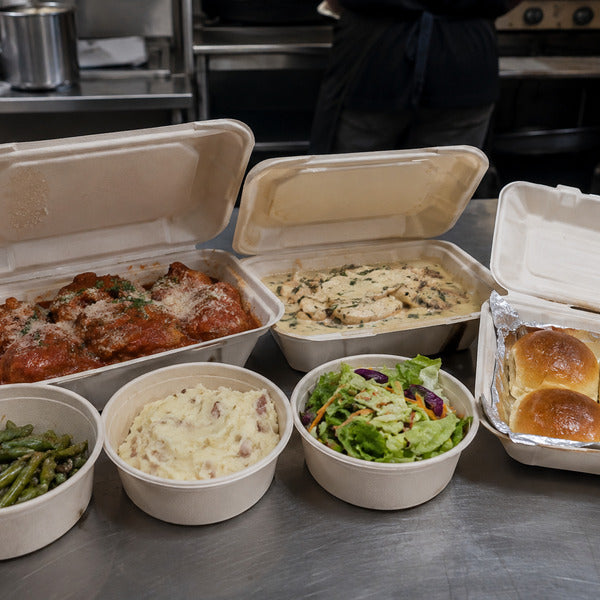
TL;DR — Family Meal Deals at a Glance
- The format: One anchor entrée + two or three shareable sides + bread or dessert, portioned for 4–6, sold as a single-price bundle.
- Why it works: Bundles lift average ticket versus a single entrée sale, simplify kitchen prep into batch production, and match how families actually order on weeknights.
- The demand is real: Value deals resonate with 8 in 10 delivery, takeout, and drive-thru customers, and off-premises diners specifically want meal bundles, according to the National Restaurant Association.
- The pricing rule: Price the bundle 10–20% below the à-la-carte total while keeping food cost near your house target — the discount comes from high-yield, batch-friendly dishes, not from giving margin away.
- The execution risk: Packaging. A family meal that arrives cold, soggy, or leaking kills repeat orders faster than any price change.
Family Meal Formats Compared
| Format | Serves | Best Channel | Operational Load | Typical Use |
|---|---|---|---|---|
| Family meal bundle (entrée + sides + bread) | 4–6 | Takeout / delivery | Low — batch prep | Weeknight family dinner specials |
| Family style meals to go (packaged in shareable containers) | 4–8 | Curbside pickup | Low–medium | Sunday dinners, game days |
| Dine-in family style service | 4–10 | On-premise | Medium — platter service | Groups, celebrations |
| Take-and-bake meals | 4–6 | Retail cooler / pickup | Low — prep ahead | Holiday and make-ahead sales |
| Catering family packages | 10+ | Catering / events | Medium–high | Offices, parties, holidays |
What Are Family Meal Deals?
Family meal deals are fixed-price menu bundles that feed an entire household in one order — most commonly a large-format entrée, two or three family-size sides, and bread, portioned for four to six people. The deal element is real but controlled: the bundle price runs below what the same items would cost à la carte, which gives the customer obvious value while the operator protects margin through batch production and high-yield ingredients.
Restaurant family meal packages took off as a takeout survival tactic in 2020, but they've outlived the moment because they solve a permanent problem: a family of four ordering individual entrées, sides, and drinks builds an expensive, complicated ticket, while a single bundle is one decision, one price, and one bag. Family bundles now show up across every segment — fried-chicken buckets, pasta trays, taco kits, barbecue packs — and the format extends naturally into family style dining on-premise, where shared platters create the same "one order feeds the table" experience at the table itself.
Why Should Restaurants Offer Family Meal Deals?
Family meal deals grow the three numbers operators care about most: average ticket, off-premise volume, and kitchen efficiency. The demand side is well documented. According to the National Restaurant Association's Off-Premises Restaurant Trends 2025 report, 47% of adults pick up takeout at least once a week, value deals resonate with 8 in 10 delivery, takeout, and drive-thru customers, and off-premises consumers specifically want restaurants to expand into meal bundles. That is a direct market signal: the customers already ordering from you want this format.
The macro picture supports the move too. The Association's 2026 State of the Restaurant Industry report projects total restaurant and foodservice sales of $1.55 trillion this year — but also notes that more than 7 in 10 consumers say they would use restaurants more often if they had more disposable income. Stats current as of July 2026. That's the exact tension family meal deals resolve: households that feel priced out of four separate entrées will still spend on one bundle that beats both à-la-carte totals and the perceived hassle of cooking.
Our foodservice customers consistently tell us the operational upside surprises them more than the sales lift. A family bundle built on batch-friendly dishes — braises, roasted proteins, tray-baked pastas, rice and bean sides — lets the kitchen produce twenty orders with the labor of five. On a Tuesday night, that's the difference between a dead shift and a profitable one.
How to Create Family Meal Deals: A 6-Step Framework
Creating family meal deals means choosing batch-friendly anchor dishes, building a fixed bundle around them, and pricing the package below à-la-carte totals while holding your food-cost target. Here is the framework we've seen work across thousands of independent operations.
Step 1: Choose anchor entrées that scale
The anchor entrée makes or breaks the program. Pick dishes that hold quality in batch production and travel well: roasted or fried chicken, braised meats, baked pastas, enchilada or taco kits, barbecue by the pound. Avoid anything that dies in a closed container — crispy-skin fish, delicate fried items without vented packaging, composed plates that depend on presentation. Your best candidates usually already exist on your menu as your highest-yield, lowest-food-cost sellers.
Step 2: Build the bundle
The classic structure is one entrée + two family-size sides + bread, serving four. Add a large salad or dessert to create a six-person tier. Keep choices tight: one or two entrée options and a short list of sides keeps prep predictable and order errors low. If you want the bundle to feel generous, oversize the sides — starch and vegetable sides carry the lowest food cost in the package, so they're the cheapest place to add perceived abundance. The same logic that drives a good bundle drives shareable menu design overall; our guide on how to create a shareable menu goes deeper on portioning for groups.
Step 3: Size the portions honestly
"Feeds four" must actually feed four adults — under-portioned family bundles generate the worst kind of review. A reliable baseline per adult: 6–8 oz cooked protein, 4–6 oz starch side, 3–4 oz vegetable side, plus bread. Test the full package on your own staff families before launch and adjust. Publishing serving counts ("Serves 4–5") sets expectations and protects you when a family of teenagers orders the four-person pack.
Step 4: Pick your channels
Decide where the deal lives: takeout and curbside, delivery apps, dine-in family style, catering, or all four. Most operators start with takeout-only family dinner specials on slow weeknights (Sunday–Wednesday), then expand. If you run take-home formats, consider a par-baked tier — our guide on how to sell take-and-bake meals covers the prep-ahead model that pairs naturally with family bundles, especially around holidays.
Step 5: Test the operation before you advertise
Run the bundle as a soft launch for two weeks. Time the pack-out: a family meal should assemble in under four minutes at the expo station or it will bottleneck your line on Friday night. Pre-portion sides during afternoon prep, stage packaging by bundle type, and build a pack checklist (entrée, sides, bread, utensils, sauces, napkins) so nothing gets forgotten — a missing side in a $60 order is a refund and a lost customer.
Step 6: Launch as a limited-time offer, then make winners permanent
Introduce the program as a rotating weekly special — "Sunday Roast Chicken Family Pack" — and track attachment rate, food cost, and repeat orders for 60 days. LTO framing creates urgency and gives you a graceful exit for bundles that don't sell. The winners graduate to a permanent family meals section on your menu and ordering site.
How to Price a Family Meal Deal
Price a family meal deal 10–20% below the à-la-carte total of its components, while keeping the bundle's blended food cost at or near your house target (most full-service operators aim for 28–35%). The discount is the customer's visible win; your margin survives because the bundle is built from high-yield, batch-produced items and because sides — the cheapest components — do the heavy lifting on volume.
Work the math from cost up, not from the discount down:
| Component | Example (roast chicken bundle, serves 4) | Food Cost |
|---|---|---|
| Anchor entrée | Two whole roasted chickens | $9.50 |
| Side 1 | Family-size mashed potatoes | $2.25 |
| Side 2 | Family-size roasted vegetables | $3.00 |
| Bread | House rolls (8) | $1.25 |
| Packaging | Containers, bag, cutlery kit | $3.00 |
| Total cost | — | $19.00 |
| Menu price at ~32% food cost | — | $59.00 |
Illustrative numbers — run your own recipe costs. Always cost packaging into the bundle; at $2.50–$4.00 per family order it is a real ingredient, not overhead.
Then check the price against the à-la-carte comparison: if those items sold separately would total $68–$72, a $59 bundle reads as clear value without a coupon. Two cautions from the field. First, never price family bundles against fast-food family meal deals — you will lose that race and destroy your margin trying; compete on quality-per-dollar, not absolute price. Second, discipline matters more than ever: the National Restaurant Association reports that 42% of operators said their restaurant was not profitable last year. A bundle priced by feel instead of by recipe cost quietly makes that problem worse.
Family Meal Deals for Restaurants: Packaging and Off-Premise Execution
Family meal deals for restaurants live or die in the last mile. The order is bigger, heavier, and hotter than a normal ticket, and it often travels 15–30 minutes before anyone opens it. In 15+ years supplying 40,000+ foodservice operations, we've seen more family meal programs stall on packaging failures — soggy fried chicken, tipped-over sides, lukewarm mains — than on pricing or marketing combined.
Build your pack-out around three rules:
- Match the container to the component. Vented containers for fried and roasted items so steam escapes; leak-resistant, lidded bowls for saucy sides and braises; separate small cups for dressings and sauces. Sturdy take out containers & to go boxes sized for family portions keep entrées intact, while catering & to go bowls with secure lids handle the mashed potatoes, pastas, and salads that make up the rest of the bundle.
- Hold temperature through the trip. Food safety doesn't pause at the pickup shelf. The USDA's "Danger Zone" guidance is blunt: bacteria multiply fastest between 40°F and 140°F — doubling in as little as 20 minutes — so hot food should be held at 140°F or above and never left out more than two hours. For delivery-heavy programs, insulated food delivery bags & catering bags keep large family orders in the safe zone from the pass to the porch. Current as of July 2026.
- Stage it like a station. Give family meals a dedicated pack-out zone with pre-staged containers, bags, cutlery kits, and a laminated checklist per bundle. Label each container — "Roast Chicken," "Green Beans," "Serves 4" — so the customer's unboxing feels organized, not chaotic.
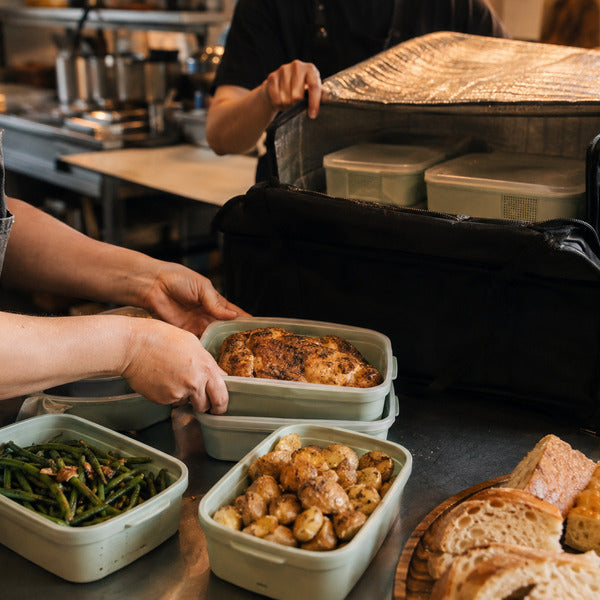
Building out a family meal program? Browse our take-out containers and to-go boxes to find family-size formats that travel as well as your food deserves.
How to Market Family Meal Bundles
Family meal bundles sell when they show up where families already search. The consumer queries around this format — "family meal deals near me," "family meal deals to go," "cheap family meal deals," "family meal deals for pickup" — are local and urgent, usually typed between 4 and 6 p.m. on a weeknight. Your job is to be the local answer:
- Own your Google Business Profile. Add the family bundle as a product with a photo and price, and post weekly about your family dinner specials. Local pack results are where "near me" searches get decided.
- Name the deal for the search. "Family Meal Deal — Feeds 4, $59" outperforms clever names on delivery apps and your ordering page because it matches the words customers actually type. Put serving count and price in the title.
- Anchor it to a night. "Sunday Family Dinner" or "Taco Tuesday Family Pack" builds a weekly habit and fills your slowest shifts. Recurring family dinner specials train customers to skip cooking on a schedule.
- Shoot the spread. One overhead photo of the full unboxed bundle — entrée, sides, bread, all containers open — sells more family meals than any description. Abundance is the message.
- Make the household visit an on-ramp. Families who love your dine-in experience are your first bundle customers. If you're building that pipeline, our guide on 7 ways to make your restaurant kid-friendly covers turning family tables into regulars.
- Plan the holiday spikes. Family style meals to go peak around Thanksgiving, Christmas, Easter, and the Super Bowl. Presell with order deadlines so production is fully planned — our roundup of the best Thanksgiving dinner ideas for restaurants shows how operators turn one holiday into a four-figure preorder book. Mother’s Day deserves the same presell treatment — our Mother’s Day restaurant ideas cover formats for the year’s biggest dining-out day.
Frequently Asked Questions About Family Meal Deals
Who has the cheapest family meal deal?
The cheapest family meal deals come from national pizza and fried-chicken chains, where bundle prices commonly land between $20 and $40 for four people — a price floor built on massive purchasing scale and centralized production. Independent operators shouldn't chase that number. Compete instead on quality-per-dollar: a $55–$65 bundle of scratch-made food that genuinely feeds four to five reads as better value to your customer than the cheapest possible option.
Where is the cheapest place to get a meal deal?
Quick-service chains and grocery-store prepared-food counters are typically the cheapest places for a meal deal, because both operate on volume economics independents can't match. From an operator's cost lens, the lesson isn't the price — it's the format: one fixed price, zero decisions, ready fast. Deliver that same convenience at your quality level and price becomes a secondary factor for most families.
What is a good cheap family meal?
A good cheap family meal is built on high-yield, low-food-cost dishes that bundle well: roasted or fried chicken, baked pastas, rice bowls, tacos, chili, and braised meats over starch. These dishes batch-produce efficiently, hold temperature in transit, and let inexpensive sides — potatoes, rice, beans, seasonal vegetables — create abundance. That's classic menu engineering: the customer sees generosity; your food cost stays on target.
What is the Texas Roadhouse family pack?
The Texas Roadhouse Family Pack is a large-format to-go bundle — a protein entrée portioned for a family of four, two family-size sides, and fresh-baked rolls — packed in sealed containers for curbside pickup. It's a useful model for any operator: one anchor protein, oversized sides, a signature freebie (the rolls), clear serving counts, and pickup-optimized packaging. Copy the structure with your own signature dishes.
How do restaurants price family meal deals?
Restaurants price family meal deals by costing every component — entrée, sides, bread, and packaging — then marking up to their target food-cost percentage (typically 28–35%), and finally checking that the bundle price lands 10–20% below the same items' à-la-carte total. That gap is the "deal." If the math doesn't produce a visible discount, rebuild the bundle around cheaper high-yield components rather than cutting margin.
Do family meal deals actually increase restaurant profits?
Yes — when they're costed correctly, family meal deals increase profits by raising average ticket, adding orders on slow nights, and concentrating labor into efficient batch production. The demand base is strong: the National Restaurant Association found value deals resonate with 8 in 10 off-premises customers, and meal bundles rank among the offerings those customers most want added. The profit risk is discipline, not demand — bundles priced by gut feel instead of recipe cost can lose money at volume.
Final Thoughts: Build the Bundle Families Come Back For
Family meal deals are one of the few restaurant programs that serve the customer and the P&L equally well: households get one easy, generous answer to "what's for dinner," and operators get bigger tickets, fuller slow nights, and a kitchen running efficient batches. Start with one bundle built on your best batch-friendly entrée, price it from recipe cost up, package it to arrive hot and intact, and market it to the weeknight "near me" search. Then let repeat orders tell you what to add next.
When you're ready to launch, outfit your pack-out station with take-out containers and to-go boxes, catering and to-go bowls, and insulated food delivery bags built for family-size orders — everything ships fast from Restaurantware.