What Is the HoReCa Industry? Hotels, Restaurants & Catering Explained
HoReCa is the foodservice industry segment comprising hotels, restaurants, and cafés/catering. The term covers businesses that prepare and serve food and beverages to guests, plus the suppliers and distributors behind them. Valued at roughly $3.6 trillion globally in 2024, the HoReCa industry is projected to grow about 6.7% annually through 2035.
If you run a commercial kitchen, sell into one, or supply one, you are already part of the HoReCa industry — even if nobody on your team uses the word. HoReCa is the umbrella term for the out-of-home food and beverage economy: the hotels that plate 500 banquet covers a night, the independent restaurants turning tables on a Saturday, and the caterers and cafés serving everyone in between. This guide defines the HoReCa industry, breaks down its three sectors, puts real numbers on its size and growth, and shows operators how to buy and equip for it — drawing on what we have learned at Restaurantware supplying more than 40,000 foodservice operations over 15+ years.

TL;DR: The HoReCa Industry at a Glance
- HoReCa full form: Hotels + Restaurants + Cafés/Catering (sometimes rendered Ho-Re-Ca or HORECA).
- What it means: the commercial foodservice channel — businesses that prepare and serve food and drink for immediate consumption, plus the distributors and suppliers that serve them.
- Global size: USD 3,574.5 billion in 2024, projected to reach USD 7,294.98 billion by 2035 at a 6.7% CAGR (Market Research Future).
- U.S. share: roughly USD 778.49 billion in 2025 — about 20% of the global market — with hotels the largest single segment at ~29% share.
- Why the term matters: FMCG brands, food distributors, and equipment suppliers use "HoReCa" to distinguish B2B foodservice sales from retail/grocery sales.
| Sector | What it includes | Typical buying priorities |
|---|---|---|
| Ho — Hotels | Hotel restaurants, room service, banquets, resorts, casinos, cruise dining | Volume consistency, brand-standard tableware, banquet and buffet equipment, hotel and restaurant linens |
| Re — Restaurants | Fine dining, casual dining, QSR/fast food, food trucks, bars and pubs | Durability, plate presentation, back-of-house restaurant equipment, takeout packaging |
| Ca — Cafés & Catering | Coffee shops, cafés, event caterers, institutional and contract catering | Portability, single-use serviceware, catering disposables, transport and display gear |
What Is the HoReCa Industry?
The HoReCa industry is the sector of the food and beverage economy made up of Hotels, Restaurants, and Cafés or Catering — businesses that prepare and serve food and drinks to customers for immediate consumption. The HoReCa industry meaning extends beyond the venues themselves: in trade usage, it also covers the wholesalers, distributors, and equipment suppliers whose customers are those venues. When a food distributor or an FMCG brand talks about its "HoReCa channel," it means sales to foodservice businesses rather than to grocery retailers or directly to consumers.
The term originated in Europe — it is standard vocabulary in the Netherlands, Belgium, Scandinavia, and much of continental Europe — and has since become common in the Middle East and Asia. The horeca industry in India, for example, is one of the fastest-growing HoReCa markets in the world, driven by urbanization, food delivery platforms, and a rapidly expanding hotel pipeline. In the United States, the same universe of businesses is usually called "foodservice" or "the hospitality industry," but the structure is identical: if you are asking "what is horeca industry" as an American operator, the short answer is that it is the industry you already work in, under its European name.
Ho — Hotels
The hotel sector covers every food and beverage operation inside lodging: hotel restaurants, room service, banquet and conference catering, resort dining, casinos, and cruise lines. Hotels are the largest single segment of the HoReCa industry, holding roughly 29% of global market share, and they buy differently than standalone restaurants — brand standards, high banquet volumes, and multi-outlet consistency drive purchasing decisions.
Re — Restaurants
Restaurants are the most visible face of the HoReCa industry and span fine dining, casual and family dining, quick-service (QSR), fast casual, food trucks, and bars. In the U.S. alone, the National Restaurant Association projects total restaurant and foodservice sales of $1.55 trillion in 2026, with industry employment reaching about 15.8 million jobs — which is also why "horeca industry jobs" is one of the most-searched phrases attached to the term (source: National Restaurant Association, 2026 State of the Restaurant Industry; current as of August 2026).
Ca — Cafés and Catering
The third leg covers cafés, coffee shops, and catering in both senses: event caterers serving weddings and corporate functions, and contract/institutional caterers running dining programs for offices, schools, hospitals, and stadiums. Depending on the country, the "Ca" is read as "cafés" or "catering" — in practice the industry treats both as part of the same segment. Global contract-catering giants such as Compass Group, Sodexo, Aramark, and Elior are among the largest HoReCa industry companies in the world.
Single Outlets vs. HoReCa Chains
Analysts also categorize the HoReCa industry by structure: single outlets (independent hotels, restaurants, and cafés) versus HoReCa chains (multi-unit brands and franchise groups). Single outlets dominate the market globally — independents still outnumber chains in nearly every country — which matters for suppliers, because it means most HoReCa buying decisions are made by individual owner-operators rather than corporate procurement teams.
What Does HoReCa Mean in FMCG and Distribution?
In FMCG (fast-moving consumer goods), HoReCa is a sales channel, not a place. A beverage brand, for instance, splits its revenue between the retail channel (supermarkets, convenience stores) and the HoReCa channel (kegs to bars, syrups to cafés, portion packs to hotels). "HoReCa sales" therefore means B2B sales into foodservice venues — different pack sizes, different pricing, different logistics. The same logic applies to broadline distributors: Sysco and US Foods in the United States, Brakes in the UK, and Martin Brower serving major QSR chains are all, functionally, HoReCa distribution businesses.
How Big Is the HoReCa Industry? Market Size & Growth Through 2035
The global HoReCa industry was valued at USD 3,574.5 billion in 2024 and is projected to grow from USD 3,813.99 billion in 2025 to USD 7,294.98 billion by 2035, a compound annual growth rate of 6.7%, according to Market Research Future's HoReCa Market report (verified at source, August 2026). Within that total, the United States accounts for roughly USD 778.49 billion in 2025 — about 20% of the global market — and hotels lead all segments with approximately 29% share, buoyed by more than 514,000 new hotel rooms expected to open globally in 2025.
Market estimates vary with methodology, and it is worth seeing the spread. Maximize Market Research values the global HoReCa market at USD 3.23 trillion in 2025, growing at a more conservative 3.64% CAGR to USD 4.15 trillion by 2032, and notes that Asia-Pacific already holds more than 48% of global HoReCa revenue (verified at source, August 2026). Both firms agree on the direction: the HoReCa industry is growing faster than the broader economy, powered by tourism recovery, urbanization, delivery and cloud-kitchen expansion, and consumers' structural shift toward eating out.
| Source | Base value | Forecast | CAGR |
|---|---|---|---|
| Market Research Future (global HoReCa) | $3,574.5B (2024) | $7,294.98B by 2035 | 6.7% |
| Maximize Market Research (global HoReCa) | $3.23T (2025) | $4.15T by 2032 | 3.64% |
| National Restaurant Association (U.S. restaurants & foodservice only) | $1.5T (2025) | $1.55T (2026 projection) | ~3–4%/yr nominal |
For a sanity check against the big global numbers: the National Restaurant Association's U.S.-only figure of $1.55 trillion for 2026 sits comfortably inside — and roughly doubles — the MRFR U.S. HoReCa estimate once you account for scope differences (the NRA counts all restaurant and foodservice sales including retail-adjacent segments, while HoReCa market reports slice hotels, restaurants, and cafés as distinct service types). The takeaway for operators is consistent across every source: demand for out-of-home dining keeps growing, and the fight is over margins, labor, and differentiation — not over whether customers will show up.
Is the HoReCa Industry Growing?
Yes — every major analyst tracks the HoReCa industry as a growth market. The drivers show up in operators' daily reality: delivery and takeaway volume (the delivery segment has grown roughly 20% in recent years per MRFR), premiumization (consumers trading up to quality ingredients and experiences), sustainability pressure (over 60% of consumers prefer venues that prioritize sustainable practices), and technology adoption from QR ordering to AI-assisted inventory. Growth is fastest in Asia-Pacific and the Middle East, steadier in North America and Europe — but positive everywhere.
How Should Operators Buy for a HoReCa Business?
Buying for a HoReCa operation is different from consumer shopping in four ways that trip up new operators. In 15+ years supplying 40,000+ foodservice operations, we've seen the same purchasing mistakes sink otherwise strong openings — here is what actually matters.
- Buy for throughput, not for looks alone. A plate that survives 300 cycles through a commercial dish machine is cheaper than a prettier plate that chips in 30. Specify commercial-grade tableware and restaurant equipment rated for back-of-house abuse.
- Match disposables to your service model. A caterer's needs (transportable, stackable, presentation-ready) differ from a QSR's (cost-per-unit, speed) and a hotel's (brand-standard consistency). Our foodservice customers consistently tell us the fastest payback comes from standardizing on a core set of restaurant disposable supplies rather than reordering ad hoc.
- Know your packaging materials. Regulations on single-use plastics vary by city and state, and material choice affects both compliance and food quality. Start with our breakdown of the 6 types of plastics used in food packaging before locking in a takeout program.
- Budget for food safety, not just aesthetics. The CDC estimates 48 million people get sick from foodborne illness in the U.S. every year, with 128,000 hospitalized (source: CDC food safety facts; current as of August 2026). Sanitation supplies, gloves, and proper cold-chain equipment are HoReCa purchases with liability attached — our guide on how to properly clean and sanitize restaurant tables covers the front-of-house basics, and the FDA Food Code is the reference standard your local health department almost certainly enforces.
One more consideration climbing every buyer's checklist: sustainability. ESG expectations now flow down the HoReCa supply chain from hotel groups and contract caterers to every vendor they buy from — if that's new territory, our guide to ESG in the food service industry explains what operators are being asked for and why.
How the HoReCa Industry Works in a Real Kitchen: Products in Context
Definitions are useful; specifics win service. Here is how the three HoReCa sectors translate into actual product decisions we help operators make every week at Restaurantware:
- Hotels (Ho): banquet and buffet programs live or die on presentation at volume. High-turnover properties standardize on durable servingware, chafing and display pieces, and hotel and restaurant linens that hold up to industrial laundering. When a 400-room property switches to a unified tabletop program, replacement costs drop and every outlet in the building plates to the same standard.
- Restaurants (Re): the dine-in/takeout split defines the buy. Front-of-house invests in plateware and glassware that photograph well (image-driven discovery is real demand generation); back-of-house needs prep, storage, and cooking gear from a reliable restaurant equipment program. For delivery, packaging is the dining room — tamper-evident, vented, and leak-resistant containers protect both the food and the review score.
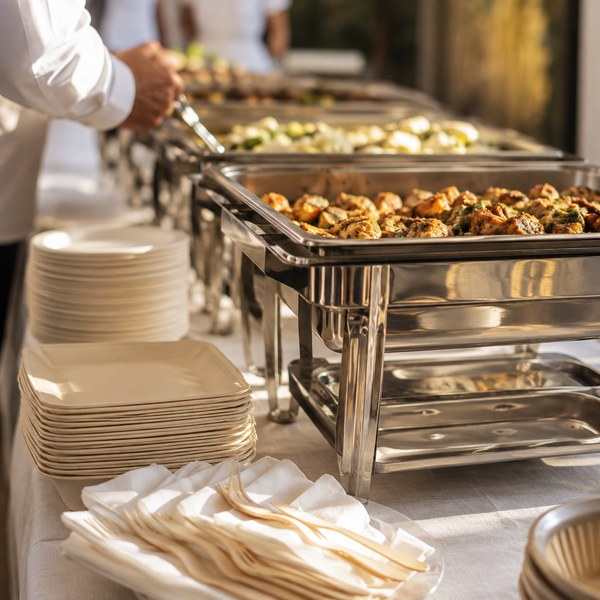
- Catering & cafés (Ca): everything must travel. Caterers build around catering disposables — serving trays, portion vessels, disposable flatware that looks intentional rather than cheap — plus insulated transport. In 15+ years serving caterers, the pattern we see most is under-buying on service pieces and over-buying on décor; guests remember whether the food was hot and easy to eat, not the centerpiece.
That operator-level view is exactly what most HoReCa market reports miss: the industry is not an abstraction, it is thousands of small buying decisions that either compound into smooth service or into nightly friction.
Frequently Asked Questions About the HoReCa Industry
What is the HoReCa industry?
The HoReCa industry is the foodservice sector comprising Hotels, Restaurants, and Cafés/Catering — businesses that prepare and serve food and beverages for immediate consumption, together with the distributors and suppliers that serve them. It is the standard European trade term for what Americans usually call the foodservice or hospitality industry.
What is HoReCa in FMCG?
In FMCG, HoReCa is a B2B sales channel: selling food, beverage, and related products to hotels, restaurants, and cafés rather than to retail stores or consumers. HoReCa channel sales use different pack formats, pricing, and distribution than retail — think kegs, bulk syrups, portion-control packs, and case quantities delivered through foodservice distributors.
What are the 4 sectors of the hospitality industry?
The hospitality industry is commonly divided into four sectors: food and beverage (restaurants, bars, catering), lodging/accommodation (hotels, resorts), travel and tourism (airlines, agencies, attractions), and recreation and entertainment (events, casinos, venues). The HoReCa industry sits primarily inside the first two sectors.
What are the 5 types of hospitality industry?
Broader classifications add a fifth category — meetings and events (MICE) — to the four above: food and beverage, lodging, travel and tourism, recreation, and meetings/events. HoReCa businesses touch all five, since hotels host events, restaurants serve travelers, and caterers power the MICE segment.
Is HoReCa a growing industry?
Yes. The HoReCa industry is projected to grow from roughly $3.8 trillion in 2025 to about $7.3 trillion by 2035 — a 6.7% CAGR — per Market Research Future, with more conservative estimates (Maximize Market Research) still showing steady 3.6% annual growth to $4.15 trillion by 2032. Growth is driven by tourism, urbanization, delivery expansion, and rising out-of-home dining spend.
Conclusion: One Industry, Three Doors In
The HoReCa industry is simply the connected world of hotels, restaurants, and catering — a $3.6-trillion-and-growing global market that runs on the same fundamentals at every scale: consistent food, safe service, and smart buying. Whether you operate one café or a hotel group's F&B program, the operators who win treat procurement as strategy, not errand.
Restaurantware supplies all three HoReCa sectors from one catalog — browse our restaurant equipment, restaurant disposable supplies, and catering disposables to equip your operation for whatever the industry does next.