Celtic Sea Salt: What It Is and How Chefs Use It
Celtic sea salt is an unrefined gray sea salt hand-harvested from clay-lined tidal ponds near Guérande, in Brittany, France. Residual moisture and trace minerals — magnesium, calcium, potassium — give it a moist texture and briny flavor. Chefs use it as a finishing salt for proteins, vegetables, and breads rather than as a baking salt.
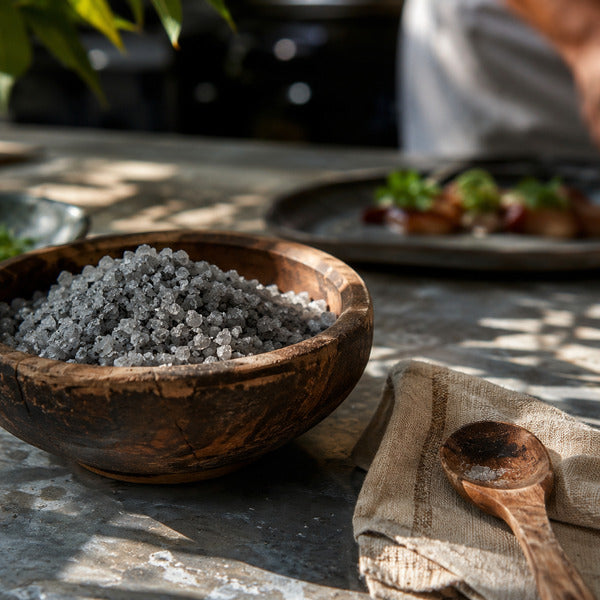
Walk the line at any chef-driven restaurant and you'll find at least one salt that never touches the pasta water. Celtic sea salt has moved from health-food shelves to professional kitchens because it does something refined salt can't: it adds texture, mineral complexity, and a visible gray sparkle at the exact moment a dish leaves the pass. In 15+ years supplying 40,000+ foodservice operations, we've watched finishing salts shift from fine-dining flourish to a standard line item — and celtic sea salt, with roughly 49,500 monthly US searches (DataForSEO, July 2026), is now the one guests ask about by name.
This guide explains what celtic sea salt is, where it comes from, how it compares to kosher, Himalayan, and table salt, and how to buy, store, and serve it in a commercial kitchen — with the health questions answered from medical sources, not marketing copy.
TL;DR — Celtic Sea Salt at a Glance
- What it is: an unrefined, moist, gray sea salt (French: sel gris) raked by hand from clay-lined evaporation ponds near Guérande, Brittany, France.
- Why it's gray: the clay pond bottom leaves mineral traces and residual moisture in the crystals; nothing is bleached or refined out.
- Best use: finishing — steaks, roasted vegetables, bread crusts, caramels — not dissolved baking applications.
- Health reality: by weight it delivers about as much sodium as any other salt; the FDA's Daily Value for sodium is less than 2,300 mg per day.
- Trademark note: "Celtic Sea Salt®" is a registered trademark of Selina Naturally; this guide uses the generic lowercase term and describes the salt style, not any brand.
| Salt | Source & processing | Texture / moisture | Color | Best kitchen use |
|---|---|---|---|---|
| Celtic sea salt (sel gris) | Hand-raked from clay-lined tidal ponds, Guérande, France; unrefined | Coarse, moist, crunchy | Light gray | Finishing proteins, vegetables, breads |
| Fleur de sel | Delicate top-crust crystals skimmed from the same ponds | Fine, flaky, slightly moist | Off-white | Premium finishing, desserts, caramels |
| Kosher salt | Mined or evaporated; refined, no additives in most brands | Dry, coarse flakes | White | All-purpose cooking, seasoning by hand |
| Himalayan pink salt | Mined rock salt (Khewra, Pakistan); minimally processed | Dry, hard crystals | Pink | Grinders, salt blocks, presentation |
| Refined table salt | Mined, refined to nearly pure sodium chloride; usually iodized, anti-caking agents | Dry, fine granules | Bright white | Baking, brines, back-of-house measuring |
What Is Celtic Sea Salt?
Celtic sea salt is a coarse, unrefined sea salt harvested by hand from shallow, clay-lined salt marshes on France's Atlantic coast, most famously around Guérande in southern Brittany. The French call it sel gris — gray salt — and the name describes exactly what makes it different: the crystals form in contact with mineral-rich clay, so they come out of the pond light gray, slightly damp, and unprocessed.
Where does celtic sea salt come from?
Celtic sea salt comes from the salt marshes of the Guérande peninsula in Brittany, France, where seawater is channeled through a series of clay-lined evaporation ponds. Independent salt farmers called paludiers rake the crystallized salt by hand using wooden tools, a method that has been practiced in the region for centuries. The tradition is formally protected: "Sel de Guérande / Fleur de sel de Guérande" was registered as a Protected Geographical Indication (PGI) in the European Union in March 2012 under Commission Implementing Regulation (EU) No 238/2012, meaning salt sold under the Guérande name must actually be produced there by the traditional method. Similar gray sea salts are also harvested elsewhere on the French Atlantic coast, such as Noirmoutier and the Île de Ré.
The "Celtic" in the name refers to Brittany's Celtic heritage — the region's historical ties to Celtic culture — not to Ireland or Scotland, a point that surprises many first-time buyers.
Why is celtic sea salt gray and moist?
Celtic sea salt is gray because its crystals form directly on the clay bottom of the evaporation ponds, picking up fine mineral-rich clay particles that refined salts have washed and bleached away. It is moist because it is sold unrefined and never kiln-dried: finished crystals typically retain noticeable residual moisture, which is why the salt clumps softly instead of pouring like sand. That moisture matters in the kitchen — it slows how fast the salt dissolves, so a pinch on a finished steak stays crunchy and visible instead of vanishing into the surface.
What minerals are in celtic sea salt?
Celtic sea salt contains sodium chloride plus trace amounts of minerals from seawater and clay — principally magnesium, calcium, and potassium. Two honest caveats belong next to that fact. First, the amounts are small: the Mayo Clinic notes that while sea salt retains trace minerals that add flavor and color, sea salt and table salt have the same basic nutritional value and comparable sodium by weight. Second, unlike standard table salt, this salt is generally not iodized, so it does not supply the iodine that fortified table salt provides for thyroid health. Buy it for flavor and texture — celtic salt minerals are a seasoning story, not a supplement.
Celtic Sea Salt vs. Sea Salt, Kosher, and Table Salt: What's the Difference?
Celtic sea salt differs from generic sea salt mainly in processing and moisture: "sea salt" is any salt evaporated from seawater, while the celtic style is a specific unrefined sea salt — hand-harvested, gray, and sold with its residual moisture intact. Compared to kosher salt, it is wetter, denser, and more mineral-tasting; compared to refined table salt, it is coarser, unbleached, and free of anti-caking additives.
For an operator, the practical differences come down to four things:
- Dissolution speed. Dry kosher salt and fine table salt dissolve fast, which is what you want in doughs, brines, and pasta water. Moist gray salt dissolves slowly — ideal on the plate, wrong in the mixing bowl. For baking, stick with refined salt or fine sea salt measured by weight.
- Flavor delivery. A coarse, slow-dissolving crystal hits the palate as a brief burst of salinity with mineral undertones, so a dish can taste fully seasoned with a lighter final hand.
- Visual presence. Gray crystals on a seared ribeye or a chocolate tart signal craft to the guest. White table salt is invisible; gray salt is plating garnish that also seasons. Note that kosher sea salt — kosher-style coarse salt evaporated from seawater — splits the difference: dry enough to cook with, coarse enough to see.
- Sodium content. By weight, they are all roughly the same. The American Heart Association notes that table salt is about 40% sodium and 60% chloride — about 2,400 mg of sodium per teaspoon (American Heart Association). Because these crystals are larger and hold moisture, a teaspoon contains somewhat less salt than a teaspoon of fine table salt — but measured gram for gram, the sodium is comparable.
How Should You Buy Celtic Sea Salt for a Foodservice Operation?
Buy celtic sea salt by matching the grain format to the job, then treat it as a premium finishing ingredient with its own storage and serving plan. It costs several times more per pound than kosher salt, so the goal is to put every crystal where a guest can taste or see it.
The three formats operators actually use:
- Coarse gray salt (gros sel). The classic moist, light-gray crystal. Use it for finishing hearty dishes, crusting roasts and whole fish, and rimming savory cocktails. It also grinds well in a dry-burr salt mill if you dry it slightly first.
- Fine ground gray salt. The same salt milled fine. It dissolves faster, making it the crossover option for kitchens that want the mineral flavor in vinaigrettes, compound butters, and spice blends without crunch.
- Fleur de sel. The delicate crystals skimmed from the surface of the same Guérande-style ponds. It is the most expensive tier — reserve it for desserts, caramels, and high-margin plates where the flaky texture is the point.
Cost-per-use math. Because this is a finishing salt, portions are tiny — a fraction of a gram per plate. A kitchen that seasons with inexpensive kosher salt during cooking and finishes with a small pinch of gray salt typically adds only pennies per cover while visibly upgrading the plate. The mistake we see is the reverse: dumping premium gray salt into stocks and pasta water, where its texture and color are destroyed and its cost is wasted.
Storage. Moist salt needs nonreactive, lidded storage. Keep the bulk salt in a sealed container away from the range (steam makes clumping worse), portion the day's supply into small crocks or ramekins and sauce cups at each station, and never store it in carbon steel or uncoated metal — the residual moisture will corrode it. Our related guide to the best containers to keep spices fresh covers the same airtight principles.
How Do Chefs Use Celtic Sea Salt in a Commercial Kitchen?
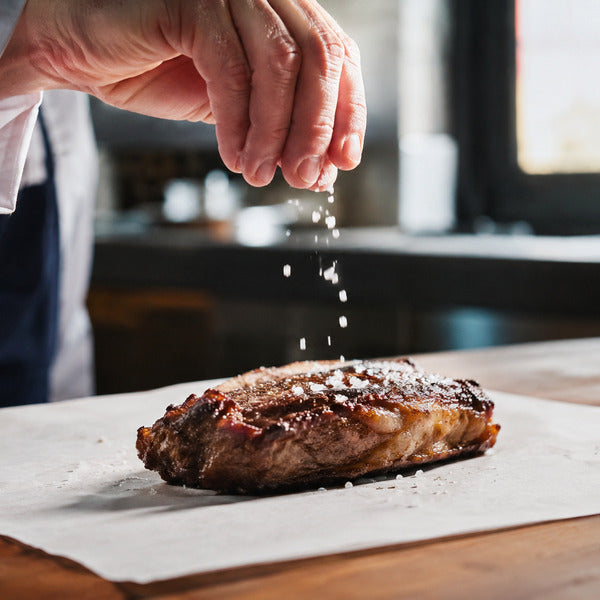
Chefs use celtic sea salt almost exclusively as a finishing salt — applied in the final seconds before a dish reaches the guest, where its crunch, moisture, and gray color still register. Here is where it earns its price:
- Proteins. A pinch over a rested, sliced steak, seared scallops, or roast chicken adds bursts of salinity and visible texture. Apply after cooking; applied before, the coarse moist crystals melt unevenly.
- Vegetables. Roasted carrots, grilled asparagus, blistered shishitos, and thick tomato slices all benefit from a crunchy mineral finish just before service.
- Breads. Pressed into focaccia dimples or scattered on pretzels and rolls before the final bake, coarse gray salt survives the oven with texture intact.
- Desserts and beverages. Salted caramel, chocolate tarts, and dark-chocolate cookies are natural pairings; fine gray salt also works in salt-rimmed micheladas and margaritas.
- Tableside and buffet service. Small pinch bowls of gray salt on the table or a labeled salt station on a buffet lets guests self-finish — a low-cost touch that reads as premium.
Our foodservice customers consistently tell us the serving hardware is what turns a specialty salt into a guest-facing moment. A moist salt will clog a standard restaurant shaker, so match the vessel to the grain: refillable salt and pepper shakers and mills handle dried or fine-ground gray salt at the table, wide-mouth spice shakers and dredges work for fine gray salt across prep and pizza stations, and open ramekins or mini pinch pots are the right call for the moist coarse crystals that define this salt. For plating ideas that make a finishing salt visible, see our food plating and presentation tips, and for building out the rest of the seasoning program, our guide to creative ways to use herbs and spices.
Is Celtic Sea Salt Healthier Than Other Salts?
No — celtic sea salt is not meaningfully healthier than other salts, because its sodium content by weight is comparable to table salt. The Mayo Clinic states plainly that sea salt and table salt have the same basic nutritional value, and the US Food and Drug Administration sets the Daily Value for sodium at less than 2,300 milligrams per day — roughly one teaspoon of table salt. The FDA also notes that more than 70% of the sodium Americans consume comes from packaged and prepared foods, not the salt shaker, which is why restaurants' seasoning decisions matter to guests watching their intake.
There are only two defensible celtic salt benefits on the nutrition side. It contains trace minerals (magnesium, calcium, potassium) that refined salt lacks — in amounts too small to treat as a dietary source. And because its coarse, moist crystals pack less densely, seasoning by the pinch or the teaspoon can deliver slightly less sodium than the same volume of fine salt. Everything beyond that — detox claims, adrenal claims, "84 minerals" marketing — is not supported by FDA or NIH guidance, and we don't repeat it. Facts above current as of July 2026.
Frequently Asked Questions About Celtic Sea Salt
What is so special about celtic sea salt?
Celtic sea salt is special because it is one of the few salts still hand-harvested by traditional methods: paludiers rake it from clay-lined tidal ponds near Guérande, France, a practice protected by an EU Protected Geographical Indication since 2012. The clay contact gives it a gray color, residual moisture, and trace-mineral flavor that refined salts lack — qualities chefs prize for finishing dishes.
Does sea salt help with itchy skin?
Possibly, in bath form — but the evidence is specific and limited. A published clinical study found that bathing in a magnesium-rich Dead Sea salt solution improved skin barrier function, improved hydration, and reduced inflammation in people with atopic dry skin (Proksch et al., International Journal of Dermatology, via PubMed). That study used Dead Sea salt, not celtic sea salt, and eating any salt has no established benefit for itchy skin. Anyone with a persistent skin condition should see a dermatologist rather than self-treat with salt.
Does celtic salt help with cramps?
There is no clinical evidence that celtic sea salt specifically prevents or relieves muscle cramps. What is established: the NIH's MedlinePlus notes that exercising while dehydrated or with low levels of minerals such as sodium, potassium, or calcium can make muscle cramps more likely (MedlinePlus, NIH), and the NIH Office of Dietary Supplements confirms magnesium's role in normal muscle and nerve function (NIH ODS). But the trace magnesium in a pinch of this salt is far too small to correct a deficiency — a normal diet, or a clinician-recommended supplement, is how those minerals are actually replaced.
Does celtic salt help bloating?
No — the research points the other way. An analysis of the DASH-Sodium clinical trial by researchers at the Johns Hopkins Bloomberg School of Public Health, published in the American Journal of Gastroenterology (2019), found that higher sodium intake increased bloating among participants (Johns Hopkins Bloomberg School of Public Health). Since celtic sea salt is still predominantly sodium chloride, adding more of it is not a bloating remedy; reducing overall sodium is the evidence-backed move.
What is the healthiest salt in the world?
No salt is meaningfully "healthiest": per the Mayo Clinic, sea salts and table salt contain comparable sodium by weight, and sodium — not the salt's color or origin — is what health guidance targets. The FDA's Daily Value is less than 2,300 mg of sodium per day. One practical nuance: iodized table salt supplies iodine for thyroid health, which unrefined salts like celtic sea salt generally do not. Choose salt for flavor and texture; manage health by managing total sodium.
Conclusion: Put Celtic Sea Salt Where Guests Can See It
Celtic sea salt earns its place in a commercial kitchen as a finishing tool: a hand-harvested, PGI-protected gray salt whose moisture, crunch, and mineral flavor register in the final seconds of a dish's journey. Season with workhorse salt, finish with gray salt, store it airtight, and serve it in vessels built for coarse, moist crystals. In our experience outfitting operations from food trucks to hotel banquet programs, the operators who win with specialty salts are the ones who make them visible — on the plate, on the table, at the station. Ready to build the service side? Explore our salt and pepper shakers and mills and spice shakers and dredges collections to give your celtic sea salt the presentation it deserves.