Commercial Kitchen Ventilation: Selecting Systems For High-Heat Kitchens
Commercial kitchen ventilation is the system of exhaust hoods, ductwork, fans, and makeup air units that removes heat, smoke, and grease-laden vapor from cooking areas. Hood type (Type 1 for grease-producing equipment, Type 2 for heat and steam) and exhaust CFM are sized to equipment heat load, with NFPA 96 governing design and fire safety.

Walk onto a line running charbroilers, woks, and fryers at full tilt and you will feel the problem immediately: heat that stacks up faster than it leaves. Commercial kitchen ventilation is the single system that decides whether a high-heat kitchen is workable, insurable, and code-compliant — or hazy, greasy, and flagged at the next fire inspection. Most guides on the topic are written by hood manufacturers selling packages; this one is not. In 15+ years supplying more than 40,000 foodservice operations at Restaurantware, we have watched brilliant kitchens underperform because the ventilation was specced wrong on day one. What follows is the vendor-neutral selection guide we wish every operator had before signing a mechanical contract.
TL;DR — The High-Heat Kitchen Ventilation Cheat Sheet
- Type 1 hoods handle grease and smoke (fryers, charbroilers, griddles, woks). Type 2 hoods handle heat, steam, and condensate only (ovens, steamers, dishwashers).
- Exhaust airflow is sized to appliance duty class. Under the International Mechanical Code (IMC), an unlisted wall-mounted canopy hood needs 200 CFM per linear foot over light-duty equipment and up to 550 CFM per linear foot over extra-heavy-duty (solid-fuel) equipment.
- Makeup air must replace what you exhaust. Skip it and the kitchen goes negative: doors whistle, pilots blow out, and hoods stop capturing.
- NFPA 96 governs fire safety for the whole grease exhaust path — hood, duct, fan — including inspection frequency from monthly (solid fuel) to annually (low volume).
- Supplemental circulation fans improve staff comfort in hot kitchens, but they never replace code-required exhaust ventilation.
Here is the quick comparison most operators need first:
| Duty Class (IMC) | Typical Equipment | Hood Type | Wall Canopy Exhaust (unlisted hood) |
|---|---|---|---|
| Light duty | Ovens, steam kettles, small kettles | Type 1 if grease/smoke; else Type 2 | 200 CFM per linear foot |
| Medium duty | Ranges, griddles, tilt skillets, pasta cookers | Type 1 | 300 CFM per linear foot |
| Heavy duty | Gas charbroilers, open-flame broilers, wok ranges | Type 1 | 400 CFM per linear foot |
| Extra-heavy duty | Solid-fuel: wood, charcoal, mesquite | Type 1 (dedicated system) | 550 CFM per linear foot |
Rates from IMC Section 507.5 for unlisted hoods; UL 710–listed hoods may operate at their lower listed rates. Current as of July 2026.
What Is Commercial Kitchen Ventilation?
Commercial kitchen ventilation is defined as the complete kitchen exhaust system — hood, grease ducts, exhaust fan, and replacement (makeup) air — engineered to capture and remove cooking effluent at its source. ASHRAE Standard 154, Ventilation for Commercial Cooking Operations, scopes the system exactly that way: kitchen hoods, exhaust systems, and replacement air systems working as one unit (ASHRAE 154 committee scope).
The four components do distinct jobs:
- The hood (also called a commercial kitchen hood or exhaust hood) sits over the cooking battery and captures rising heat, smoke, and grease vapor before it escapes into the room.
- Grease ductwork carries that effluent to the outside. The IMC requires grease duct systems serving a Type 1 hood to maintain an air velocity of at least 500 feet per minute so grease stays entrained instead of pooling in the duct (IMC 506.3.4).
- The exhaust fan — usually an upblast fan on the roof — creates the pull. It is sized to deliver the hood's required CFM against the resistance of the duct run.
- The makeup air unit (MUA) pushes replacement air back into the kitchen so the building doesn't run at negative pressure.
A restaurant ventilation system fails as a chain: an oversized fan with no makeup air captures poorly, and a beautiful hood over an undersized duct becomes a fire hazard. Spec the system, not the parts.
Type 1 vs Type 2 Hoods: Which Does Your Kitchen Need?
The first — and most consequential — selection decision is hood type. Commercial kitchen hood requirements in the IMC split every appliance into two paths.
Type 1 (Grease) Hoods — Charbroilers, Fryers, Griddles, Wok Lines
A Type 1 hood is required wherever cooking appliances produce grease or smoke. The IMC mandates Type 1 hoods over all medium-duty, heavy-duty, and extra-heavy-duty cooking appliances, and over light-duty appliances that produce grease or smoke (IMC 507.2). Type 1 hoods include grease filters (baffles), are built of continuously welded steel, connect to fire-rated grease duct, and carry a fire suppression system. Hoods themselves are tested and listed to UL 710, Exhaust Hoods for Commercial Cooking Equipment, now in its 7th edition (2024) (UL 710 Ed. 7).
If your concept involves a fryer bank, flat-top, charbroiler, or wok range, you are in Type 1 territory — no exceptions worth chasing.
Type 2 (Condensate/Heat) Hoods — Ovens, Steamers, Dishwashers
A Type 2 hood handles heat, steam, and odor where no grease is generated: combi ovens on steam cycles, pasta cookers in some jurisdictions, and dish machines. Type 2 hoods are lighter-gauge, need no grease duct or suppression, and are dramatically cheaper. The IMC sets Type 2 dishwashing hood exhaust at a flat 100 CFM per linear foot (IMC 507.5.5).
Operator warning from our side of the counter: the most expensive ventilation mistake we see among Restaurantware customers is buying equipment first and hood second. A menu tweak that swaps a convection oven (Type 2) for a charbroiler (Type 1, heavy duty) is not an equipment swap — it is a new exhaust system, new duct, new suppression, and a new permit. Decide the cooking lineup before you sign the mechanical bid.
How Many CFM Do You Need? Sizing Exhaust to Equipment Heat Load
Exhaust volume — measured in cubic feet per minute (CFM) — is sized to the duty classification of the appliances under the hood, not to the size of the room. That is the core logic of every kitchen ventilation system code in the US.
Light, Medium, Heavy, and Extra-Heavy Duty Classifications
The IMC's minimum net exhaust rates for unlisted hoods scale by duty class and hood style (IMC 507.5):
| Hood Style | Light Duty | Medium Duty | Heavy Duty | Extra-Heavy Duty |
|---|---|---|---|---|
| Wall-mounted canopy | 200 CFM/ft | 300 CFM/ft | 400 CFM/ft | 550 CFM/ft |
| Single island canopy | 400 CFM/ft | 500 CFM/ft | 600 CFM/ft | 700 CFM/ft |
| Double island canopy (per side) | 250 CFM/ft | 300 CFM/ft | 400 CFM/ft | 550 CFM/ft |
| Backshelf/pass-over | 250 CFM/ft | 300 CFM/ft | 400 CFM/ft | Not allowed |
Source: IMC Section 507.5.1–507.5.4. When mixed duty classes share one hood, the whole hood is sized to the heaviest-duty appliance beneath it. Current as of July 2026.
Three practical sizing rules follow from that table:
- Island hoods are expensive air movers. A single island canopy needs roughly double the CFM of a wall canopy over the same equipment because it has no back wall helping capture. Put the high-heat line against a wall whenever the layout allows.
- One charbroiler upgrades the whole hood. Mixed lineups are rated by the heaviest appliance — a 12-foot medium-duty hood jumps from 3,600 to 4,800 CFM the day a heavy-duty charbroiler slides under it.
- Listed hoods buy you efficiency. A UL 710–listed hood may legally operate at the (usually lower) exhaust rate established in its listing rather than the table above — which is why listed hoods dominate new builds and why every CFM saved also saves conditioned makeup air, all year, forever.
Makeup Air: The Half of the System Most Kitchens Get Wrong
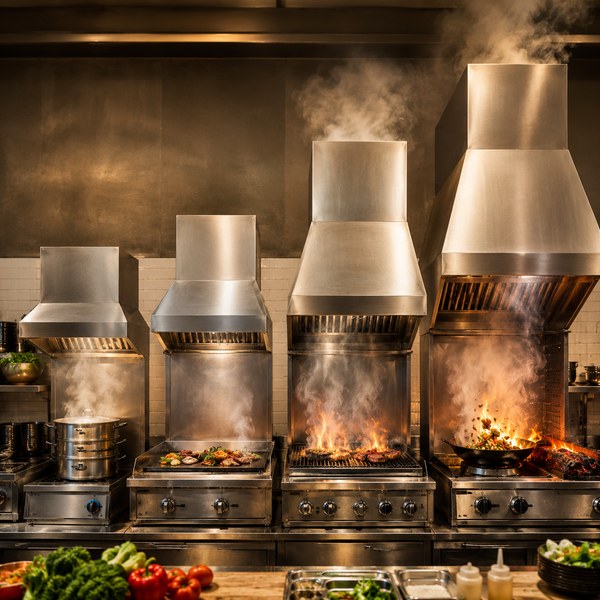
Makeup air is replacement air, mechanically supplied to offset what the hoods exhaust. Every CFM that leaves through the roof must come back in somewhere — and if you don't provide it deliberately, the building will take it violently: doors that slam or won't open, gas pilots that blow out, smoke rolling from the hood face, and dining rooms that smell like the fry station.
What operators speccing a high-heat kitchen should demand:
- Interlocked operation. The MUA runs whenever the exhaust fans run, matched to within roughly 10% of exhaust volume so the kitchen holds slightly negative pressure relative to the dining room (kitchen odors stay in the kitchen).
- Tempered air in cold climates. Untempered winter makeup air dumps freezing air on your cooks and can drop line temperatures enough to affect food safety holding temps.
- Delivery that doesn't kill capture. Makeup air blasted directly at the hood face disrupts the thermal plume and causes spillage — the exact failure the system exists to prevent. Displacement or perimeter delivery beats a ceiling diffuser aimed at the hood.
In our years outfitting kitchens, makeup air is the component value-engineered out of more projects than any other — and the one whose absence operators feel every single shift. If the mechanical bid doesn't have an MUA line item, ask why before you sign, not after the doors start whistling.
Mid-article CTA: Outfitting or refreshing a hot line? Browse Restaurantware's industrial tools for the fans, safety gear, and back-of-house equipment that keep high-heat kitchens running.
NFPA 96 Compliance in Plain English
NFPA 96 is the Standard for Ventilation Control and Fire Protection of Commercial Cooking Operations, published by the National Fire Protection Association (NFPA 96). It governs the fire-safety side of the entire grease exhaust path — hood, filters, duct, fan, and suppression — and it becomes legally enforceable when your state or local fire code adopts it, which nearly all do. The mechanical-code side (hood sizing, duct construction, makeup air) lives in IMC Chapter 5, Exhaust Systems (2021 IMC, Chapter 5), or your local mechanical code. Your authority having jurisdiction (AHJ) decides which editions apply, so confirm locally.
The requirements operators actually get cited on:
- Clearance to combustibles. Unenclosed grease duct and exhaust equipment serving a Type 1 hood must keep at least 18 inches of clearance to combustible construction (3 inches to noncombustible), unless a listed factory-built or field-applied enclosure reduces it (IMC grease duct clearances).
- Minimum duct velocity. Grease ducts must sustain at least 500 feet per minute of air velocity so grease vapor doesn't condense and accumulate in the run.
- Scheduled inspection for grease buildup. NFPA 96 sets inspection frequency by cooking volume: monthly for solid-fuel operations; quarterly for high-volume operations such as 24-hour cooking, charbroiling, or wok cooking; semiannually for moderate-volume operations; and annually for low-volume operations like churches and seasonal camps — with cleaning by trained, certified personnel when buildup is found (public schedule summary: Anchorage Fire Department, NFPA 96 requirements).
- Fire suppression. Grease hoods carry an automatic suppression system (typically wet chemical, designed to UL 300) that also shuts fuel to the appliances on discharge.
Why the paperwork matters: the U.S. Fire Administration reports an estimated 5,600 restaurant building fires per year, causing roughly $116 million in annual property loss — and restaurant fires account for about 6% of all nonresidential building fires (USFA restaurant fires data snapshot). The grease-loaded exhaust path is exactly where a flare-up becomes a building fire, which is why inspectors treat hood-cleaning records as seriously as health scores. Keep the service reports; your insurer and your AHJ will both ask.
How Do You Choose a Ventilation System for a High-Heat Kitchen?
Choose a ventilation system for a high-heat kitchen by working through six decisions in order — equipment first, hardware last. This is the checklist we walk through with operators building charbroiler- and wok-heavy lines:
- Lock the cooking lineup. List every appliance, its fuel, and its duty class. The heaviest-duty appliance under each hood drives the whole hood's requirement.
- Determine hood type and style. Grease or smoke anywhere on the line means Type 1. Wall-mounted canopy beats island for capture efficiency and operating cost.
- Size the CFM honestly — including growth. Use the duty-class table (or the hood's UL 710 listing) and leave headroom. If a charbroiler or solid-fuel oven is on the two-year wish list, spec for it now; upsizing later means new duct and fan.
- Spec makeup air as a required line item. Interlocked, roughly balanced to exhaust, tempered where winters demand it, delivered away from the hood face.
- Plan the duct run before signing a lease. Short, straight, vertical grease duct with 18-inch clearances is cheap; a 60-foot horizontal run through a historic building is a five-figure surprise. High-heat concepts should verify duct routing during site selection, not after.
- Budget the operating layer. Filters, quarterly-to-monthly professional cleaning, fan belt service, and suppression inspections are recurring costs. A preventive schedule keeps them predictable — our guide on maintaining equipment to prevent downtime covers how to build one.
Modern controls deserve a look too: demand-control kitchen ventilation (DCKV) modulates fan speed to actual cooking activity, cutting fan and conditioning energy during slow hours — one of several upgrades covered in our post on the impact of technology on kitchen efficiency. And remember ventilation's neighbor on the heat map: refrigeration compressors dump heat into the same air your hoods are fighting, so placement matters — see our guide to choosing the right refrigeration units.
Supplemental Air Movement and Spot Cooling: Where Restaurantware Fits
Let's be precise about roles, because this is where a lot of vendor content gets sloppy: circulation fans are not exhaust ventilation and never satisfy hood requirements. What they do — and do well — is move air across people. Even a code-perfect kitchen exhaust system leaves radiant heat pouring off charbroilers and fryer banks, and OSHA identifies environmental heat and hot equipment in the work area as core occupational heat-stress risk factors employers must assess (OSHA heat hazard recognition). Air movement across the skin is one of the simplest controls available.
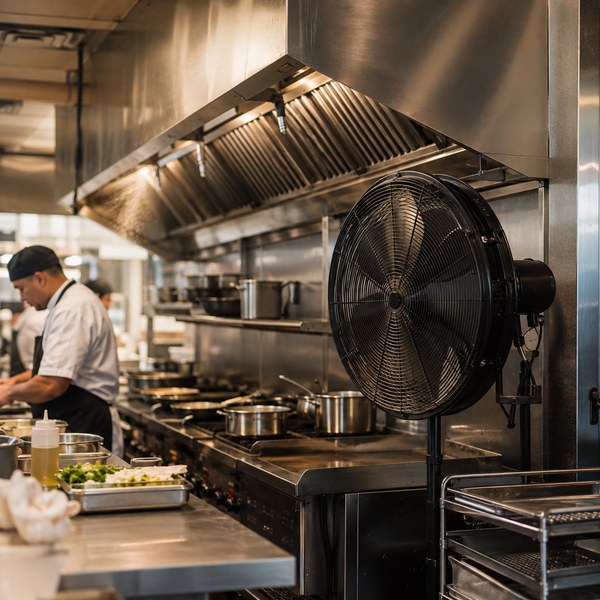
Our foodservice customers running high-heat lines consistently tell us the same thing: a well-placed industrial fan at the end of the line, aimed along the cooks' station rather than at the hood, is the cheapest morale upgrade in the building. Three placement rules keep it from working against your hoods:
- Never aim a fan at the hood face or across the cooking battery. Cross-drafts strip the thermal plume and cause capture spillage — you'll see smoke roll at the hood edge immediately.
- Aim parallel to the line or at prep and dish areas, where staff work hot but no capture is happening.
- Match the fan to the space. For tight stations, a compact unit like the Wind Blade 12-inch 3-speed industrial floor fan (1,680 CFM) spot-cools one or two positions; the 18-inch tilt-head model (4,080 CFM) covers a full prep station; and the 20-inch 4,750 CFM unit handles dish pits, loading docks, and back-of-house corridors where heat pools.
Tilt heads matter: angling airflow slightly upward clears the "heat blanket" at head height without disturbing plates or pilot flames at counter level.
Outfitting the High-Heat Line Around Your Ventilation
Ventilation is the skeleton of a high-heat kitchen; the daily gear is the muscle. After 15+ years supplying 40,000+ foodservice operations, we've learned that the kitchens that stay compliant are the ones that make the supporting supplies effortless to grab:
- Degreasers, brushes, and PPE for the filter-cleaning rotation NFPA 96 inspections assume you're doing — baffle filters that go through the dish machine on schedule never build the buildup inspectors cite.
- Heat-rated gloves and aprons for crews pulling and re-seating hot baffle filters.
- Floor care and safety gear — grease travels, and the area under and around the line needs mats, caution signage, and absorbents ready.
- Air movement and facility hardware — from the industrial fans above to shelving, gaskets, and replacement casters — stocked in our facility supplies collection so the maintenance day actually happens.
The pattern we see across our best-run accounts: ventilation compliance isn't a project, it's a routine — filters weekly, fan and belts monthly, professional duct service on the NFPA 96 clock, and consumables reordered before they run out.
Frequently Asked Questions
What is a vent system for a commercial kitchen?
A commercial kitchen vent system is the combination of an exhaust hood, grease ductwork, a roof- or wall-mounted exhaust fan, and a makeup air unit that together capture and remove heat, smoke, steam, and grease vapor from cooking areas and replace the exhausted air with fresh supply air.
What are the exhaust requirements for a commercial kitchen?
Exhaust requirements come from the adopted mechanical code — most commonly IMC Chapter 5 — plus NFPA 96 for fire safety. Grease-producing appliances require a Type 1 hood exhausting 200–700 CFM per linear foot depending on duty class and hood style (for unlisted hoods), grease duct holding at least 500 feet per minute velocity, 18-inch clearance to combustibles for unenclosed duct, fire suppression, and makeup air replacing the exhausted volume. Local amendments vary, so confirm with your AHJ.
Which exhaust fan is best for a commercial kitchen?
For Type 1 grease hoods, the standard choice is a UL 762–listed upblast centrifugal roof fan, which directs grease-laden exhaust up and away from the roof surface and includes a grease collection provision, hinged base for duct cleaning access, and capacity matched to the hood's required CFM plus duct static pressure. Type 2 hoods can use lighter general-exhaust fans. Size the fan to the calculated system, not to a catalog number.
How does commercial kitchen ventilation work?
Commercial kitchen ventilation works by capture and replacement. Hot cooking effluent rises in a thermal plume; the hood canopy captures it; the exhaust fan pulls it through grease filters that strip larger grease particles; ductwork carries the remainder outdoors; and the makeup air unit supplies replacement air so the kitchen stays close to pressure-neutral and the hood keeps capturing instead of spilling.
What type of hood do I need for my restaurant?
If any appliance under the hood produces grease or smoke — fryers, griddles, charbroilers, ranges, woks — you need a Type 1 hood with grease filters, fire-rated duct, and suppression. If the equipment produces only heat, steam, or condensate — most ovens, steamers, and dish machines — a Type 2 hood is sufficient. When in doubt, your mechanical engineer classifies each appliance against the IMC duty tables.
How many CFM do I need for a commercial kitchen?
Multiply the hood's length by the IMC rate for its style and the heaviest duty class beneath it. Example: a 10-foot unlisted wall canopy over heavy-duty charbroilers needs 10 × 400 = 4,000 CFM; the same hood over light-duty ovens needs only 2,000 CFM. UL 710–listed hoods use the rate in their listing instead, which is typically lower.
What is NFPA 96?
NFPA 96 is the National Fire Protection Association's Standard for Ventilation Control and Fire Protection of Commercial Cooking Operations. It sets fire-safety requirements for every part of the grease exhaust path — hood construction, duct clearances, exhaust fans, fire suppression, and scheduled inspection and cleaning of grease buildup — and it is enforceable wherever the local fire code adopts it.
How much does commercial kitchen ventilation cost?
Cost depends on five drivers: hood length and type (Type 1 costs several times Type 2), duty class (solid fuel needs a dedicated system), duct run length and routing, fire suppression coverage, and whether makeup air must be tempered. A short straight duct on a one-story building is the cheap end; a long engineered run with tempered MUA in a multi-story or historic building is the expensive end. Get itemized mechanical bids for your specific site — and treat any quote missing a makeup air line item as incomplete.
Conclusion: Spec the System Before the First Service
Commercial kitchen ventilation rewards operators who decide early and precisely: cooking lineup first, hood type and CFM second, makeup air always, NFPA 96 maintenance on the calendar forever. Get those four right and the hottest line in town stays clear, comfortable, and inspection-ready. Then take care of the people standing in the heat — from spot-cooling fans to the daily gear that keeps the compliance routine running, shop Restaurantware's industrial tools collection.