Food Shelf Life: Best Practices For Extending Perishables
Food shelf life is the period a food stays safe and at peak quality under proper storage. In restaurants, three levers extend it: temperature control (refrigeration at 40°F/4°C or below), protective packaging such as vacuum sealing, and FIFO rotation — first in, first out — with dated labels on every container.
Every case of chicken, flat of berries, and tub of prepped mise en place in your walk-in is losing value by the hour. In the United States, food waste is estimated at 30–40 percent of the food supply — roughly 133 billion pounds and $161 billion worth of food in USDA's benchmark estimate — according to the U.S. Food and Drug Administration. For an independent restaurant running tight margins, understanding food shelf life isn't trivia; it's the difference between profitable plates and product in the dumpster. This guide gives you a printable food shelf life chart for restaurants — refrigerated, frozen, and dry storage — plus the best practices that actually extend the shelf life of perishable foods.

TL;DR: Keep cold food at 40°F (4°C) or below and frozen food at 0°F (-18°C). Raw poultry and ground meat last 1–2 days refrigerated; steaks and chops 3–5 days; cooked leftovers 3–4 days. Freezing keeps food safe indefinitely — only quality declines. Vacuum sealing, airtight containers, and dated FIFO rotation are the fastest ways to make food last longer.
| Storage Zone | Target Temperature | Typical Shelf Life Range | Primary Risk |
|---|---|---|---|
| Refrigerated | 40°F (4°C) or below; 41°F max under the FDA Food Code | 1 day – 5 weeks by item | Bacterial growth, cross-contamination |
| Frozen | 0°F (-18°C) or below | 1–12 months for best quality; safe indefinitely | Freezer burn, quality loss |
| Dry / shelf-stable | Cool and dry; below 85°F | 12 months – 5 years by item | Heat, humidity, pests, can damage |
What Is Food Shelf Life?
Food shelf life is the length of time a food remains safe to eat and acceptable in flavor, texture, and appearance under specific storage conditions. Shelf life of food has two distinct clocks running at once — and confusing them is expensive:
- Safety shelf life is governed by pathogenic bacteria such as Salmonella, E. coli O157:H7, and Listeria monocytogenes. The USDA Food Safety and Inspection Service (FSIS) warns that bacteria grow fastest between 40°F and 140°F — the "Danger Zone" — doubling in as little as 20 minutes. Pathogens generally don't change how food looks, smells, or tastes, which is why time and temperature rules exist.
- Quality shelf life is governed by spoilage bacteria, enzymes, oxidation, and moisture loss. Food past its quality window is usually unappetizing rather than dangerous — but no operator wants to serve it either.
Date labels muddy the water further. Per USDA FSIS, product dating ("sell by," "use by," "best if used by") is not required by federal regulation except for infant formula, and it indicates quality — not safety. That means a printed date is a starting point, not a substitute for the food storage times below.
Perishable foods — raw proteins, dairy, produce, and anything cooked — are categorized by the storage environment they demand: refrigerated, frozen, or dry/shelf-stable. Each category gets its own chart.
Printable Restaurant Food Shelf-Life Chart
This is the core reference — a food shelf life chart for restaurants built from USDA FSIS storage data. Print it, laminate it, and post it on the walk-in door. Times assume food was received in good condition and held at the correct temperature from the moment it hit your dock.
Refrigerated Foods Shelf-Life Chart (40°F / 4°C or Below)
Refrigerated shelf life is short: most raw proteins last only 1–5 days. The times below come from the USDA FSIS refrigerated storage chart. Note that USDA's consumer guidance is 40°F or below, while the FDA Food Code standard for commercial cold holding is 41°F (5°C) or below — run your boxes at 38°F or lower and both are covered.
| Food | Refrigerated Shelf Life |
|---|---|
| Ground beef, turkey, pork, lamb; stew meat | 1–2 days |
| Fresh poultry, whole or parts | 1–2 days |
| Fresh fish and shellfish | 1–2 days |
| Steaks, chops, roasts (beef, veal, lamb, pork) | 3–5 days |
| Raw sausage (meat or poultry) | 1–2 days |
| Bacon | 7 days |
| Ham, fully cooked (whole) | 7 days |
| Hot dogs | 2 weeks unopened; 1 week opened |
| Luncheon meats | 2 weeks unopened; 3–5 days opened |
| Prepared deli salads (egg, chicken, tuna, ham, macaroni) | 3–5 days |
| Pre-stuffed pork/lamb chops, stuffed chicken breasts | 1 day |
| Cooked leftovers, casseroles, soups, and stews | 3–4 days |
| Eggs, fresh in shell | 3–5 weeks |
| Eggs, hard-cooked | 1 week |
Fresh produce is the wildcard — refrigerated shelf life runs from 2 days for delicate berries and herbs to several weeks for hardy roots, and depends heavily on humidity and ethylene exposure. Our produce storage guide for restaurants breaks it down item by item, and our restaurant's guide to produce preservation covers the preservation techniques.
One more refrigerator rule worth posting: FSIS cautions that Listeria monocytogenes can multiply even at refrigeration temperatures. Cold slows spoilage — it doesn't stop the clock.
Frozen Foods Shelf-Life Chart (0°F / -18°C)
Here's the fact that surprises most new kitchen managers: according to USDA FSIS freezing guidance, food held constantly at 0°F is safe indefinitely. Freezer storage times are quality windows, not safety limits — past them, expect freezer burn, off flavors, and moisture loss, not illness.
| Food | Best-Quality Window at 0°F |
|---|---|
| Bacon and sausage | 1–2 months |
| Ham, hot dogs, lunch meats | 1–2 months |
| Cooked meat; soups and stews | 2–3 months |
| Casseroles | 2–3 months |
| Ground meat, uncooked | 3–4 months |
| Frozen dinners and entrées | 3–4 months |
| Poultry, cooked | 4 months |
| Roasts, steaks, chops (uncooked) | 4–12 months |
| Poultry parts, uncooked | 9 months |
| Whole poultry, uncooked | 12 months |
| Egg whites / egg substitutes | 12 months |
Two freezer best practices from the same USDA source: freeze fast (a 2-inch-thick package should freeze solid in about 2 hours — spread packages in a single layer until frozen), and wrap tight, because freezer burn is caused by air contacting the food surface. Vacuum-sealed packages can be frozen as-is.
Dry & Shelf-Stable Storage Chart (Cool, Dry, Below 85°F)
Shelf-stable foods — canned goods, rice, pasta, flour, sugar, spices, and oils — still have limits. USDA FSIS shelf-stable guidance says to store them in a cool, dry place below 85°F, never near cooking lines, dish machines, or damp storage areas, because heat sharply raises spoilage risk.
| Item | Best-Quality Window | Notes |
|---|---|---|
| High-acid canned goods (tomatoes, fruit, juices, pickles, vinegar-based items) | 12–18 months | Acid reacts with the can over time (Clemson University HGIC) |
| Low-acid canned goods (meats, most vegetables, beans, soups) | 2–5 years | Same source; safe longer if cans stay intact |
| Shelf-stable canned ham (labeled for pantry storage) | 2–5 years | USDA FSIS; refrigerated "Keep Refrigerated" hams are NOT shelf stable |
| Dry staples (white rice, dried beans, pasta, flour, sugar, salt) | 12+ months; salt and sugar keep essentially indefinitely | Airtight containers, cool and dry; rotate flour and whole grains faster — their oils go rancid |
| Cooking oils and dried spices | Months, not years, for peak flavor | Heat and light accelerate rancidity and flavor fade |
Whatever the chart says, condition overrides the calendar: FSIS says to discard cans that are bulging, leaking, heavily rusted, or deeply dented on any seam — those are botulism red flags, and no date label saves them.
How Do You Extend the Shelf Life of Food?
You extend food shelf life by controlling three variables: temperature, exposure (air, light, moisture), and time in inventory. If you're asking how to make food last longer, every technique below — from vacuum sealing to FIFO — works by attacking one of those three variables. Here's how to extend shelf life of food systematically.
1. Temperature Control: Win the Danger Zone
Temperature is the single biggest shelf-life lever. USDA FSIS's rules are blunt: keep cold food at or below 40°F, hot food at or above 140°F, and never leave perishables in between for more than 2 hours (1 hour above 90°F). Commercially, the FDA Food Code (2022 edition) — the model regulation most U.S. health departments adopt — sets cold holding for time/temperature control for safety (TCS) foods at 41°F (5°C) or below. In practice:
- Put an appliance thermometer in every cooler and freezer and log temps every shift — door-mounted displays drift.
- Cool hot foods fast: divide large batches into shallow containers before refrigerating, per FSIS guidance. A stockpot of soup cooled whole is a bacteria incubator in the middle.
- Keep raw proteins sealed and stored below ready-to-eat foods so drips can't cross-contaminate.
- Don't overload coolers past the airflow line, and keep door-open time short during rushes.
2. Protective Packaging and Vacuum Sealing
Air is the enemy of quality: oxygen drives rancidity, moisture migration causes freezer burn, and open containers absorb odors. Swapping cling film and hotel-pan improvisation for true airtight food storage containers is the cheapest quality upgrade in most kitchens. For proteins and portioned prep, vacuum sealing goes further — removing the air entirely so oxidation and freezer burn essentially stop. Commercial vacuum packaging machines pay for themselves quickly in kitchens that break down whole proteins or batch-prep sauces; our deep dive on the role of vacuum sealing in food quality maintenance covers technique and equipment selection.
Humidity matters too, especially in dry storage and produce coolers — flour cakes, spices clump, and greens wilt when moisture is wrong. See our guide to understanding the impact of humidity on stored foods for target ranges by category, and our post on optimizing ingredient storage for maximum flavor retention for the flavor side of the same problem.
3. FIFO Rotation and Date Labeling
FIFO — first in, first out — means the oldest stock is always used first. It sounds obvious; it fails constantly in real kitchens because new deliveries get shoved in front of old product. Make it mechanical:
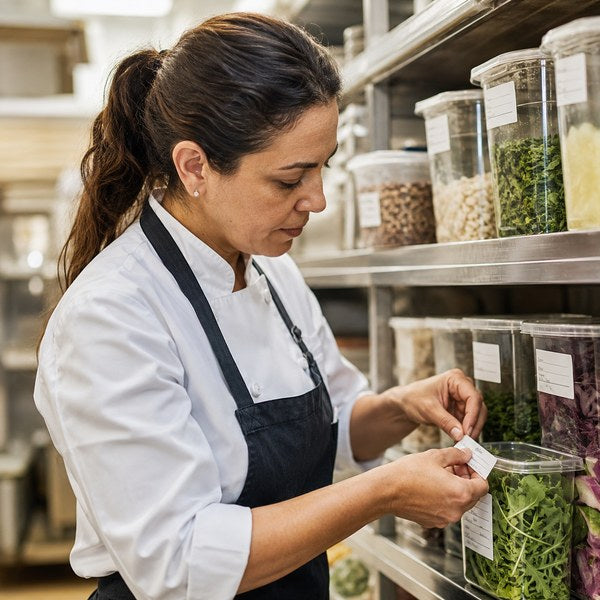
- Label everything on arrival and on prep. Every container gets a received/prepped date and a use-by date. Color-coded date stickers & food rotation labels (a color per day of the week) let anyone spot out-of-rotation product from across the walk-in.
- Load from the back, pull from the front. New stock goes behind old stock, always.
- Follow the 7-day rule. The FDA Food Code requires date marking on ready-to-eat TCS foods held over 24 hours, with a maximum of 7 days at 41°F or below (day of prep counts as day one). Most local codes enforce exactly this.
- Do a weekly purge. FSIS recommends a standing routine of discarding expired perishables — tie it to a slow shift and log the waste so purchasing can see the pattern.
Shelf Life Starts at Receiving: Buying Considerations for Operators
The chart times above assume day one is a good day one. Shelf life is set — or lost — at the loading dock:
- Check temperatures at receiving. Refrigerated goods arriving above 41°F have already spent unknown time in the Danger Zone. Probe, log, and reject.
- Inspect packaging. Per FSIS, refuse bulging, leaking, rusted, or deeply dented cans; torn vacuum packs; and crushed produce cases. Damaged packaging means a shortened or unsafe shelf life you're paying full price for.
- Buy to your velocity. A case-price discount on fish you'll hold past 1–2 days is not a discount. Match order sizes to verified usage, and let long-shelf-life staples — not delicate perishables — carry your par-stock buffer.
- Sequence the put-away. Frozen first, refrigerated second, dry goods last. Every minute a pallet sits on the dock is shelf life burning.
Putting It to Work: A Foodservice Shelf-Life System
In 15+ years supplying 40,000+ foodservice operations, we've seen the same pattern over and over: the kitchens with the lowest waste aren't the ones with the most expensive refrigeration — they're the ones where labeling and rotation are non-negotiable habits. A complete shelf-life system needs only three product categories:
- Airtight storage: clear, stackable food storage containers so staff can see contents and labels without opening lids — every open-and-sniff costs cold air and time.
- Rotation labeling: dissolvable or removable day-of-week date stickers that survive the cooler but don't leave adhesive residue on containers.
- Air removal: a vacuum packaging machine for proteins, sous vide prep, and high-value items where oxidation is the failure mode.
Our foodservice customers consistently tell us the payback shows up in two places within the first quarter: lower protein waste (vacuum-sealed portions stop dying of freezer burn) and faster health inspections (dated, labeled, properly stored product answers the inspector's questions before they're asked). Start with the walk-in you lose the most money in — for most operations, that's protein storage — and build the habit outward.
Frequently Asked Questions About Food Shelf Life
How long do perishable foods last?
Most raw perishable foods last 1–5 days refrigerated at 40°F or below: ground meats, poultry, and seafood 1–2 days; whole cuts of beef and pork 3–5 days; cooked leftovers 3–4 days. Shell eggs are the outlier at 3–5 weeks. Frozen at 0°F, food stays safe indefinitely, with quality windows of 1–12 months.
What is the shelf life of refrigerated food?
Refrigerated food shelf life at 40°F (4°C) or below ranges from 1 day (pre-stuffed raw chicken breasts) to 5 weeks (shell eggs). USDA FSIS's benchmarks: raw poultry and ground meat 1–2 days, steaks and roasts 3–5 days, bacon and cooked whole ham 7 days, lunch meat 3–5 days once opened, and cooked leftovers 3–4 days. Under the FDA Food Code, ready-to-eat TCS foods max out at 7 days.
How do restaurants track food shelf life?
Restaurants track food shelf life with date labels and FIFO rotation: every item is marked with a prep or received date and a use-by date, new stock loads behind old, and day-of-week color-coded rotation labels make expired product visible at a glance. Many operations add temperature logs each shift and a weekly discard audit to close the loop.
What is FIFO in food storage?
FIFO means "first in, first out" — the stock rotation method where the oldest product is always positioned to be used first. New deliveries go behind existing stock, everything carries a date label, and staff pull from the front. FIFO minimizes the product that quietly ages out at the back of the shelf.
How can you extend the shelf life of produce?
Extend produce shelf life by controlling temperature and humidity by item: most vegetables want high humidity, most fruit lower humidity, and ethylene producers (apples, bananas, tomatoes) must be kept away from ethylene-sensitive greens. Store delicate items dry and unwashed until use, in breathable or purpose-designed containers, and rotate on 1–3 day cycles.
Is 20-year-old canned food still good?
No commercial kitchen should hold or serve decades-old canned food. Intact cans can technically remain safe long past their dates, but best quality lasts 12–18 months for high-acid foods (tomatoes, fruit) and 2–5 years for low-acid foods (meats, vegetables), per Clemson University's Home & Garden Information Center. Any can that is bulging, leaking, rusted, or deeply dented should be discarded regardless of age — those are botulism warning signs per USDA FSIS.
What food has a 20-year shelf life?
Honey, salt, sugar, white rice, and dried beans can remain usable for decades when stored cool, dry, and tightly sealed — salt and sugar essentially indefinitely. Quality still drifts: old dried beans take longer to soften, and rice can pick up off flavors. For restaurants, these belong in par stock at realistic volumes, not stockpiles.
What are the best long-shelf-life staples for a restaurant to par-stock?
Par-stock dry staples that hold 12 months or more when kept cool, dry, and sealed: white rice, dried beans, pasta, flour, sugar, salt, cooking oils, canned goods (rotated within their quality windows), vinegar, and dried herbs and spices. Buy these in bulk for price breaks — and let short-lived perishables be ordered to actual weekly velocity instead.
Conclusion: Small Habits, Longer Shelf Life
Extending food shelf life isn't one big fix — it's temperature discipline, honest packaging, and FIFO rotation repeated every shift. Print the charts above, post them where receiving and prep happen, and give your team the tools that make the right habit the easy habit. When you're ready to build out your system, start with our food storage containers collection — airtight, stackable, and label-ready — and add rotation labels and vacuum packaging as your volume grows. Less waste, safer food, better margins: that's shelf life managed well.
Sources — current as of August 2026: USDA FSIS, Refrigeration & Food Safety; USDA FSIS, Freezing and Food Safety; USDA FSIS, Danger Zone; USDA FSIS, Shelf-Stable Food Safety; FDA Food Code 2022; FDA, Food Loss and Waste; Clemson University HGIC, Safe Handling of Canned Goods.