AI In Restaurants: How AI Is Transforming Commercial Kitchen Operations
AI in restaurants is the use of artificial intelligence software to run kitchen and restaurant operations — forecasting demand, managing inventory, guiding prep production, cutting food waste, and taking orders. For operators, the takeaway is practical: start with one software tool that attacks your biggest cost line, prove the savings, then expand.

AI in restaurants has crossed from hype to line item. According to the National Restaurant Association's 2026 State of the Restaurant Industry report, 26% of restaurant operators now use AI-related tools in their operations (Restaurant Dive, Feb 2026) — and while marketing gets the headlines, the fastest payback we see is in the back of house. In 15+ years supplying 40,000+ foodservice operations at Restaurantware, we've watched restaurant technology decisions shift from "should we try AI?" to "which cost line do we point it at first?" This guide covers exactly that: what AI in commercial kitchen operations actually does in 2026, what it costs, where it fails, and how to adopt it without burning capital.
TL;DR — AI in Restaurants at a Glance
- Adoption is real but early: 26% of operators use AI tools; only 6% use AI for customer ordering so far (NRA, 2026).
- Back of house is where the money is: inventory, demand forecasting, prep planning, and food-waste tracking deliver measurable food-cost savings — AI waste-tracking vendor Winnow cites 2–8% food cost reductions.
- Voice AI has scaled: Taco Bell runs voice AI at 890+ U.S. drive-thrus; McDonald's killed its IBM test in 2024 — vendor choice matters.
- AI won't replace your kitchen staff: it removes counting, guessing, and paperwork — humans still cook, taste, and lead.
- Start with software, not robots. Robotics hardware is a separate, bigger decision — covered in our guide to the 4 types of robots in the food industry.
| Kitchen AI Use Case | What It Does | Example Tools / Proof | Typical Payback Signal |
|---|---|---|---|
| Demand forecasting | Predicts covers and item-level sales from history, weather, events | Forecasting modules in modern POS and inventory platforms | Less overprep, tighter labor scheduling |
| Inventory management | Tracks stock in real time, auto-suggests orders, flags variance | AI-driven inventory suites tied to POS and invoices | Lower food cost %, fewer 86'd items |
| Food-waste tracking | Camera + scale identify what's thrown away and why | Winnow VisionAI (2–8% food cost savings) | Smaller waste bins, smarter batch sizes |
| Voice ordering AI | Takes drive-thru and phone orders automatically | Taco Bell × Omilia at 890+ drive-thrus; Wendy's FreshAI | Faster lines, staff redeployed to production |
| Prep & cooking automation | AI-guided fry stations and cook-line monitoring | Miso Robotics Flippy fry station | Consistency at peak hours (hardware — see robots guide) |
| Equipment monitoring | Sensors predict failures, watch temps for HACCP logs | IoT/predictive-maintenance platforms on refrigeration and cooklines | Fewer emergency repairs, automatic temp logs |
What Is AI in Restaurants and Where Is It Used?
AI in restaurants is defined as software that learns from operational data — sales, invoices, waste, temperatures, labor hours — and turns it into predictions and decisions a manager would otherwise make by gut. It spans the whole operation, but usage today concentrates in a few zones. Per the NRA's 2026 report, marketing is the most common application (19% of full-service and 15% of limited-service operators), about 10% of operators use AI for administrative tasks, and 6% use it for customer orders (Restaurant Dive, Feb 2026).
That gap is the opportunity. Front-of-house AI — chatbots, review responders, campaign generators — is easy to adopt and widely covered. The larger, less crowded prize is commercial kitchen operations: the back-of-house workflows where food cost, labor cost, and waste actually live. That's what the rest of this guide focuses on, and it's the lens most page-one articles skip.
One boundary worth drawing early: AI is the software brain; robots are the hardware hands. A demand-forecasting model, a waste camera, and a voice bot are AI. A fry arm, a server robot, and a delivery rover are robotics — a different budget, footprint, and permitting conversation. If hardware is what you're evaluating, start with our 4 types of robots in the food industry hub; this article owns the software and operations side.
How Is AI Used in Commercial Kitchen Operations? 6 Use Cases That Pay
These are the six applications of restaurant AI that consistently produce measurable back-of-house returns, ordered roughly by how easy they are to adopt.
1. Demand forecasting — the foundation everything else sits on
AI demand forecasting predicts how many covers you'll do and what they'll order, using your sales history plus signals like weather, local events, holidays, and day-of-week patterns. Old-school forecasting was a manager eyeballing last Tuesday. Machine-learning forecasting runs item-level predictions every day, automatically. The output feeds everything downstream: prep lists sized to real demand, order quantities that don't rot in the walk-in, and labor schedules that match actual volume. Most modern POS and inventory platforms now ship a forecasting module — if your restaurant technology stack was installed before 2023, this is the first upgrade to evaluate.
2. AI inventory management — killing the clipboard count
AI restaurant inventory management connects your POS, supplier invoices, and recipes so the system always knows theoretical stock on hand — then flags the variance between what you should have used and what actually left the shelf. That variance is where shrinkage, over-portioning, and unrecorded waste hide. The practical wins our customers describe: suggested order quantities instead of guess-and-fax, alerts before an item 86s mid-service, and food-cost visibility by menu item instead of one blended number at month-end. Pair the software with disciplined physical organization — clearly labeled food preparation containers and consistent shelving — because an AI count is only as accurate as the humans stocking the shelves.
3. Food-waste reduction — the fastest measurable ROI in the kitchen
The scale of the problem is hard to overstate: ReFED estimates that in 2024 the U.S. let 29% of its 240-million-ton food supply go unsold or uneaten, with about 60 million tons ending up as waste (ReFED). In a commercial kitchen, that waste is bought, received, stored, and prepped before it hits the bin — you paid labor to throw it away.
AI waste tracking attacks this with computer vision. Winnow's VisionAI, trained on 500+ million images, sits over the waste bin, identifies more than 1,000 food types as they're discarded, and reports exactly what was thrown out and what it cost — no manual logging. Winnow cites 2–8% food cost savings for kitchens using the system, and its highest-profile deployment, IKEA's global kitchens, publicly reported cutting food waste by half. When chefs can see that Tuesday's batch of soup dies every week, they prep less soup on Tuesdays. It's that direct.
4. Voice ordering AI — proven at scale, but vendor-dependent
Order-taking is the most visible AI in the food industry, and 2026 is the year it stopped being a pilot. Taco Bell, through its partnership with voice-AI company Omilia, now runs drive-thru voice AI at more than 890 U.S. locations across 38 states (Restaurant Dive, Jul 2026). Wendy's has expanded its Google Cloud-built FreshAI from a two-state pilot toward a systemwide rollout (Wendy's, 2025).
The counterexample matters just as much: McDonald's shut down its IBM automated order-taking test at 100+ drive-thrus in July 2024 after well-publicized order errors (AP News) — then went back to the drawing board rather than abandoning the idea. The lesson for independents evaluating AI phone answering or kiosk upsell tools: the technology works, but accuracy varies wildly by vendor. Pilot in one location, measure order accuracy against your human baseline, and keep a one-touch human handoff.
For the kitchen, voice AI's real value isn't replacing a cashier — it's redeploying that person to the make line during peak, which is where most operations are actually short-staffed.
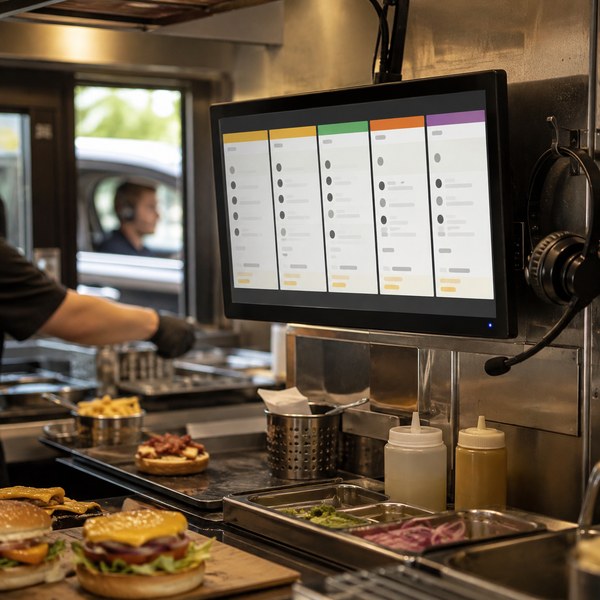
5. Prep and cooking automation — where AI software meets hardware
Kitchen automation on the cookline blends both worlds: AI vision and scheduling software driving physical equipment. The best-known example is Flippy, Miso Robotics' AI-powered fry station. It's also the best-known reality check. Flippy debuted in 2017, and Miso's newest third-generation fry station (launched January 2026) can fry and portion 40+ menu items while cutting staff interaction with hot-oil equipment by 90% — yet per Miso's own filings, only 14 Flippy units were deployed (at White Castle and Insert Coin) as of the end of 2025, and earlier partnerships with CaliBurger and Panera ended (Fortune, Feb 2026).
Translation for operators: cooking robots are improving fast, but adoption is still measured in dozens of units, not thousands. The AI that's ready for your kitchen today is softer: kitchen display systems that sequence tickets intelligently, cook-time monitoring, and AI-guided prep lists. If you want the full hardware picture — fry arms, server robots, delivery rovers — that's covered in our robots in the food industry guide. Meanwhile, semi-automated prep equipment (slicers, portioners, mixers with smart controls) delivers most of the consistency benefit at a fraction of the cost — see our take on optimizing workflow with automated food prep equipment.
6. Equipment monitoring and food safety — the quiet workhorse
Predictive maintenance is AI applied to your refrigeration, ovens, and hoods: IoT sensors stream temperatures, vibration, and energy draw, and the model flags drift before a compressor dies on a Friday night. The same sensor layer automates HACCP temperature logs — continuous digital records instead of a clipboard someone pencil-whips at 4:55 PM. Beyond safety, the energy data alone often justifies the sensors; pairing monitoring with the basics in our energy efficiency tips for commercial kitchen equipment is one of the few AI adjacencies that lowers a utility bill directly.
How Do You Choose AI Tools for Your Restaurant?
Choosing restaurant AI comes down to pointing the tool at your biggest measurable cost line, not the flashiest demo. The evaluation framework we recommend to operators:
- Start with the P&L, not the product. Food cost creeping past 32%? Start with inventory + waste tracking. Labor scheduling chaos? Forecasting first. Missed phone orders? Voice AI.
- Demand POS integration. An AI tool that can't read your sales data is a spreadsheet with better marketing. Native integration with your POS and suppliers is non-negotiable.
- Pilot one location, one quarter. Define the metric (food cost %, order accuracy, waste weight) before the pilot, and compare against a control location if you have one.
- Ask who fixes it at 6 PM Friday. Support hours, onboarding, and training materials matter more in a kitchen than model architecture ever will.
- Check data ownership. Your sales and recipe data should remain yours, exportable, when you leave the platform.
We go deeper on vendor vetting in our companion piece on selecting the best AI tools for your foodservice operation, and on the broader stack in the role of technology in modern kitchen operations.
Ready to modernize the physical side while you evaluate the software? Browse our Kitchen Tek line of work tables and back-of-house workhorses — the infrastructure every smart kitchen still runs on.
Setting Up Your Kitchen So AI Actually Works (Our Moat: The Physical Layer)
Here's what a decade and a half of supplying real kitchens has taught us: AI fails in disorganized kitchens. Every system above depends on physical discipline that no algorithm can supply.
- Inventory AI needs consistent storage. If the same product lives in three spots, theoretical stock never matches reality. Standardize with labeled, uniform food preparation supplies — clear containers, date labels, first-in-first-out shelving.
- Forecasting AI needs consistent portioning. A model predicting 40 servings of a dish is useless if portions swing 30% by cook. Portion scales, scoops, and standardized serveware close that loop.
- Waste AI needs clean stations. Vision systems misread cluttered bins and mixed waste streams; station layout and dedicated prep zones fix it.
- Monitoring AI needs reliable equipment underneath. Sensors on a failing walk-in just document the failure. Sound restaurant equipment is the substrate; AI is the layer on top.
Our foodservice customers consistently tell us the same thing after an AI rollout: the software exposed every sloppy habit in the building. Treat that as the feature it is — fix the physical workflow first, and the AI's numbers start matching reality within weeks.
Frequently Asked Questions About AI in Restaurants
How can AI be used in a restaurant?
AI is used in restaurants for demand forecasting, inventory management, prep planning, food-waste tracking, voice and online ordering, dynamic scheduling, equipment monitoring, and marketing automation. Most operators start with one back-of-house tool — typically inventory or forecasting — because those attack food and labor cost directly.
What are examples of AI in commercial kitchens?
Concrete examples of AI in commercial kitchens include Winnow VisionAI cameras that identify discarded food and price the waste, Miso Robotics' Flippy AI fry station, Taco Bell's Omilia-powered voice ordering at 890+ drive-thrus, POS-integrated forecasting modules, and IoT sensors that predict refrigeration failures and auto-log HACCP temperatures.
How is AI used in food prep and inventory?
In prep and inventory, AI forecasts item-level demand, generates right-sized prep lists, suggests purchase orders, and flags variance between theoretical and actual usage. The result is less overproduction, fewer stockouts, and food-cost visibility per menu item instead of one blended monthly number.
Will AI replace kitchen staff?
No — AI in restaurants replaces tasks, not cooks. It removes counting, logging, guessing, and order-taking so staff spend their hours on production and hospitality. NRA 2026 data shows only 6% of operators use AI for customer orders, and even highly automated concepts still staff full kitchen teams. Expect role shifts, not eliminations.
What is the 30/30/30 rule for restaurants?
The 30/30/30 rule is a budgeting rule of thumb: keep food costs near 30% of sales, labor near 30%, and overhead near 30%, leaving roughly 10% profit. It's a guideline, not gospel — but it's useful for AI planning, because it tells you which 30% bucket your first tool should target.
How much does restaurant AI cost?
Restaurant AI costs range from modest monthly software subscriptions (inventory, forecasting, and scheduling tools priced per location) to significant hardware investments — waste-tracking cameras, voice-AI installations, and robotics leases. Software-only tools typically pay back through food-cost savings within months; hardware requires a formal capex or robotics-as-a-service analysis. Always pilot one location first.
What is the 30% rule in AI?
The 30% rule in AI is a workplace heuristic: AI tends to automate roughly a third of the tasks within a job rather than the whole job. In a kitchen, that's the counting, logging, forecasting, and order-entry — while cooking, tasting, plating, and leading the line stay human.
Which 3 jobs will survive AI?
In foodservice, the three most AI-resistant roles are chefs and culinary creatives (taste and menu judgment), managers and hospitality leaders (people decisions and guest recovery), and skilled service staff (human connection guests pay for). Notably, the NRA found nearly two-thirds of operators believe technology improves hospitality — but only 41% of consumers agree, which is exactly why the human roles endure.
Conclusion: Adopt the Software, Keep the Craft
AI in restaurants in 2026 is neither the robot takeover the headlines promised nor a fad you can ignore. It's a set of proven software tools — forecasting, inventory, waste tracking, voice ordering, equipment monitoring — that a quarter of your competitors already run, and that reliably shave points off food cost when the physical kitchen underneath is organized enough to feed them clean data. Start with one tool aimed at your biggest cost line, pilot it in one location, and build from there.
And while the software learns, make sure the hardware layer is ready: outfit your back of house with dependable restaurant equipment and smart-kitchen infrastructure from our Kitchen Tek collection — because the best algorithm in the world still can't fix a wobbly prep table.