Implementing Technology for Streamlined QSR Operations
QSR technology is the set of digital tools — POS systems, kitchen display systems, self-order kiosks, and drive-thru and delivery integrations — that quick-service restaurants implement to speed service and cut labor costs. Successful implementation starts with one high-impact system, staff training, and measurable goals like ticket times before expanding the stack.
Implementing technology for streamlined QSR operations is no longer optional — it is how quick-service restaurants protect margins that keep getting squeezed. According to the National Restaurant Association's 2026 State of the Restaurant Industry report, more than 9 in 10 operators cite food, labor, insurance, energy, and swipe fees as significant challenges, and 42% of operators reported their restaurant was not profitable last year. The same report projects total restaurant and foodservice sales will reach $1.55 trillion in 2026 — the demand is there, but capturing it profitably means squeezing seconds out of every order. This guide walks through the QSR technology stack piece by piece — kiosks, kitchen display systems, drive-thru tech, and order-accuracy tools — and gives you a practical rollout framework built from what we've seen work across tens of thousands of foodservice operations.

TL;DR — The QSR Technology Stack at a Glance
- Self-order kiosks shift order entry to the guest, lift average checks through automatic upselling, and free up counter labor. 61% of kiosk users now want more kiosks in restaurants, per Tillster's 2025 Phygital Index.
- Kitchen display systems (KDS) replace paper tickets, route items to the right station, and time courses so everything in an order finishes together.
- Drive-thru technology — timers, clear speaker systems, and pre-sell boards — attacks the two biggest time sinks: garbled audio and repeated orders.
- Order-accuracy tools (order confirmation screens, KDS modifiers, labeled packaging) protect the metric guests punish hardest when it slips.
- Rollout rule: implement one high-impact system at a time, train before launch, and measure ticket times and accuracy before adding the next layer.
| Technology | Where It Lives | Primary Payoff | Key Metric to Track |
|---|---|---|---|
| POS system | Front of house | Single source of truth for orders and sales data | Transaction time, sales mix |
| Self-order kiosk | Front of house | Higher average check, redeployed labor | Average ticket, kiosk share of orders |
| Kitchen display system (KDS) | Back of house | Faster, more accurate ticket flow | Ticket time, remake rate |
| Drive-thru timer + speaker tech | Drive-thru lane | Seconds saved per car, fewer repeats | Total time per car, order accuracy |
| Online ordering / delivery integration | Off-premises | Direct injection of digital orders into the KDS | Order error rate, quote-time accuracy |
| Inventory & labor software | Back office | Lower food cost, tighter scheduling | Food cost %, labor cost % |
What Is QSR Technology and Which Types Matter Most?
QSR technology is the combination of front-of-house, back-of-house, and off-premises digital systems that quick-service restaurants use to take orders, fire them to the kitchen, and get accurate food to guests faster. The stack matters because speed and accuracy are the two levers that decide whether a quick-service restaurant wins repeat visits.
Self-Order Kiosks: The Front-of-House Workhorse
Self-order kiosks are touchscreen stations that let guests build and pay for their own orders without a cashier. Guest sentiment has flipped decisively in their favor: Tillster's 2025 Phygital Index Report, a survey of 1,500 U.S. QSR and fast-casual consumers, found 61% of kiosk users want more kiosks available in restaurants — up from 57% in 2024 and just 36% in 2023. The same report found 76% of kiosk users have bought more than they intended, because kiosks upsell every single order without hesitation or forgetfulness. That consistency is why major chains — from Shake Shack, where kiosks became the largest ordering channel, to Wendy's and Bojangles — keep accelerating deployments.
For operators, kiosks deliver three things: a higher average check, order entry shifted from paid labor to the guest, and error reduction, since guests review their own orders on screen before paying. The practical trade-off is floor space and a modest maintenance burden — plan your queue layout and your fast food trays & cafeteria trays handoff point so kiosk orders don't collide with counter traffic at pickup.
Kitchen Display Systems: The Back-of-House Nerve Center
A kitchen display system (KDS) is a screen-based ticket management system that replaces printed chits, routing each item to the correct prep station and color-coding tickets by age so nothing gets buried. When a kiosk, drive-thru, app, or third-party delivery order comes in, the KDS sequences it automatically — fries drop when the grill items are 90 seconds out, so the whole order lands in the bag hot and together.
In our experience, the KDS is the single highest-leverage back-of-house upgrade for most independent QSRs because it fixes the invisible problem: orders that are taken correctly but assembled wrong or late. A KDS timestamps every ticket, which means you finally get honest ticket-time data instead of anecdotes. If you already integrated online ordering with your POS, the KDS is the natural next step — it is where all those channels converge into one prioritized queue. For a broader look at how digital tools reshape kitchen workflow, see our guide to the impact of technology on kitchen efficiency.
Drive-Thru Technology: Where Seconds Equal Revenue
Drive-thru technology covers the timers, headsets, speaker systems, pre-sell menu boards, and lane-management tools that squeeze seconds out of every car. The math is unforgiving: Intouch Insight's 2025 Drive-Thru Study — 165 mystery shops per brand across 13 U.S. chains — found that clear speaker systems alone cut 54 seconds off wait times, and not needing to repeat an order saved a full 1 minute and 25 seconds per car. Taco Bell posted the fastest total time in the study at 4 minutes 16 seconds. When one hardware upgrade (a clearer speaker) is worth nearly a minute per car, the ROI conversation gets short.
Voice-AI ordering is the newest layer here — the 2025 study included 120 Voice-AI orders across three brands where an AI assistant handled the lane — but it remains an emerging experiment rather than a solved problem. We cover the broader automation picture in our article on the role of automation in reducing kitchen labor costs; for drive-thru purposes, the proven wins are still audio clarity, order-confirmation screens, and disciplined lane design.
Order Accuracy: The Metric That Quietly Decides Loyalty
Order accuracy is the percentage of orders delivered exactly as the guest requested — and it is slipping industry-wide. Intouch Insight's 2025 study recorded a 2-percentage-point drop in drive-thru order accuracy versus the prior year, with dinner the weakest daypart and afternoon visits the best at 90%. The top error sources were mundane: 51% of mistakes were missed ice requests on beverages, and 25% were entirely wrong items. Guests forgive a slow order faster than a wrong one, because a wrong order means a second trip or a refund.
Technology attacks accuracy at three points: order confirmation screens (guest verifies before the kitchen fires), KDS modifier displays (the "NO ICE" line appears in red at the drink station, not buried on a paper chit), and clear labeling at packout so bags get matched to the right car or courier. Accuracy is also where packaging becomes part of the tech stack — tamper-evident seals and clearly-labeled containers are the last checkpoint before the guest.
How Should Operators Choose and Roll Out New Restaurant Technology?
Operators should choose restaurant technology by identifying their single most expensive bottleneck, then piloting one system against a measurable target before expanding. Implementing new technology in a restaurant fails most often not because the tool is bad, but because the rollout skipped training and measurement. Here is the five-step process we recommend to operators:
- Diagnose with data, not instinct. Pull two weeks of numbers: ticket times by daypart, order error/remake counts, labor hours by station. The bottleneck is usually obvious once it's on paper — and it tells you whether your first dollar goes to a kiosk, a KDS, or drive-thru hardware.
- Set one measurable goal per system. "Cut average ticket time from 6:30 to 5:00" or "raise order accuracy to 95%" — a number, a deadline, and a person who owns it. Vague goals ("modernize operations") produce shelfware.
- Pilot in one location or one daypart. Run the new system during lunch only, or in one store, for 30 days. Keep the old process as fallback. You will find the workflow breaks — station layouts, power drops, Wi-Fi dead zones — while the stakes are low.
- Train before launch, not during. Schedule hands-on sessions where every crew member processes real order scenarios on the new system before it goes live. Assign a "tech captain" per shift as the first line of troubleshooting. Crews abandon tools they were never taught to trust.
- Measure, tune, then expand. Compare 30-day results against your goal. If the numbers moved, roll out wider and add the next system. If they didn't, fix the workflow before spending another dollar — stacking new technology on a broken process just automates the chaos.
Two buying rules cut through vendor noise. First, integration beats features: a kiosk that doesn't inject orders directly into your POS and KDS creates a re-keying station, which is a new error source you paid for. Second, demand exportable data — your ticket times, sales mix, and error logs should belong to you, not live trapped in a vendor dashboard. AI-driven analytics and robotic prep systems get the headlines, and they are maturing fast, but they sit on top of this foundation — get the ordering-to-kitchen pipeline solid first.
Implementing Technology in a Working QSR Kitchen: What It Looks Like on the Line
In a working QSR kitchen, implementing technology means pairing every digital system with the physical workflow that lets it pay off. In 15+ years supplying 40,000+ foodservice operations, we've seen the same pattern repeatedly: the operators who win with technology are the ones who redesign the physical line around it, not the ones who bolt a screen onto an old layout.
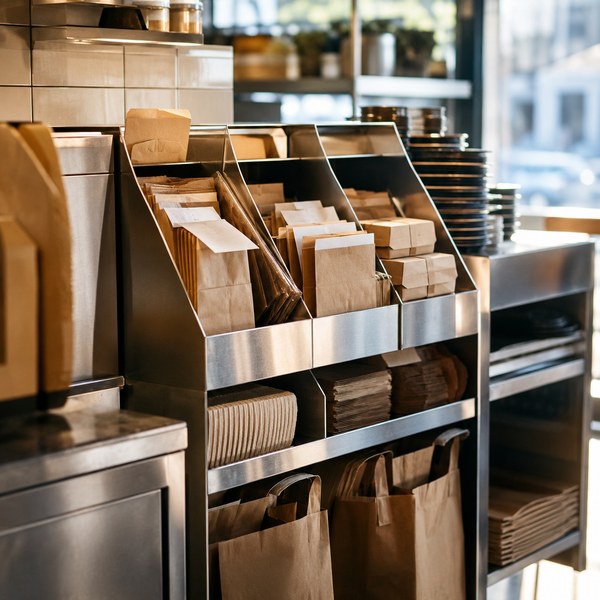
Consider the packout station — the choke point where kiosk, drive-thru, counter, and delivery orders all converge. A KDS can sequence tickets perfectly, but if your crew is hunting for the right container while an expo screen counts up, the seconds you bought upstream evaporate. Our foodservice customers consistently tell us the same thing: the moment digital ordering volume grows, packaging organization becomes an operations problem, not a supplies problem. That means dedicated, clearly-zoned storage for each container type, insulated Delivery Tek bags staged where couriers actually stand, and stackable trays that let one runner carry a full order without a second trip.
The same physical-digital pairing shows up across the line. Digital order volume rises → you need faster, more standardized packout → tamper-evident containers and labeled bags become your last accuracy checkpoint. Kiosks redeploy a cashier to the dining room → that team member needs serviceware and cleaning tools staged for the new role. A KDS shortens ticket times → your holding equipment and restaurant equipment have to keep pace, because food that finishes faster but sits longer defeats the purpose. Technology sets the tempo; the physical kitchen has to keep the beat. We break down the equipment side of this in the role of technology in modern kitchen operations.
One more angle operators underweight: efficiency tech is sustainability tech. Systems that cut remakes cut food waste directly — a 25%-wrong-item error rate at the drive-thru is a food-cost line item, not just a guest-experience problem. We explore that connection in the environmental impact of high-tech kitchen solutions, and how digital menu tools support newer menu categories in leveraging technology to enhance plant-based menu offerings.
Frequently Asked Questions
What is implementing technology?
Implementing technology is the structured process of selecting, installing, training staff on, and measuring a new digital system so it delivers a specific operational result. In a QSR, that means moving from purchase to full adoption — pilot, training, launch, and measurement against a target like ticket time or order accuracy — rather than simply plugging in new hardware.
What are the 4 types of technology in a QSR?
The four types of QSR technology are: (1) front-of-house — POS terminals, self-order kiosks, and digital menu boards; (2) back-of-house — kitchen display systems, cooking automation, and holding equipment controls; (3) off-premises — online ordering, delivery integrations, and drive-thru systems; and (4) back-office — inventory, labor scheduling, and analytics software. A streamlined operation connects all four so an order flows from entry to handoff without manual re-entry.
What are the 5 steps of the implementation process?
The five steps of technology implementation are: (1) diagnose your bottleneck with real operational data; (2) set one measurable goal per system; (3) pilot in a single location or daypart; (4) train every crew member hands-on before launch; and (5) measure results for 30 days, tune the workflow, and only then expand. Skipping the pilot or the training step is the most common reason restaurant technology fails.
What are the 4 C's of technology integration?
The 4 C's of technology integration are connection, communication, collaboration, and creation — a framework borrowed from education that maps cleanly onto QSR operations. Connection means systems that talk to each other (kiosk to POS to KDS); communication means order data reaching the right station instantly; collaboration means front- and back-of-house working from one queue; and creation means using the data those systems generate to build better menus, schedules, and layouts.
What are the 7 core technologies of a modern QSR?
The seven core technologies of a modern quick-service restaurant are: a cloud POS system, self-order kiosks, a kitchen display system, drive-thru timing and audio technology, online ordering with delivery integration, inventory and labor management software, and a customer loyalty/data platform. Most operators should implement them roughly in that order — each layer feeds cleaner data to the next.
Conclusion: Build the Stack One Proven System at a Time
Implementing technology for streamlined QSR operations comes down to a simple discipline: pick the bottleneck, deploy one system against a measurable goal, train the crew, and let the results fund the next upgrade. The operators winning in 2026 aren't the ones with the most screens — they're the ones whose kiosks, KDS, and drive-thru tools all feed one accurate, fast pipeline from order to handoff, backed by a physical line designed to keep up.
When you're ready to match your digital stack with the physical side of speed — packout, delivery, and holding — browse our restaurant equipment collection or explore Delivery Tek insulated delivery gear built for high-volume digital ordering.