Restaurant Brand Building Through Exceptional Delivery Experiences
Restaurant brand building is the process of shaping how guests recognize and remember your restaurant at every touchpoint, including delivery. Branded packaging, tamper-evident seals, and a consistent unboxing experience turn off-premise orders into marketing. For operators, the delivery handoff is often the only physical brand experience a customer ever receives.
A guest who orders delivery never sees your dining room, never meets your host, and never hears the hum of your open kitchen. Their entire impression of your restaurant arrives in a bag. That is why restaurant brand building now runs straight through the delivery experience: nearly 75% of all restaurant traffic happens off-premises, according to the National Restaurant Association's 2025 Off-Premises Restaurant Trends report. For most operators, the takeout bag is no longer an afterthought — it is the storefront, the table setting, and the goodbye handshake rolled into one. This guide breaks down how to turn every delivery order into a brand-building moment, from packaging and tamper-evident seals to temperature control and the unboxing itself.

TL;DR — Restaurant Brand Building Through Delivery
- The delivery handoff is a brand touchpoint. With almost 3 out of 4 restaurant orders now taken to go, packaging does the job your dining room used to do.
- Branded packaging is measurable marketing. In the National Restaurant Association's 2025 data, over half of consumers say they would pay more for premium packaging that protects food quality in transit.
- Trust is the baseline. In a US Foods survey, 28% of delivery drivers admitted to taking food from orders — and 85% of customers said they want tamper-evident packaging.
- Consistency beats flash. A repeatable packing routine — same containers, same seals, same insert, same bag — builds recognition faster than any one-off promotion.
| Delivery Touchpoint | What It Signals | Brand-Building Move |
|---|---|---|
| Exterior bag | First impression; your "storefront" at the door | Branded or custom-printed bag with a clean, legible logo |
| Tamper-evident seal | Safety, professionalism, trust | Custom tamper-evident labels on every order, every time |
| Food containers | Food quality and care | Leak-resistant, vented, presentation-grade containers |
| Temperature on arrival | Kitchen standards | Insulated delivery bags; separate hot and cold items |
| Unboxing moment | Hospitality without a host | Branded insert, handwritten note, or QR code to reorder |
What Is Restaurant Brand Building — and Why Is Delivery a Brand Touchpoint?
Restaurant brand building is the deliberate work of making your restaurant recognizable, trustworthy, and memorable at every point where a guest interacts with you — your menu, your signage, your staff, and increasingly, your delivery packaging. A brand is not a logo; it is the sum of expectations a guest carries about you. Every touchpoint either deposits into that account or withdraws from it.
Delivery is now the touchpoint with the highest traffic and the least operator control. The National Restaurant Association reports that off-premises dining accounts for a larger share of sales than in 2019 for 58% of limited-service and 41% of full-service operators, and that 94% of consumers say speed is critical to the off-premises experience (National Restaurant Association, April 2025; current as of July 2026). Once an order leaves your window, a third-party driver — not your best server — represents your brand for the final mile. The only part of that mile you control is what the food travels in.
That is why branding through delivery is less about clever design and more about engineered consistency. In 15+ years supplying 40,000+ foodservice operations, we've seen a clear pattern at Restaurantware: the restaurants that treat packaging as a spec — chosen once, documented, and executed on every order — build repeat delivery business, while the ones that grab whatever container is closest train customers to see them as interchangeable with every other listing on the app.
Why does packaging carry so much brand weight?
Packaging carries brand weight because it is the only physical artifact of the transaction. The NRA's 2025 off-premises research found that 90% of consumers say they would order a greater variety of menu items if the food maintained on-premises quality during delivery, and over half would pay more for premium packaging that supports that quality (source). Read that as a menu-engineering insight: better packaging literally expands what customers are willing to order from you. Our own deep dive on how packaging choices affect brand image covers the perception side in detail — from material choices to color psychology.
How Do You Build a Restaurant Brand Through Delivery? The 5-Rung Delivery Brand Ladder
Building a brand through delivery follows five rungs, in order: protect, seal, present, warm, and connect. Each rung is a failure point if skipped and a brand deposit if executed. Here is the framework we recommend to operators:
| Rung | Objective | Execution Standard |
|---|---|---|
| 1. Protect | Food arrives intact | Leak-resistant, crush-resistant containers matched to each menu item; vented lids for fried food |
| 2. Seal | Food arrives untouched | Tamper-evident label across every bag closure and container lid |
| 3. Present | Food looks intentional | Branded bag, consistent container line, tidy packing order (heavy items base, garnishes on top) |
| 4. Warm | Food arrives at temperature | Insulated bags for hot items; cold items packed separately; sauces cupped and lidded |
| 5. Connect | Customer remembers you, not the app | Insert card, QR code to direct ordering, loyalty offer, social handle |
Rung 1 — Protect: match the container to the menu item
Protection means the burger arrives assembled, the ramen arrives in the bowl, and the fries arrive crisp. No single container does all three. Map every delivery-menu item to a specific container spec: vented hinged boxes for fried items, gasketed round bowls for liquids, compartment trays for anything that must not touch. Custom takeout packaging that fits the food snugly reduces slide and spill — and every avoided spill is an avoided one-star review. Our guide to the 7 benefits of custom food packaging walks through the ROI case item by item.
Rung 2 — Seal: make tampering visible and trust automatic
Sealing is the highest-leverage, lowest-cost brand move in delivery. A US Foods survey of roughly 500 delivery drivers and 1,500 customers found that 28% of drivers admitted to taking food from an order, and 85% of customers said they want restaurants to use tamper-evident labels or packaging (NPR, July 2019; current as of July 2026). A sticker that tears on opening tells the guest, before they taste anything, that your restaurant thought about their safety. Printed with your logo, that same sticker becomes a brand asset. Restaurantware's tamper evident labels collection includes plain, printed, and custom options sized for bags, boxes, and cups.
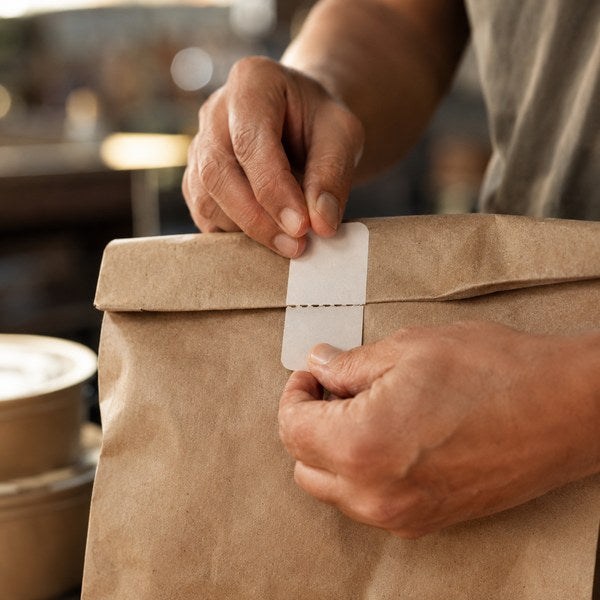
Rung 3 — Present: design the unboxing like a table setting
Presentation off-premises means the bag opens in a logical order: utensils and napkins on top, entrées level and centered, sauces upright, receipt visible. Branded packaging amplifies this — a matching container line in your colors reads as a set table, while a mix of foam clamshell, deli cup, and grocery bag reads as an afterthought. If your brand has an eco-positioning, carry it through: bamboo, PLA-lined paper, and palm-leaf lines communicate sustainability without a word of copy. Uniforms play the same role for in-person handoffs and curbside pickup; see our piece on leveraging branded uniforms to build team identity for extending visual consistency to your people.
Rung 4 — Warm: temperature is a brand promise
Temperature on arrival is the single most common delivery complaint, and it is solvable with equipment, not apologies. Hot food should leave the kitchen above 135°F and stay hot in transit inside an insulated carrier; cold items ride separately. Route timing matters too — food that waits 15 minutes on a pickup shelf needs insulation more than food handed off in 90 seconds. Restaurantware's insulated food delivery bags & catering bags range from single-order totes for in-house drivers to rigid catering carriers for volume drops.
Rung 5 — Connect: convert the app customer into your customer
Connection is where delivery branding pays compounding returns. A third-party marketplace owns the customer relationship unless you claim it. Slip a branded insert into every bag: a QR code to your direct-ordering page, a loyalty sign-up, a discount code for the next direct order, or simply a thank-you with your social handle. The NRA found over 60% of takeout and delivery users say loyalty membership affects where they order — the insert card is your cheapest enrollment channel. For a broader off-premise growth checklist, our take-out playbook collects strategies operators still use to elevate off-premise programs.
How Should Operators Choose Delivery Packaging? Buying Considerations That Protect the Brand
Choosing delivery packaging is a specification exercise, not a shopping trip. Evaluate every candidate product against five operator criteria:
- Menu fit: Does the container hold this specific dish through a 25-minute car ride? Test with your actual food — sauce migration and steam sog show up in transit, not on the pass.
- Stack and pack: Do containers stack securely in your delivery bags? Flat, interlocking lids cut packing time and spills.
- Line speed: Can staff close, seal, and label it in seconds during a rush? A beautiful box that takes 30 seconds to assemble fails on Friday night.
- Cost per order, not per unit: Premium packaging that prevents one remake or refund per hundred orders often nets positive. With more than half of consumers willing to pay extra for quality-preserving packaging, a modest menu-price adjustment can absorb the difference.
- Brand alignment: Material, color, and print should match your positioning — a fine-dining concept in generic foam undercuts every plate the kitchen sends out.
Order samples before committing to a case quantity, run them through a real delivery loop, and document the winning spec so every shift packs identically. Consistency is the entire point: brand building strategies fail most often not from bad design but from inconsistent execution.
Foodservice Application: Building the Delivery Experience with Restaurantware
Our foodservice customers consistently tell us the same thing: delivery branding sticks when the products are standardized and reorderable, so the experience never drifts between shifts or locations. These are the Restaurantware categories operators combine most often into a delivery brand kit:
- Delivery Tek — a dedicated line of delivery-first supplies, from shipping-grade containers to bag closures, built for the rigors of the final mile.
- Tamper-evident labels — security seals in stock sizes and custom prints; the fastest trust upgrade an operator can make, and the one customers explicitly ask for.
- Insulated food delivery bags and catering bags — thermal totes and rigid carriers that keep hot food above safe holding temperatures from pass to porch.
One pattern we've watched repeatedly in 15+ years of supplying operators: a ghost kitchen or multi-brand operation that unifies its packaging spec across concepts cuts SKU count, speeds packing, and still differentiates each brand with nothing more than a printed label and insert card. The container does the protecting; the label does the branding. That division of labor keeps costs predictable while the brand stays visible on every order.
Ready to spec your delivery kit? Browse the Delivery Tek collection to build a consistent, branded off-premise experience.
What Else Strengthens a Restaurant Brand Beyond the Bag?
Packaging is the highest-traffic touchpoint, but restaurant brand building extends past the handoff. Three adjacent moves compound the effect:
- Menu strategy that travels. Feature delivery-friendly items prominently and flag fragile dishes as dine-in only. A dish that arrives poorly damages the brand more than its sales justify. Watching what's working globally helps here — our guide to leveraging global dining trends to boost sales shows how operators translate trend data into menu decisions.
- Consistent voice everywhere. The tone on your insert card should match your app listing, your signage, and your social replies. Restaurant branding ideas only work when they repeat — recognition is a function of repetition.
- Close the feedback loop. Delivery reviews mention packaging constantly. Mine them monthly: every "arrived cold" or "spilled everywhere" is a spec problem you can fix with a product change, and every "loved the packaging" tells you the investment is landing.
Frequently Asked Questions
What do you mean by brand building?
Brand building means the ongoing process of creating awareness, recognition, and preference for a business through consistent experiences at every customer touchpoint. For a restaurant, brand building spans the menu, the dining room, the staff, and — for the majority of today's orders — the delivery packaging and handoff. Building a brand is cumulative: each consistent interaction strengthens recall, and each inconsistent one erodes it.
What are the four steps of brand building?
The four steps of brand building are: (1) define your brand identity — who you serve, what you stand for, and how you look and sound; (2) position and differentiate — articulate why a guest should choose you over the alternatives; (3) build awareness — put the identity in front of customers consistently across touchpoints, from signage to branded packaging; and (4) deepen loyalty — convert recognition into repeat behavior through quality, consistency, and rewards. In delivery, all four steps compress into the box a guest opens on their counter.
What is the 3-7-27 rule of branding?
The 3-7-27 rule is a marketing heuristic stating that it takes about 3 exposures for a person to notice a brand, 7 to remember it, and 27 to trust it enough to act consistently. The numbers are directional rather than scientific, but the lesson for operators is concrete: repetition builds brands. A regular delivery customer who sees your logo on the bag, the seal, the container, and the insert card racks up brand impressions four at a time with every order.
What are the 4 types of branding?
The four commonly cited types of branding are corporate branding (the company as a whole), product branding (a specific item or line), service branding (the experience of being served), and personal branding (an individual, such as a chef-owner). Most restaurants blend all four: the restaurant name is the corporate brand, signature dishes are product brands, hospitality — including the delivery experience — is the service brand, and a visible chef or founder is the personal brand.
What are the 5 C's of branding?
The 5 C's of branding are clarity, consistency, credibility, competitiveness, and connection. Clarity means a guest can state what you offer in one sentence; consistency means every touchpoint repeats it; credibility means you deliver on the promise every time; competitiveness means the promise is meaningfully different from the restaurant next door; and connection means guests feel something — which, off-premises, comes down to how opening the bag feels. Frameworks like these (popularized in branding books such as Donald Miller's Building a StoryBrand) are useful checklists, not laws — pick one and apply it relentlessly.
Conclusion: The Bag Is the Brand
Restaurant brand building used to end at the front door. Today, with almost three-quarters of restaurant traffic happening off-premises, it ends on a customer's kitchen counter — and the operators who win treat that moment with the same intent as a table-side greeting. Protect the food, seal it visibly, present it deliberately, keep it hot, and give the customer a reason to order direct next time. None of it requires a rebrand; it requires a spec, a supplier, and the discipline to repeat it on every order.
Restaurantware stocks everything on that spec sheet — start with tamper-evident labels and insulated delivery bags, and build a delivery experience your guests remember by name, not by app.
EDITOR / PUBLISHING NOTES (remove before publish):
- All stats verified at source July 2026: NRA 2025 Off-Premises Trends press release (75% off-premises traffic; 58%/41% share vs 2019; 94% speed; 90% variety / 50%+ premium packaging; 60%+ loyalty) and NPR coverage of the US Foods survey (28% drivers, 85% tamper-evident demand). Original US Foods survey URL is dead — cited NPR instead.
- Images: placeholder 1 = hero (branded packaging spread), placeholder 2 = product-in-use (tamper label on bag) — satisfies ≥1 product-in-use requirement.