Kitchen Efficiency: 5 Ways To Run Your Restaurant Kitchen More Efficiently
Kitchen efficiency is how effectively a commercial kitchen converts labor, space, and equipment into finished dishes with minimal wasted time and motion. The fastest improvement a restaurant operator can make is organizing every station with mise en place, so cooks reach ingredients and tools without leaving their positions during service.
Watch a great line during a Friday dinner rush and you'll notice something: nobody runs. Kitchen efficiency is not about cooks moving faster — it is about food moving through the kitchen with fewer steps, fewer questions, and fewer wasted motions. That distinction matters more than ever. According to the National Restaurant Association's 2026 State of the Restaurant Industry report, more than 9 in 10 operators cite food, labor, insurance, energy, and swipe fees as significant challenges, and 42% of operators reported their restaurant was not profitable last year (current as of July 2026). When margins are that tight, the kitchens that win are the ones that squeeze more output from the same square footage and the same payroll. In 15+ years supplying 40,000+ foodservice operations, we've seen that the difference between a chaotic kitchen and a calm one is almost never talent — it's systems. Here are the five that matter most.
TL;DR — The 5 Ways at a Glance
| Method | What It Fixes | First Step |
|---|---|---|
| 1. Standardize mise en place | Cooks leaving stations mid-service | Station diagrams + prep container standards |
| 2. Design the line around order flow | Crossed paths, collisions, long ticket times | Map dish journey from storage to pass |
| 3. Run a prep schedule with par levels | 86'd items, over-prep, food waste | Set pars from 2–4 weeks of sales data |
| 4. Define roles and cross-train | Bottlenecks when one person is out | Written station duties + rotation plan |
| 5. Put tools where the work happens | Walking, reaching, searching | Point-of-use storage audit per station |
What Is Kitchen Efficiency in a Restaurant?
Kitchen efficiency is the ratio of output (finished, correct dishes) to input (labor hours, space, energy, and ingredients) in a commercial kitchen. An efficient restaurant kitchen produces more covers per labor hour, shorter ticket times, and less waste — without asking staff to rush. Restaurant kitchen efficiency is usually measured through ticket times, covers per labor hour, food cost variance, and prep yield.
Commercial kitchen workflow breaks down into five stages: receiving, storage, prep, cooking, and service. Every efficiency gain comes from removing friction at one of those stages or at a handoff between them. The five methods below follow that exact chain — station readiness, layout, prep planning, labor structure, and equipment placement. Related disciplines like cutting food purchase costs, energy efficiency, and supply chain management compound these gains — we cover each in its own dedicated guide, so this article stays focused on workflow, stations, and labor.
5 Ways To Run Your Restaurant Kitchen More Efficiently
1. How Does Mise en Place Improve Kitchen Efficiency?
Mise en place — "everything in its place" — improves kitchen efficiency by eliminating the single largest time thief in any commercial kitchen: cooks leaving their stations during service. Every trip to the walk-in, every borrowed pair of tongs, every hunt for a sixth pan is 30–90 seconds of dead line time that multiplies across hundreds of tickets.
Standardizing mise en place means treating station setup as a system, not a personal habit:
- Station diagrams. Photograph or sketch the correct setup for each station — pan placement, container order, tool positions — and post it. New hires set up identically to veterans from day one.
- Container standards. Use uniform, clear food storage containers and steam table pans in fixed sizes per ingredient, so cooks can see fill levels at a glance and swap pans without re-learning the station.
- Labeling and rotation. Date-label everything and enforce FIFO (first in, first out). This is where kitchen efficiency and food safety overlap — the FDA estimates that 30–40% of the U.S. food supply is wasted (current as of July 2026), and disorganized stations that bury older product are a direct contributor at the restaurant level.
- Pre-service checks. A 5-minute station walkthrough before service catches missing backups while there's still time to fix them.
Our foodservice customers consistently tell us the same thing: when they standardized station containers and labeling across all locations, mid-service walk-in trips dropped dramatically and ticket times followed. Stock the system with dedicated food preparation supplies for each station rather than sharing tools between them — shared tools create wait time, and wait time is the enemy.
2. How Should You Design Stations for Commercial Kitchen Workflow?
Design each station around the order of work: ingredients enter one side, finished plates exit the other, and nothing forces a cook to turn around or cross another cook's path. The residential "kitchen work triangle" (sink, stove, refrigerator) scales up in a commercial kitchen to a straight-line or zone-based flow — receiving → storage → prep → line → pass — because multiple people work simultaneously.
Effective kitchen station setup follows four rules:
- One direction of travel. Food should move toward the pass, never backward. If a dish's journey doubles back on itself, the layout — not the cook — is costing you seconds on every plate.
- Zone by task, not by equipment. Group each station's refrigeration, work surface, and cooking equipment together. A sauté cook with an undercounter fridge at their hip plates faster than one who shares a lowboy three stations away.
- Right-size the aisles. Line aisles of roughly 36–48 inches let two cooks pass without collisions; wider than that wastes steps, tighter than that causes accidents.
- Protect the pass. The expo window is the kitchen's bottleneck by design — keep it clear of storage, prep spillover, and anything that isn't a finished plate.
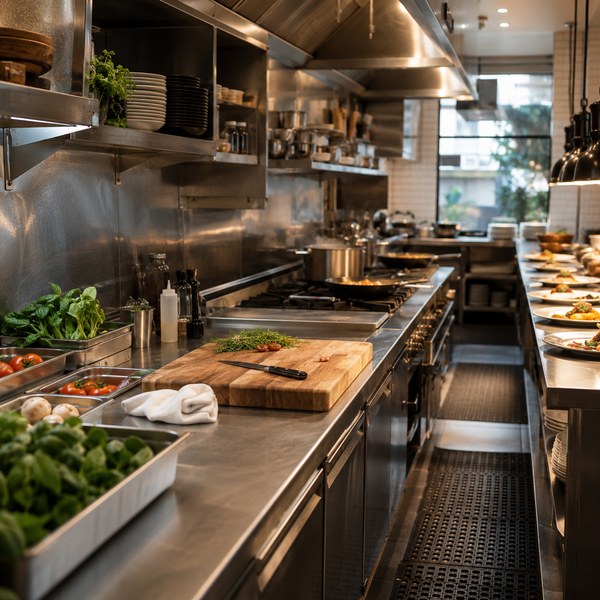
You don't need a renovation to fix flow. Mobile work tables, wire shelving, and equipment stands let you re-zone a kitchen over a single closed day. Our guide to choosing the right wire shelving kit covers how to spec shelving that turns dead wall space into point-of-use storage.
3. Why Does a Prep Schedule With Par Levels Matter?
A prep schedule with par levels matters because it converts prep from guesswork into a production plan — the kitchen preps exactly what service will consume, no more and no less. Under-prepping causes mid-service 86s and emergency prep that pulls cooks off the line; over-prepping creates waste that lands straight on your food cost.
Build the system in three steps:
- Set pars from data. Pull 2–4 weeks of sales by menu item, convert to ingredient quantities, and set a par (target on-hand amount) for every prepped item by day of week. Friday's pars are not Tuesday's pars.
- Write a daily prep sheet. List each item, its par, the current count, and the difference — that difference is the prep list. Assign every line to a name, with the longest lead-time items (stocks, braises, sauces) scheduled first.
- Count at close, adjust weekly. A 10-minute closing inventory of prepped items feeds tomorrow's sheet, and a weekly par review catches menu-mix drift before it becomes waste.
Organized storage makes counting fast: see our guides on how to organize a restaurant storeroom and produce storage for restaurants for shelving maps and rotation systems that turn a 30-minute count into 10. And because prep pars only work when deliveries arrive as ordered, pair this system with disciplined ordering — our guide to managing supply chains for consistent food quality covers the supplier side in depth.
4. How Do You Run a Restaurant Kitchen With Clear Roles and Cross-Training?
Ask any chef how to run a restaurant kitchen and the answer starts with people, not equipment. You run a restaurant kitchen efficiently by giving every person a written station, a clear chain of command, and at least one backup skill. The classic kitchen brigade survives in modern form because it answers the two questions that stall a busy line: "whose job is this?" and "who covers when they're out?"
Labor is the hardest input to add right now. The National Restaurant Association projects restaurant and foodservice employment will reach 15.8 million jobs in 2026, yet nearly three-quarters of operators who plan to hire expect difficulty finding experienced managers and chefs (current as of July 2026). When you can't reliably hire experience, you have to build it:
- Write station descriptions. Each station gets a one-page duty list: setup, service responsibilities, closing tasks, and quality standards. Our guide to understanding restaurant job titles & descriptions maps the full brigade structure if you're formalizing roles for the first time.
- Cross-train deliberately. Rotate each cook through a second station during slow shifts until every position has at least two qualified people. A kitchen where only one person can work sauté is one sick day away from a bad night.
- Run a 5-minute pre-shift. Counts on limited items, 86s, VIPs, and large parties — communicated once, to everyone, before the first ticket. It prevents the mid-service questions that interrupt the line.
- Standardize closing duties by station. When cleaning and breakdown are part of each station's written role, closes get faster and mornings start ready — our restaurant kitchen cleaning checklist breaks the full schedule down by daily, weekly, and monthly tasks.
5. Where Should Tools and Equipment Go for Kitchen Workflow Optimization?
Tools and equipment belong at the point of use — within arm's reach of the task they serve. Kitchen workflow optimization at the equipment level means auditing every station and asking one question: how many steps does a cook take to reach each item they use during service? The answer should be zero for anything touched more than once per hour.
Run this audit in an afternoon:
- Track the walking. Follow one cook for 30 minutes of service and mark every trip off-station. Each recurring trip is a candidate for point-of-use storage: a shelf, a rail, an undercounter drawer, or a dedicated backup container.
- Duplicate cheap, high-use tools. Tongs, spatulas, portion scoops, and squeeze bottles cost little; keeping a full set of kitchen utensils at every station costs far less than the labor minutes lost sharing them.
- Go vertical. Wall-mounted shelving, overshelves on work tables, and rail systems put the second tier of tools at eye level instead of in a drawer across the kitchen.
- Match equipment to volume. An undersized prep station forces batch-splitting; oversized equipment eats line space. When you do replace equipment, choosing energy-smart models compounds the savings — our energy efficiency guide for eco-friendly kitchens covers that decision in full.
How To Choose Efficiency-Focused Supplies and Equipment
Choose kitchen supplies for efficiency using four criteria, in this order:
- Standardization. Fewer container sizes and one labeling system beat a drawer of mismatched formats. Every standardized item removes a micro-decision from service.
- Visibility. Clear containers, open shelving, and labeled bins let staff verify stock at a glance instead of opening lids and digging.
- Durability under commercial use. NSF-listed smallwares and commercial-grade shelving survive the wash cycle and the drop; replacing broken tools mid-week is its own inefficiency.
- Mobility. Casters on work tables, racks, and equipment stands mean the layout can evolve with the menu instead of being fixed at buildout.
Budget note: efficiency upgrades are among the cheapest ROI in the building. A full station re-fit with containers, labels, and shelving typically costs less than one busy night's revenue — and unlike a discount from a vendor, the labor minutes it saves recur every single service. (For the purchasing side of the margin equation, see our guide to cutting food purchase costs.)
How Restaurantware Products Support Kitchen Efficiency
Restaurantware supplies 40,000+ foodservice operations, and the products that move the efficiency needle are rarely glamorous — they're the ones that keep stations self-sufficient through a full service:
- Work tables and shelving from our Kitchen Tek line. Stainless work tables with undershelves and overshelves create point-of-use storage at every station, and wire shelving kits re-zone storage areas without construction. Browse the Kitchen Tek collection for commercial-grade tables, stands, and racks.
- Food prep containers and organization. Uniform prep containers, portioning tools, and labeling supplies from our food preparation collection make mise en place standards enforceable rather than aspirational.
- Station smallwares. Duplicating tongs, turners, whisks, and portion scoops across stations is the fastest efficiency purchase in this guide — our kitchen utensils collection covers the full line-cook toolkit.
- Everything else that keeps a line moving. From cutting boards to storage bins, the broader kitchen supplies collection is organized by task so you can outfit a station, not just buy a product.
Frequently Asked Questions
What is kitchen efficiency?
Kitchen efficiency is how effectively a kitchen converts labor, space, equipment, and ingredients into finished dishes with minimal wasted time, motion, and food. In restaurants, it is measured through ticket times, covers per labor hour, prep yield, and food cost variance — and improved through station organization, layout, and prep planning.
What is the 60 30 10 rule for kitchens?
The 60-30-10 rule is an interior design guideline for color: 60% of a space in a dominant color, 30% in a secondary color, and 10% in an accent. It applies to kitchen aesthetics, not operations — commercial kitchen efficiency depends on workflow, station setup, and equipment placement rather than color balance.
How can I make my kitchen more efficient?
Make a kitchen more efficient by standardizing mise en place at every station, arranging stations so food flows one direction toward the pass, prepping to data-driven par levels, cross-training staff with written station roles, and storing tools at the point of use. Start with station organization — it delivers the fastest visible gain.
What is the 3x4 kitchen rule?
The 3x4 kitchen rule is a design guideline calling for at least three work areas of roughly four feet each, giving distinct zones for prep, cooking, and cleanup. Commercial kitchens apply the same principle at larger scale: each station gets dedicated work surface, equipment, and storage so tasks never compete for space.
What is the most efficient kitchen layout?
The most efficient commercial kitchen layout is the assembly-line (straight-line) layout, where food moves in one direction from storage through prep, cooking, and plating to the pass. Island and zone layouts suit larger menus, but for most restaurants, one-directional flow with no backtracking produces the shortest ticket times.
How do restaurants keep food warm efficiently?
Restaurants keep food warm efficiently with holding equipment matched to the item: steam tables and bain-maries for sauces and sides, heat lamps at the pass for plated dishes, and insulated holding cabinets for batch-cooked proteins. Efficient holding preserves food safety above 135°F while minimizing the energy and labor of re-firing dishes.
What is the kitchen triangle rule?
The kitchen triangle rule is a residential design principle placing the sink, stove, and refrigerator at three points of a triangle, with each leg between 4 and 9 feet, to minimize walking. Commercial kitchens replace the triangle with station-based zones, because multiple cooks work simultaneously and each station needs its own self-contained triangle of storage, surface, and heat.
Conclusion: Kitchen Efficiency Is a System, Not a Sprint
Kitchen efficiency comes from five compounding systems: standardized mise en place, one-directional station flow, par-driven prep, clear cross-trained roles, and point-of-use equipment. None requires a renovation, and each one pays for itself in labor minutes and saved food — the two costs squeezing operator margins hardest in 2026. Pick the method that targets your loudest pain point, implement it fully, and move to the next.
Ready to outfit your stations? Explore commercial-grade work tables, shelving, prep containers, and station tools in our kitchen supplies collection — everything ships fast, so your next efficiency upgrade can happen before next weekend's rush.
INBOUND LINK ACTIONS (for publishing team — remove before publish)
- Add contextual link TO this guide FROM: /blogs/food-prep-and-organization/how-to-organize-a-restaurant-storeroom (anchor: "kitchen efficiency"), /blogs/food-prep-and-organization/produce-storage-guide-for-restaurants (anchor: "run your kitchen more efficiently"), /collections/kitchen-supplies description (anchor: "kitchen efficiency tips"), and /blogs/restaurant-management/restaurant-job-titles-and-descriptions (anchor: "restaurant kitchen efficiency").
- Dropped brief anchor "how to set up a continental breakfast" — off-topic for this article per brief's internal-link relevance rule.