How To Choose The Right Wire Shelving For Your Restaurant
- Content type: Content refresh / substantive rewrite. Primary keyword: "how to choose wire shelving" (guide intent). Secondary: wire shelving, commercial wire shelving, restaurant shelving, wire shelving unit, NSF wire shelving.
- External links: set target="_blank" rel="nofollow noopener" on all external citations at publish.
- Images: 3 placeholders marked in-line — insert product/in-use photography in CMS with the suggested alt text.
[AI-OVERVIEW ANSWER BLOCK — place immediately after H1]
To choose wire shelving for a restaurant, match the unit to its environment: NSF-certified chrome wire shelving for dry storage, epoxy- or polymer-coated shelving for walk-in coolers and dishrooms, and up to 800 lb per-shelf capacity for heavy stock. Verify NSF certification, shelf depth, and post height before buying.
Buy the wrong shelving for your walk-in cooler and you will watch it corrode in eighteen months; buy the right unit once and it will outlast most of your kitchen equipment. Knowing how to choose wire shelving comes down to five decisions — finish, certification, capacity, size, and mobility — and this guide walks through each one the way an operator actually makes them. Wire shelving is the backbone of restaurant storage because it is strong, adjustable, air-permeable, and inexpensive relative to solid stainless steel. But "wire shelving" covers everything from a flimsy closet rack to an NSF-certified commercial wire shelving unit rated for 800 pounds per shelf, and the difference matters when a health inspector — or 300 pounds of #10 cans — shows up.
TL;DR — Choosing Restaurant Wire Shelving in 30 Seconds
- Dry storage: NSF-certified chrome wire shelving — lowest cost, highest strength-per-dollar.
- Walk-in coolers, freezers, dishrooms: epoxy- or polymer-coated wire shelving — chrome will rust in wet or cold-humid environments.
- Capacity: quality commercial shelves hold up to 800 lb each (evenly distributed); check the rating, not the look.
- Compliance: the FDA Food Code requires food stored at least 6 inches (15 cm) off the floor — shelving is not optional.
- Sizing: 18–24 in deep for most kitchens; 74–86 in posts; leave clearance for door swings and carts.
Quick Comparison: Wire Shelving Finishes
| Finish | Best Environment | Corrosion Resistance | Relative Cost | Watch Out For |
|---|---|---|---|---|
| Chrome-plated | Dry storage, offices, FOH display | Low — rusts in humidity | $ | Never use in walk-ins or dish areas |
| Epoxy-coated (green/black) | Walk-in coolers, freezers, dishrooms | High | $$ | Chips in coating expose steel — inspect yearly |
| Polymer / plastic-composite | Walk-ins, wash-down areas | Very high — many have removable washable mats | $$$ | Slightly lower per-shelf capacity on some lines |
| Stainless steel wire | Wet areas, high-acid or salt environments | Very high | $$$$ | Price — reserve for where it is truly needed |

What Is Commercial Wire Shelving?
Commercial wire shelving is a modular storage system built from welded steel-wire shelves that lock onto grooved vertical posts, letting you adjust shelf heights (typically in 1-inch increments) without tools. A standard wire shelving unit — often sold as a kit — includes four posts, four to six shelves, split sleeves that clamp the shelves in place, and leveling feet or casters. The open-wire design is what separates it from solid shelving: air, light, and water pass straight through, which improves cold-air circulation in walk-ins, reduces dust accumulation, and lets you see inventory at a glance.
Wire shelving is also called wire rack shelving, metro shelving (a genericized reference to the Metro brand, which invented the category), or wire utility shelving. In foodservice, the meaningful distinction is not the name but the certification and finish: an NSF wire shelving unit built for commercial kitchens is a different product from the light-duty closet shelving sold at home-improvement stores, even when they look similar in photos.
The demand side keeps growing: the National Restaurant Association projects total restaurant and foodservice sales to reach $1.55 trillion in 2026, with operators adding more than 100,000 jobs — and every one of those operations needs compliant, durable storage behind the line (figures current as of July 2026).
How Do You Choose the Right Wire Shelving for a Restaurant?
Choose restaurant wire shelving by working through five decisions in order: (1) match the finish to the environment, (2) verify NSF certification, (3) confirm weight capacity, (4) size the footprint and post height, and (5) decide between stationary and mobile. Get the first decision wrong and the other four cannot save you.
1. Match the Finish to the Environment (Chrome vs Epoxy vs Polymer)
The finish decision is the one operators most often get wrong. Chrome-plated wire shelving is the strongest value for dry environments — dry storage rooms, paper-goods storage, back offices, and front-of-house display. But chrome is a thin decorative plating, not a corrosion barrier. Put a chrome unit in a walk-in cooler and condensation will find every micro-gap in the plating; rust follows within a year or two.
Epoxy-coated wire shelving (usually green or black) wraps the steel wire in a baked-on polymer layer engineered for humid, cold, and wet environments — walk-in coolers, freezers, dishrooms, and prep areas near sinks. Many epoxy lines also carry an antimicrobial additive in the coating. Polymer-composite shelving goes a step further: plastic shelf mats over a coated frame, with mats that lift off and run through the dish machine. For the harshest duty — seafood storage, high-salt environments — stainless steel wire shelving is the endgame, at a matching price.
The rule of thumb we give customers: if the room ever sees moisture, do not buy chrome. The savings evaporate the first time you replace a rusted unit — and rusted shelving over food is a health-inspection finding, not just an eyesore.
2. Verify NSF Certification
NSF/ANSI 2 is the American National Standard covering food equipment, and it sets minimum food-protection and sanitation requirements for the materials, design, and construction of commercial kitchen equipment — explicitly including shelves, tables, counters, and sinks. NSF-certified wire shelving means the materials in contact with your food packaging will not corrode into it, the surfaces are cleanable, and the design avoids harborage points where soil and bacteria collect.
Why it matters practically: many local health departments require commercial kitchen equipment to be certified to an ANSI food-equipment standard, and inspectors look for the NSF mark. Buying uncertified residential shelving to save $40 can cost you a correction order later. Check for the NSF listing on the shelf label or the manufacturer's spec sheet — genuine certified products are searchable in NSF's public listing database.
3. Confirm Weight Capacity — Real Numbers, Not Marketing
Weight capacity is where commercial wire shelving earns its price difference. Top-tier commercial lines are rated up to 800 lb per shelf (evenly distributed) and up to 2,000 lb per stationary unit; light-duty residential wire shelving may be rated for 250–350 lb per shelf or less. Three details operators miss:
- "Evenly distributed" is doing heavy lifting in that rating. A shelf rated 800 lb distributed may handle far less as a concentrated point load. Center a stack of #10 can cases; don't pile them on one corner.
- Longer shelves hold less. Capacity ratings typically drop as shelf length increases, because the wire span deflects more. A 36-inch shelf and a 72-inch shelf from the same line do not carry the same load.
- Casters cut the unit rating. A mobile unit's capacity is limited by its casters — often to roughly half the stationary rating. If you're storing bulk flour, rice, or canned goods, keep the unit stationary or spec heavy-duty casters.
Budget your load honestly: a single case of six #10 cans weighs about 40 lb, so one shelf of canned goods can pass 400 lb quickly.
4. Size the Unit: Depth, Width, and Post Height
Wire shelving is sold in standard modular dimensions. Use this table to shortlist sizes before you measure your room — then measure your room anyway.
| Dimension | Common Options | How to Choose |
|---|---|---|
| Shelf depth | 14", 18", 21", 24" | 18" suits most storerooms and walk-ins; 24" for bulk storage and sheet-pan-sized items; 14" for tight aisles and FOH display |
| Shelf width (length) | 24"–72" (typically in 6"–12" steps) | Longer shelves = fewer posts per foot of storage, but lower per-shelf capacity; mix widths to fill the wall |
| Post height | 34", 54", 63", 74", 86" | 74" is the workhorse; 86" maximizes cube in high-ceiling storerooms (keep 18" clearance below sprinkler heads, per fire code) |
| Shelves per unit | 4–6 | Add a 5th/6th shelf for small-item density; keep 15"+ vertical clearance where bins and cases must slide out |
Two compliance-driven measurements belong in this step. First, the FDA Food Code (§3-305.11) requires food to be stored at least 6 inches (15 cm) above the floor — so your bottom shelf position is regulated, not a preference. Wire shelving kits with adjustable bottom shelves make this easy to hit. Second, leave working aisles: 30–36 inches between facing units lets staff move sheet pans and bus tubs without knocking stock off shelves, and wider if carts must pass.
5. Stationary or Mobile?
Stationary posts with leveling feet give you maximum capacity and stability — the default for dry storage and walk-ins. Casters transform a wire shelving unit into a mobile prep station, a catering staging cart, or a flexible FOH merchandiser, and they make deep-cleaning behind and beneath units dramatically faster. If you go mobile: spec at least two locking casters, confirm the reduced unit capacity, and check that doorways and ramps on the route are wider than your shelf plus knuckles.
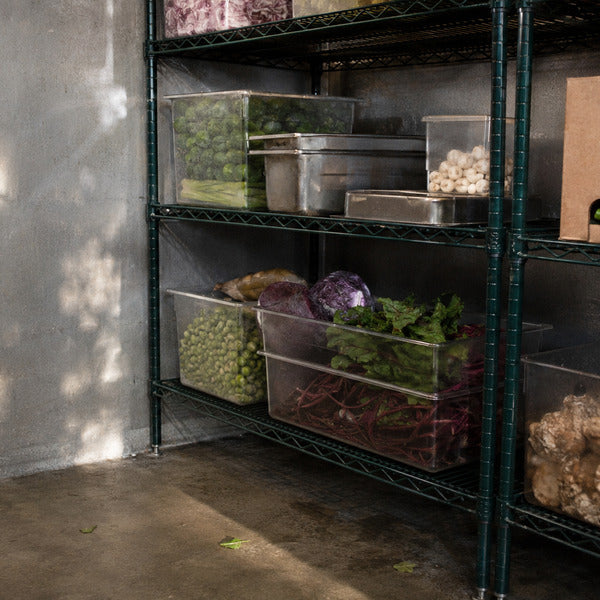
Ready to spec your storeroom? Browse NSF-listed wire shelving units and kits, plus wire shelving components — posts, casters, and add-on shelves — at Restaurantware.
Where Does Wire Shelving Work Best in a Restaurant?
Wire shelving works best in four restaurant zones: dry storage, walk-in coolers and freezers, dish and prep areas, and front-of-house display. Each zone rewards a different configuration.
Dry Storage and the Storeroom
This is chrome wire shelving's home turf. Run 74"–86" posts along the walls, 18"–24" deep, and organize by FIFO rotation — heaviest goods (cans, sacks, oil jugs) on lower shelves, light paper goods up top. The open-wire design keeps sight lines clear for faster inventory counts. If you are rebuilding your storeroom from scratch, our guide on how to organize a restaurant storeroom covers layout and labeling in depth.
Walk-In Coolers and Freezers
Epoxy or polymer only. The open wire is a genuine functional advantage here: cold air circulates through the shelves rather than pooling around solid surfaces, which keeps product temperatures more uniform. Keep shelves a few inches off the walls for airflow, and use the adjustability to fit crisper bins and produce lugs — pairing shelving choices with smart rotation habits from our produce storage guide for restaurants.
Dish Rooms and Prep Areas
Coated wire shelving above and beside warewashing zones lets rinsed items air-dry with full drainage — no puddling like solid shelves. For staging heavy bus tubs and bulk ingredient containers at floor level, pair shelving with dunnage racks, which are purpose-built for the heaviest low-level loads.
Front of House and Retail Display
Chrome wire shelving units double as merchandisers for grab-and-go items, retail shelf-stable products, or backbar storage. The industrial look reads intentional in fast-casual and market-style concepts — and the same modularity that reconfigures your storeroom reconfigures your seasonal display in an afternoon.
Which Wire Shelving Does Restaurantware Recommend?
In 15+ years supplying 40,000+ foodservice operations, we've seen one pattern repeat: operators under-buy shelving on the first order and pay for it twice — once in replacements and once in the labor of reorganizing mid-service. The fix is boring and reliable: buy NSF-certified units sized for the load you will have in year three, not week one.
Our foodservice customers consistently tell us the adjustability is what they end up valuing most. Menus change, suppliers change case sizes, and a shelving system you can re-pitch in one-inch increments absorbs those changes without a new purchase. That is why our wire shelving collection centers on NSF-listed chrome and epoxy-coated units in the standard commercial footprints (14"–24" deep, up to 86" posts), stocked alongside the components — extra shelves, posts, split sleeves, and casters — that let you extend a system instead of replacing it. For zones where wire is the wrong tool, our storage racks and broader restaurant storage and transport collections cover dunnage racks, pan racks, and bulk movers. Everything ships fast because a storeroom rebuild cannot wait three weeks — and if you run your kitchen lean, shelving is step one of the efficiency playbook we outline in five ways to run your kitchen more efficiently.

What Are the Disadvantages of Wire Shelving?
Wire shelving has four honest disadvantages: small items tip or fall through the wire gaps, chrome finishes corrode in wet environments, wire spans can dent or bow under concentrated point loads, and the industrial look does not suit every dining room. None are disqualifying, and all four have cheap fixes — shelf liners or mats solve the small-item problem, epoxy and polymer finishes solve corrosion, honest load planning solves deflection, and FOH placement is simply a design choice. We would rather you know the trade-offs before buying than discover them after; wire shelving remains the best value-per-pound storage system in foodservice for the majority of applications.
What Can You Use Instead of Wire Shelving?
The main alternatives to wire shelving are solid polymer shelving, solid stainless steel shelving, and dunnage racks — each better than wire in a specific niche:
- Solid polymer (plastic) shelving resists corrosion completely and often features removable, dishwasher-safe shelf mats — a strong walk-in choice when small loose items make open wire impractical.
- Solid stainless steel shelving is the premium option for wash-down zones, chemical storage, and anywhere spills must not drip to shelves below. It costs several times more than coated wire.
- Dunnage racks sit 8–12 inches high and carry the very heaviest bulk loads — flour sacks, oil cases, beverage stock — at floor level while keeping product FDA-compliant above the floor. Most storerooms should run both: dunnage low, wire shelving above.
- Wall-mounted shelving frees floor space over prep tables and dish stations where a floor unit will not fit.
Frequently Asked Questions
What are the disadvantages of using wire shelving?
The disadvantages of wire shelving are that small items can tip or slip through the gaps, chrome finishes rust in humid or wet environments, and concentrated heavy loads can bow the wire span. Shelf liners, epoxy or polymer coatings, and even load distribution address all three issues inexpensively.
What can you use instead of wire shelving?
Instead of wire shelving, restaurants use solid polymer shelving (corrosion-proof, washable mats), solid stainless steel shelving (premium wet-area option), dunnage racks (heavy bulk loads near floor level), or wall-mounted shelves. Most commercial kitchens combine wire shelving with dunnage racks rather than replacing wire entirely.
Is wire shelving cheaper than wood?
Wire shelving is generally cheaper than comparable finished wood shelving and far better suited to commercial kitchens: it is stronger per dollar, adjustable, and cleanable. Raw wood is also a poor fit for food storage areas because it is absorbent and hard to sanitize — a problem under health codes that require smooth, easily cleanable surfaces.
What is wire shelving called?
Wire shelving is also called wire rack shelving, metro shelving (after the Metro brand that popularized it), wire utility shelving, or chrome shelving. In foodservice catalogs it is usually listed as commercial wire shelving or NSF wire shelving, sold as complete units/kits or as individual shelves and posts.
Does Home Depot cut wire shelves for you?
Home-improvement stores generally do not cut welded commercial-style wire shelves; cutting is typically offered only for laminate or wood boards, and policies vary by store. Commercial wire shelving should not be cut at all — cutting voids the load rating and NSF listing. Buy the correct modular width instead; commercial shelves come in sizes from 24" to 72".
How do you build a wire shelving unit?
To build a wire shelving unit: (1) snap the split sleeves onto each post at your chosen groove heights, (2) lower the bottom shelf's corner collars over the sleeves on all four posts, (3) press each corner down until it seats with a tap of a rubber mallet, (4) repeat for the remaining shelves, and (5) level the feet or lock the casters. Assembly needs no tools beyond a mallet and takes about 15 minutes.
What is the best wire shelving for a pantry?
The best wire shelving for a pantry or dry-storage room is NSF-certified chrome wire shelving, 18–24 inches deep on 74-inch posts, with the bottom shelf set at least 6 inches above the floor to meet FDA Food Code storage requirements. Add shelf liners on one or two shelves for small, loose items.
How much weight can wire shelves hold?
Commercial-grade wire shelves hold up to 800 lb per shelf evenly distributed, with stationary units rated up to 2,000 lb total; light-duty residential wire shelves may hold only 250–350 lb per shelf. Capacity drops as shelf length increases and when units are mounted on casters, so always check the manufacturer's rating for your exact size and configuration.
Conclusion: Buy Once, Configure Forever
Choosing the right wire shelving for your restaurant comes down to a five-point checklist: match the finish to the environment (chrome dry, epoxy/polymer wet), verify NSF certification, confirm real weight capacity for your loads, size the depth and post height to the room, and decide stationary versus mobile before you order. Do that once and you get a storage system that reconfigures with every menu change instead of ending up in the dumpster. Explore NSF-listed wire shelving units and kits, add-on wire shelving components, and the full range of storage racks at Restaurantware — in stock and ready to ship to your kitchen.
Sources (verified live, July 2026): National Restaurant Association 2026 State of the Restaurant Industry press release (restaurant.org); FDA Food Code 2022 §3-305.11 (fda.gov); NSF/ANSI 2 Food Equipment standard overview (nsf.org); Metro wire shelving capacity specifications (metro.com).