Eco-Friendly Napkins: A Restaurant Operator's Buying Guide
Eco-friendly napkins are napkins made from recycled paper, bamboo, or other rapidly renewable fibers — or reusable cloth — that reduce landfill waste compared with virgin-pulp disposables. For restaurants, the most sustainable choices are 100% recycled or compostable paper napkins for high-volume service and laundered cloth napkins for full-service dining rooms.
Napkins are the most-handled disposable in your restaurant, and one of the easiest places to make a visible sustainability upgrade. Switching to eco friendly napkins costs less than almost any other green initiative an operator can take on — no equipment, no retraining, no menu changes — yet guests see the difference at every single table touch. The catch is that "eco-friendly" on a napkin case can mean recycled content, compostability, tree-free fiber, or unbleached processing, and those are not the same thing. This guide breaks down each option so you can choose the right napkin for your service style, waste stream, and budget.

TL;DR — Eco-Friendly Napkin Options at a Glance
- Recycled paper napkins divert post-consumer fiber from landfills and skip virgin tree pulp — the best default for most high-volume operations.
- Compostable napkins break down into soil in commercial composting; they only pay off if you have organics collection.
- Bamboo napkins use a grass that regrows in years, not decades — a premium tree-free option.
- Cloth napkins are the lowest-waste choice per use in full-service settings, but laundering adds water, energy, and cost.
- Napkin dispensers cut napkin consumption in counter-service settings — often the single biggest waste reduction available.
| Napkin Type | Material | End of Life | Best For | Relative Cost |
|---|---|---|---|---|
| Recycled paper napkins | Post-consumer recycled fiber | Compostable (if food-soiled and unbleached/uncoated); otherwise landfill | QSR, fast casual, catering, high volume | $ |
| Virgin paper napkins | New tree pulp (look for FSC certification) | Compostable in most programs; otherwise landfill | Operations prioritizing bright-white presentation | $ |
| Bamboo napkins | Bamboo fiber (rapidly renewable grass) | Compostable; naturally lower-chemical processing available | Eco-branded concepts, premium fast casual | $$ |
| Compostable-certified napkins | Paper or plant fiber, BPI-certified or ASTM-compliant | Commercial compost | Venues with organics collection or zero-waste goals | $$ |
| Cloth napkins | Cotton, linen, or blends; reused hundreds of times | Reuse, then rag recycling | Full-service dining, hotels, banquets | $$$ upfront, low per-use |
What Makes a Napkin Eco-Friendly?
An eco-friendly napkin is defined by three things: what it is made from, how that material was processed, and where it ends up after one use. A napkin can win on one dimension and lose on another — a bright-white "recycled" napkin bleached with chlorine compounds is better than virgin stock but worse than an unbleached kraft napkin. Here is how the four main categories compare.
Recycled Paper Napkins
Recycled napkins are made from recovered paper — office paper, cartons, and other post-consumer fiber — instead of freshly cut trees. This matters because tissue products are a recycling dead end: the U.S. EPA reports that tissue paper and towels (a category that includes table napkins) accounted for 3.8 million tons of municipal solid waste in 2018, and the agency identified no significant recycling of used tissue products (EPA, Nondurable Goods data, current as of August 2026). Once a napkin is used, it cannot be recycled — so the only way to put recycled fiber into the napkin lifecycle is to buy napkins already made from it. Look for a stated percentage of post-consumer recycled content (PCR) on the case; 100% recycled with high PCR is the gold standard. "Recycled paper napkins" with no percentage disclosed may contain mostly mill scraps, which manufacturers would have reused anyway.
Compostable Napkins
Compostable napkins are designed to break down into soil-safe organic matter in a composting environment. Most plain, uncoated paper napkins — recycled or virgin — are accepted by commercial composters, and food-soiled napkins are actually a good compost feedstock because the food residue that ruins paper recycling feeds the composting process. For verified performance, look for certification from the Biodegradable Products Institute (BPI), which tests products against ASTM composting standards in commercial-facility conditions. One honest caveat we give every customer: a compostable napkin sent to a landfill delivers almost none of its promised benefit. If you don't have organics collection, prioritize recycled content over compostability claims.
Biodegradable vs. Compostable — Not the Same Claim
"Biodegradable napkins" means the material will eventually break down; "compostable" means it breaks down within a defined timeframe under defined conditions and leaves no toxic residue. The Federal Trade Commission's Green Guides — the U.S. standard for environmental marketing claims since 1992, last revised in 2012 — require marketers to substantiate both claims, and unqualified "biodegradable" claims are a common enforcement target. As a buyer, treat "biodegradable" as marketing and "certified compostable" as a specification. We cover this distinction in depth in our guide to biodegradable vs. compostable materials.
Bamboo Napkins
Bamboo napkins are made from bamboo fiber — technically a grass, and one of the fastest-growing plants on earth. Where a pulp tree takes decades to mature, bamboo regenerates from its own root system in a few growing seasons without replanting, which is why it anchors so many tree-free paper lines. Bamboo napkins tend to be soft, naturally strong, and compostable, and their distinctive look signals sustainability to guests without a word of copy. They typically price above standard recycled stock, which makes them a fit for eco-branded concepts where the napkin is part of the story. (Bamboo's advantages extend well beyond napkins — see our post on the benefits of bamboo tableware.)
Virgin Paper — When You Choose It, Choose Certified
Some operators need the brightness, softness, or wet strength that premium virgin-fiber dinner napkins deliver. If that's your standard, the responsible version is fiber certified by the Forest Stewardship Council (FSC), which verifies that pulp comes from responsibly managed forests. FSC-certified virgin napkins are not as low-impact as 100% recycled, but they are a meaningful step above uncertified stock.
Are Paper or Cloth Napkins More Sustainable for a Restaurant?
Cloth napkins are more sustainable per use in full-service restaurants where they replace hundreds of disposables over their lifespan; paper napkins — ideally recycled or compostable — are the practical choice for counter service, takeout, and high-volume settings where cloth is unworkable. The cloth napkins vs paper napkins question isn't a single answer; it's a service-model decision.
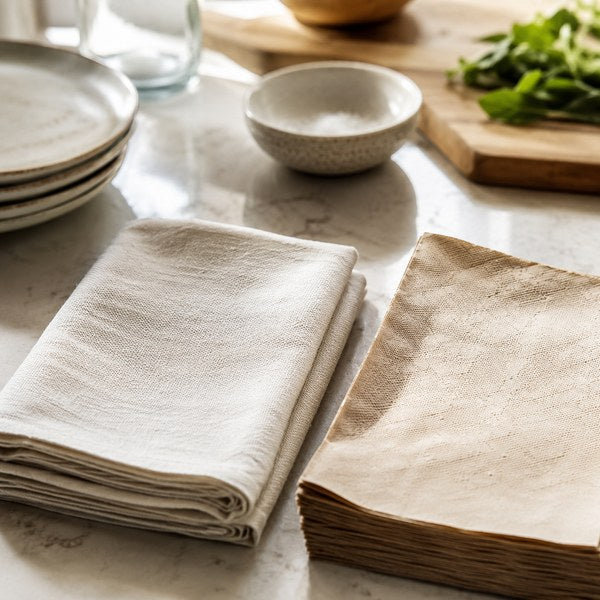
Here's how the trade-off actually works in an operation:
- Cloth wins on waste. A cotton napkin reused 100+ times generates a fraction of the landfill volume of 100 paper napkins. In a dining room already running linen service for tablecloths, adding napkins to the laundry cycle is nearly free from a logistics standpoint.
- Laundering is cloth's hidden footprint. Every wash cycle consumes water, energy, and detergent — and commercial linen service adds delivery truck miles. Cloth pays off environmentally when napkins survive many cycles; high loss and low reuse counts erode the advantage.
- Paper wins on food safety simplicity and speed. No inventory of soiled linens, no laundry contracts, no par-level shortages on a busy Saturday. For QSR and fast casual, paper is the only realistic option — so the sustainability lever is which paper you buy and how much of it guests take.
- Hybrid is the most common real-world answer. Many of our full-service customers run cloth in the dining room and recycled dispenser napkins at the bar, patio, and takeout station.
In 15+ years supplying more than 40,000 foodservice operations, the pattern we've seen is consistent: operators who switch dining rooms to cloth rarely go back, and operators who can't use cloth get their biggest sustainability gain not from the napkin itself but from dispensers that control how many napkins each guest takes. A loose stack on the counter disappears twice as fast as the same napkins in a one-at-a-time dispenser.
How Are Sustainable Napkins Categorized When You're Buying?
Supplier catalogs categorize napkins by fiber source, ply, fold, and certification — and each affects both footprint and cost per case. Decoding the spec sheet is how you avoid paying for green claims that don't hold up:
- Fiber source: 100% recycled (check the post-consumer percentage), FSC-certified virgin, bamboo/tree-free, or blends. This is the single biggest sustainability variable.
- Bleaching: Unbleached (natural kraft/brown) napkins skip the bleaching stage entirely. If you need white, "processed chlorine free" (PCF) or "totally chlorine free" (TCF) avoids chlorine-compound bleaching.
- Ply and basis weight: A well-made 1-ply dispenser napkin that guests use singly often beats a plush 3-ply that guests grab in stacks. Right-size the ply to the menu — barbecue needs more napkin than espresso service.
- Fold and format: Interfold dispenser napkins enforce one-at-a-time dispensing; flat-pack luncheon and dinner napkins suit table settings and catering rolls.
- Certifications to trust: BPI (compostability), FSC (fiber sourcing), and disclosed PCR percentages. Under the FTC Green Guides, vague unqualified claims like "green" or "earth-friendly" carry no defined meaning — certifications and numbers do.
How to Choose Eco-Friendly Napkins for Your Operation
Choose eco friendly napkins by matching material to your waste stream, format to your service style, and case cost to your actual per-guest usage. Work through these five questions:
- Where do your napkins end up? If you have commercial composting, certified compostable napkins (and unbleached recycled paper) turn a waste line into a diversion line. If everything goes to landfill, prioritize maximum recycled content instead.
- What's your service model? Full-service → cloth or premium recycled dinner napkins. Counter service → recycled dispenser napkins in portion-control dispensers. Takeout → compostable napkins that match your compostable packaging story.
- What's your real cost per guest? Don't compare cost per case — compare cost per guest served. A cheaper case that guests grab five-at-a-time costs more per cover than a pricier interfold napkin dispensed singly. When we've helped counter-service customers move from countertop stacks to dispensers, consumption drops are frequently dramatic enough to fund the upgrade to recycled stock outright.
- Does presentation carry brand weight? Natural kraft napkins visibly communicate sustainability; embossed white linen-feel napkins communicate premium. Both exist in recycled versions — you don't have to trade image for impact.
- Do the claims check out? Ask suppliers for the PCR percentage, the certification body, and the bleaching process. A legitimate eco friendly paper napkins program can answer all three in one email.
Buying Eco-Friendly Paper Napkins in Bulk
Buying eco friendly paper napkins bulk by the case or pallet is where the economics turn in your favor. Recycled and kraft napkins purchased in bulk case counts routinely land at or below the per-unit price of brand-name virgin napkins bought in smaller packs, because you're paying for fiber and freight, not retail packaging. Three bulk-buying rules from our warehouse floor: first, standardize on one or two napkin SKUs across the operation so volume concentrates into better case pricing. Second, confirm storage — napkins are bulky but light, and a pallet buy only saves money if it isn't crowding out food storage. Third, re-check your usage rate after installing dispensers, not before; ordering to pre-dispenser consumption is the most common over-buy we see, and right-sizing that first reorder is itself a waste reduction.
The customer pressure behind this decision is real and measurable. In the National Restaurant Association's State of the Restaurant Industry research, sustainable, reusable, and recyclable packaging ranked #1 among the top ten food and menu trends, and 70% of millennials and 72% of Gen Z adults said they'd pay extra for upgraded to-go packaging (current as of August 2026). Guests notice the disposables that touch their hands — and napkins touch every hand in the house.
Putting It to Work: Sustainable Napkin Setups for Real Foodservice
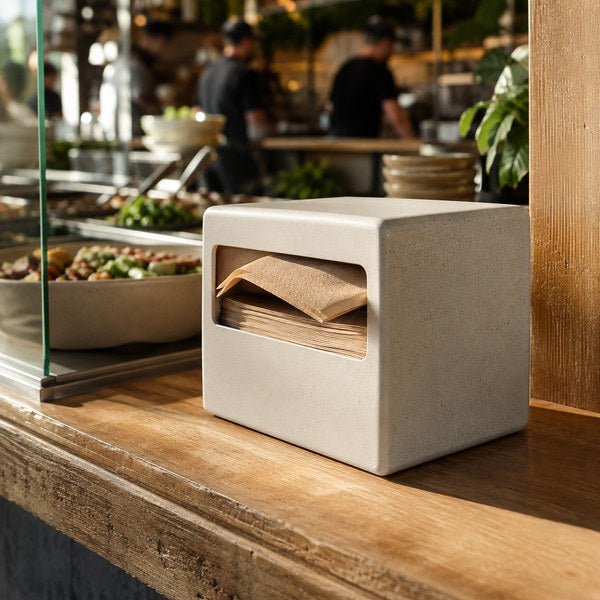
Here's how we see sustainable napkins for restaurants deployed across the operations we supply, matched to Restaurantware product categories:
- Fast casual & QSR: Recycled or kraft interfold napkins from our dispenser napkins collection, loaded into counter or tabletop napkin dispensers. This combination attacks both sides of the equation — greener fiber and lower consumption.
- Full-service dining: Reusable cloth napkins in the dining room, with recycled cocktail napkins at the bar. Our foodservice customers consistently tell us cloth upgrades perceived quality at the same time it cuts waste hauling volume.
- Catering, events & takeout: Kraft and colored options from our paper napkins collection, chosen to match compostable plates and takeout boxes so the whole place setting can go into one organics bin. If you're building that full setup, start with our eco-friendly packaging guide.
- Coffee shops & bakeries: Small-format recycled luncheon napkins, single-dispensed. Pastry service rarely needs a dinner napkin — right-sizing is its own sustainability win.
Ready to switch? Shop eco-friendly paper napkins — recycled, kraft, and compostable options in bulk case counts, in stock and ready to ship.
Frequently Asked Questions
What is a sustainable alternative to napkins?
The most sustainable alternative to disposable napkins is reusable cloth napkins, which replace hundreds of single-use napkins over their lifespan. Where cloth isn't practical, 100% recycled or certified compostable napkins dispensed one at a time from a napkin dispenser cut both fiber impact and total consumption.
Are napkins environmentally friendly?
Conventional virgin-pulp napkins are not especially environmentally friendly: they're used once, cannot be recycled after use, and mostly end up in landfills — the EPA counted 3.8 million tons of tissue paper and towels (including napkins) in U.S. municipal waste in 2018 with no significant recycling. Napkins become environmentally friendly when they're made from recycled or rapidly renewable fiber, composted after use, or replaced with reusable cloth.
Why don't the Japanese use napkins?
Japanese restaurants traditionally offer an oshibori — a rolled wet towel, hot or cold — instead of a paper napkin, and diners are expected to keep their hands and face tidy without wiping at the table throughout the meal. The oshibori is laundered and reused, making it functionally similar to Western cloth napkin service and a naturally low-waste custom.
What is the most environmentally friendly paper?
The most environmentally friendly paper is 100% recycled paper with high post-consumer content, processed without chlorine bleaching. For napkins specifically, unbleached 100% recycled kraft stock has the lightest footprint; tree-free fibers like bamboo are a strong second because they regrow rapidly without deforestation.
Are compostable napkins worth it without a composting program?
Generally no. A compostable napkin in a landfill delivers little of its intended benefit, so operators without organics collection get more real-world impact from 100% recycled napkins plus dispensers that reduce how many napkins each guest takes. Compostable certification becomes worth the premium the day you add commercial composting.
The Bottom Line
Eco friendly napkins are one of the fastest, cheapest sustainability wins in foodservice: pick recycled or compostable paper matched to your waste stream, use cloth where your service style supports it, and control consumption with dispensers. Verify claims through BPI, FSC, and disclosed recycled-content percentages rather than front-of-case buzzwords. After a decade and a half helping 40,000+ operations make exactly this switch, we can tell you the operators who succeed treat the napkin as a system — fiber, format, and dispensing together — not a line-item swap.
Browse our full paper napkins collection — including recycled, kraft, and compostable options — or explore cloth napkins for the dining room. In stock, ships today.