Difference Between Biodegradable And Compostable
Biodegradable means a material can break down naturally over time, with no set timeframe or conditions. Compostable means it breaks down into non-toxic organic matter within a defined period under composting conditions, verified by standards like ASTM D6400 or EN 13432 and certified by BPI. All compostable items are biodegradable — the reverse isn't true.
Walk any foodservice trade show floor and you will see "biodegradable" and "compostable" printed on packaging as if they were interchangeable. They are not — and the difference between biodegradable and compostable determines whether your takeout containers become soil or become a contamination fee from your composter. In 15+ years supplying 40,000+ foodservice operations, we've seen operators pay premium prices for "biodegradable" products that no composting facility would ever accept. This guide defines both terms precisely, names the certifications that actually prove compostability, and shows you how to buy with confidence.
TL;DR — Biodegradable vs. Compostable at a Glance
- Biodegradable is an unregulated umbrella term: the material will break down eventually, but no timeframe, conditions, or end-product quality is guaranteed.
- Compostable is a tested, certifiable claim: the item must disintegrate and biodegrade within a defined window under composting conditions and leave no toxic residue, per ASTM D6400, ASTM D6868, or EN 13432.
- Certification is the proof. Look for the BPI Certification Mark (commercial composting, North America) or TÜV Austria's OK compost marks (including OK compost HOME for backyard composting).
- For operators: "compostable" only delivers value if a composting pathway exists. Check local facility acceptance before you switch.
| Attribute | Biodegradable | Compostable |
|---|---|---|
| Definition | Breaks down naturally via microorganisms — eventually | Breaks down into non-toxic organic matter under composting conditions |
| Timeframe | Undefined — months to centuries | Defined — roughly 90–180 days in commercial composting (per ASTM/EN test conditions) |
| Conditions required | Unspecified | Controlled heat, moisture, oxygen, and microbial activity |
| End product | Unspecified; may leave residues or fragments | Compost: water, CO₂, biomass — no toxic residue (ecotoxicity tested) |
| Governing standards | None specific (FTC Green Guides restrict marketing claims) | ASTM D6400, ASTM D6868 (US); EN 13432 (EU) |
| Third-party certification | None widely recognized | BPI (North America), TÜV Austria OK compost / OK compost HOME |
| Relationship | All compostable items are biodegradable | Not all biodegradable items are compostable |
What Is the Difference Between Biodegradable and Compostable?
The difference between biodegradable and compostable is specificity: biodegradable describes what a material can do given enough time, while compostable describes what a material will do under defined conditions, within a defined timeframe, with a verified non-toxic result. Compostable is the stricter, testable subset of biodegradable.
What Does Biodegradable Mean?
Biodegradable means a material can be broken down by microorganisms — bacteria and fungi — into water, carbon dioxide, and biomass. The Ellen MacArthur Foundation, whose framing is widely cited across the packaging industry, defines biodegradable materials as those that break down "over an unspecified length of time and in undefined conditions." That unspecified part is the problem. A pine cone is biodegradable. So, technically, is a "biodegradable" plastic fork that takes decades to fragment in a landfill — where the anaerobic (oxygen-free) environment slows decomposition dramatically and can generate methane in the process.
Because the term is so elastic, the U.S. Federal Trade Commission's Green Guides restrict how marketers may use it. Under the Green Guides (first issued in 1992, most recently revised in 2012), an unqualified "degradable" or "biodegradable" claim is only appropriate if the entire product will completely break down and return to nature within a reasonably short period after customary disposal — and customary disposal for most packaging is a landfill, where that rarely happens. The FTC has pursued enforcement actions against companies making unsubstantiated biodegradability claims.
What Does Compostable Mean?
Compostable means a product is designed and verified to break down into non-toxic organic matter — compost — under composting conditions within a defined period. In practice, that verification means passing a standardized test protocol covering three things:
- Disintegration: the item must physically break apart (no more than 10% of original dry weight remaining on a 2mm screen after roughly 12 weeks under ASTM/EN test conditions).
- Biodegradation: at least 90% of the organic carbon must convert to CO₂ within about 180 days under controlled composting conditions.
- Ecotoxicity and heavy metals: the finished compost must support plant growth and stay under strict heavy-metal limits — the end product must be safe soil amendment, not just "gone."
That third requirement is what makes compostable a genuinely different claim from biodegradable. A compostable product is not simply one that disappears; it is one that becomes something useful and demonstrably non-toxic.
Why the Distinction Matters for Foodservice Operators
For a restaurant, café, or caterer, the difference between compostable and biodegradable is operational, not academic. Food is the single most common material sent to U.S. landfills, comprising 24.1% of municipal solid waste, according to the U.S. EPA — and EPA data show that of the 66.2 million tons of wasted food generated by the retail, foodservice, and residential sectors in 2019, only about 5% was composted (figures current as of July 2026). Certified compostable packaging lets you divert food-soiled containers and the food scraps stuck to them into one organics stream — something recycling can't do, because grease-contaminated packaging is a recycling contaminant. Uncertified "biodegradable" packaging, by contrast, is a contaminant in every stream: composters reject it, recyclers reject it, and it defaults to landfill.
Which Certifications Prove a Product Is Compostable?
Certifications prove compostability; marketing language does not. Four names cover nearly everything you will encounter on foodservice packaging in North America: ASTM D6400, ASTM D6868, EN 13432, and the BPI Certification Mark (plus TÜV Austria's marks for home compostability).
ASTM D6400 — Compostable Plastics
ASTM D6400 is the U.S. standard specification for plastics designed to be aerobically composted in municipal or industrial facilities. It covers items made wholly of plastic — CPLA cutlery, PLA cold cups, compostable can liners and compostable biodegradable bags — and sets the disintegration, biodegradation, and ecotoxicity requirements described above.
ASTM D6868 — Coated Paper and Fiber Products
ASTM D6868 covers end items that combine plastics or polymer coatings with paper and other substrates — think PLA-lined hot cups, coated paper food trays, and laminated fiber containers. If a paper product has any plastic coating or additive, D6868 is the standard that applies, not D6400.
EN 13432 — The European Benchmark
EN 13432 is the European standard for packaging recoverable through composting and biodegradation. Its requirements closely parallel the ASTM standards — 90% disintegration within 12 weeks, 90% biodegradation within 6 months, plus heavy-metal and ecotoxicity limits. If you source packaging internationally, EN 13432 certification is the European equivalent signal.
BPI Certification — The North American Mark to Look For
The Biodegradable Products Institute (BPI) is the leading third-party certifier of compostable products in North America. BPI certification verifies that a product meets ASTM D6400 or D6868, meets limits for total fluorine (a screen for intentionally added PFAS "forever chemicals"), and is connected to the food-scrap and yard-trim waste streams composters actually want. BPI's searchable database currently lists over 50,000 certified items, from compostable bags and foodservice items to resins and packaging materials (count current as of July 2026). When in doubt, look the product up: every legitimately certified item appears in that catalog, down to the item number.
TÜV Austria OK compost — Including Home Compostability
TÜV Austria's OK compost INDUSTRIAL mark certifies to EN 13432 for commercial facilities, and its OK compost HOME mark certifies products that break down at the lower, less consistent temperatures of a backyard compost pile. Home compostability is a meaningfully harder test — most certified-compostable foodservice packaging is industrially compostable only. Our guide to what is home compostable packaging? covers that distinction in depth.
Where Do Biodegradable and Compostable Items Actually End Up?
Disposal pathway — not label language — decides the real-world outcome. A certified compostable clamshell in a landfill behaves much like any other item in a landfill: entombed, slow to degrade, generating no compost. The label only pays off when the item reaches a composting facility.
Here is the honest infrastructure picture. BioCycle's nationwide survey of full-scale food waste composting infrastructure identified roughly 200 full-scale food waste composting facilities in the U.S. — under 4% of the more than 4,700 composting facilities operating nationwide, most of which accept yard trimmings only. The encouraging trend: of those 200 food waste composters, 71% now accept compostable food-contact packaging, up from 58% in BioCycle's 2018 survey, and acceptance has continued climbing since (figures current as of July 2026).
Practical takeaways for operators:
- Call before you commit. Ask your hauler or local composter whether they accept BPI-certified food-contact packaging — and get their accepted-items list in writing.
- No composter nearby? Certified compostable packaging still eliminates PFAS-added materials and conventional plastic from your waste stream, but weigh that against cost. Our cost analysis: compostable vs. recyclable packaging breaks down when each option wins.
- Set up front-of-house collection properly. Clearly labeled compost bins with signage showing exactly which items go in are the difference between a clean organics stream and a rejected load.
How to Choose: Buying Considerations for Operators
Choosing between biodegradable and compostable products comes down to five checks. Run every SKU through this list before it lands on your order sheet:
- Demand certification, not adjectives. "Eco-friendly," "green," "earth-safe," and unqualified "biodegradable" are marketing terms. BPI certification, ASTM D6400/D6868 compliance, or EN 13432/OK compost marks are verifiable claims. Check the BPI database if the mark isn't printed on the item.
- Match the product to your disposal reality. Commercial composting access → BPI-certified industrial compostables. No composting access → prioritize recyclable or reusable formats, or choose fiber products for their non-plastic material profile.
- Check heat performance. PLA cold cups deform above roughly 105°F; CPLA (crystallized PLA) cutlery and lids handle hot food. Buy the right polymer for the application, or you'll pay for it in customer complaints.
- Ask about PFAS. BPI has required certified products to meet total-fluorine limits since 2020, which screens out intentionally added PFAS grease-proofing agents. If a fiber container isn't BPI-certified, ask the supplier directly for fluorine test data.
- Price the whole system, not the unit. Compostable units typically cost more than conventional plastic, but organics hauling can cost less than trash hauling in many markets, and several states and cities now mandate organics diversion or restrict single-use plastics. Factor regulation into a 2–3 year view.
Ready to compare options side by side? Browse our full range of eco friendly supplies — every compostable product page lists its certification so you can verify before you buy.
Biodegradable vs. Compostable in a Working Kitchen
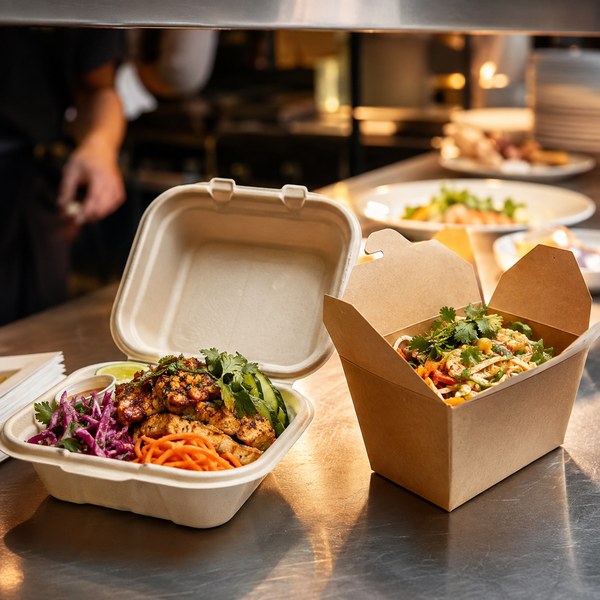
Here is how the difference between biodegradable and compostable plays out across the products a foodservice operation actually buys:
- To-go containers: Bagasse (sugarcane fiber) clamshells and PLA-lined paper boxes are the workhorses of certified-compostable takeout. Our eco friendly to go containers collection spans both, with certifications listed per item. Our foodservice customers consistently tell us that bagasse clamshells are the easiest first switch — they perform like foam for insulation, and guests immediately recognize them as compostable.
- Cutlery and cups: CPLA cutlery for hot applications, PLA for cold drinks. A "biodegradable" plastic fork with no certification is usually conventional plastic with an additive — composters treat it as contamination.
- Bags and liners: Compostable biodegradable bags for organics collection should carry BPI or OK compost certification; a certified compostable liner is what makes back-of-house food-scrap collection sanitary and hauler-approved. In 15+ years supplying 40,000+ foodservice operations, the single most common compliance mistake we've seen is a kitchen pairing certified compostable containers with uncertified "green" liners — and having the whole load rejected at the facility gate.
- Plates and bowls: Palm leaf and bagasse dinnerware in our eco friendly disposables collection offer certified-compostable options sturdy enough for catering service.
Planning a full program rather than a product-by-product swap? Follow our step-by-step guide on how to transition to compostable packaging in your restaurant.
Frequently Asked Questions
Does 100% biodegradable mean compostable?
No. "100% biodegradable" is an unregulated marketing claim with no defined timeframe or conditions, while compostable requires verified breakdown into non-toxic compost under composting conditions per ASTM D6400, ASTM D6868, or EN 13432. All compostable products are biodegradable, but a biodegradable label alone proves nothing about compostability.
What are three things you shouldn't compost?
Three common items to keep out of compost are conventional plastics (including uncertified "biodegradable" plastics), glass and metals, and pet waste. In a commercial organics program, the biggest offender is look-alike packaging: conventional plastic items that resemble certified compostable ones and contaminate the load.
What are 5 items that should not be composted?
Five items to exclude: (1) conventional or uncertified "biodegradable" plastics, (2) glass and metal, (3) produce stickers and twist ties, (4) glossy or foil-laminated paper without compostability certification, and (5) pet waste. Some municipal programs also exclude meat and dairy — commercial facilities generally accept them, but always confirm your local composter's accepted list.
Is a Ziploc bag compostable?
No. Standard zip-top bags are made of polyethylene, a conventional plastic that is neither compostable nor biodegradable in any practical sense. For organics collection, use certified compostable bags carrying the BPI Certification Mark or TÜV Austria OK compost logo instead.
Does compostable mean no microplastics?
Certified compostable means the material is tested to fully biodegrade — not merely fragment. ASTM D6400 and EN 13432 require roughly 90% conversion of organic carbon to CO₂ within about 180 days, plus disintegration and ecotoxicity testing on the finished compost. Certified products are therefore designed to leave no persistent plastic fragments, unlike uncertified "degradable" plastics, which often break into smaller pieces without fully biodegrading — the very mechanism that creates microplastics.
Is compostable the same as recyclable?
No. Recyclable materials are reprocessed into new products; compostable materials biologically break down into compost. The two streams are incompatible: compostable packaging contaminates recycling, and conventional recyclables contaminate compost. Food-soiled packaging generally cannot be recycled, which is exactly where certified compostable packaging earns its keep.
What does "compostable bag" actually mean?
A compostable bag is a bag verified to break down into non-toxic compost under composting conditions, typically certified to ASTM D6400 (via BPI) or EN 13432 (via TÜV Austria or DIN CERTCO). Check the printed certification mark — an uncertified bag labeled "compostable" or "biodegradable" may not be accepted by any composting facility.
Are BPI-certified compostable products microwave safe?
Not automatically. BPI certification addresses compostability, not heat performance. Many bagasse and fiber products tolerate brief reheating, while PLA items deform at low temperatures. Check each product's stated temperature rating — compostability and microwave safety are separate specifications.
Conclusion: Certified Compostable Is the Claim That Counts
The difference between biodegradable and compostable comes down to proof. Biodegradable is a promise with no deadline; compostable — backed by ASTM D6400, ASTM D6868, or EN 13432 and verified by BPI or TÜV Austria — is a tested guarantee that a product becomes safe, usable compost within a defined timeframe. For foodservice operators, the playbook is simple: verify certification on every SKU, confirm your local composting pathway, and label your bins so the right items reach the right stream.
When you're ready to make the switch, explore Restaurantware's certified-compostable eco friendly to go containers and the full eco friendly supplies catalog — certifications are listed on every product page, so what you order is what your composter will accept.