How To Throw a Charcuterie Board Party
A charcuterie board party is a gathering centered on shared boards of cured meats, cheeses, and accompaniments — served as one statement board, a grazing table, or a build-your-own station. Plan 2–3 ounces of meat and cheese per guest, follow the 3-3-3 rule, and keep perishables out no more than 2 hours per USDA FSIS.
Throwing a charcuterie board party is one of the easiest ways to feed a crowd well without running a full kitchen — which is exactly why hosts, caterers, and restaurants keep leaning on it. Everything is prepared cold and in advance, guests serve themselves, and the board itself doubles as the table's centerpiece. In 15+ years supplying 40,000+ foodservice operations, we've watched charcuterie grow from an appetizer-menu line item into a full event format: statement boards for dinner parties, grazing tables for weddings and corporate events, and single-serve charcuterie cups for catering drop-offs. This guide covers all of it — planning, portions, building, scaling, packaging, and the food-safety rules that keep a self-serve spread out of trouble.
TL;DR: Pick your format (one big board, a grazing table, a DIY station, or single-serve cups), plan 2–3 oz of meat and cheese per guest for an appetizer spread (5–6 oz if it's the meal), build with the 3-3-3 rule (3 meats, 3 cheeses, 3 accompaniments), give every cheese its own knife, and pull perishables after 2 hours at room temperature (1 hour above 90°F, per USDA FSIS).
| Party Format | Best For | Guest Count | Key Equipment |
|---|---|---|---|
| Statement board | Dinner parties, wine nights | 4–12 | One large wood or slate board, cheese knives |
| Grazing table | Weddings, corporate events, showers | 20–150+ | Multiple boards and platters, risers, labels |
| Build-your-own station | Casual parties, team events | 8–40 | Ingredient bowls, mini boards or plates, tongs |
| Single-serve charcuterie | Catering drop-offs, grab-and-go, mixers | Any | Cups, jars, boxes, cones, mini trays |
What Is a Charcuterie Board Party?
A charcuterie board party is a gathering where the food service is built entirely around charcuterie — cured meats, cheeses, and accompaniments arranged on shared boards instead of plated courses. The format is flexible, which is its whole appeal. The same core ingredients work as one dramatic centerpiece board for eight, a grazing table that runs the length of a banquet room, or a build-your-own board station where each guest assembles a personal plate.
"Charcuterie" technically means preserved and cured meats — prosciutto, salami, soppressata, chorizo, pâté — but the modern charcuterie board party treats the word loosely. A complete spread includes cheeses, crackers and bread, fresh and dried fruit, nuts, olives, spreads, and something sweet. Cheese consumption data explains part of the momentum: USDA Economic Research Service data shows US per-capita natural cheese consumption reached 39.9 pounds in 2024, near the record 40.2 pounds set in 2023 (USDA ERS, current as of August 2026). Americans are eating more cheese than ever, and the board format is one of the most social ways to serve it.
For foodservice operators, the format matters commercially. Charcuterie programs are cold-prep, high-margin, and scale from a single appetizer board to a catered event for 200 with the same ingredient list — one reason boards have spread across restaurant, catering, and grocery deli menus alike.
How Much Charcuterie Do You Need Per Guest?
Plan 2–3 ounces of combined meat and cheese per guest when the charcuterie board party is an appetizer, and 5–6 ounces per guest when it replaces a meal. In 15+ years supplying caterers, this is the portion math we see professionals actually use — and the most common rookie mistake is scaling meat and cheese correctly but under-buying crackers and bread, which disappear roughly twice as fast.
| Item | Appetizer (per guest) | Main event (per guest) |
|---|---|---|
| Cured meats | 1–1.5 oz | 2.5–3 oz |
| Cheeses | 1–1.5 oz | 2.5–3 oz |
| Crackers / bread | 3–4 pieces | 6–8 pieces |
| Accompaniments (fruit, nuts, olives, spreads) | 1–2 oz total | 2–3 oz total |
Round up for parties longer than two hours, for boards served near a bar, and for any crowd skewing toward guests who treat the board as dinner regardless of your intentions — in our experience, that's most crowds.
What Is the 3-3-3 Rule for Charcuterie Boards?
The 3-3-3 rule means building a board with 3 meats, 3 cheeses, and 3 accompaniments. It is a proportion guide, not a law — its point is variety without chaos. Three meats spanning textures (one sliced-thin like prosciutto, one firm like a dry salami, one spreadable like pâté), three cheeses spanning firmness (one soft, one semi-soft, one hard), and three accompaniments spanning flavor (something sweet, something briny, something crunchy). Some hosts extend it to 3-3-3-3 by adding three vehicles: crackers, baguette, and breadsticks. For a large charcuterie board party, keep the rule but multiply quantities rather than adding a dozen more varieties — more of nine great items beats a little of twenty mediocre ones.
How To Build a Party Charcuterie Board, Step by Step
Building a party board takes about 20 minutes once ingredients are prepped. Work in this order:
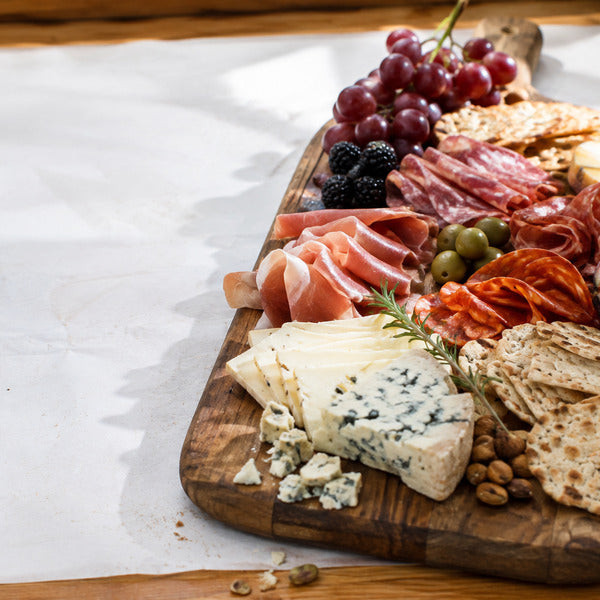
- 1. Start with the right board. For 8–12 guests you want a surface at least 18–24 inches across — a large wood serving board, or two or three boards clustered together. Our bread boards & charcuterie cheese boards collection covers everything from individual serving boards to display-scale pieces caterers use on grazing tables.
- 2. Place cheeses first. Space them at the board's corners or thirds — they anchor the layout. Cut hard cheeses into slices or cubes in advance; leave soft cheeses whole with a dedicated knife.
- 3. Add small bowls. Olives, jams, honey, and mustard go in ramekins before anything else so you're not squeezing them in later. Bowls also add height.
- 4. Fold and river the meats. Fold salami into quarters or ribbons, drape prosciutto loosely, and fan firm slices in overlapping rows that "flow" between the cheeses.
- 5. Fill with crackers, fruit, and nuts. Work from largest to smallest, filling gaps until almost no board shows. Grapes in small clusters, dried apricots fanned, nuts poured into crevices.
- 6. Finish with tools and labels. One knife per cheese, small tongs or forks for meats, and labeled cheese markers. Our foodservice customers consistently tell us that labeled cheese buttons and a dedicated knife per cheese are what keep a self-serve board orderly — and that they noticeably cut cross-contact complaints from guests with allergies or dietary restrictions. Find both in our cheese knives & cheese buttons collection.
[VIDEO PLACEHOLDER 1 — filename: charcuterie-board-party-assembly.mp4 — alt: "Time-lapse assembly of a party charcuterie board from empty board to finished spread"]
How Do You Choose Cheeses for a Charcuterie Party?
Choose one cheese from each texture family — soft, semi-soft, and hard — and you cannot build a bad lineup. A classic party trio is Brie (soft), Havarti or Gouda (semi-soft), and aged Cheddar or Manchego (hard); add a blue like Gorgonzola as a fourth if your crowd is adventurous. Pre-cut hard cheeses so guests aren't sawing at a block mid-party, and pull all cheeses from refrigeration 30–45 minutes before serving so they hit their full flavor at room temperature. For a deeper walk through the five cheese categories, chef favorites, and the tools for cutting and serving each style, see our guide to different types of cheese.
Which Meats and Accompaniments Round Out the Board?
Meats should span three textures: delicate (prosciutto, speck), firm (Genoa salami, soppressata, chorizo), and spreadable (pâté, 'nduja). One pound of sliced meat serves roughly 5–8 guests at appetizer portions. Buy pre-sliced where you can — slicing dense cured meat evenly without a deli slicer is the most time-consuming part of prep.
Accompaniments do the flavor balancing: sweet (fig jam, honey, dried apricots, grapes), briny (Castelvetrano olives, cornichons, marinated artichokes), crunchy (Marcona almonds, candied pecans, breadsticks), and tangy (whole-grain mustard, pickled onions). A drizzle of hot honey over an aged cheese is the single most repeated trick we see event caterers use to make a board memorable.
How Do You Scale Up to a Grazing Table?
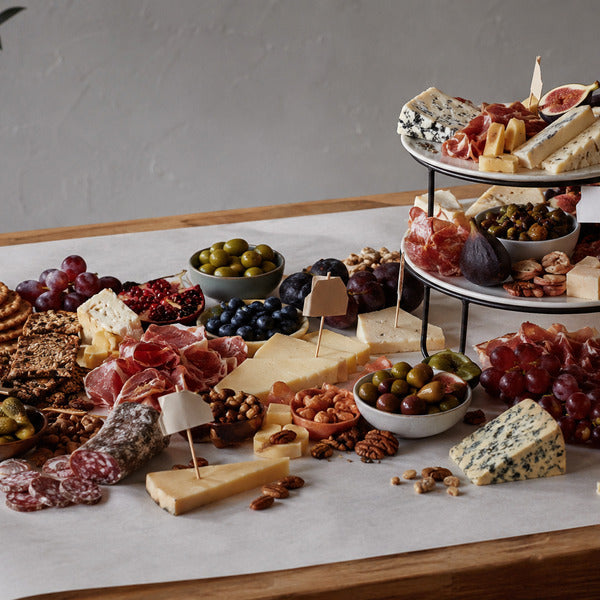
A grazing table is a charcuterie board party at architectural scale — the entire table surface becomes the board. Caterers use them for weddings, corporate receptions, and holiday parties from 20 to several hundred guests. Scaling is mostly logistics, not recipes:
- Build in zones, not one giant layout. Repeat the same meat-cheese-accompaniment cluster every 3–4 feet so guests never queue at a single "good section." Each zone is essentially one statement board.
- Add height. Risers, cake stands, and crates lift platters into a landscape. Flat grazing tables photograph poorly and crowd poorly.
- Use replaceable platters. In 15+ years supplying event caterers, the operators who run the smoothest grazing tables never refill on the table — they stage duplicate platters in the back and swap them whole when a zone hits two-thirds empty. Dedicated platters, including seasonal options from our holiday party platters collection, make the swap a ten-second job.
- Label everything. At scale, guests can't ask the host what each cheese is. Markers and allergen labels are non-negotiable for corporate events.
- Stagger perishables. Don't set out the full quantity at once — the 2-hour safety window (below) applies to when food hits the table, so hold reserves refrigerated and rotate.
How Does a Build-Your-Own Charcuterie Board Station Work?
A build-your-own charcuterie board station turns assembly into the party activity: ingredients sit in bowls and on platters, and each guest composes a personal board or plate. It's the lowest-stress format for the host — no artful arranging required — and it solves dietary restrictions automatically, since every guest picks only what they can eat.
Set the station in a logical build order: boards or plates first, then cheeses, meats, crackers, accompaniments, and sweets at the end. Give every ingredient its own serving tool so nothing gets touched by hands, and post a small "suggested combos" card (salami + Manchego + fig jam; prosciutto + Brie + honey) — it keeps the line moving and guests love the prompt. A variation trending at showers and birthday parties is the "bring your own board" party, where each guest brings one component and the host supplies boards, tools, and vehicles. It cuts host cost dramatically, and the potluck variety usually beats anything one person would buy.
7 Ways To Package Single-Serve Charcuterie
Single-serve charcuterie is individual-portion charcuterie packaged in its own cup, jar, box, or cone — and it has become its own catering category, driven by grab-and-go retail, boxed-lunch catering, and events where a shared board isn't practical. Charcuterie packaging done well keeps the same visual appeal as a board while adding portability, portion control, and a cleaner food-safety story (each portion has its own sealed environment and its own 2-hour clock). Here are the seven formats we see foodservice operators use most:
- 1. Charcuterie cups ("jarcuterie" cups). Clear cups packed vertically — skewered meats and cheese cubes standing up, crackers fanned along the wall, nuts and dried fruit at the base. The most photogenic single-serve charcuterie format and the standard for cocktail parties and mixers.
- 2. Mason jars. The original "jarcuterie." Layer heavy items (olives, cubes, nuts) at the bottom and delicate ribbons of meat on top; the lid makes them stackable and transport-ready for drop-off catering.
- 3. Windowed boxes. Kraft or white boxes with a film window show the arrangement while keeping it sealed — the go-to for retail grab-and-go coolers and boxed-lunch add-ons, with room for a label listing contents and allergens.
- 4. Cones. Paper cones filled with folded meats, cheese sticks, breadsticks, and grapes, displayed upright in racks. Fast to assemble in volume and easy to eat one-handed at standing receptions.
- 5. Mini boards and plates. An individual palm-sized board or plate per guest — the "plated" version of the party board, popular at seated dinners as a composed first course.
- 6. Compartment (bento-style) trays. Trays with molded wells keep meats, cheeses, crackers, and wet items separated — crackers stay crisp, and portioning is idiot-proof for volume production lines.
- 7. Sealed snack packs. Film-sealed or lidded packs built for retail coolers and room-service minibars: shelf-stable presentation, tamper evidence, and full labeling. The least glamorous format and the biggest volume seller.
For events, match the format to the flow: cones and cups for standing crowds, jars and windowed boxes for anything transported, trays for production volume. Our disposable party supplies collection covers the cups, cones, boxes, mini serving pieces, and tasting utensils that make single-serve charcuterie practical at party scale.
How Long Can a Charcuterie Board Sit Out? (Food Safety)
A charcuterie board can sit at room temperature for a maximum of 2 hours — or 1 hour when the ambient temperature is above 90°F, such as outdoor summer parties. That window comes from USDA FSIS "Danger Zone" guidance: between 40°F and 140°F, bacteria can double in as little as 20 minutes, and perishable food should never sit out of refrigeration longer than 2 hours (USDA FSIS, current as of August 2026). Cured meats and hard cheeses are more forgiving than fresh items, but soft cheeses, cut fruit, and dips are fully perishable — treat the whole board on one clock.
Practical moves for hosts and caterers: set out food in waves instead of all at once, keep backup platters refrigerated and swap rather than refill, nest bowls of soft cheese or dip over ice for outdoor service, and when the 2-hour window closes, discard what's left on the table rather than re-chilling it. Single-serve packaging helps here too — sealed portions pulled from the cooler start their own clock at pickup.
Charcuterie for Foodservice: Boards, Tools, and Setup That Scale
For restaurants and caterers, charcuterie is one of the highest-margin cold programs available — no cook line, prep hours ahead, premium price point. The difference between a program that scales and one that doesn't is almost always equipment, not ingredients. From supplying 40,000+ foodservice operations, the core kit we see winning operators standardize on: a graduated range of charcuterie cheese boards (appetizer boards for table service, display boards for grazing tables), dedicated cheese knives with labeled cheese buttons for self-serve stations, swappable platters for event work, and disposable single-serve vessels for catering and grab-and-go. Standardizing the vessels also standardizes the portions — which is how charcuterie stays profitable at volume instead of drifting into food-cost creep.
Frequently Asked Questions
How do you do a charcuterie board party?
To do a charcuterie board party, pick a format (one large board, a grazing table, a build-your-own station, or single-serve cups), plan 2–3 oz of meat and cheese per guest, and build with the 3-3-3 rule — 3 meats, 3 cheeses, 3 accompaniments. Give each cheese its own labeled knife, set food out in waves, and pull perishables after 2 hours at room temperature.
What is the 3-3-3 rule for charcuterie boards?
The 3-3-3 rule is a charcuterie board formula: 3 meats, 3 cheeses, and 3 accompaniments. Vary textures within each group — thin, firm, and spreadable meats; soft, semi-soft, and hard cheeses; sweet, briny, and crunchy accompaniments. For bigger parties, increase quantities of the same nine items rather than adding more varieties.
Are charcuterie boards okay for diabetics?
Charcuterie boards can be a diabetes-friendly party option because their core items — cheeses, cured meats, nuts, and olives — are high in protein and fat and low in carbohydrates. The carb-dense components are the crackers, bread, dried fruit, honey, and jams, so guests managing blood sugar can build a plate around meats, cheeses, nuts, and fresh vegetables and go light on those. Cured meats are typically high in sodium, which matters for guests also managing blood pressure. Individual needs vary, so guests should follow their own clinician's or dietitian's guidance.
Can I have charcuterie while pregnant?
Pregnant guests should be cautious with charcuterie because deli meats, dry sausages, and soft cheeses are among the foods USDA FSIS identifies as potential carriers of Listeria — and pregnant women and their newborns are one of the highest-risk groups for listeriosis, an illness that causes roughly 1,600 US infections a year per CDC data (USDA FSIS, current as of August 2026). The safer play: stick to pasteurized cheeses, skip cold cured meats unless they've been heated until steaming hot, and enjoy the fruit, nuts, crackers, and spreads. Hosts can help by labeling pasteurized cheeses and including a listeria-safe zone on the board.
Ready To Build Your Board?
A great charcuterie board party comes down to a handful of decisions made early: the right format for your headcount, honest portion math, the 3-3-3 rule for variety, and a 2-hour clock you actually enforce. Everything else — the folding, the fanning, the hot-honey drizzle — is the fun part. Whether you're hosting twelve or catering two hundred, start with the right surface: browse our bread boards & charcuterie cheese boards collection for boards, and outfit the spread with cheese knives, platters, and single-serve vessels built for foodservice volume.