Catering Trends 2026: A Deep Dive Into Tech-Driven & Sustainable Catering
Catering trends in 2026 center on four shifts: tech-enabled ordering and operations, sustainable service with eco-friendly disposables, experiential live-action stations, and dietary personalization. For a mid-size caterer, online ordering delivers measurable ROI first — it captures orders 24/7 at low upfront cost, while sustainability upgrades build loyalty over each following season.
The catering trends reshaping 2026 are not about novelty menus — they are about how orders get placed, how food gets served, and what ends up in the trash afterward. Caterers who understand where the industry is heading can invest ahead of demand instead of scrambling behind it. In 15+ years supplying 40,000+ foodservice operations, we've watched catering evolve from phone-and-fax order pads to AI-assisted production schedules, and the operators who adopted early consistently outgrew the ones who waited. This guide breaks down the five biggest catering trends of 2026, then goes where page-one lists don't: a phased adoption roadmap that connects technology and sustainability, plus a cost/ROI reality check for every trend.
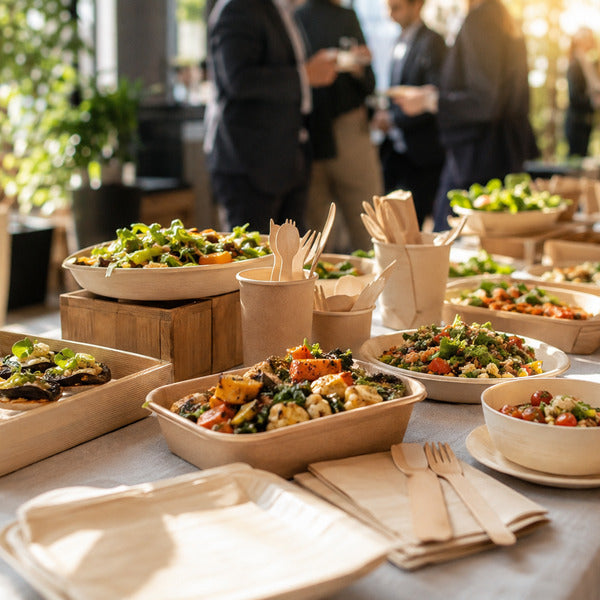
TL;DR — Catering Trends 2026 at a Glance
- Tech-enabled ordering and operations is the fastest-payback trend — the National Restaurant Association's 2026 report highlights operator investment in digital ordering, AI, and data analytics to protect margins.
- Sustainable catering is now a client expectation, not a differentiator — compostable serviceware and zero-waste stations win RFPs.
- Corporate catering is growing: 56% of workplace food orderers plan to increase spending in 2026 (ezCater).
- Experiential stations and dietary personalization command premium pricing but require more labor and planning.
- The smartest move is a phased rollout: quick wins first (online ordering + sustainable disposables), workflow tech second, full sustainable service program third.
| Catering Trend | What It Looks Like | Adoption Difficulty | Payback Speed |
|---|---|---|---|
| Tech-enabled ordering & ops | Online menus, AI-assisted planning, digital payments | Low–Medium | Fast (weeks–months) |
| Sustainable catering service | Compostable disposables, zero-waste stations | Low | Fast–Medium |
| Experiential live-action stations | Chef-attended stations, interactive bars | Medium–High | Medium (premium pricing) |
| Dietary personalization | Plant-forward, allergen-labeled, build-your-own menus | Medium | Medium |
| Corporate catering shifts | Drop-off formats, recurring workplace programs | Low–Medium | Fast (recurring revenue) |
What Are the Biggest Catering Trends in 2026?
The biggest catering trends in 2026 are tech-enabled ordering and operations, sustainable catering service, experiential live-action stations, dietary personalization, and the continued reshaping of corporate catering around hybrid workplaces. The backdrop is a $1.55 trillion U.S. restaurant and foodservice industry: the National Restaurant Association's 2026 State of the Restaurant Industry report projects total sales reaching $1.55 trillion in 2026, with employment climbing to 15.8 million jobs — but also finds more than 9 in 10 operators citing food, labor, insurance, energy, and swipe fees as significant cost challenges. Every trend below is ultimately a response to that squeeze: win more orders, waste less, and charge for experiences clients can't replicate in-house.
Trend 1 — Tech-Enabled Ordering & Operations
Catering technology in 2026 means digital ordering, AI-assisted planning, and data analytics — the exact investment areas the National Restaurant Association's 2026 report identifies as operators' path to "technology-driven efficiency" under margin pressure. For caterers specifically, that translates into three layers:
- Online ordering and digital menus. Clients — especially corporate clients — expect to browse packages, customize headcounts, and pay online without a phone call. Marketplaces such as ezCater have normalized this expectation for workplace orders, and caterers without a self-serve ordering path lose those bookings by default.
- AI-assisted planning and quoting. AI tools now draft proposals, scale recipes to headcounts, and flag ingredient overlaps across a week's events. The value is not replacing chefs; it is compressing the hours between inquiry and signed contract.
- Back-of-house analytics. Order-history data reveals which menus actually get rebooked, which delivery windows cluster, and where prep labor goes. Caterers using that data quote more accurately and stop underpricing labor-heavy menus.
The trend's honest caveat: technology only pays when it removes a real bottleneck. A caterer drowning in phone-tag benefits from online ordering immediately; a caterer whose bottleneck is kitchen capacity should spend elsewhere first.
Trend 2 — Sustainable Catering Service
Sustainable catering is the practice of running events with minimal environmental impact — eco-friendly disposables, zero-waste service stations, local sourcing, and food-waste reduction. Two verified numbers explain why it has moved from marketing angle to operating standard. First, the USDA estimates food waste at 30–40% of the U.S. food supply, and buffet-style catering is one of the most visible contributors — a fact clients increasingly notice. Second, the EPA reports containers and packaging make up 28.1% of municipal solid waste — 82.2 million tons in its most recent product-specific data — which is exactly the waste stream single-use catering service creates.
In practice, 2026 sustainable catering looks like: compostable or fiber-based eco friendly disposables replacing plastic; portion-controlled stations instead of over-provisioned buffets; donation partnerships for surplus food; and waste-diversion signage clients can point to in their own ESG reporting. Our foodservice customers consistently tell us that corporate clients now ask about serviceware sustainability during the RFP stage — before price. For a deeper operational framework, see our guide to understanding zero-waste in foodservice.
Trend 3 — Experiential & Live-Action Stations
Experiential catering means turning service into part of the entertainment: chef-attended carving and pasta stations, made-to-order taco and poke bars, live dessert torching, and interactive beverage programs. The driver is simple — clients hosting in-person events in a hybrid-work era need those gatherings to feel worth attending, and a passed tray of room-temperature appetizers doesn't clear that bar anymore.
Live-action stations command premium pricing precisely because they cost more to run: skilled labor on-site, station-specific equipment, and tighter logistics. They pair naturally with the presentation-forward serviceware trend — small-format tasting vessels, mini plates, and modern displayware that make each station photogenic. (Guests photograph stations; those photos are unpaid marketing.) Caterers building out station programs should start with one signature station they can execute flawlessly rather than a menu of five they can only staff inconsistently.
Trend 4 — Dietary Personalization
Dietary personalization is the expectation that every guest — vegan, gluten-free, halal, allergen-restricted — gets a genuine option, not an afterthought salad. Plant-forward menus have moved from niche to default inclusion: 2026 proposals routinely lead with one or two vegetable-centric dishes that happen to be vegan, rather than segregating a "special diets" section. Clear allergen labeling at stations, build-your-own formats that let guests self-select, and separate serving utensils per dish are now table stakes for corporate and wedding work alike.
The operational trend behind the menu trend: caterers are standardizing a core menu architecture where 70–80% of dishes are naturally adaptable (sauce on the side, protein swappable) instead of cooking parallel one-off meals. That keeps personalization from destroying kitchen efficiency. For menu direction that complements this, see our post on menu planning food trends to keep on your radar.
Trend 5 — Corporate Catering Shifts
Corporate catering trends in 2026 revolve around hybrid workplaces using food as an attendance strategy. The data is unambiguous: ezCater's 2026 survey of more than 2,300 workplace food stakeholders found 56% of orderers plan to increase workplace food spending in 2026, and 91% plan to spend the same or more. Related ezCater data shows 96% of workplaces tried a new restaurant in 2025 — meaning workplace orders are also a discovery channel that converts into personal and repeat business.
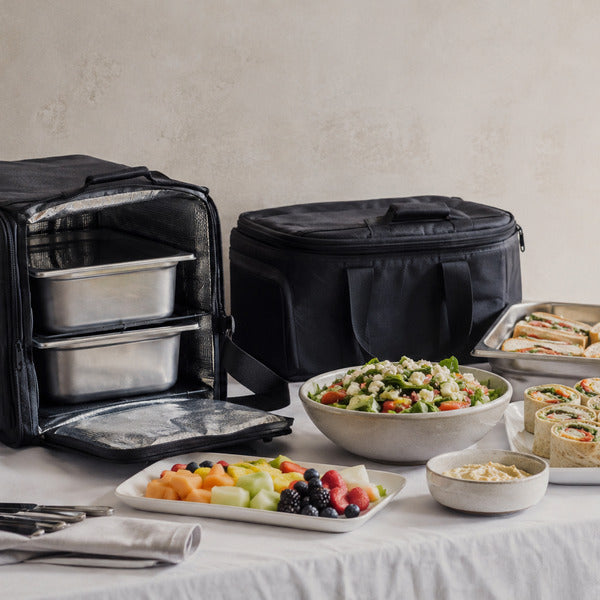
Format-wise, the growth is in drop-off catering: individually packaged or family-style meals delivered ready-to-serve, no on-site staff. Drop-off suits recurring weekly programs (team lunches, training days) that give caterers predictable revenue between marquee events. Winning this segment is largely a logistics game — accurate delivery windows, food arriving at temperature in professional insulated food delivery bags & catering bags, and packaging that presents well when an office manager opens the box in front of forty colleagues.
Tech + Sustainability Adoption Roadmap: How Should a Caterer Adopt These Trends?
A caterer should adopt 2026's two biggest trends — technology and sustainability — in three phases ordered by payback speed, not ambition. Most trend lists treat tech and sustainability as separate checkboxes; in practice they compound each other. Digital ordering data tells you exact headcounts, which cuts over-production, which is the single biggest sustainability win. Here is the roadmap we recommend to operators.
Phase 1 — Quick Wins (0–3 Months)
Phase 1 is two moves with fast, visible payback:
- Stand up online ordering. A bookable menu with set packages and digital payment — via your website, a catering platform, or a marketplace listing. This captures after-hours inquiries you currently lose and creates the order data Phase 2 runs on.
- Swap core disposables to sustainable equivalents. Plates, bowls, utensils, and napkins are the highest-visibility items guests touch. Swapping to compostable catering disposables requires zero workflow change — same box, better material — and immediately upgrades your sustainability story in proposals. Run the numbers with our cost-benefit analysis of switching to green packaging.
Phase 2 — Workflow Tech (3–9 Months)
Phase 2 applies technology to operations rather than sales: delivery-route planning to cut fuel and late arrivals, digital prep sheets scaled automatically from confirmed headcounts, and inventory tracking tied to order history. This is where the sustainability compounding shows up — accurate headcount-driven prep is the most effective food-waste reduction tool a caterer has, more than any packaging change. Against the USDA's 30–40% food-supply waste estimate, catering operations that prep to confirmed digital orders instead of padded estimates routinely eliminate whole trays of surplus per event.
Phase 3 — Full Sustainable Service Program (9–18 Months)
Phase 3 turns scattered eco-friendly choices into a documented program you can sell: a stated waste-diversion target, compost and recycling stations at every event, a surplus-food donation partnership, local-sourcing commitments on the menu, and a one-page sustainability summary clients can drop into their own ESG reporting. This is the phase that wins enterprise RFPs, because procurement teams need documentation, not vibes. It also supports the USDA and EPA's national goal of cutting food waste 50% by 2030 — a goal line clients increasingly reference.
Cost/ROI Reality Check: What Does Each Catering Trend Actually Cost?
Each 2026 catering trend carries a different upfront cost and payback window. The table below is our honest planning-level view for a mid-size caterer, based on patterns we see across the foodservice operations we supply — treat ranges as directional and validate against your own volume.
| Trend | Typical Upfront Cost | Payback Window | ROI Signal to Watch |
|---|---|---|---|
| Online ordering & digital payments | Low (platform fees or % per order) | Weeks–3 months | Share of orders booked without a phone call |
| AI-assisted planning/quoting | Low (subscription) | 1–6 months | Hours from inquiry to signed proposal |
| Sustainable disposables swap | Low–moderate per-unit premium | Immediate–1 season | RFP win rate; client sustainability mentions |
| Routing & prep-automation tech | Moderate (software + setup time) | 3–9 months | Fuel/labor cost per delivery; surplus trays per event |
| Experiential live stations | Moderate–high (equipment + skilled labor) | 3–12 months | Premium per-guest pricing accepted |
| Dietary personalization systems | Low–moderate (menu re-architecture) | 1–2 quarters | Fewer one-off special meals cooked per event |
| Full sustainable service program | Moderate (program design + partnerships) | 6–18 months | Enterprise/corporate RFPs won |
The pattern worth internalizing: the cheapest moves (online ordering, disposables swap) also pay back fastest, which is why the roadmap front-loads them. The expensive moves (stations, full programs) are pricing-power plays — they don't cut costs, they justify higher invoices.
Foodservice Application: Putting Catering Trends Into Practice With the Right Supplies
Trends become revenue only when they show up on the table. These are the supply categories that operationalize 2026's catering trends, drawn from what our catering customers actually reorder:
- Eco-friendly serviceware for sustainable service. Palm-leaf and bagasse plates, wooden cutlery, and compostable bowls from our eco friendly disposables collection let you deliver the sustainability trend at every price tier — from casual drop-off to plated premium.
- Presentation-grade catering disposables for experiential stations. Mini tasting vessels, small-format plates, and modern serving trays in our catering disposables collection make live-action stations photogenic without the breakage risk and dishwashing logistics of china off-site.
- Insulated transport for the drop-off boom. Professional insulated food delivery bags & catering bags are the difference between corporate drop-off that gets rebooked weekly and a lukewarm first-and-last order.
If you're building your kit from scratch, start with our rundown of the top 10 essential catering equipment, then browse the rest of our catering guides for format-specific playbooks.
Frequently Asked Questions About Catering Trends
What are current trends in the catering industry?
Current catering industry trends are tech-enabled ordering and operations, sustainable service with compostable disposables, experiential live-action stations, dietary personalization, and drop-off corporate catering. All five respond to the same pressures: rising operating costs — cited by more than 9 in 10 operators in the National Restaurant Association's 2026 report — and client demand for convenience and sustainability.
What are the trends in catering in 2026?
Catering trends in 2026 specifically emphasize AI-assisted planning and quoting, recurring workplace food programs (56% of corporate orderers plan to spend more this year, per ezCater), documented sustainability programs that survive procurement review, plant-forward default menus, and premium chef-attended stations at in-person events designed to make attendance worthwhile.
How is technology changing catering?
Technology is changing catering at three layers: clients book and pay through online ordering instead of phone calls; AI tools compress proposal and menu-scaling work from hours to minutes; and analytics on order history sharpen pricing, routing, and prep quantities. The National Restaurant Association's 2026 report frames these investments — digital ordering, AI, data analytics — as operators' primary lever against margin pressure.
What is sustainable catering?
Sustainable catering is event foodservice designed to minimize environmental impact. It means compostable or fiber-based serviceware instead of plastic, portion planning that attacks the USDA-estimated 30–40% food-supply waste rate, surplus-food donation, local sourcing, and waste-diversion stations at events. In 2026 it is a client expectation — often screened in RFPs before price.
What is the most profitable food to cater?
The most profitable catering foods pair low ingredient cost with high perceived value: pasta and grain-bowl stations, taco and slider bars, breakfast spreads, and appetizer-style small plates. Profitability in 2026 depends as much on format — drop-off packages and chef-attended stations both carry stronger margins than traditional full-service buffets when priced correctly.
What do clients want from caterers now?
Clients now want frictionless online booking, visible sustainability they can report on, genuine options for every dietary need, and — for corporate buyers — reliable recurring drop-off programs. ezCater's 2026 workplace data shows 91% of corporate orderers plan to spend the same or more than last year, but they concentrate that spend on caterers who make ordering effortless.
What is the hottest food trend right now?
The hottest food trend in catering right now is the experiential station — chef-attended, made-to-order, and photogenic — usually with a plant-forward or globally inspired menu (think live pasta, poke, birria, or dessert-torching stations). It converts catering from a cost line into event entertainment, which is exactly what hybrid-era hosts are paying for.
Conclusion: Ride the Catering Trends That Pay First
The catering trends of 2026 reward sequence over enthusiasm. Start with the quick wins — online ordering and a sustainable disposables swap — then layer in workflow tech, and graduate to a documented sustainability program and premium experiential formats once the fast-payback moves are funding them. The industry backdrop is favorable: $1.55 trillion in projected foodservice sales and corporate catering budgets growing, not shrinking. The caterers who capture that growth will be the ones whose operations already look like 2026, not 2019.
Ready to put these trends on the table? Stock your next event from our eco friendly disposables collection and explore the full range of catering disposables built for modern service.