Picnic Food Ideas: 5 Ways To Cater The Perfect Picnic
The best picnic food ideas are foods that hold up without a kitchen: handheld sandwiches and wraps, sturdy grain and vegetable salads, boxed individual lunches, grazing boards, and make-ahead desserts. The one rule that separates a professional catered picnic from a home one is packaging — every item travels in a sealed, portion-ready container that keeps cold food at 40°F or below.
TL;DR — Picnic Food Ideas at a Glance
- Five ways to cater a picnic: boxed individual lunches, build-your-own handheld stations, grazing and charcuterie boards, hot handhelds served in paper cones, and make-ahead salads, sides, and desserts.
- Food-safety rule: perishable food is discarded after 2 hours in the 40°F–140°F danger zone — 1 hour when the outdoor temperature is above 90°F (USDA).
- Quantity rule: plan roughly 1 pound of total food per adult guest for a 2–3 hour picnic, plus two beverages per person.
- Packaging rule: individual, sealed, compostable-friendly packaging beats family-style bowls outdoors — it controls portions, temperature exposure, and pests.
| Picnic Food Idea | Best For | Travels How | Key Risk To Manage |
|---|---|---|---|
| Boxed individual lunches | Corporate picnics, 50–200 covers | Stacked catering lunch boxes in insulated carriers | Cold chain — keep at or below 40°F |
| Build-your-own handhelds | Family events, mixed diets | Components packed separately, assembled on-site | Condiment mess; sauce on the side |
| Grazing & charcuterie boards | Upscale and luxury picnics | Pre-arranged trays with lids or film | Cheese and cured meat time-out-of-cooler limits |
| Hot handhelds in paper cones | Festivals, company field days | Fried items transported hot, served in vented cones | Hold at 140°F or above, or serve within the window |
| Make-ahead salads, sides & desserts | Every picnic format | Sealed portion cups and bowls over ice | Skip mayo-heavy recipes in high heat |
Searches for picnic food ideas spike every summer — and most of the lists that answer them are written for a family of four. This guide is different. At Restaurantware, we have spent 15+ years supplying more than 40,000 foodservice operations, and a large share of them cater outdoors every season. So this list gives you picnic food ideas that genuinely taste great on a blanket and the execution details — transport, holding temperatures, packaging, and per-person math — that let you scale the same menu from 6 guests to 200. Demand is there: the National Restaurant Association projects total restaurant and foodservice sales to reach $1.55 trillion in 2026, with Gen Z and millennials leading off-premises growth — and a catered picnic is off-premises dining at its most literal.
What Foods Work Best for a Picnic?
The foods that work best for a picnic are foods engineered to survive travel: handhelds (sandwiches, wraps, sliders, fried chicken), sturdy salads built on grains, pasta, or hardy vegetables, make-ahead mains served at ambient-safe temperatures, and desserts that don't melt — cookies, bars, and hand pies. Three traits define every great picnic food:
- It holds. No wilting greens, no melting frosting, no bread that goes soggy in an hour. Dressings and sauces ride on the side.
- It's portable. The best picnic menu items are eaten with one hand or a single fork — no knife work on a blanket.
- It's temperature-tolerant. Either it's safe at ambient temperature (breads, whole fruit, hard cheeses, cookies) or it can be held reliably cold at 40°F or below, or hot at 140°F or above.
That third trait is non-negotiable. The USDA defines the "Danger Zone" as 40°F to 140°F — the range where bacteria can double in as little as 20 minutes. Perishable food should never sit out of refrigeration for more than 2 hours, and when the outdoor temperature is above 90°F, that window shrinks to 1 hour. Build your entire picnic menu around that clock and you'll never serve a risky plate. (Data current as of July 2026.)
5 Ways To Cater A Picnic: Picnic Food Ideas That Travel Well
Here are the five picnic catering formats we see win again and again when you're planning picnic food for a crowd — each with specific menu ideas and the operator notes that make them work at 50, 100, or 200 covers.
1. Boxed Individual Picnic Lunches
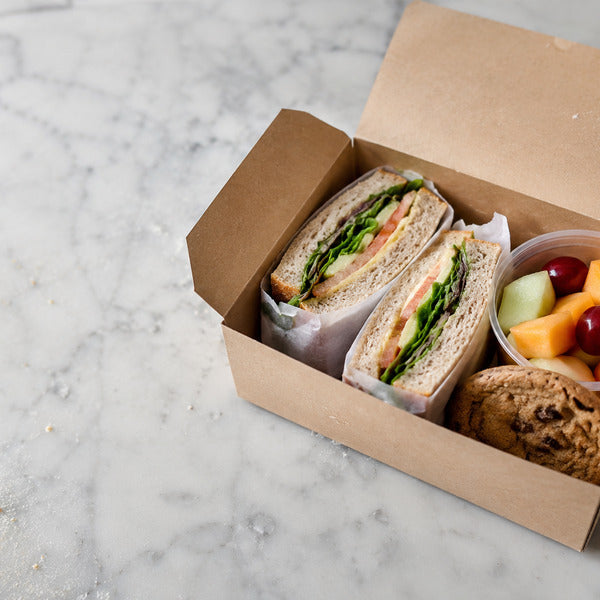
The boxed lunch is the single most reliable format for company picnic food. Each guest gets a sealed box: one handheld main (a turkey-brie baguette, a caprese ciabatta, a grilled-vegetable wrap), one sturdy side (sesame noodle salad, herbed potato salad with a vinegar base, fruit cups), one dessert (a chocolate-chunk cookie or lemon bar), and a napkin-and-cutlery kit. Label each box with its contents and allergens.
Why it wins: portion control, allergen isolation, zero on-site assembly, and a service line that moves 200 people in 20 minutes. Boxes stack tight in insulated carriers over gel packs, which keeps the cold chain intact from your walk-in to the park. It's also the format guests remember — our foodservice customers consistently tell us that a well-designed box, tied with butcher twine or a branded sticker, photographs better than any buffet table and ends up on the client's social feed.
Operator notes: Build boxes no more than 4 hours before service and refrigerate immediately. Pack proteins and dairy-based items at the bottom of the carrier where it stays coldest. Sturdy catering lunch boxes with window lids let guests pick without opening — fewer touched-and-returned boxes on the line.
2. Build-Your-Own Handheld Stations
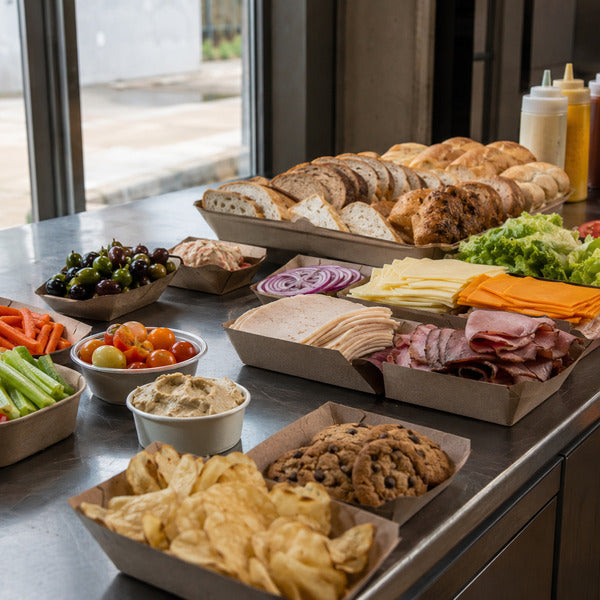
When guests want choice, break the handheld into components: a bread basket (brioche buns, pretzel rolls, sliced sourdough), two or three proteins (pulled chicken, sliced roast beef, marinated portobello), cheeses, crunchy vegetables, and sauces in squeeze bottles or portion cups. The same logic works for taco bars, slider bars, and banh mi stations.
Why it wins: one station covers omnivores, vegetarians, and gluten-free guests without separate meal counts. Components also transport more safely than finished sandwiches — bread stays dry, proteins stay in the cooler until the moment of service.
Operator notes: Keep proteins in shallow pans nested over ice, and swap pans every 30–45 minutes in hot weather rather than topping them off. Sauce always rides on the side — it's the difference between a crisp handheld at hour two and a soggy one. Portion two to three sauce cups per guest; they disappear faster than you think.
3. Grazing Boards & Charcuterie Spreads
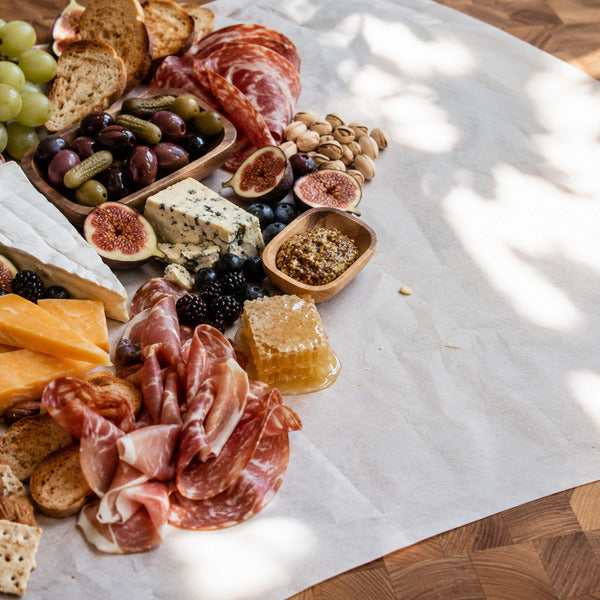
For upscale and luxury picnics — proposals, bridal showers, client entertainment — the grazing board is the anchor. Think cured meats, a mix of hard and soft cheeses, seasonal fruit, olives, nuts, honeycomb, crackers, and baguette. Build boards in lidded disposable trays in the kitchen so they arrive camera-ready; never assemble charcuterie on a blanket.
Why it wins: it is the most photographed picnic format, it serves as both appetizer and centerpiece, and it scales linearly — one tray per 8–10 guests. If you're building a premium outdoor experience around it, our guide on how to create a luxury picnic covers the styling side in depth.
Operator notes: Cured meats and soft cheeses are still perishable — they follow the same 2-hour/1-hour rule as everything else. Portion boards small enough to be consumed within the window rather than leaving one giant board out all afternoon. Hard cheeses, dried fruit, nuts, and crackers can be pre-staged; add the perishables from the cooler at service time.
4. Hot Handhelds Served in Paper Cones
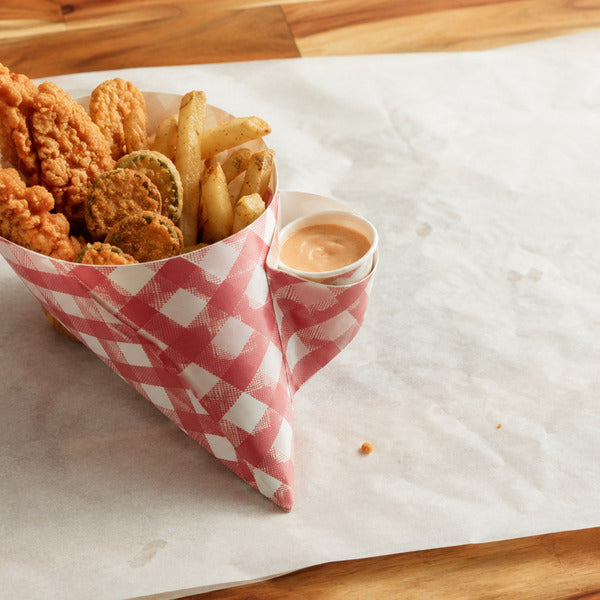
Fried chicken is arguably the most beloved picnic food in America — and the way to serve it (plus fries, shrimp, hushpuppies, or churros) at an outdoor event is the paper cone. Cones are one-handed, self-venting so fried food stays crisp instead of steaming itself soft, and they turn a simple fry-basket menu into festival-style presentation. We designed our Cone Tek picnic print paper food cone (11 1/2" x 5 1/2") for exactly this service, and the large picnic print cone with a built-in dipping pocket solves the eternal outdoor problem of where the sauce goes — no separate cup to balance on a knee.
Why it wins: hot food outdoors is a differentiator. Most picnic caterers surrender to an all-cold menu; a single hot station — fried chicken cones, or even soft pretzels — makes the event feel like an occasion.
Operator notes: Hot food must be held at 140°F or above (chafing setups or insulated hot boxes), or timed so it lands in cones within the safe window. Fry as close to service as logistics allow; batch small and often. For lighter apps, the 11" x 6 1/2" dipping-pocket cone right-sizes the portion and your food cost.
5. Make-Ahead Salads, Sides & Dessert (Plus the Beverage Station)
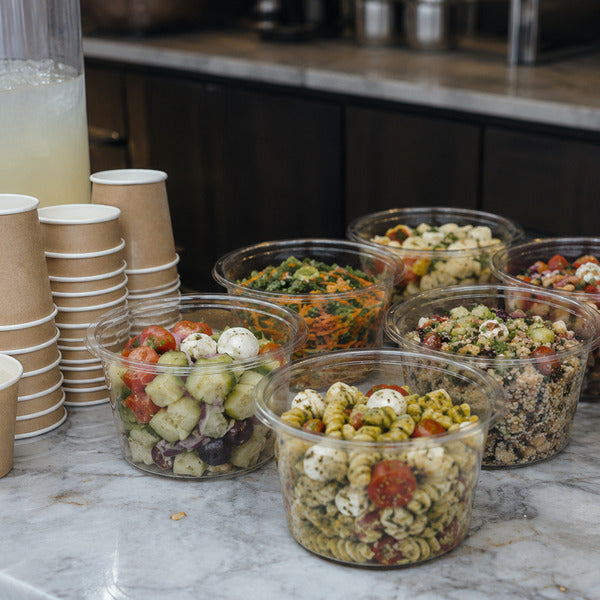
Every catered picnic needs its supporting cast, and this is where make-ahead discipline pays. The salads that survive outdoors are the ones that improve as they sit: orzo with feta and roasted peppers, sesame-soy noodle salad, three-bean salad, slaw dressed in vinaigrette, watermelon-mint. Skip delicate leaf salads and go easy on mayonnaise-bound recipes in high heat — not because mayo itself is uniquely dangerous, but because mayo-bound salads usually carry eggs, potatoes, and proteins that demand strict cold holding. Dessert follows the same logic: cookies, blondies, hand pies, and pound cake travel; frosted layer cakes and anything with whipped cream do not.
The beverage station: plan two drinks per guest minimum in summer heat. Dispensers of lemonade, iced tea, and infused water beat single bottles on cost and waste. Follow the FDA's cooler rule and pack beverages in a separate cooler from perishable food — the drinks cooler gets opened constantly, and every opening costs the food cooler its cold air. For coffee service at morning picnics, insulated cups like our Restpresso 12 oz picnic print spiral-wall coffee cup hold heat without a sleeve, and take-out cup carriers let one runner move four drinks at a time across a lawn.
Operator notes: Pre-portion salads into sealed cups rather than serving from communal bowls — portion cups hold temperature better on ice, eliminate serving-spoon bottlenecks, and keep insects out. It's the single biggest upgrade most operators make to their picnic catering ideas after their first large outdoor event.
How To Plan Quantities, Transport, and Timing (The Operator Layer)
Once the menu is set, three planning decisions determine whether the picnic runs smoothly.
How much food per person?
Plan roughly 1 pound of total food per adult for a 2–3 hour picnic: one handheld main (6–8 oz), two sides (3–4 oz each), and one dessert. Add 15–20% overage for outdoor appetites and for events with teenagers. Two beverages per guest minimum; three in temperatures above 85°F.
How does the food get there?
Cold food travels in coolers or insulated carriers at 40°F or below, packed with ice or frozen gel packs — the FDA recommends packing coolers full (a full cooler holds temperature longer than a half-empty one) and transporting them inside the air-conditioned cabin, not a hot trunk. Hot food travels in insulated hot boxes at 140°F or above. Anything ambient — bread, whole fruit, crackers, cookies — travels in regular transport crates and frees up cooler space.
What's the service timeline?
Work backward from the eat time. Perishables leave refrigeration as late as possible, the service window is capped at 2 hours (1 hour above 90°F per the USDA's take-out food guidance), and anything that exceeds the window is discarded — never re-cooled and re-served. If the event runs long, stage food in waves from the coolers instead of laying everything out at once. For a deeper comparison of what changes when you leave the building, see our guide to indoor catering vs. outdoor catering.
Foodservice Application: Packaging a Catered Picnic Like a Pro
Packaging is our moat at Restaurantware, and it should be yours too. In 15+ years supplying 40,000+ foodservice operations, we've seen the same pattern: the operators who win repeat picnic and corporate-event contracts are the ones whose food arrives looking intentional — matched packaging, coordinated napkins, branded touches — not assembled from whatever was on the shelf.
A picnic-ready packaging kit looks like this:
- Individual boxes for mains — windowed catering lunch boxes that stack in transport and present at service.
- Cones for hot and fried items — the picnic print paper food cone line was literally designed for this occasion, gingham print and all.
- Coordinated napkins — a detail guests notice. Our Luxenap black picnic print napkins tie the whole service together and hide barbecue-sauce evidence better than white ever will.
- Portion cups with lids for salads, sauces, and desserts — sealed until the guest opens them.
- Cup carriers and dispensers for the beverage station, so drinks move in fours, not ones.
Browse the full catering disposables collection to build your kit — everything above ships from stock. And if you're formalizing picnic service as a menu offering, our walkthrough on how to create a catering menu shows how to price and package it.
Frequently Asked Questions
What food should I bring for a picnic?
Bring foods that hold at ambient temperature or travel well in a cooler: sandwiches and wraps, grain or pasta salads dressed in vinaigrette, fried chicken, cheese and charcuterie, whole fruit, cookies and bars, and plenty of beverages. Pack perishables at 40°F or below and keep sauces on the side.
What is the most popular food at a picnic?
Fried chicken and sandwiches top most American picnic menus — YouGov polling puts fried chicken among America's most popular dishes, with an 81% popularity rating — alongside potato salad, watermelon, and deviled eggs. For catered picnics, boxed sandwich lunches are the most requested format because they're portable, portion-controlled, and easy to serve at scale.
What are good finger foods for a picnic?
Good picnic finger foods include sliders, chicken tenders, caprese skewers, deviled eggs, cheese cubes, stuffed grape leaves, empanadas, spring rolls, fruit skewers, and cookies. Serve fried finger foods in paper cones to keep them crisp and one-handed, with dipping sauce in portion cups or built-in pockets.
What can I take on a picnic instead of sandwiches?
Instead of sandwiches, take grain bowls, cold noodle salads, quiche or frittata slices, empanadas, sushi rolls, charcuterie boards, tamales, or fried chicken. Anything make-ahead that's eaten at ambient temperature or holds well over ice works — the goal is one-handed or one-fork eating with no on-site cooking.
How do you cater an outdoor picnic?
Catering an outdoor picnic means designing a make-ahead menu around transportable formats (boxed lunches, grazing boards, cone service), packing cold food at 40°F or below and hot food at 140°F or above, capping the service window at 2 hours (1 hour above 90°F), and pre-portioning everything into individual sealed packaging.
How do you keep picnic food cold?
Keep picnic food cold with full coolers packed with ice or frozen gel packs, held at 40°F or below. Use a separate cooler for beverages so the food cooler stays closed, transport coolers in the air-conditioned cabin rather than the trunk, and keep them in shade with lids closed on site.
How much food per person for a picnic?
Plan about 1 pound of food per adult for a 2–3 hour picnic: one 6–8 oz main, two 3–4 oz sides, and one dessert, plus at least two beverages per person. Add 15–20% overage for hot weather, active events, and groups with teenagers.
Conclusion: Great Picnic Food Ideas Are a Packaging Decision
Anyone can list picnic food ideas — the caterers who get rebooked are the ones who deliver them cold, crisp, and camera-ready after a 40-minute drive and two hours in the sun. Choose formats that travel (boxes, cones, boards, portion cups), respect the USDA's 2-hour/1-hour clock, and let the packaging do the presenting. When you're ready to build your picnic service kit, start with our catering disposables collection — from picnic print cones to lunch boxes, it's everything the food needs to arrive as good as it left.