What Is Influencer Marketing? A Restaurant Operator's Guide
Influencer marketing is a strategy where brands partner with creators who have engaged audiences to promote products or services through authentic recommendations. For restaurants, that means paying or gifting local food creators to showcase dishes, driving reservations and orders. Micro-influencers (10,000–100,000 followers) typically deliver the strongest engagement per dollar.
If you run a restaurant, cafe, bar, or ghost kitchen, you have probably watched a competitor's dining room fill up after one viral video and wondered exactly what is influencer marketing — and whether it can work at your price point. The short answer: it can, and it is one of the few advertising channels where a 40-seat independent can outperform a national chain. In 15+ years supplying more than 40,000 foodservice operations, we've watched influencer marketing move from a novelty to a line item on serious operators' marketing budgets — and the operations that win treat it like purchasing: defined specs, vetted vendors, measurable results. This guide explains what influencer marketing is, the four influencer tiers, what creators cost, how to vet them, and how to make your food camera-ready before the first creator ever walks in.
TL;DR — The 4 Influencer Tiers at a Glance
| Tier | Follower Range | Typical Cost per Post* | Best Restaurant Use Case |
|---|---|---|---|
| Nano-influencer | 1,000–10,000 | Free meal ("gifting") to ~$100 | Neighborhood buzz, soft openings, UGC volume |
| Micro-influencer | 10,000–100,000 | $100–$1,000 (often meal + fee) | Local reach with high trust — the sweet spot for most independents |
| Macro-influencer | 100,000–1,000,000 | $1,000–$10,000+ | Regional launches, multi-unit groups, delivery-app promos |
| Mega/celebrity influencer | 1,000,000+ | $10,000 to six figures | National chains and CPG-style brand campaigns |
*Rates vary widely by market, platform, and engagement; treat these as planning ranges, not quotes. Current as of July 2026.
What Is Influencer Marketing, and How Is It Categorized?
Influencer marketing is defined as a form of digital marketing in which a brand compensates a content creator — with money, free product, or both — to recommend that brand to the creator's audience. It sits at the intersection of advertising and word-of-mouth: the message is paid for, but it arrives in the voice of someone the audience already follows and trusts. In digital marketing terms, influencer marketing is a paid-media channel that behaves like earned media, which is exactly why it converts skeptical diners who scroll past traditional ads.
This is not a fringe tactic. The global influencer marketing industry reached an estimated $32.55 billion in 2025, up from $24 billion in 2024, according to Influencer Marketing Hub — growth from just $1.4 billion in 2014 (current as of July 2026). Restaurants are among the biggest beneficiaries because food is the single most natural content category on visual platforms.
Influencer marketing campaigns are categorized three ways:
- By influencer tier: nano, micro, macro, or mega — the four types in the table above.
- By compensation model: gifting (comped meals), flat-fee sponsored posts, affiliate/promo-code deals, and content licensing (you pay for the video and reuse it in your own ads).
- By platform: TikTok and Instagram Reels dominate restaurant discovery, with YouTube and local Facebook groups playing supporting roles.
What Is an Influencer in Marketing?
An influencer is a person who has built a dedicated online audience and can affect that audience's purchasing decisions through content, credibility, or relationship. That is the practical definition of influencer that matters to an operator: not fame, but sway over a specific group of people. Search behavior reflects the confusion — queries like "what is an influencer" and even "what is a influencer" far outnumber more precise phrases — but the marketing meaning is consistent.
So what is a marketing influencer versus an ordinary content creator? The difference is commercial intent. A creator makes content; a marketing influencer makes content and accepts brand partnerships, which makes them a media vendor. For a restaurant, the most valuable influencer in marketing terms is rarely the biggest one — it's the local food reviewer whose followers actually live within delivery range.
What Are the 4 Types of Influencers?
The four types of influencers are nano, micro, macro, and mega, sorted by audience size. Each tier trades reach for trust in a predictable way.
Nano-Influencers (1,000–10,000 followers)
Nano-influencers are everyday locals with small, highly personal followings. Their recommendations read like a friend's text message, which makes them ideal for soft openings and neighborhood restaurants. Most will post in exchange for a well-executed comped meal.
Micro-Influencers (10,000–100,000 followers)
What is a micro influencer? A micro-influencer is a creator with roughly 10,000–100,000 followers, usually concentrated in one niche — for restaurants, that niche is local food. Micro-influencers consistently deliver the best cost-per-engagement for independent operators: enough reach to fill tables, small enough that followers still trust the recommendation and creators still answer their own DMs.
Macro-Influencers (100,000–1,000,000 followers)
Macro-influencers are full-time professional creators with regional or national reach. They suit multi-unit groups, franchise launches, and delivery-platform campaigns where you need volume, not just neighborhood credibility. Expect formal rate cards, contracts, and content approval rounds.
Mega-Influencers (1,000,000+ followers)
Mega-influencers and celebrities offer massive awareness at premium prices. For most foodservice operators they are the wrong tool — their audiences are geographically scattered, so the impressions rarely convert to covers unless you're a national chain.
How Does Influencer Marketing Work for Restaurants?
Influencer marketing for restaurants works by exchanging value — meals, fees, or commissions — for authentic content that puts your dishes in front of local diners. The proof that it moves traffic is strong: an MGH survey found that 58% of TikTok users have visited a restaurant after seeing it on TikTok, up from 38% in the agency's 2022 survey, and 52% said they spent more than usual at a restaurant they discovered there (current as of July 2026). A typical campaign follows five steps:
- 1. Define the objective. New-location awareness, a menu launch, slow-night traffic, or delivery orders. One objective per campaign.
- 2. Identify creators. Search location tags, local hashtags (#[YourCity]Eats), and competitor tags. Prioritize creators whose comment sections mention your city.
- 3. Agree on the exchange. Gifting, flat fee, promo code, or affiliate deal — in writing, with deliverables (e.g., "1 Reel + 3 Stories, restaurant tagged, posted within 14 days").
- 4. Stage the visit. Seat them at your best-lit table, serve your most photogenic dishes, and brief the kitchen so plating is flawless. This is where the meal becomes the ad.
- 5. Measure and reuse. Track promo-code redemptions, reservation spikes, and follower growth — then license the best content for your own paid ads.
Compliance is not optional. Under FTC rules, creators must clearly disclose any material connection to your restaurant — including free meals, not just cash. Point every partner to the FTC's Disclosures 101 for Social Media Influencers guide and require #ad or "sponsored" labels in your agreement. The disclosure burden is shared: brands that encourage hidden ads carry liability too.
What Are the 3 R's of Influencer Marketing?
The 3 R's of influencer marketing are Relevance, Reach, and Resonance — a vetting framework that ranks creators by fit rather than follower count.
- Relevance: Does the creator's content match your concept and market? A vegan lifestyle creator is irrelevant to a steakhouse no matter how large the following.
- Reach: How many people — specifically, how many local people — will actually see the post? Ask for audience-location screenshots from the creator's analytics.
- Resonance: Does the audience act? Look at comment quality ("Where is this?!" beats fire emojis), saves, and shares — the signals that predict covers, not vanity metrics.
How to Choose an Influencer: A Buying Checklist for Operators
Choose an influencer the way you would choose a supplier: verify capacity, check references, and put terms in writing. Our foodservice customers consistently tell us their worst influencer experiences came from skipping exactly one of these steps.
| Check | What Good Looks Like | Red Flag |
|---|---|---|
| Audience location | 40%+ of followers within your trade area | Followers scattered globally |
| Engagement quality | Real questions and tags in comments | Bot-like emoji strings; engagement pods |
| Content fit | Food shot in natural style matching your concept | Only glam travel content, no food close-ups |
| Professionalism | Media kit, clear rates, signed agreement | "DM me and we'll figure it out" |
| Disclosure history | #ad used consistently on past partnerships | Hidden sponsorships (your liability too) |
| Past partner results | References from 2–3 restaurants they've promoted | No restaurant can vouch for them |
Budget-wise, influencer campaigns pair naturally with the other low-cost tactics in our guide to cost-effective marketing strategies for your beverage program — a signature cocktail is often the single most-filmed item on a menu. For more channel-by-channel tactics, browse our full restaurant advertising & marketing library.
Making Your Restaurant Camera-Ready: The Foodservice Application
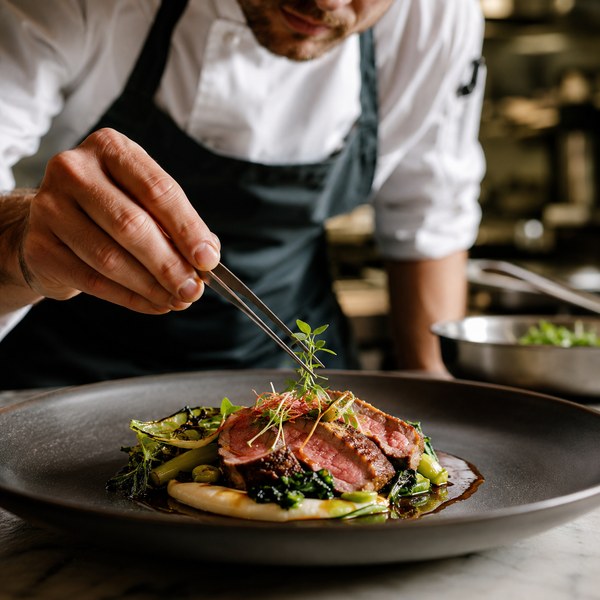
Here is the part most influencer marketing guides skip: the content is only as good as what you put in front of the lens. A creator can bring the audience, but your plating, table setting, and packaging decide whether the video makes people hungry. In 15+ years supplying 40,000+ foodservice operations, we've seen the same pattern over and over — the restaurants that get repeat influencer coverage (often unpaid, after the first campaign) are the ones that engineered their dishes and dining rooms to photograph well.
Four areas repay the investment fastest:
- Plating precision. Sauce dots, height, and negative space read dramatically on camera. Professional food presentation & plating tools — plating wedges, precision tongs, saucier spoons — let line cooks reproduce the "hero plate" on every ticket, not just for the creator's visit.
- The tablescape. Creators shoot the whole table, not just the plate. Coordinated table decor & displays — risers, stands, candle holders — turn a standard two-top into a set.
- The unboxing moment. Delivery and takeout content is its own genre. Branded, structurally sound take-out containers and to-go boxes keep food composed in transit so the on-camera reveal looks like the dining-room plate.
- The backdrop. A single well-designed corner — a statement wall, greenery, distinctive commercial decor — gives every visiting creator (and every guest) an obvious place to shoot, which multiplies organic tags long after the paid campaign ends.
Which Platforms Work Best for Restaurant Influencer Marketing?
TikTok and Instagram are the two platforms that matter most for restaurant influencer marketing, and they serve different jobs. TikTok is the discovery engine: its recommendation feed pushes food videos to non-followers, which is how a single clip from a mid-sized creator can put a line outside an unknown restaurant by the weekend. In the MGH survey cited above, 50% of TikTok users named it the key influencer in their restaurant choices — ahead of Instagram, Facebook, and Yelp. Instagram, by contrast, is the credibility layer: it's where diners go to verify that your food, room, and menu look the way the video promised, and where Stories drive same-day "we're going tonight" decisions.
A practical split for independents: run paid creator campaigns on TikTok and Reels for reach, and use Instagram Story re-shares, geotags, and creator takeovers to convert that attention locally. YouTube long-form suits chef-driven concepts with a story to tell; local Facebook groups still quietly drive traffic for family restaurants in suburban markets. Whatever the platform, negotiate content-usage rights up front — a licensed 20-second creator video typically outperforms agency-produced footage when you re-run it as a paid ad, because it doesn't look like an ad.
How Do You Measure Influencer Marketing ROI?
Measure influencer marketing by tying each campaign to one trackable action: a unique promo code, a reservation link, a landing page, or a "mention the video" offer at the register. Compare redemptions and cover counts against the campaign's total cost, including comped food at cost. Layering a signup offer onto the campaign also feeds your database — see our guide to implementing loyalty programs in foodservice for turning one-time influencer-driven visits into repeat guests.
The upside justifies the discipline. The National Restaurant Association projected the industry would reach $1.5 trillion in sales in 2025 while adding 200,000+ jobs (current as of July 2026) — we covered what that growth means for operators in our report on the restaurant industry's projected $1.5 trillion year. In a market that large and that competitive, discovery is the bottleneck — and influencer content is currently the highest-leverage discovery channel an independent restaurant can buy.
Frequently Asked Questions
What does influencer marketing do?
Influencer marketing puts your restaurant in front of a creator's audience through trusted, native-feeling content. It drives discovery (new guests learning you exist), consideration (watching your food before choosing), and action (visits, reservations, and delivery orders), while generating photo and video assets you can license for your own advertising.
What are the 4 types of influencers?
The four types of influencers are nano (1,000–10,000 followers), micro (10,000–100,000), macro (100,000–1,000,000), and mega (1,000,000+). Smaller tiers offer higher trust and engagement at lower cost; larger tiers offer reach. Most independent restaurants get the best return from local nano- and micro-influencers.
What are the 3 R's of influencer marketing?
The 3 R's are Relevance (the creator's content fits your concept and market), Reach (how many local diners will actually see the post), and Resonance (whether the audience engages and acts). Vet every potential partner against all three before discussing rates.
Do influencers make money?
Yes. Influencers earn money through sponsored posts, affiliate commissions, content licensing, and platform creator funds. Restaurant partnerships commonly range from a comped meal for nano-influencers to $100–$1,000 per post for local micro-influencers, with professional macro creators charging $1,000 to $10,000+.
What are the top influencer niches?
Leading influencer niches include food and dining, beauty, fashion, fitness, travel, gaming, parenting, personal finance, home/DIY, and technology. Food is one of the most commercially active niches — good news for operators, because nearly every market has established local food creators actively looking for restaurant partners.
What is an influencer marketing agency, and do I need one?
An influencer marketing agency finds creators, negotiates rates, manages contracts and FTC compliance, and reports results for a fee or retainer. Multi-unit groups running regional campaigns benefit most. A single-location restaurant usually doesn't need one — local creators are easy to find through location tags, and direct relationships cost less.
Final Thoughts
So, what is influencer marketing for restaurants? It is word-of-mouth with a budget and a measurement plan: you compensate trusted local creators to show real people your food, then convert that attention into covers, orders, and repeat guests. Start small — two or three local micro-influencers, one clear offer, one trackable code — and reinvest in what works. And before the first creator walks through your door, make sure every plate can survive a close-up: explore our food presentation & plating tools and table decor & displays to make your restaurant the one that's impossible to scroll past.