How To Host A Holiday Party At A Restaurant
To host a holiday party at a restaurant, book the venue 6–8 weeks ahead, confirm private-room minimums and per-person menu pricing, choose a plated, buffet, or passed-appetizer format, and finalize headcount one week out. Restaurants handle food, staffing, and cleanup, making them a low-effort venue for company celebrations.
A restaurant holiday party is the easiest event most planners will ever run — if they lock in the right venue before the calendar fills up. Every December, private dining rooms in most U.S. cities are fully committed by mid-November, and the planners who waited are left negotiating for a Tuesday lunch slot. This guide walks through the entire process: why a restaurant beats the office or your home, how to choose the venue, what it actually costs, and — because Restaurantware supplies the operators on the other side of the table — how restaurants themselves can win and execute holiday events profitably.

TL;DR — Restaurant Holiday Party at a Glance
- Book: 6–8 weeks before your date; 10–12 weeks for Thursday–Saturday nights in December.
- Budget: plan $50–$150 per person all-in at most full-service restaurants; food and beverage (F&B) minimums for private rooms commonly run $1,000–$10,000+ depending on market and night.
- Format: plated dinners feel formal and control cost per plate; buffets maximize variety; passed appetizers keep guests mingling.
- Paper trail: get the F&B minimum, deposit, service charge, and cancellation terms in a signed banquet event order (BEO).
- Headcount: most venues require a final guarantee 3–7 days out — you pay for that number even if fewer show.
| Venue option | Typical cost | Effort for the host | Best for |
|---|---|---|---|
| Restaurant private room | $50–$150/person + minimum | Low — venue handles food, staff, cleanup | Teams of 10–80, low planning bandwidth |
| Full restaurant buyout | $3,000–$50,000+ minimum | Low–medium | Large companies, exclusive feel |
| Office party (catered) | $20–$60/person | High — you manage setup, rentals, cleanup | Tight budgets, casual culture |
| Event hall / banquet space | $2,000–$15,000+ rental + catering | High — separate vendors for everything | 150+ guests, custom production |
Why Host a Holiday Party at a Restaurant?
A restaurant is the lowest-effort, highest-polish venue for a holiday party because the food, staff, tableware, and cleanup are built into one per-person price. Of all the places to host a holiday party — rented halls, hotel ballrooms, the office break room, or someone's home — a restaurant eliminates the three biggest planning burdens: catering logistics, service staffing, and teardown. Planners searching for places to host company holiday party events usually end up comparing the same four options in the table above, and the restaurant column wins on effort-to-polish ratio almost every time for groups under 100.
The demand is real. According to the Challenger, Gray & Christmas 2024 Holiday Party Survey, 64% of companies planned holiday celebrations — matching the prior year — while 17% said they were trimming party budgets (current as of December 2024). That combination is exactly why restaurants win: a private dining room delivers a premium experience at a per-person price that is far easier to control than building an event from scratch with venue rental, caterer, rentals, and staffing contracts.
Specific advantages of a restaurant holiday party venue:
- One contract, one invoice. The banquet event order covers food, beverage, staff, and room — no juggling four vendors.
- Professional kitchen and service. Courses arrive hot and on time, which a self-catered office party rarely manages.
- Built-in atmosphere. Most restaurants decorate for the season anyway; you inherit the ambiance free.
- Liability shifts to the venue. Licensed bartenders and the restaurant's liquor liability coverage handle alcohol service — a significant risk reduction versus pouring drinks in the office.
- Neutral ground. Employees relax more away from their desks, and nobody has to host colleagues at home.
How Do You Choose the Right Restaurant?
Choose a restaurant holiday party venue by matching three things to your event: capacity (private room vs. semi-private vs. buyout), the food-and-beverage minimum against your budget, and a booking window of at least 6–8 weeks. Everything else — cuisine, location, parking — is a tiebreaker.
What is a private-room F&B minimum?
A food and beverage minimum is the amount you must spend on food and drink to reserve a private space; it is not a rental fee. If the room carries a $3,000 minimum and your group spends $3,400 on dinner and drinks, you owe nothing extra for the space. Spend only $2,500, and the venue bills the $500 difference as a room charge. Minimums scale with demand: a Saturday night in December can run two to three times a Tuesday lunch, which is why flexible dates are the single biggest lever for stretching a budget.
When should you book?
Book 6–8 weeks ahead as a floor, and 10–12 weeks for prime December Thursday–Saturday evenings. In 15+ years supplying more than 40,000 foodservice operations, we've watched the same pattern every year: our restaurant customers report their December private-dining calendars are substantially committed by early November, and the best rooms in major metros go earlier still. Booking in September or October is not overkill — it's how you get first pick of dates, rooms, and menus.
Restaurant holiday party planning timeline
| When | What to do |
|---|---|
| 8–12 weeks out | Set budget and headcount range; shortlist 3–5 venues; request private-dining packets and minimums. |
| 6–8 weeks out | Tour top venues; sign the banquet event order; pay the deposit; send save-the-dates. |
| 4 weeks out | Select the menu; confirm dietary accommodations; arrange A/V, decorations, or entertainment approvals. |
| 2 weeks out | Send final invitations/reminders; confirm bar package and timeline (arrival, toasts, dessert). |
| 3–7 days out | Give the final guaranteed headcount; reconfirm setup details and payment method. |
| Day of | Arrive 30 minutes early; walk the room; hand the venue one point-of-contact phone number. |
Two timeline rules matter more than the rest. First, the final guaranteed headcount is a financial commitment: if you guarantee 45 and 38 show, you pay for 45, so guarantee slightly under your RSVP count and let the venue's standard 5% overage buffer absorb late additions. Second, appoint one point of contact. Venues execute flawlessly when one person answers questions about timing, the bar cap, and the toast schedule — and stall when five people give conflicting answers.
How do you handle dietary needs and accessibility?
Collect dietary requirements on the RSVP itself — not the week of the event. Every pre-set menu should include one vegetarian or vegan entrée and a gluten-free path through each course; good private-dining kitchens accommodate these at no upcharge when told at menu selection, and scramble (or charge) when told day-of. Confirm the room itself works for every guest: step-free access, an accessible restroom on the same level, and seating flexibility for mobility devices. Five minutes on this at the venue tour prevents the most memorable kind of party failure.
Questions to ask before you sign
- What is the F&B minimum for my specific date and time, and does it include service charge and tax? (Service charges of 18–25% typically do not count toward the minimum — ask.)
- Is the room truly private, semi-private, or a partitioned section of the dining room?
- What deposit holds the date, and when does it become non-refundable?
- When is the final guaranteed headcount due, and what happens if attendance drops?
- Can we bring decorations, a cake, gifts, or branded signage — and is there a cake-cutting or outside-dessert fee?
- Are there A/V capabilities (screen, microphone, music control) in the room?
How Much Does a Restaurant Holiday Party Cost?
A restaurant holiday party costs $50–$150 per person at most full-service restaurants once food, a standard bar package, service charge, and tax are combined; upscale venues and full buyouts run higher. The restaurant industry was projected to reach $1.5 trillion in sales in 2025 according to the National Restaurant Association's State of the Restaurant Industry report (current as of February 2025), and December private-event business is a meaningful, high-margin slice of that — which means venues have real packages, real pricing, and real flexibility for groups that ask.
Per-person budget framework
| Line item | Casual venue | Mid-range venue | Upscale venue |
|---|---|---|---|
| Food (per person) | $25–$40 | $45–$75 | $85–$150+ |
| Beverage (per person) | $10–$20 | $20–$40 | $40–$75+ |
| Service charge | 18–25% of F&B (confirm whether it counts toward the minimum) | ||
| Extras (cake fee, A/V, valet) | $0–$15 per person equivalent — ask for the full fee schedule up front |
Plated, buffet, or passed appetizers?
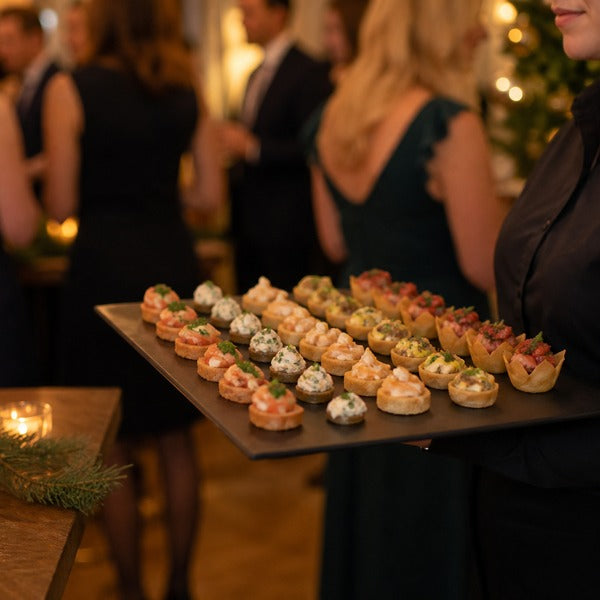
A plated dinner is the most formal format and the easiest to budget: a fixed price per plate, chosen from a limited pre-set menu, served in courses. It suits seated dinners with speeches or awards. A buffet maximizes variety and lets guests eat on their own schedule, but venues price it assuming generous consumption, so it is rarely cheaper than plated at quality restaurants. Passed appetizers with stations keep the room social and standing — ideal when mingling is the point — and typically price 15–30% below a full plated dinner, making them the format of choice for budget-conscious hosts who still want polish.
Bar strategy
The bar is where budgets slip. Your three options, in ascending cost-risk order: a drink-ticket system (each guest gets 1–2 tickets, then a cash bar), a limited hosted bar (beer, wine, and one signature holiday cocktail), or an open bar billed on consumption or per person per hour. For most company events, the limited hosted bar hits the sweet spot — festive, generous, and capped. Whatever you choose, put it in writing on the BEO with a not-to-exceed number and instruct the venue to alert your point of contact at 80% of the cap.
How Can Restaurants Host and Sell Holiday Parties Profitably?
For operators, holiday parties are the highest-leverage revenue of Q4. Restaurants that host holiday party groups every December enjoy what the rest of the year rarely offers: pre-booked covers, guaranteed minimums, deposits collected weeks in advance, and per-check averages well above a normal service. Restaurants that build a simple private-event program — a one-page packet with three menu tiers, room capacities, minimums by night, and a deposit policy — consistently convert inquiry calls that competitors lose to slow email replies. Our foodservice customers consistently tell us the operational difference between a profitable event season and a chaotic one comes down to two things: locking menus into pre-set tiers (which stabilizes food cost and prep) and standardizing the service wares so the back of house can execute a 60-top party with the same crew that runs a Tuesday.
Operational buying considerations for event season:
- Presentation at volume. Passed-appetizer and station formats live or die on serving vessels. Stocking dedicated holiday party platters and mini serving dishes lets a kitchen plate hundreds of pieces fast without cannibalizing the main dining room's wares.
- Disposables where they make sense. For cocktail-style events, dessert displays, and to-go favors, premium disposable party supplies — palm-leaf plates, bamboo picks, mini flutes — cut dish-pit load on the busiest nights of the year while keeping the look upscale.
- Seasonal styling without a remodel. Our holiday magic guide collection exists because operators asked for a fast way to turn a private room festive — metallic accents, seasonal servingware, and tabletop décor that stores flat in January.
- Menu engineering. Build event menus from dishes your line already executes; our guide on how to create a catering menu covers tiering and costing in detail.
Food safety is non-negotiable when buffets and stations sit out through a long party. The FDA's Serving Up Safe Buffets guidance is blunt: discard perishables left at room temperature for more than 2 hours, and keep hot foods hot and cold foods cold with chafers and ice baths (current as of August 2026). Build replenishment — small platters swapped often, rather than large platters sitting long — into the event plan.
Marketing the program is its own discipline: start promoting private-event availability in September, put a booking form on your site, and email last year's hosts first — repeat bookings close fastest. For front-of-house inspiration, see our roundup of the best Christmas ideas for your restaurant, and consider pairing the season with a giving-back angle from our top charity ideas for your restaurant — charity tie-ins routinely convert corporate bookers choosing between comparable venues.
Outfitting for event season? Browse our holiday party platters collection — in stock and ready to ship before your first December booking.
Frequently Asked Questions
How much does it cost to host a holiday party at a restaurant?
Hosting a holiday party at a restaurant typically costs $50–$150 per person all-in, covering food, a standard bar package, an 18–25% service charge, and tax. Private rooms carry food-and-beverage minimums — commonly $1,000–$10,000+ depending on the market, room size, and night of the week — and full buyouts run higher.
How far in advance should you book a restaurant for a holiday party?
Book at least 6–8 weeks in advance, and 10–12 weeks for Thursday–Saturday evenings in December. Private dining calendars at popular restaurants are substantially committed by early November, so September–October booking gives you first choice of dates, rooms, and menu options.
What is a private-room food and beverage minimum?
A food and beverage minimum is the required spend on food and drink to reserve a private room — it is not a fee on top of your bill. If your group's spending meets the minimum, the room costs nothing extra; if it falls short, the venue bills the difference. Confirm whether service charges and tax count toward it (they usually do not).
Should you choose a plated dinner, buffet, or passed appetizers?
Choose plated for formal seated events with predictable per-plate costs, a buffet for maximum variety with a self-paced flow, and passed appetizers for social, standing events — the passed format usually prices 15–30% below plated and keeps guests mingling, which suits most company holiday parties.
How do deposits and cancellation policies work for restaurant holiday parties?
Most venues require a deposit of roughly 25–50% of the minimum (or a flat fee) to hold the date, credited to your final bill. Deposits typically become non-refundable 2–4 weeks before the event, and cancellations inside the final week can trigger charges up to the full guaranteed amount. Get every deadline in the signed banquet event order.
Can you bring your own decorations or cake to a restaurant party?
Usually yes, with limits. Most restaurants allow table décor, centerpieces, and an outside celebration cake, but prohibit anything affixed to walls, open flames, glitter, and confetti. Expect a cake-cutting or outside-dessert fee at some venues ($1–$5 per person is common), and clear all décor with the event manager before the day.
Conclusion
A restaurant holiday party rewards early movers: shortlist venues in September, sign the banquet event order by October, and let the restaurant do what it does professionally every night — feed people well. Planners get a one-contract event with built-in staff and atmosphere; operators get pre-booked, high-margin covers that anchor the fourth quarter. Whichever side of the table you're on, the playbook above — timeline, budget framework, format choice, and a tight BEO — is the whole game.
Restaurant operators: get event-ready with our holiday magic guide collection and disposable party supplies — everything you need to execute a full private-event calendar.