What Are Reusable Food Container Programs?
A reusable food container program lets restaurants serve takeout in durable, food-safe containers that customers return for commercial washing and reuse, replacing single-use packaging. A food container return program runs on deposits, return apps, or third-party reuse services, and it cuts packaging spend and waste for operators once containers complete enough return cycles.
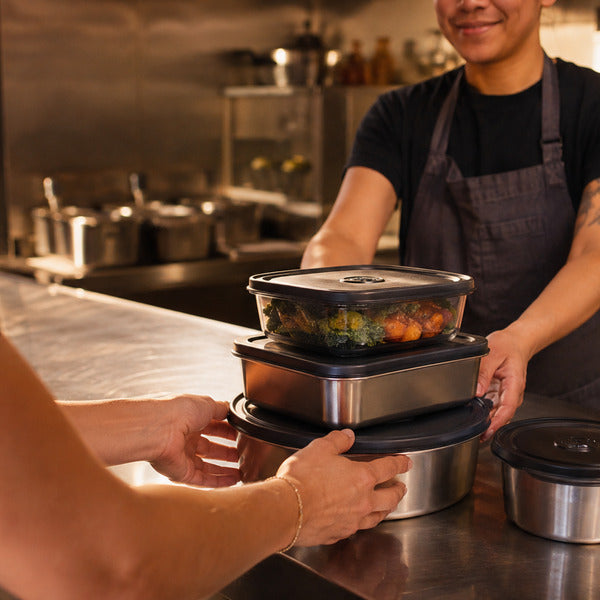
Reusable food containers are moving from campus dining halls into mainstream restaurant takeout — and the operators who run structured return programs are the ones making the economics work. A reusable food container program is not just "buying sturdier to-go boxes." It is a closed loop: serve, collect, sanitize, restock. This guide explains how these programs work, the three operating models to choose from, the FDA Food Code rules that govern them, what they cost, and how to run one in a real commercial kitchen.
TL;DR — Reusable Food Container Programs at a Glance
- Definition: A system where takeout food goes out in durable containers that customers return for professional washing and reuse.
- Three models: every reusable packaging program runs as an in-house deposit system, app-based tracking, or a third-party reuse service.
- Environmental break-even: a reusable container beats single-use after roughly 4–13 uses, per University of Michigan research.
- Return rates: the citywide Petaluma Reusable Cup Project returned over 220,000 cups — a 51% return rate that exceeded the system's environmental break-even threshold.
- Compliance: FDA Food Code 2022 §3-304.17 explicitly permits refilling returned containers when they are multiuse-rated and cleaned and sanitized per Part 4-7.
- The prize: U.S. restaurants and foodservice businesses spend about $24 billion a year on disposables (Upstream). Every completed reuse cycle claws some of that back.
What Is a Reusable Food Container Program and How Does It Work?
A reusable food container program is a managed return-and-reuse loop in which a restaurant serves takeout in durable containers, recovers them from customers, sanitizes them to health-code standards, and puts them back into service. The loop replaces the buy-use-toss cycle of disposable packaging with an asset that gets cheaper every time it completes a cycle.
The stakes are bigger than most operators realize. Containers and packaging made up 82.2 million tons of U.S. municipal solid waste in 2018 — 28.1% of everything Americans threw away — according to the U.S. Environmental Protection Agency. On the cost side, Upstream's Reuse Wins report puts U.S. restaurant and foodservice spending on disposables at roughly $24 billion per year. A container program attacks both numbers at once. (Figures current as of August 2026.)
Every program — whether it is a two-location taqueria or a citywide pilot backed by Starbucks — runs the same four-stage loop. We call it the Serve–Return–Sanitize–Restock loop:
| Stage | What Happens | Operator Responsibility |
|---|---|---|
| 1. Serve | Takeout or delivery order goes out in a multiuse-rated container; a deposit is charged or the container is checked out via app. | POS setup, staff scripting, container inventory |
| 2. Return | Customer brings the container back to the counter, a drop bin, or a partner location within the return window. | Visible drop points, return incentives, tracking |
| 3. Sanitize | Returned containers are washed, rinsed, and sanitized by food employees per FDA Food Code Part 4-7 — never refilled as-is. | Dish machine or three-compartment sink capacity, logs |
| 4. Restock | Sanitized containers are air-dried, inspected for wear, and returned to the service line. | Storage space, culling damaged units, shrink counts |
The loop only pays off if containers keep cycling. Research from the University of Michigan found that reusable takeout containers — which take more energy to manufacture up front — break even with single-use containers after four to 13 uses, depending on the disposable being replaced. Past that point, every additional cycle is pure environmental and financial gain. That is why program design — not container choice — is where most programs succeed or fail.
What Program Models Can Restaurants Choose?
Restaurants run returnable container programs under three main models: an in-house deposit system, an app-based checkout system, or a third-party reuse service. Each model trades off control, labor, and cost differently — but all of them put reusable to-go containers in customers' hands and define how those containers come back.
| Model | How It Works | Best For | Watch Out For |
|---|---|---|---|
| In-house deposit | Customer pays a refundable deposit at the register (cash or POS line item); deposit is refunded on return. | Independent restaurants, cafés, and delis with loyal regulars | Deposit accounting, containers that never come back, staff training |
| App-based checkout | Customer scans a QR code to "borrow" the container; the app tracks the loan and charges the card only if it is not returned in time. | Fast casual, campus dining, multi-unit groups that want data | Platform fees, customer app fatigue, integration with your POS |
| Third-party reuse service | A service provider supplies containers, collection bins, tracking, and in some markets off-site commercial washing; the restaurant pays per use or per month. | High-volume operators and delivery-heavy concepts that lack dish capacity | Per-cycle fees, service coverage limited to certain metros |
The strongest proof yet that shared-loop models can work at scale came from the Petaluma Reusable Cup Project, run by the NextGen Consortium — a collaboration led by Closed Loop Partners' Center for the Circular Economy with Starbucks, The Coca-Cola Company, PepsiCo, Yum! Brands, and other partners. For three months, 30 businesses across Petaluma, California served every to-go beverage in a reusable cup at no cost to the customer. Customers returned more than 220,000 cups — a 51% return rate that pushed the system past its environmental break-even point versus single-use. Notably, 79% of cups came back to a different location than where they were purchased, which shows dense, convenient return points matter more than customer loyalty to any single store. (Results published February 2025; current as of August 2026.)
How Do You Choose the Right Program for Your Operation?
Choose your program model by matching four operational realities — volume, dish capacity, customer base, and menu fit — against what each model demands. Here is the decision framework we walk operators through:
1. Takeout volume and order mix
Under roughly 50 takeout orders a day, an in-house deposit program is usually the simplest path: your regulars are the returners, and a whiteboard or POS report can track floats. Past a few hundred daily orders — or across multiple units — manual tracking breaks down and app-based or third-party tracking earns its fees.
2. Dish room capacity
Every returned container is added warewashing load. If your dish machine already runs at capacity through service, budget for off-peak wash blocks or consider a third-party service that washes off-site. Undersizing this step is the number-one program killer we see.
3. Customer geography
Return convenience drives return rates — Petaluma's 79% cross-location return figure proves customers return containers where their day takes them, not where they bought lunch. A single suburban location should keep the loop simple (deposit, counter return). Downtown clusters and campus environments can support shared bins and partner drop points.
4. Menu fit
Start with the menu items that best survive a durable container — bowls, curries, grain plates, soups — and expand from there. Items that need vented, crisp-preserving disposable packaging can stay disposable; a program does not have to be all-or-nothing. Our guide to balancing speed and quality in delivery packaging covers which formats protect which foods.
Whichever model you pick, the customer-facing rules must be printed, posted, and scripted: what the deposit is, how long the return window runs, and what condition containers should come back in. Ambiguity kills return rates faster than apathy does.
Is a Reusable Container Program Health-Code Compliant? The Sanitation Workflow
Yes — reusable food container programs are explicitly permitted under the FDA Food Code, provided containers are multiuse-rated and every returned container is cleaned and sanitized before refilling. Section 3-304.17 ("Refilling Returnables") of the FDA Food Code 2022 allows containers returned to a food establishment to be refilled with food when the container is designed and constructed for multiuse and is cleaned and sanitized as specified under Part 4-7 of the Code. Because the Food Code is a model code, your state or county may adopt it with amendments — confirm the current adopted version with your local health department before launch. (Current as of August 2026.)
In practice, a compliant sanitation workflow looks like this:
- Segregate at intake. Returned containers enter the operation as soiled ware — straight to the dish area, never across prep surfaces or the service line.
- Wash, rinse, sanitize. Run containers through your high-temp dish machine or three-compartment sink exactly as you would house dishware, meeting Part 4-7 cleaning and sanitizing requirements.
- Air-dry and inspect. No towel drying. Cull any container with cracks, deep scratches, cloudiness, or warped lids — damaged surfaces are harder to sanitize and undermine customer trust.
- Store protected. Sanitized containers go into covered, food-safe storage, inverted, off the floor — the same standard you hold for plates and pans.
- Log it. Track wash cycles and sanitizer concentration checks so you can show your health inspector a controlled process, not an improvised one.
Container material matters for compliance too. Multiuse containers must meet the Food Code's requirements for food-contact surfaces: safe materials that are durable, smooth, non-absorbent, and easily cleanable. Commercial-grade polypropylene, stainless steel, and tempered glass all qualify; thin single-use clamshells re-pressed into service do not. Stock your dish area properly as well — our rundown of cleaning supplies for commercial kitchens covers the chemicals and test strips a reuse loop depends on.
What Does a Reusable Container Program Cost — and When Does It Pay Off?
A reusable container program costs more up front and less per use, and it pays off when your return rate keeps containers cycling. The math has three levers:
- Unit cost vs. cycle count. A commercial-grade reusable container costs several times what a disposable clamshell does — but a disposable is spent after one use, while a well-made polypropylene container is rated for hundreds of commercial wash cycles. Amortized per use, the reusable wins early: even on environmental accounting, the University of Michigan found break-even at just 4–13 uses.
- Return rate. Every container that never comes back is a full replacement cost. This is why deposits and app holds exist — they convert losses into recovered fees. The Petaluma project's 51% return rate cleared its modeled break-even band; a single restaurant with a deposit system and regular customers should target much higher.
- Labor and water. Added warewashing is real but marginal when returns ride along with existing dish loads. Off-peak batch washing keeps it from touching service-hour labor.
Set against that: the disposables line item you are currently paying every week, forever, out of the $24 billion the U.S. industry spends annually. And there is a demand-side upside operators underweight. The National Restaurant Association's 2025 Off-Premises Restaurant Trends research found that 90% of off-premises customers would order a greater variety of items if the packaging held food closer to dine-in quality — and more than half, including 60% of Gen Z and millennial adults, will pay extra for packaging that maintains food quality. Rigid, gasket-lidded reusable containers are quality-holding packaging by definition. A program is not just a cost project; it is a food-quality upgrade customers will pay for. (Current as of August 2026.)
In 15+ years supplying more than 40,000 foodservice operations, we've watched the disposables line become one of the most volatile costs on the P&L — and the operators who pilot reuse on even 10% of their takeout volume are the ones who stop treating packaging as a pure expense and start treating it as an asset with a cycle count.
How Do You Run a Container Program in a Real Foodservice Operation?
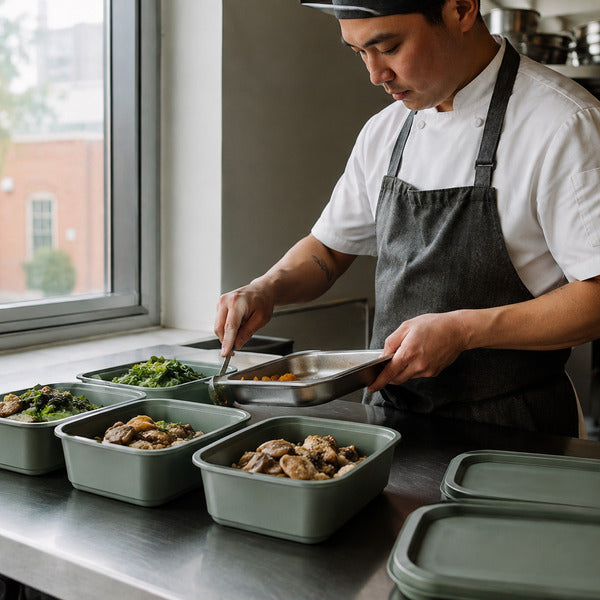
Run your first program as a 90-day pilot on a limited menu, with counted inventory and one clearly-owned return workflow. Here is the launch sequence we recommend to our customers:
- Weeks 1–2 — Spec and stock. Choose commercial-grade, dishwasher-rated vessels sized to your two or three highest-volume takeout items. Durable food storage containers with secure lids do double duty here: back-of-house prep storage and customer-facing program stock from the same SKU family simplifies inventory. Beverage-forward concepts can close the loop on drinks the same way with reusable milk & juice bottles for cold-pressed juices, cold brew, and house beverages, plus reusable straws for dine-in service.
- Week 3 — Build the loop. Add the deposit as a POS line item, place a labeled return bin where customers already queue, and write the three-sentence staff script: what it costs, when it's due back, where it goes.
- Weeks 4–12 — Cycle and count. Track four numbers weekly: containers out, containers back, containers culled, deposits kept. Return rate below 70% at week six means your return point or window is wrong — fix convenience before blaming customers.
- Week 13 — Decide. Compare per-use container cost against the disposables you displaced. Expand the menu coverage, switch models, or scale to a second location.
Our foodservice customers consistently tell us the pilot's hardest week is the first one — staff scripting feels awkward, and the return bin sits empty for a few days. By week four, regulars treat returns like library books. The operational muscle you are building is the same one behind every successful off-premise upgrade: consistent packaging, clear process, measured results. If your kitchen still runs disposables for part of the menu (most do), keep those choices sharp too — see our breakdown of the 6 types of plastics used in food packaging and our guide to navigating compliance and safety standards in packaging.
Ready to build your loop? Browse Restaurantware's commercial-grade food storage containers — durable, dishwasher-safe, and stocked for same-day shipping.
Frequently Asked Questions
How do reusable container programs work?
Reusable container programs work on a four-stage loop: the restaurant serves takeout in a durable container, the customer returns it to a counter or drop bin, staff wash and sanitize it to health-code standards, and it goes back into service. Deposits, app-based holds, or third-party services keep containers accountable between stages.
Are reusable food containers sanitary and health-code compliant?
Yes. The FDA Food Code 2022 (§3-304.17) permits refilling returned containers when they are designed for multiuse and are cleaned and sanitized under Part 4-7 of the Code before refilling — the same wash-rinse-sanitize standard applied to in-house dishware. Local jurisdictions adopt the Food Code with variations, so confirm requirements with your health department.
What containers can be reused for food?
Containers reused for food must be multiuse-rated: durable, smooth, non-absorbent, easily cleanable, and made of safe food-contact materials per the FDA Food Code. Commercial-grade polypropylene, stainless steel, and tempered glass qualify. Thin single-use clamshells, deli cups, and foam containers are not designed for commercial rewashing and should not be recirculated.
How many uses does a reusable container need to beat single-use?
University of Michigan researchers found reusable takeout containers break even with single-use containers on greenhouse-gas and energy impacts after four to 13 uses, depending on which disposable they replace. Every cycle beyond break-even compounds the advantage, which is why return rate is the metric that matters most.
Do customers actually return reusable containers?
Yes — when returns are convenient. The citywide Petaluma Reusable Cup Project saw over 220,000 cups returned, a 51% return rate that exceeded the system's environmental break-even threshold, and 79% of cups were returned somewhere other than the purchase location. Single restaurants with deposits and regular customers typically see higher rates than open citywide systems.
What does a reusable container program cost a restaurant?
Costs include container inventory (several times the unit price of disposables, amortized over hundreds of wash cycles), added warewashing labor and utilities, and platform fees if you use an app or third-party service. These are offset by eliminated disposable purchases — part of the roughly $24 billion U.S. foodservice spends on disposables yearly — plus retained deposits on unreturned containers. Most operators can model break-even from their current disposables invoice and a conservative return-rate assumption.
Conclusion: Close the Loop, Keep the Margin
Reusable food container programs turn a permanent expense into a cycling asset. The mechanics are proven — FDA Food Code compliance is explicit, break-even arrives within 4–13 uses, and real-world programs from single cafés to an entire California city have cleared their return-rate thresholds. Start with a 90-day pilot, one deposit workflow, and containers built for hundreds of cycles.
Restaurantware stocks the commercial-grade vessels to build your loop — from food storage containers to full take-out containers and to-go boxes for everything your program doesn't cover yet. Ship today, cycle for years.