Bar Cart Essentials: How To Stock A Bar Cart
Bar cart essentials are the core tools, glassware, and spirits a functional bar cart needs: a cocktail shaker, jigger, muddler, bar spoon, strainer, ice bucket, and mixing glass, plus rocks and coupe glasses and two to three base spirits. Stock tools first — a well-equipped cart mixes classic cocktails without a full bar.
A bar cart earns its keep when it can actually make a drink — not just look good in a corner. Whether you run a restaurant that rolls tableside cocktail service, cater events with a mobile bar, or entertain at home, the same bar cart essentials apply: tools first, glassware second, spirits third, styling last. In 15+ years supplying 40,000+ foodservice operations, we've watched operators sink money into beautiful carts that couldn't strain a single cocktail. This guide fixes that, in order of priority.
TL;DR — Bar Cart Essentials Checklist
- Tools (non-negotiable): cocktail shaker, jigger, bar spoon, strainer, muddler, ice bucket with tongs, mixing glass
- Glassware: 4 rocks glasses, 4 highballs, 2–4 coupes or martini glasses
- Spirits: start with 2–3 base spirits (vodka, whiskey, tequila or gin), one vermouth, one orange liqueur, two bitters
- Mixers & garnish: club soda, tonic, citrus, simple syrup, cocktail picks and napkins
- Cart: two tiers minimum, locking casters, roughly 30–36" tall for comfortable pouring
| Stocking Tier | What Goes On the Cart | Approx. Budget | Cocktails You Can Make |
|---|---|---|---|
| Starter | Shaker, jigger, strainer, bar spoon, 4 rocks glasses, 2 spirits, 2 mixers | $75–$150 | Highballs, sours, margaritas |
| Standard | + Muddler, mixing glass, ice bucket, coupes, 4 spirits, vermouth, bitters | $200–$400 | Old fashioneds, martinis, mojitos, negronis |
| Pro / Service Cart | + Fine strainer, ice molds, citrus press, cocktail picks, 6+ spirits, house syrups | $450+ | Nearly any classic, tableside |
What Are Bar Cart Essentials?
Bar cart essentials are the minimum set of equipment and ingredients that let a cart function as a working bar rather than a display shelf. The list breaks into four layers: bar tools, glassware, spirits and mixers, and serving accessories. A cart stocked in that order can build most of the classic cocktails — the same drinks that dominate bar sales year after year (we ranked them in The 10 Most Popular Cocktails).
The mistake most first-time buyers make is inverting the order: they buy ten bottles and zero tools. Ten bottles with no jigger makes exactly one drink — spirit over ice. One bottle with a full tool kit makes a dozen. Stock the hardware first and your bar cart setup pays for itself every time you skip a $16 bar tab.
Which Bar Tools Does Every Bar Cart Need?
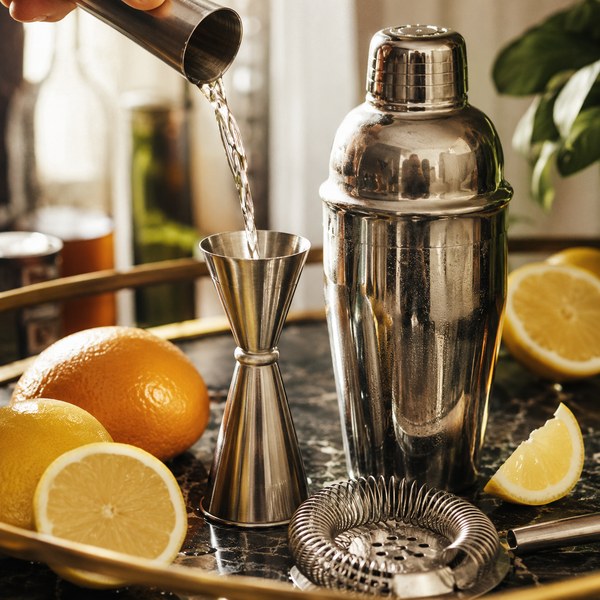
Every bar cart needs seven core tools: a cocktail shaker, jigger, bar spoon, strainer, muddler, ice bucket with tongs, and a mixing glass. These seven cover shaking, stirring, measuring, crushing, and chilling — the five mechanical jobs behind nearly every classic cocktail.
| Tool | What It Does | What the Pros Spec |
|---|---|---|
| Cocktail shaker | Chills and aerates shaken drinks (daiquiris, sours, margaritas) | 28 oz weighted Boston tin, or a 3-piece cobbler for home ease |
| Jigger | Measures pours for balance and cost control | Dual-sided 1 oz / 2 oz with interior 0.5 oz and 0.75 oz lines |
| Bar spoon | Stirs spirit-forward drinks without over-diluting | Twisted-stem, 11–12" for a standard mixing glass |
| Strainer | Holds ice back when pouring | Hawthorne for shaken; julep for stirred; fine mesh for "up" drinks |
| Muddler | Presses oils and juice from mint, citrus, berries | 8"+ hardwood or stainless with a flat, unvarnished head |
| Ice bucket + tongs | Keeps service ice clean and within reach | Double-walled stainless — condensation ruins wood cart shelves |
| Mixing glass | Builds stirred drinks (martinis, negronis, old fashioneds) | 500–700 ml seamless glass with a pour spout |
Buy these as a set or piece them together from dedicated collections of cocktail shakers, jiggers for cocktails, muddlers, and cocktail strainers. One spec note from our warehouse data: stainless steel outsells every other bar tool material for a reason — it survives commercial dishwashers, doesn't pit from citrus acid, and looks the same on year five as day one.
The jigger deserves special emphasis. Free-pouring feels faster, but a measured pour is what keeps a cocktail balanced — and what keeps alcohol service responsible. The National Institute on Alcohol Abuse and Alcoholism defines a standard drink as 1.5 fluid ounces of 80-proof distilled spirits (NIAAA, current as of July 2026) — exactly what a standard jigger's large cup measures. That is not a coincidence; it is the whole point of the tool.
What Glassware Belongs on a Bar Cart?
A bar cart needs three glass shapes to serve every major cocktail family: rocks glasses, highballs, and coupes. Four of each covers a dinner party of eight with a buffer for breakage.
- Rocks (old fashioned) glasses, 8–12 oz: for spirits neat, old fashioneds, negronis, margaritas on the rocks.
- Highball or collins glasses, 10–14 oz: for gin and tonics, mojitos, palomas, and anything topped with soda.
- Coupes or martini glasses, 5–8 oz: for anything served "up" — martinis, daiquiris, and classics like the Corpse Reviver.
Two practical buying notes from the operator side. First, buy glassware in sets of four or six from the same line — mismatched "eclectic" glass looks charming until you try to stack or store it on a 16-inch shelf. Second, weight matters more than looks on a rolling cart: a heavy-bottomed rocks glass survives the bump over a door threshold that sends a delicate tumbler to the floor.
Wine glasses and champagne flutes are welcome additions, not essentials — most carts inherit them from the kitchen anyway. If cart space is tight, skip the coupes last: a chilled coupe is the one glass that visibly upgrades a drink the moment it hits the table. For outdoor service, patios, and pool decks, swap in shatter-resistant drinkware; a broken glass ends a party faster than an empty bottle.
How Do You Stock the Spirits and Mixers?
Stock a bar cart with two to three base spirits, two modifiers, two bitters, and three mixers before buying anything else. That compact lineup — not twenty bottles — is what working bartenders call a functional starting bar.
Vodka remains America's best-selling spirit at $7 billion in 2025 supplier revenue, followed by tequila/mezcal at $6.4 billion and American whiskey at $5.1 billion (Distilled Spirits Council, current as of July 2026). Those sales rankings are a sensible shopping list — stock what your guests already order:
- Base spirits (pick 2–3 to start): vodka, bourbon or rye, blanco tequila, London dry gin, white rum
- Modifiers: dry vermouth, sweet vermouth (refrigerate both after opening), and an orange liqueur
- Bitters: aromatic (Angostura-style) and orange — two dashes transform a drink
- Mixers: club soda, tonic water, fresh lemons and limes, simple syrup (1:1 sugar and water, made in five minutes)
That shelf builds an old fashioned, martini, margarita, daiquiri, gin and tonic, whiskey sour, and negroni — seven of the drinks on any most-ordered list. For exact specs and ratios, our guide to the 10 most popular cocktails covers each recipe; this cart stocks all of them.
How Do You Choose the Right Bar Cart?
Choose a bar cart by working surface height, shelf count, and wheel quality — in that order. Looks come fourth. Here is the buying checklist we give operators:
- Height: 30–36 inches puts the top shelf at standard counter height, so you can build drinks without hunching. Taller than 38" and stirring a mixing glass gets awkward.
- Tiers: two minimum — working surface up top, backup bottles and extra glassware below. Three tiers if the cart doubles as storage.
- Casters: locking wheels are non-negotiable for any cart that moves with full bottles on board. Rubber-tread casters cross tile and carpet transitions without rattling glassware.
- Material: stainless or powder-coated steel for service use; wood and brass for stationary home carts. If it will hold an ice bucket, the shelf must tolerate condensation.
- Weight rating: a stocked cart easily carries 40–60 lbs of bottles, ice, and glass. Check the load spec before buying — flexing shelves are how bottles walk off the edge.
Sizing rule of thumb: a 30" x 16" two-tier cart comfortably runs service for groups up to about a dozen guests. Bigger events need either a second cart or a dedicated back-bar table for backup stock. Once the cart itself is sorted, outfit it in one pass from our bartending supplies collection — tools, strainers, and serviceware in one order.
How Do Foodservice Operators Stock a Bar Cart?
Foodservice operators stock bar carts for speed, durability, and per-drink cost control — three priorities the home-décor guides never mention. With total restaurant and foodservice sales projected to reach $1.55 trillion in 2026 (National Restaurant Association, current as of July 2026) and margins under persistent cost pressure, a rolling bar cart is one of the cheapest revenue programs an operator can launch: tableside cocktail service commands a premium without adding a square foot of bar.
Our foodservice customers consistently tell us the same three things separate a cart that makes money from a cart that gathers dust:
- Duplicate the high-touch tools. One jigger means one drink at a time. Service carts carry two jiggers, two strainers, and a backup shaker tin so a dropped tool never stalls a table.
- Pre-batch and garnish ahead. Carts that roll with pre-squeezed citrus, batched syrup, and skewered garnishes on reusable cocktail picks cut tableside build time roughly in half.
- Upgrade the ice. Large-format clear cubes from silicone ice molds melt slower and photograph better — and guests genuinely pay attention. In 15+ years supplying 40,000+ foodservice operations, oversized ice is the single accessory we've seen most reliably justify a $2–3 menu-price premium on an otherwise identical pour.
Operators should also watch what guests drink at home, because it walks into the dining room next. Spirits held the largest share of the U.S. beverage alcohol market for the fourth consecutive year at 42.4% in 2025, and spirits-based ready-to-drink cocktails grew 16.4% to a nearly $4 billion category (DISCUS Annual Economic Briefing, current as of July 2026). Translation for your cart program: guests increasingly expect real-spirit cocktails, and a well-run cart delivers them with more theater than any canned RTD.
How Do You Organize and Style a Bar Cart?
Organize a bar cart in three zones: build zone on the top shelf's dominant-hand side, bottle display on the opposite side, and storage below. Zoning is what keeps a cart usable once it's styled.
- Top shelf, working side: shaker, jigger, strainer, bar spoon, and a folded bar towel. Nothing decorative lives here — this is your cutting board equivalent.
- Top shelf, display side: your 2–3 prettiest bottles, bitters, and a small vase or lamp if you want the styled look. Labels face out.
- Bottom shelf: backup glassware, mixers, napkins, and the ice bucket (until service starts, when it moves up top).
A few bar cart ideas that work in both dining rooms and living rooms: hang stemware from an under-shelf rail to free flat space; corral small bar cart accessories — picks, stirrers, coasters — in a single tray so the cart never looks cluttered; and rotate the display bottles seasonally, amber spirits in winter, agave and gin in summer. Restraint styles a cart better than abundance: a cart with eight visible items looks curated, while a cart with thirty looks like storage. The same home bar essentials logic applies whether the cart lives beside a banquette or your bookshelf.
Frequently Asked Questions
What should I put on my bar cart?
Put seven tools (shaker, jigger, bar spoon, strainer, muddler, ice bucket, mixing glass), three glass shapes (rocks, highball, coupe), two to three base spirits, vermouth, bitters, and basic mixers on your bar cart. Add garnish tools and décor only after those essentials are covered.
What is the 3-2-1 rule in bartending?
The 3-2-1 rule is a memory formula for balanced cocktails: 3 parts base spirit, 2 parts sweet or liqueur, 1 part sour (citrus). The best-known example is the classic margarita — 3 parts tequila, 2 parts orange liqueur, 1 part lime juice. Use it as a starting ratio, then adjust to taste.
What are the 5 P's of bartending?
The 5 P's of bartending are most commonly cited as pride, passion, preparation, professionalism, and presentation. For a bar cart, preparation and presentation do the heavy lifting: prep citrus, syrup, and garnishes before guests arrive, and keep the cart's working zone clean throughout service.
What is the 50 rule in bartending?
The "50 rule" is informal bar shorthand with two common meanings: a service cue — when a guest's glass is about 50% empty, offer the next round — and a balance guideline of roughly equal parts alcohol and mixer in simple highballs. It is a rule of thumb, not an industry standard.
What liquor should I start with for a home bar?
Start with vodka, a bourbon or rye whiskey, and a blanco tequila — the three top-selling spirit categories in the U.S. by revenue. Add London dry gin and white rum next. Five bases plus vermouth, orange liqueur, and bitters will build the overwhelming majority of classic cocktails.
How do you organize a bar cart?
Organize a bar cart in three zones: tools on the top shelf's working side, display bottles and bitters on the other, and backup glassware, mixers, and storage on the lower shelf. Keep labels facing out, group small accessories in a tray, and leave open counter space to actually build drinks.
What size bar cart do I need?
A two-tier cart around 30–36 inches tall and 28–32 inches wide handles most homes and tableside service for groups up to roughly a dozen guests. Choose three tiers if the cart is your only liquor storage, and locking casters at any size that rolls while loaded.
Conclusion: Stock Tools First, Style Last
A great bar cart is a working bar in miniature — and the bar cart essentials that make it work are the tools, not the bottles or the brass. Start with the seven core tools, add three glass shapes, stock the spirits guests actually order, and organize in zones so the cart pours as good as it looks. Do that and one rolling shelf can cover everything from Tuesday negronis to full tableside cocktail service.
Ready to build yours in one order? Shop our full bartending supplies collection — shakers, jiggers, strainers, ice molds, and serviceware, stocked and shipped the way 40,000+ foodservice operations already buy them.