Checklist: How To Open A Ghost Kitchen
To open a ghost kitchen, secure a licensed commercial kitchen space, register your business, obtain food-service permits and health-department approval, plan a delivery-only menu, purchase equipment and takeout packaging, and onboard with delivery apps like DoorDash and Uber Eats. Most operators launch for $20,000–$60,000 within 30–60 days.
Learning how to open a ghost kitchen is one of the fastest, lowest-cost paths into the restaurant industry. A ghost kitchen — also called a cloud kitchen, dark kitchen, or virtual kitchen — is a commercial cooking facility built exclusively for delivery and takeout, with no dining room and no storefront. Every dollar goes into the food, the equipment, and the packaging that carries your brand to the customer's door. In 15+ years supplying 40,000+ foodservice operations, we've helped hundreds of delivery-only kitchens outfit entire operations around takeout containers and delivery-first workflows, and the same lesson repeats: the operators who succeed are the ones who treat opening day as a checklist, not a leap of faith.
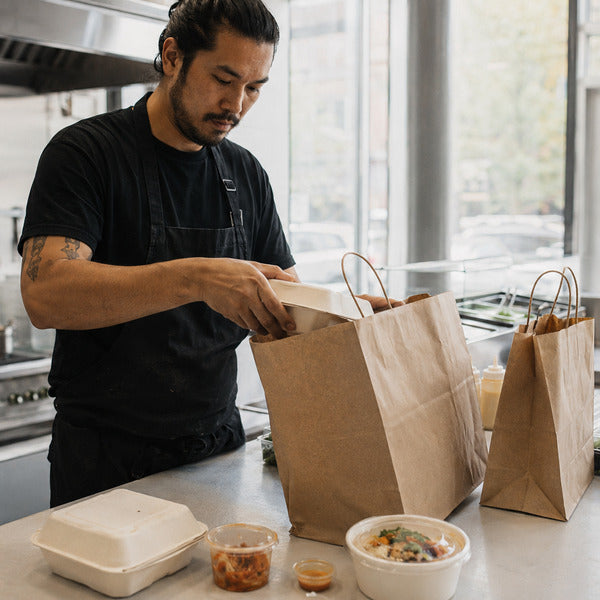
TL;DR: Ghost Kitchen Launch At A Glance
- Startup cost: roughly $20,000–$60,000 for most shared-space operators; up to $100,000+ with a full equipment build-out.
- Timeline: 30–60 days from lease to first order in a licensed shared kitchen — versus 12–18 months for a traditional restaurant.
- Non-negotiables: business license, food-service permit, health-department inspection, food handler certifications, and commercial liability insurance.
- The delivery math: nearly 75% of all U.S. restaurant traffic is now off-premises, so a delivery-only model targets the majority of demand, not a niche.
- The moat most operators miss: packaging is the only physical touchpoint a ghost kitchen has with its guests — spec it as seriously as the menu.
| Factor | Ghost Kitchen | Traditional Restaurant |
|---|---|---|
| Startup investment | $20,000–$100,000 | $175,000–$750,000+ |
| Time to open | 30–60 days | 12–18 months |
| Front-of-house staff | None | Hosts, servers, bussers, bartenders |
| Revenue channel | Delivery apps + direct online ordering | Dine-in first; delivery secondary |
| Customer touchpoint | Packaging and the delivery handoff | Full in-person hospitality experience |
| Menu flexibility | High — swap virtual brands overnight | Low — printed menus, dining-room identity |
Cost and timeline ranges per 7shifts and GoFoodservice, current as of July 2026.
What Does It Take To Open A Ghost Kitchen?
Opening a ghost kitchen takes four things: a licensed commercial kitchen space, the correct permits and licenses, a delivery-optimized menu and equipment package, and live listings on the delivery platforms your customers already use. Because there is no dining room to design, build, or staff, nearly all of your planning energy concentrates on the production line and the last mile.
How Much Does It Cost To Start A Ghost Kitchen?
Starting a ghost kitchen costs between $20,000 and $60,000 for most operators renting space in a shared or turnkey commissary facility, with build-outs reaching $100,000 or more when you add dedicated equipment, custom ventilation, or multiple virtual brands. By comparison, a traditional brick-and-mortar restaurant typically requires $175,000–$750,000+ and can take years to break even, according to 7shifts (current as of July 2026). Budget across these buckets:
- Kitchen space: shared commissary rentals commonly run $1,000–$3,500/month; dedicated ghost kitchen suites cost more but include hoods, grease traps, and utilities.
- Equipment: cooking line, refrigeration, prep tables, and smallwares — often reduced 60–70% in shared facilities where hood systems and dish pits are communal.
- Licensing and insurance: business registration, food-service permits, and general liability coverage, typically a few thousand dollars combined depending on your city.
- Packaging and consumables: takeout containers, tamper-evident seals, bags, cutlery kits, and napkins — a recurring cost that scales with order volume, so negotiate bulk pricing early.
- Technology and marketing: POS, order-aggregation tablets, and launch promotions on the delivery apps.
Does A Ghost Kitchen Need A License?
Yes — a ghost kitchen needs the same core food-service licensing as any restaurant, even without a dining room. Requirements vary by state and county, but virtually every U.S. operation needs a business license, an EIN, a food-service establishment permit, a passed health-department inspection, and food handler (and usually a certified food protection manager) certifications. Cooking from an unlicensed home kitchen and selling through delivery apps is illegal in most jurisdictions; if you want to start small, rent hours in a licensed commissary kitchen instead. One advantage of established ghost kitchen facilities: the building's core health permits, hood certifications, and grease-trap compliance are often already in place, which is a major reason launches compress into 30–60 days.
What Equipment Does A Ghost Kitchen Need?
A ghost kitchen equipment list is a restaurant line minus everything guest-facing. The core package includes:
- Cooking: ranges, fryers, griddles, or high-speed/convection ovens matched to your menu (a wing brand and a salad brand need very different lines).
- Cold storage: reach-in refrigerators and freezers, plus refrigerated prep tables for assembly speed.
- Prep: stainless work tables, commercial food processors, slicers, and scales — see our Kitchen Tek line for compact prep equipment built for tight delivery-only footprints.
- Smallwares: pans, cambros, portioning tools, squeeze bottles, and thermometers from a full kitchen supplies program.
- Delivery staging: shelving or heated staging racks near the pickup door, insulated delivery bags, and a dedicated packing station with containers, seals, and bags within arm's reach.
The Complete Checklist For Opening A Ghost Kitchen
This is the step-by-step checklist for opening a ghost kitchen that we walk new delivery-only operators through. Work it top to bottom; each step gates the next.
| Step | Task | Key Details |
|---|---|---|
| 1 | Write a cloud kitchen business plan | Define concept, target delivery radius, unit economics (food cost, packaging cost, 15–30% app commissions), and break-even volume. |
| 2 | Choose your business structure & register | LLC is most common; get an EIN, open a business bank account. |
| 3 | Secure kitchen space | Shared commissary, dedicated ghost kitchen suite, or licensed second-use of an existing restaurant kitchen. Prioritize delivery-driver access and parking. |
| 4 | Obtain licenses & permits | Food-service permit, health inspection, food handler certs, fire/occupancy where required, and insurance. |
| 5 | Engineer a delivery-only menu | Every item must survive 20–30 minutes in transit. Cut anything that arrives soggy, cold, or collapsed. |
| 6 | Buy equipment & smallwares | Match the line to the menu; lease where cash is tight. |
| 7 | Spec your packaging program | Vented containers for fried items, tamper-evident seals, leak-resistant bowls, branded bags. Test every menu item in its container with a 25-minute hold. |
| 8 | Set up technology | POS, delivery-app tablets or an aggregator, direct online ordering, and kitchen display screens. |
| 9 | Onboard with delivery platforms | DoorDash, Uber Eats, Grubhub — plus your own website ordering to protect margin. |
| 10 | Hire & train a compact team | Cooks and packers only; cross-train everyone on food safety and order accuracy. |
| 11 | Build your sanitation program | Adopt a written restaurant kitchen cleaning checklist covering daily, weekly, and monthly tasks before day one. |
| 12 | Soft launch, then scale | Run friends-and-family orders, time your pack-out, fix bottlenecks, then switch the apps live. |
Two supporting resources worth bookmarking as you work the list: our guide to selecting the right venue for high-volume foodservice functions (the same site-evaluation logic — utilities, workflow, access — applies to kitchen facilities), and our catering supplies checklist if your ghost kitchen will also produce catering or bulk orders, which many do to smooth demand between delivery day-parts.
How Ghost Kitchens Took Over The Restaurant Industry
Ghost kitchens took over the restaurant industry because consumer demand moved off-premises and never moved back. Nearly 75% of all U.S. restaurant traffic now happens off-premises — takeout, drive-thru, or delivery — according to the National Restaurant Association's 2025 Off-Premises Restaurant Trends report. The same research found two-thirds of Gen Z and millennial consumers call takeout essential to their lifestyle, and nearly 6 in 10 order takeout or drive-thru at least weekly (current as of July 2026).
The pandemic was the accelerant: by 2021, CloudKitchens reported that 51% of U.S. restaurateurs had already shifted to ghost kitchens or virtual kitchens — a majority of the industry experimenting with delivery-only production in a single disruptive stretch. The model stuck because the economics work: no front-of-house payroll, no prime-corner rent, and the ability to launch or kill a virtual brand in days instead of quarters.
The ghost kitchen industry is now a major market in its own right. The global ghost kitchens market is projected to grow from $97.2 billion in 2025 to $112.99 billion in 2026 — a 16.2% annual growth rate — and to reach $204.33 billion by 2030, per The Business Research Company (current as of July 2026).
What Are The Advantages Of A Ghost Kitchen?
The benefits of a ghost kitchen come down to lower risk and faster iteration:
- Lower startup and operating costs — no dining room build-out, no servers, smaller square footage.
- Speed to market — 30–60 days to first order in a licensed shared facility.
- Multi-brand leverage — one kitchen can run several virtual brands from shared ingredients, multiplying delivery-app shelf space.
- Data-driven menus — every order arrives digitally, so you can A/B test items, pricing, and photos weekly.
- Location flexibility — you need delivery-radius density, not foot traffic, so cheaper industrial or second-tier real estate works.
Are Ghost Kitchens Good For Large-Scale Food Production Or Just Delivery?
Ghost kitchens are good for both. While the model is delivery-first, the same licensed, production-optimized kitchen is well suited to large-scale output: catering programs, meal-prep subscriptions, wholesale items for local retailers, and commissary production for food trucks or satellite locations. Because there is no service window tied to a dining room, operators schedule long production blocks during off-peak hours — a wing brand at night can be a meal-prep operation by day. Many multi-site restaurant groups now use ghost kitchens as central production hubs that feed their whole system.
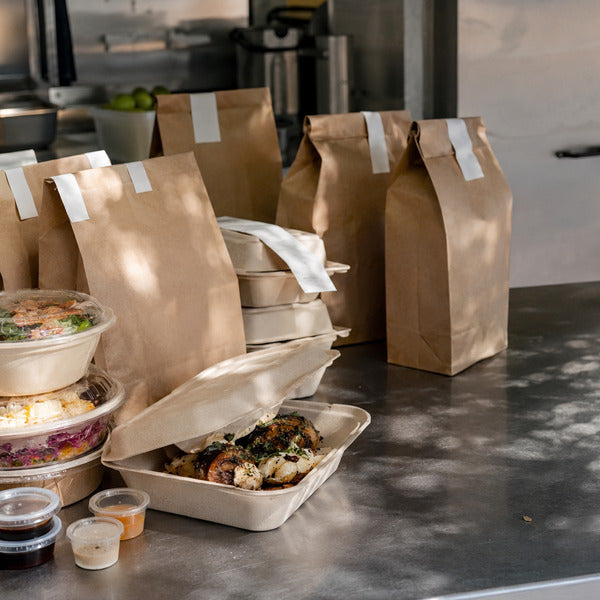
How Do You Select The Ideal Packaging For Diverse Ghost Kitchen Menus?
Selecting packaging for a diverse ghost kitchen menu means matching each menu category — and each virtual brand — to a container engineered for its food, then consolidating those choices into one manageable consumables footprint. Our foodservice customers consistently tell us packaging is the only physical touchpoint a ghost kitchen has with its guests: there is no host, no plating, no ambiance. The container is the dining room. Get it wrong and a five-star dish earns a one-star review.
Match The Container To The Food, Not The Brand Logo
- Fried and crispy items: vented containers or vented-lid boxes that release steam so coatings stay crunchy through a 25-minute ride.
- Saucy and brothy dishes: leak-resistant, tight-seal round bowls and soup containers; double-check seal integrity when the container is filled hot.
- Hot + cold combos: multi-compartment containers or separate vessels so dressings, slaws, and garnishes never ride against hot proteins.
- Premium entrées: rigid, high-wall take-out containers and to-go boxes that survive stacking in a delivery bag and open flat for presentation.
- Beverages and desserts: spill-proof lids and separate small-format bags — nothing torpedoes a rating like a milkshake tipped into a burger box.
How Do You Run Multiple Virtual Brands Without A Packaging Explosion?
Ghost kitchens running experimental delivery menus or several concepts from one line should standardize on a compact family of container sizes and differentiate brands with labels, sleeves, and stickers rather than separate SKUs. In 15+ years supplying 40,000+ foodservice operations, the pattern we see in successful multi-brand kitchens is a "core five" consumables footprint — one entrée box, one bowl, one small side cup, one drink lid system, one bag size range — that serves every concept in the building. That discipline cuts storage space, simplifies reordering, prevents packers from grabbing the wrong container during a rush, and unlocks bulk pricing on the handful of SKUs you actually use. When a new experimental menu launches, it must fit the core five before it earns its own packaging.
Delivery Food Safety: Seal It, Hold It Hot, Prove It
Temperature control is the packaging spec most new operators underweight. Bacteria multiply fastest between 40°F and 140°F — the "Danger Zone" — doubling in as little as 20 minutes, per USDA Food Safety and Inspection Service guidance (current as of July 2026). A delivery order can spend 20–30 minutes in that window if it leaves the kitchen barely hot in thin packaging. Insulated delivery bags from our Delivery Tek collection keep food out of the danger zone in transit, and tamper-evident containers and seals — see our Tamper Tek line — give customers visible proof the order was untouched between your packer and their door. Delivery apps and health departments increasingly expect tamper-evident packaging on third-party orders; building it into your spec from day one is cheaper than retrofitting after a complaint.
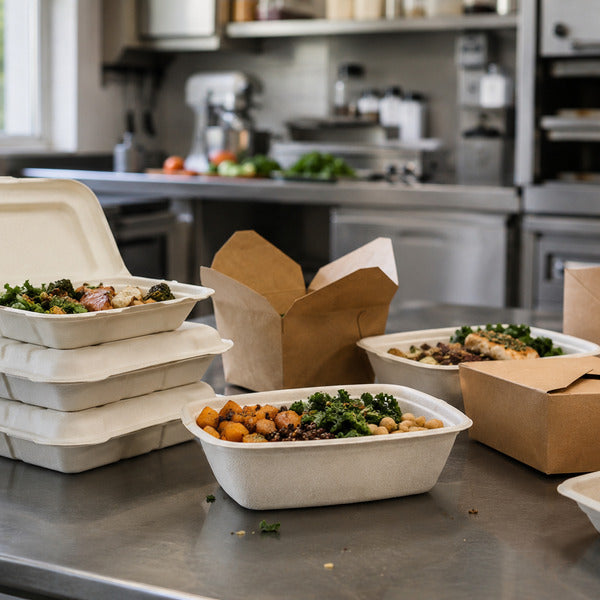
What Are The Best Sustainable Packaging Choices For Eco-Friendly Ghost Kitchens?
Sustainable ghost kitchen packaging means compostable, recyclable, or renewable-fiber containers — bagasse (sugarcane), molded pulp, kraft paper, bamboo, and PLA-lined alternatives — chosen to replace conventional plastic and foam without sacrificing transit performance. For a delivery-only brand, sustainability is unusually visible: the customer literally holds your environmental choices in their hands with every order, and unboxing photos travel further than any ad. Our eco-friendly disposables collection covers compostable containers, plates, and cutlery purpose-built for this trade-off.
Choosing Materials That Survive Delivery
- Bagasse and molded fiber: excellent heat tolerance and rigidity for hot entrées; naturally vented enough to limit sogginess.
- Kraft paper boxes with grease-resistant linings: strong stacking performance and a premium, earthy shelf presence customers photograph.
- PLA and rPET: clear cold-cup and salad formats — verify local composting or recycling streams before printing claims on the label.
- Check local rules: foam bans and single-use plastic ordinances now apply in many U.S. cities and states; spec compliant materials once, rather than re-speccing per market.
How Do You Choose Bulk Packaging That Cuts Waste Across Multi-Site Kitchens?
Bulk packaging cuts waste when you standardize SKUs across every site, right-size containers to actual portions, and order case quantities matched to real velocity. The playbook for multi-site and cloud kitchen groups:
- One spec sheet, every location: a shared packaging standard eliminates orphaned cases of one-off containers that expire in dry storage.
- Right-size the vessel: oversized containers waste material and make portions look small; portion-matched sizes cut per-order packaging weight.
- Audit your waste stream: track what your kitchens throw away for two weeks — packaging film, mis-picks, damaged cases — then attack the top three sources. A structured waste-management review often pays for the sustainable-packaging price premium by itself.
- Consolidate suppliers: fewer vendors means fewer shipments, less inbound packaging waste, and stronger bulk-tier pricing on the SKUs that matter.
- Close the loop with customers: print disposal instructions ("compost me," "recycle #1") on or in the bag so the sustainability spend actually lands in the right bin.
Outfitting Your Ghost Kitchen: Where Restaurantware Fits
Restaurantware has supplied delivery-first operations for over 15 years, and the equipment-and-consumables package for a ghost kitchen is a solved problem. A typical launch order we assemble for a new delivery-only kitchen looks like this:
- Packing line: stackable, leak-resistant take-out containers and to-go boxes in a standardized size family, plus cutlery kits and napkins.
- Order integrity: Tamper Tek tamper-evident containers and seals for every third-party order.
- Transit temperature: Delivery Tek insulated delivery bags sized to your bag-out volume.
- Back of house: Kitchen Tek work tables and prep equipment plus core kitchen supplies for a compact line.
- Sustainability track: eco-friendly disposables where your brand or local regulations call for compostable formats.
One concrete observation from the field: the single most common day-one failure we see is a great menu packed in containers that were never transit-tested. Before you go live, pack every menu item, drive it around for 25 minutes, and open it. What you see is what your customer rates.
Frequently Asked Questions
How much does it cost to start a ghost kitchen?
Starting a ghost kitchen costs $20,000–$60,000 for most operators using shared or turnkey kitchen space, and up to $100,000+ for dedicated build-outs with full equipment packages. That compares to $175,000–$750,000+ for a traditional restaurant. Major line items are kitchen rent, equipment, licensing, packaging, and delivery-app technology.
Is owning a ghost kitchen profitable?
A ghost kitchen can be profitable because it eliminates front-of-house labor and dining-room rent, but margins depend on managing delivery-app commissions of roughly 15–30% per order. Profitable operators push direct online ordering, run multiple virtual brands from one line to raise volume, engineer menus around high-margin travel-friendly items, and control packaging and food costs with bulk purchasing. With demand structurally high — nearly 75% of U.S. restaurant traffic is off-premises — a well-run delivery-only kitchen reaches break-even far faster than a traditional restaurant carrying dining-room overhead.
Does a ghost kitchen need a license?
Yes. A ghost kitchen needs a business license, a food-service establishment permit, a passed health-department inspection, and food handler certifications, plus liability insurance — the same core requirements as a dine-in restaurant. Renting a licensed shared commercial kitchen shortcuts much of the facility-level compliance, which is why most first-time operators start there rather than building out their own space.
How long does it take to open a ghost kitchen?
Most ghost kitchens open in 30–60 days when renting licensed shared kitchen space, since the facility's health permits, hoods, and utilities already exist. A dedicated build-out with new construction and inspections extends the timeline to several months — still far shorter than the 12–18 months typical for a traditional restaurant.
Can I start a ghost kitchen from home?
In most U.S. jurisdictions, no — delivery platforms and health departments require food sold commercially to come from a licensed commercial kitchen, and standard home kitchens don't qualify. Some states' cottage food laws allow limited home production of low-risk foods, but hot meals for app-based delivery almost always require licensed space. The practical workaround is renting hours in a commissary kitchen, which keeps startup costs low while keeping you fully legal.
Conclusion: Work The Checklist, Then Defend The Doorstep
Knowing how to open a ghost kitchen is ultimately about sequencing: plan, license, equip, package, launch. The kitchen line gets your food made; the packaging program gets your brand delivered. With off-premises dining now the default way America orders restaurant food, a delivery-only kitchen that nails temperature, seal integrity, and presentation at the doorstep competes with restaurants ten times its budget. And when you’re ready to put a face on the brand, our guide on how to start a pop-up restaurant maps the natural next step.
Ready to outfit your launch? Start with our take-out containers and to-go boxes, add Delivery Tek insulated bags for the last mile, and build out your line with kitchen supplies trusted by 40,000+ foodservice operations.