Fine Dining At Home: How To Enjoy The Restaurant Experience Without Leaving
Fine dining at home means recreating a restaurant-quality experience — a multi-course menu, refined plating, polished tableware, and intentional ambiance — in your own dining room. Three elements separate it from an ordinary dinner: professional plating, upscale dinnerware and glassware, and atmosphere (lighting, linens, music). Start with quality plates, flatware, and cloth napkins.
You don't need a reservation to eat like you have one. Fine dining at home is one of the fastest-growing ways people are treating themselves: according to the National Restaurant Association's 2026 State of the Restaurant Industry report, more than 7 in 10 consumers say they would dine out more often if they had more disposable income — which means millions of people are hungry for the restaurant experience but recreating it in their own dining rooms instead. The good news: after 15+ years supplying more than 40,000 foodservice operations with plates, glassware, and plating tools, we can tell you the "restaurant magic" is a repeatable system — and every part of it works at home. This guide walks you through the full playbook: menu planning, plating, tableware, table setting, and ambiance.
TL;DR: The 5 Elements Of Fine Dining At Home
A fine dining experience at home is built from five elements restaurants control on purpose: menu structure, plating, tableware, table setting, and ambiance. Get each one roughly right and the whole evening feels intentional. Here is the quick comparison of an ordinary dinner versus a restaurant-style dinner at home:
| Element | Ordinary Dinner | Fine Dining At Home |
|---|---|---|
| Menu | One dish, served all at once | 3–5 courses, paced 20–30 minutes apart |
| Plating | Food scooped onto the plate | Composed plates: focal point, sauce work, negative space |
| Tableware | Everyday mixed dishes | Matching porcelain plates, stemmed glassware, full flatware |
| Table setting | Fork and a paper towel | Charger plates, cloth napkins, course-by-course place setting |
| Ambiance | Overhead lights, TV on | Dimmed lighting, candles, background music, phones away |
What Is Fine Dining At Home?
Fine dining at home is the practice of applying restaurant techniques — coursed menus, professional plating, upscale tableware, and deliberate atmosphere — to a meal served in your own home. It is not defined by expensive ingredients. A $12 roast chicken plated on white porcelain with a proper sauce, served by candlelight in three courses, reads as fine dining. A $60 steak dropped on a mismatched plate under fluorescent light does not.
That distinction matters because it is exactly how restaurants think. Restaurants are a $1.55 trillion industry in 2026 (projected total restaurant and foodservice sales, per the National Restaurant Association, current as of July 2026), and a large share of what customers pay for isn't the food — it's the experience layer wrapped around the food. The plate shape, the weight of the fork, the fold of the napkin, the dim of the lights. Every one of those is a purchasable, learnable element. That's the premise of this entire guide: the restaurant experience at home is assembled, not improvised.
How Do You Plan A Restaurant-Style Menu At Home?
Plan a restaurant-style menu at home by choosing 3–5 courses that build in intensity, doing 80% of the prep before guests sit down, and pacing courses 20–30 minutes apart. Restaurant style meals at home fail most often from over-ambition, not under-skill — so pick dishes you can stage in advance.
Structure The Courses
- Amuse-bouche (optional): one bite, served on a spoon or tasting dish. This single touch signals "restaurant" faster than anything else on the menu.
- Starter: a cold or room-temperature dish — crudo, salad, soup — that can be plated before anyone arrives.
- Main: one protein, one sauce, one starch, one vegetable. Resist the urge to add more components; restaurant mains are edited, not crowded.
- Dessert: make-ahead wins here — panna cotta, chocolate mousse, or a plated tart.
Pair The Beverages
A different pour with each course is the single easiest upgrade. You don't need a sommelier's cellar — one white with the starter, one red with the main, and something sweet or sparkling with dessert covers the classic arc. For the actual matching logic (acid with fat, weight with weight, sweet with heat), see our full guide on how to pair wine with food.
Mind The Timing — And The Temperature
Pacing is hospitality, but it has a food-safety edge case: perishable food should never sit out of temperature control for more than 2 hours, because bacteria in the 40°F–140°F "Danger Zone" can double in as little as 20 minutes, per USDA Food Safety and Inspection Service guidance (current as of July 2026). If you're coursing a long dinner, hold hot components at 140°F or above in a low oven and keep cold courses refrigerated until the moment you plate. Restaurants live by this rule; home hosts should too.
How Do You Plate Food Like A Fine Dining Restaurant?
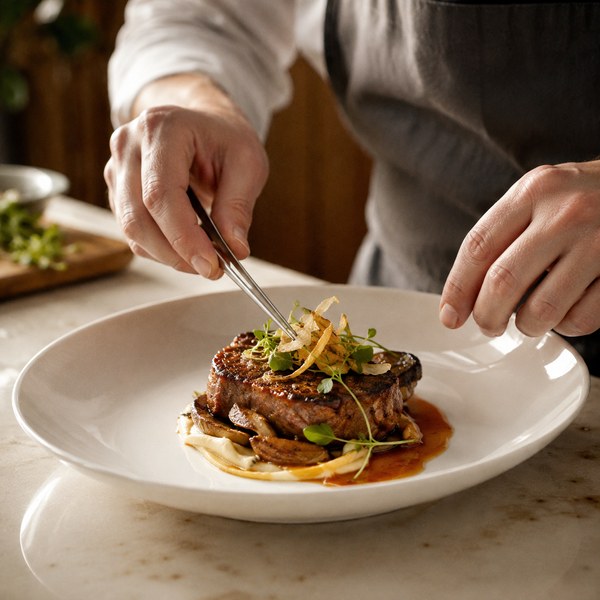
Plate food like a fine dining restaurant by using a large white plate, placing the main element off-center, adding sauce with intention (a swoosh, dots, or a pool under the protein), and leaving 30–50% of the plate empty. Negative space is the fastest "tell" of professional plating — crowded plates read homemade, composed plates read restaurant.
The working method our chef customers use, condensed to five steps:
- 1. Pick the canvas. White, matte or glossy, 10–12 inches. Wide-rim and coupe shapes frame food the way a mat frames a photo.
- 2. Anchor the focal point. Place the protein slightly off-center — imagine the plate as a clock and build around 5 o'clock.
- 3. Sauce first or last, never puddled. Swoosh with the back of a spoon, dot with a squeeze bottle, or pool beneath the protein.
- 4. Build height. Lean elements against each other; flat plates look like cafeteria trays.
- 5. Garnish only what belongs. Every garnish should be edible and echo a flavor already on the plate.
In 15+ years supplying 40,000+ foodservice operations, we've watched plating trends move from tall, architectural stacks to today's low, naturalistic compositions — but the fundamentals above haven't changed since Escoffier. A small set of plating tools — offset spatula, plating tongs, saucier spoon, squeeze bottles — costs less than one restaurant entrée and covers 95% of techniques. For the complete technique breakdown with examples, read our dedicated guide to food plating and presentation tips.
What Tableware Do You Need For Fine Dining At Home?
Fine dining at home requires five tableware categories: white porcelain dinner plates, full-size stainless flatware, stemmed wine glasses, cloth napkins, and (optionally) charger plates. This is the exact kit restaurants standardize on, and it's the section where our day job gives us an unfair advantage — these are the products we supply to working restaurants every day.
Our foodservice customers consistently tell us the same thing when they open a new dining room: guests judge the table before the first course lands. The same psychology applies at your dining table. Here's the operator-grade starter kit, in priority order:
| Item | What To Buy | Why It Matters |
|---|---|---|
| Porcelain plates | White coupe or wide-rim dinner plates, 10–12", plus smaller plates for starters and dessert | The single biggest visual upgrade; white porcelain makes every dish look composed |
| Flatware | 18/10 or 18/0 stainless in a matching pattern — dinner fork, salad fork, knife, teaspoon minimum | Weight in the hand signals quality before the first bite |
| Wine glasses | Stemmed all-purpose glasses; add coupes or flutes if you serve cocktails or sparkling | Stemware changes posture — people literally sit and sip differently |
| Cloth napkins | Cotton or linen-feel dinner napkins, pressed and folded | The #1 lowest-cost, highest-impact fine dining signal |
| Charger plates | Chargers in gold, silver, or natural texture under each place setting | Frames every course and keeps the setting anchored between plates |
One buying tip from the supply side: buy plates and glasses the way restaurants do — a couple of spares beyond your seat count. Breakage is inevitable, and discontinued patterns are the reason so many home cabinets hold five plates of everything. Browse the full porcelain plate collection to build a matched set that survives years of dinner parties.
How Do You Set A Fine Dining Table At Home?
Set a fine dining table at home by working from the outside in: charger at center, flatware placed in order of use (outermost pieces first), glassware at the upper right, and the cloth napkin on the charger or to the left of the forks. Guests use the outside-in rule automatically, so a correctly ordered setting quietly guides the whole meal.
The 60-second version for a three-course dinner:
- Charger plate centered on each setting; starter plate on top when guests sit.
- Forks left (salad fork outside, dinner fork inside); knife right with blade facing the plate; spoon right of the knife.
- Dessert fork or spoon horizontal above the charger.
- Water glass above the knife; wine glass to its right at a diagonal.
- Cloth napkin folded on the charger, in a napkin ring, or under the forks.
Formal service adds bread plates, butter knives, and multiple wine glasses; casual service subtracts. We keep a full diagram-level walkthrough — including formal versus casual layouts — in our guide on how to set tables for formal and casual dining, so this article won't rehash it: set the table once from that guide and the skill sticks for life.
How Do You Create Restaurant Ambiance At Home?
Create restaurant ambiance at home by controlling three things restaurants engineer deliberately: lighting (dim, warm, and low), sound (background music at conversation level), and visual order (a cleared table, a pressed runner, no packaging in sight). Ambiance is why the same dish tastes different in a dining room than in a kitchen — context is a seasoning.
Lighting
Kill the overhead lights. Fine dining rooms run warm and low — think 2,700K bulbs on dimmers, plus point sources of flame-level light at the table. Real or flameless table candles and lamps do most of the work; restaurants use rechargeable table lamps precisely because they flatter both the food and the faces around it.
Sound
Music at a volume where conversation never strains — jazz, bossa nova, or acoustic playlists are defaults for a reason. And turn the TV off; nothing collapses a fine dining experience at home faster than a glowing screen.
Service Rituals
Borrow the small rituals: water poured before anyone asks, wine presented and poured at the table, plates cleared only when everyone finishes, dessert offered rather than assumed. If you're hosting, plate in the kitchen and carry finished plates out — the reveal moment is half the theater of how to create a restaurant experience at home.
Date Night Dinner At Home: A One-Evening Blueprint
A date night dinner at home is the most common reason people attempt fine dining at home, so here is the complete two-person blueprint — achievable on a weeknight with one cook:
- 5:30 pm — Set the stage. Table set with chargers, cloth napkins, stemware; candles positioned; playlist queued; dessert already made and chilling.
- 6:00 pm — Prep the courses. Starter plated and refrigerated; main components prepped to the final-cook stage; sauce made and held warm.
- 7:00 pm — Course one. Pour the first wine, serve the cold starter. No kitchen time required — you did it at 6:00.
- 7:30 pm — Course two. Ten minutes of finish-cooking, plate at the counter, carry both plates out together. Pour the second wine.
- 8:15 pm — Dessert. Pull the made-ahead dessert, add one garnish, serve with coffee or a dessert pour.
The pattern to notice: every course is 80% done before the evening starts. That's how a single host stays at the table instead of at the stove — and it's the same mise en place discipline every professional kitchen runs on.
Frequently Asked Questions
What is fine dining at home?
Fine dining at home is recreating a restaurant-quality experience — multi-course menu, professional plating, upscale tableware, and intentional ambiance — in your own dining room. It's defined by presentation and atmosphere, not ingredient cost: coursing, white porcelain, cloth napkins, and dim lighting do most of the work.
How can I make dinner at home feel like a restaurant?
Serve the meal in courses instead of all at once, plate food in the kitchen and carry finished plates to the table, dim the lights and add candles, use cloth napkins and stemmed glasses, and play background music. Those five changes convert an ordinary dinner into a restaurant experience at home without changing the recipe.
How do you plate food like a fine dining restaurant?
Use a large white plate, place the protein off-center, apply sauce deliberately (swoosh, dots, or a pool), build a little height, and leave 30–50% of the plate empty. Basic plating tools — tongs, a saucier spoon, squeeze bottles — make each step dramatically easier.
What tableware do you need for fine dining at home?
Five categories: white porcelain dinner plates (plus starter and dessert sizes), matching stainless flatware, stemmed wine glasses, cloth napkins, and charger plates. That kit mirrors what restaurants standardize on and covers every course of a formal dinner.
How do you set a fine dining table at home?
Work outside-in: charger centered, forks on the left and knife and spoon on the right in order of use, dessert utensil above the plate, water and wine glasses at the upper right, cloth napkin on the charger. Formal settings add bread plates and extra glasses; casual settings subtract.
What are good date night dinner ideas at home?
Choose a three-course menu where two courses are made ahead: a cold starter (crudo, burrata, or salad), one pan-finished main (seared steak, scallops, or duck breast with a pan sauce), and a chilled make-ahead dessert (panna cotta or chocolate mousse). Pair each course with a different pour and plate everything in the kitchen.
Bring The Restaurant Home
Fine dining at home isn't a talent — it's a checklist. Structure the menu in courses, plate with intention, set the table properly, control the light and sound, and serve with a few borrowed rituals. Every element in this guide is the same system 40,000+ restaurants use nightly, scaled down to one table. Start with the two upgrades that punch hardest — white porcelain plates and cloth napkins — then build out your plating tools and glassware as your dinners get more ambitious. The reservation is yours whenever you want it.