Tamper Evident Packaging For Takeout: Types, Seals And Fit
Tamper evident packaging is any container, seal, band or label that leaves visible proof once a package has been opened. It does not stop someone from getting in. It shows the customer that nobody did, which is the point on a delivery order that sits unattended between your counter and their door.
Key takeaways
- Tamper evident packaging shows the customer whether a package has been opened. It does not prevent entry, and the foodservice formats below are all built for evidence.
- No federal rule requires a seal on restaurant takeout. The 2026 FDA Food Code does not use the term for packaging.
- Five formats cover almost every menu: locking-lid containers, security seals, adhering paper bands, tamper-evident labels, and heat seal film or tear tape.
- Match the format to the package you already use. A band suits a clamshell, a seal suits a bag, a locking lid suits a bowl.
- A seal only works if staff apply it the same way every time and the customer can still open it without a knife.
What is tamper evident packaging?
Tamper evident packaging is a container or closure carrying an indicator that breaks, tears or marks when the package is opened. The clearest federal definition sits in drug regulation rather than food rules, and foodservice borrowed it, because the underlying idea travels well: evidence beats resistance when the customer is the one doing the checking.
The Food and Drug Administration defines the term in 21 CFR 211.132, a rule titled Tamper-evident packaging requirements for over-the-counter (OTC) human drug products. It describes a tamper-evident package as "one having one or more indicators or barriers to entry which, if breached or missing, can reasonably be expected to provide visible evidence to consumers that tampering has occurred."
Read that definition closely, because two parts of it matter for a takeout order. The indicator has to be visible to the customer, not to you, so a seal hidden under a bag fold earns nothing. And it has to be missing or breached in a way that cannot be undone, which rules out anything a person can smooth back down.
The same rule adds a second test that is easy to miss. The package has to be "distinctive by design" or carry an identifying characteristic such as a pattern, name, logo or picture, and it defines distinctive by design as packaging that "cannot be duplicated with commonly available materials or through commonly available processes." A strip of clear tape fails that test. A printed band does not.
Tamper-evident packaging vs. tamper-resistant packaging
The two terms get used interchangeably and they are not the same thing. Tamper-evident packaging shows that a package was opened. Tamper-resistant packaging is built to make opening it difficult in the first place. A zip tie through the handles of a bag is evident. A locked catering cabinet is resistant.
Foodservice almost always wants the first one. You are not trying to defeat a determined person with a pocket knife, and you could not at these price points anyway. You are trying to give the customer a clear yes or no answer to one question when the bag arrives, and to give yourself a defensible answer when they call to say the order looked opened.
Does the FDA require tamper evident packaging for restaurant food?
No. There is no federal rule requiring a seal on a restaurant takeout order. The rule quoted above covers over-the-counter drugs, not food, and the FDA Food Code does not use the term for packaging at all. The pressure to seal orders comes from somewhere else entirely.
We checked the 2026 FDA Food Code text directly. It contains no packaging use of tamper-evident, tamperproof or tamper-resistant. Its only tamper-resistant language covers rodent bait stations at 7-206.12, which requires rodent bait to be held in a covered, tamper-resistant bait station, and a passing reference to tamper-resistant bait boxes in the Annex 3 discussion of pesticide devices. The concept the Food Code does carry is food defense, defined in the list of terms at 1-201.10 as "the effort to protect food from acts of intentional adulteration or tampering."
That is a goal rather than a specification. The Food Code points operators toward the FDA's own food defense guidance for retail food stores and food service establishments, which it describes as covering mobile food carts, restaurants and vending machine operators, and which identifies preventive measures operators may take. It names no seal, no material and no format.
States and counties adopt the Food Code on their own schedule and often amend it, so confirm the version your local health department enforces. Delivery platforms push for sealing rather than require it, and the wording sits in their merchant terms rather than in public health rules. Check your own platform agreements, since terms vary.
The five types of tamper evident packaging for foodservice
Five formats cover nearly every takeout menu: locking-lid containers, security seals or zip ties, adhering paper bands, tamper-evident labels, and heat seal film or tear tape. Locking lids add no step at the pass, seals close a whole bag, bands and labels fit packaging you already stock, and film suits high-volume bowl lines.
| Seal type | How it shows tampering | Best for | Restaurantware range |
|---|---|---|---|
| Locking-lid container | Molded lid tabs snap on first opening and stay broken | Salads, grain bowls, parfaits, sandwiches | Tamper Tek |
| Security seal or zip tie | Must be cut to open and cannot be refastened | Bags, catering boxes, cooler lids, bulk drops | Serve Secure |
| Adhering paper band | Tears across the seam when the lid is lifted | Clamshells, bakery boxes, wrapped plates | Chef 101 paper packaging bands |
| Tamper-evident label | Damages itself or leaves residue when peeled | Cup lids, carton flaps, bag folds | Label Tek Plastic Fresh Label |
| Heat seal film or tear tape | Film or tape breaks and cannot be smoothed back | Bowls run on a sealing line at volume | Not in this range; needs a sealing machine |
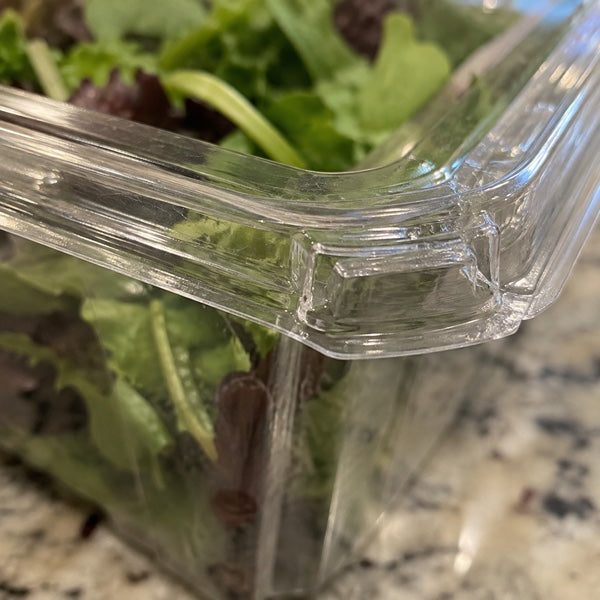
- Locking-lid containers: the lid carries molded tabs that snap when it is first lifted and stay broken. Nothing to apply and nothing to run out of, which is why this is the lowest-effort option at the pass. The whole Tamper Tek range works this way, whichever lid the listing title names, including the hinged-lid containers.
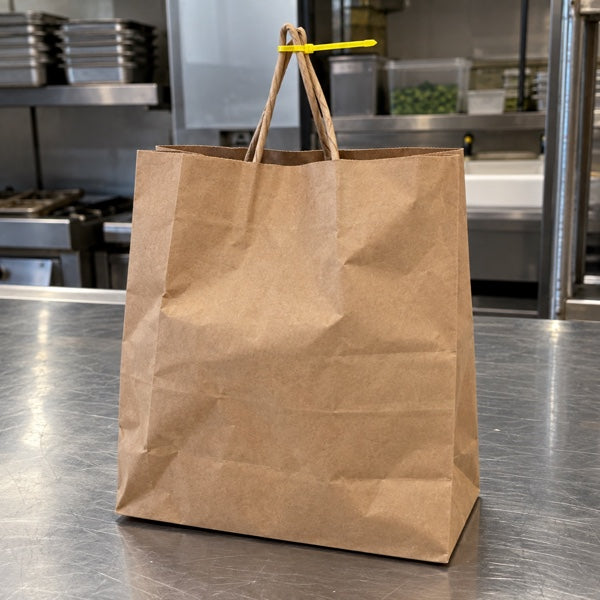
- Security seals and zip ties: a colored tie with a write-on handle for the order number that has to be cut and cannot be refastened. This is the only format on the list that seals a bag rather than a container, so it is what you reach for on a full order rather than a single item. The Serve Secure range comes in five colors at 7 3/4 inches, plus a 15 3/4 inch self-locking security seal for larger handles and cooler lids.
- Adhering paper bands: a printed paper strip that wraps the seam and tears when the lid is opened. Paper rather than plastic, which matters to some operators, and the printing on the band makes it hard to swap for a lookalike. The FDA's drug rule calls this an identifying characteristic. A plain colored band doesn't count. The Chef 101 bands are 12 inches and come in kraft, white, black, midnight blue and eco green.
- Tamper-evident labels: an adhesive label that damages itself or leaves residue when peeled, so a removed label cannot be reapplied cleanly. Useful where the package has no seam to band, such as a cup lid or a carton flap.
- Heat seal film and tear tape: film sealed onto a bowl rim by a machine, or a narrow tape that breaks across the opening. Heat-sealable bags close the same way with an impulse sealer, and bottled drinks or sauce cups take a label across the cap. The strongest evidence of the five and the fastest at volume once the sealing line is running, but it needs a sealing machine and a matching bowl, so it suits a high-volume operation rather than an occasional delivery order.
One honest caveat, carried over from the earlier version of this guide: stretch film over a tray is not reliable evidence. It looks loose when it has been disturbed, but it also looks loose when it has been jostled in a car, and a person can rewrap a tray well enough to pass a glance. Treat film as a freshness and spill measure, not as a seal.
How to choose a tamper evident container by menu item
Start from the package the item already ships in, not from the seal. If the dish travels in a bowl, a locking-lid bowl is a straight swap. If it travels in a bag of several items, seal the bag. The chart below lists the Tamper Tek range by capacity, shape and lid type.
| Capacity | Shape | Lid, as titled | Dimensions | Material |
|---|---|---|---|---|
| 8 oz | Rectangle | with Hinged Lid | 4 3/4" x 6" x 1 1/4" | PET |
| 11 oz | Parfait cup | with Lid | 4 1/4" x 4 1/4" x 3 1/2" | PET |
| 12 oz | Square salad bowl | with Lid | 4 3/4" x 4 1/2" x 2 1/4" | PET |
| 16 oz | Rectangle | with Hinged Lid | 4 3/4" x 6" x 2" | PET |
| 20 oz | Rectangle salad | with Lid | 7 1/4" x 5 1/2" x 2" | PET |
| 24 oz | Round bowl | with Hinged Lid | 7" x 7" x 2 3/4" | PET |
| 32 oz | Round bowl | with Hinged Lid | 7" x 7" x 3 1/2" | PET |
| 48 oz | Square salad bowl | with Lid | 7 1/2" x 7 1/4" x 3 1/4" | PET |
| 64 oz | Rectangle | with Hinged Lid | 8 1/4" x 7 1/2" x 3 1/4" | PET |
Salads and grain bowls are the easiest win, because the category already uses a deep round or square bowl and the locking versions come in the same capacities. A 24 oz round bowl covers a standard entree salad, the 32 oz round bowl suits a shareable one, and a 48 oz square bowl takes a family portion. Parfaits and layered desserts have their own format, an 11 oz clear parfait cup, and a 4 oz two-compartment insert that drops into it for granola and fruit.
Sandwiches and wraps want the flatter shapes rather than a bowl, and the Tamper Tek range includes square, rectangle, triangle and pinwheel versions sized for a half or a whole sandwich. Combo plates are where compartments earn their keep: there is a 13 oz four-compartment container, an 11 oz three-compartment and a 24 oz two-compartment, which keeps a dressing or a sauce from crossing into the rest of the box.
Two details to check before you order. First, look at the product photo to see how the lid closes, since the title doesn’t always say. It affects how containers stack and how fast staff can close them at the pass.
Second, check whether it’s microwavable. Only one Tamper Tek item is: the 24 oz round bowl with lid (6 3/4" x 6 1/2" x 2 1/2"). It’s made of polypropylene, not PET, so it can be reheated. The 24 oz hinged-lid bowl in the chart above is a different product and isn’t listed as microwavable. For anything else that needs reheating, use our microwavable to-go boxes and seal the bag instead.
Writing a seal policy your staff will follow
A seal is a habit before it is a product. The failure mode is not a bad band, it is an order that went out unsealed on a Friday rush because the person bagging it had not been told whose job it was. Four decisions make the habit stick.
- Name the station, not the person. The seal goes on wherever the order is closed, which is usually the expo or bagging station rather than the line. If two people can close an order, both get trained and the supplies live at both spots.
- Seal the outer package once, not every item inside it. Sealing a bag and every container in it doubles the work and the customer only checks the outside. Seal individual containers when items travel loose, such as a single bowl handed straight to a driver.
- Put the seal where the customer will look. Across the closing flap or the lid seam, facing out. A seal applied to the underside of a lid is invisible and therefore pointless.
- Keep it openable without a tool. Customers resent packaging that needs scissors more than they value a seal, so test every format by opening one yourself before you commit to a case.
Train the explanation too, not just the action. Staff who can say in one sentence why the band is there apply it consistently, and a short line on the receipt or a sticker telling customers to check the seal before opening turns the whole thing into something they notice rather than something they peel off without reading.
Four mistakes that make a seal worthless
The formats are simple enough that most problems come from how a seal is applied rather than which one was bought. Each one produces a package that looks sealed but proves nothing to the person receiving it. All four are fixable at the bagging station without changing what you buy.
- Sealing a package that opens somewhere else: a band across a clamshell's front seam is useless if the hinge end also lifts. Check that your seal crosses the only opening, and on a bag, that the tie goes through both handles rather than one.
- Using clear tape: it is cheap, but anyone can buy the same roll and replace it, so it proves nothing.
- Reusing a band or a tie: a tie cut and taped back, or a band saved off a returned order, destroys the only thing the seal was buying. Single use is the entire mechanism.
- Treating the seal as a temperature or freshness claim: it proves the package was not opened, nothing more. Hot TCS food still has to leave at 135°F or above and cold food at 41°F or below (FDA Food Code), and a seal has no bearing on either.
If you are starting from scratch, the cheapest useful change is usually a band or a security seal on the packaging you already buy, because it needs no change to the rest of your order flow. Browse the tamper evident packaging range for containers and bands together, or the Serve Secure security seals if you bag orders rather than box them.
Frequently Asked Questions
What is tamper-evident packaging?
Tamper-evident packaging is a container, closure, seal, band or label that leaves visible proof once the package has been opened. The FDA's definition in 21 CFR 211.132 calls it an indicator or barrier which, if breached or missing, gives the consumer visible evidence that tampering has occurred. It shows entry rather than preventing it.
What is an example of tamper-evident packaging?
A takeout bowl whose lid tabs snap when it is first opened is one example. So is a colored security zip tie threaded through the handles of a delivery bag, a printed paper band wrapped across the seam of a clamshell, and a label that tears apart when peeled. Each one leaves damage that cannot be undone.
What is the difference between tamper-proof and tamper-evident packaging?
Tamper-evident packaging shows that a package was opened. Tamper-proof, more accurately called tamper-resistant packaging, is built to resist being opened at all. Nothing in foodservice is genuinely tamper-proof at a usable price, so the practical goal is evidence the customer can see, not a barrier a determined person cannot cross.
What is an example of a tamper-proof container?
In everyday use people mean a container with a locking lid whose tabs break on opening, such as a sealed salad bowl. Strictly it would mean something that resists entry, like a locked transport cabinet. Local requirements differ, so check what your own health department and delivery platforms ask for before standardizing on one format.
Sources
- 21 CFR 211.132, Tamper-evident packaging requirements for over-the-counter (OTC) human drug products, Electronic Code of Federal Regulations.
- FDA Food Code 2026, including the list of terms at 1-201.10 and the pest control provisions at 7-206.12.
- Guidance for Industry: Food Security Preventive Measures Guidance for Retail Food Stores and Food Service Establishments, U.S. Food and Drug Administration.
- Product dimensions, capacities and color options are taken from the Restaurantware product listings linked above.