No-Contact Delivery: Everything Restaurant Operators Need to Know
No-contact delivery is a fulfillment method where the driver leaves an order at the customer's door, confirms drop-off with a photo, and departs without a hand-to-hand exchange. For restaurant operators, it requires tamper-evident packaging, insulated delivery bags, and clear ordering-app instructions to protect food safety and customer trust.
No-contact delivery started as an emergency measure in 2020, but it never went away — it simply became the way most customers prefer to receive food. Open DoorDash, Grubhub, or Uber Eats today and "leave it at my door" is a standard toggle, not a special request. For restaurants, that shift changes what happens in your kitchen: your packaging, sealing, and handoff process now do the job your host stand used to do. This guide covers how no-contact delivery works in 2026, how to set it up in-house and on the major platforms, and the packaging decisions that decide whether your food arrives hot, sealed, and photo-ready.
TL;DR — No-Contact Delivery at a Glance
- What it is: The driver drops the order at an agreed spot, photographs it, and leaves — no hand-to-hand exchange.
- Is it still a thing? Yes. It is a permanent default option on DoorDash, Grubhub, and Uber Eats, and off-premises orders now make up nearly 75% of all restaurant traffic (National Restaurant Association, 2025).
- What operators must do: Seal every order with tamper-evident labels or containers, keep hot food above 140°F in transit, and write drop-off-friendly packaging into your delivery workflow.
- Legal note: California's AB-3336 already requires tamper-evident sealing on third-party delivered food, and similar rules are spreading.
| Platform | Customer-facing name | How it works | What the restaurant controls |
|---|---|---|---|
| DoorDash | No-Contact Delivery ("Leave it at my door") | Dasher places order at the agreed spot, takes a required photo, notifies customer in-app | Sealed, spill-safe packaging; clear pickup protocol for Dashers |
| Grubhub | Contact-Free Delivery | Customer checks a box at checkout; driver follows highlighted drop-off instructions | Order staging, sealing, and bag labeling before driver handoff |
| Uber Eats | Leave at Door | One of three standard drop-off options; customer adds location notes | Insulated, tamper-evident packaging that survives a doorstep wait |
| In-house delivery | Set by you | Your driver, your rules — photo confirmation via text or your ordering app | Everything: routing, packaging, temperature, and confirmation flow |
What Is No-Contact Delivery?
No-contact delivery (also called contactless delivery) is a delivery format in which the courier leaves the order at a location the customer chooses — a doorstep, lobby, or porch — instead of handing it over in person. The driver confirms the drop-off, almost always with a timestamped photo, and the customer retrieves the food after the driver steps away.
Here is the step-by-step of how a typical no-contact delivery works on a third-party app:
- Customer selects the option at checkout. On DoorDash it's "Leave it at my door"; on Grubhub it's a contact-free checkbox; on Uber Eats it's the "Leave at door" drop-off setting. Customers add notes like "leave on the bench, don't ring the bell."
- The restaurant preps and seals the order. The kitchen packs the food, applies tamper-evident seals or labels, bags it, and stages it for pickup. This is the only stage the operator fully controls — and the one that determines food quality and safety at the door.
- The driver picks up and delivers. The courier transports the order (ideally in an insulated bag) to the customer's address and places it at the specified spot.
- The driver confirms with a photo. On DoorDash, the Dasher app requires a photo of the placed order before the delivery can be completed on a no-contact request — the photo protects the driver, the customer, and the restaurant against "missing order" disputes (DoorDash Dasher Support).
- The customer is notified and collects the order. The app pings the customer, who picks up the food — which is why packaging needs to hold temperature for a few extra unattended minutes.
The key operational difference from standard delivery is simple: nobody vouches for the order face-to-face. There is no moment where a driver hands a bag to a customer who can immediately ask, "is this everything?" The packaging has to answer that question on its own — sealed, labeled, upright, and warm.
Is No-Contact Delivery Permanent?
Yes — no-contact delivery is a permanent fixture of restaurant operations, not a pandemic leftover. The COVID-19 era created the format in March 2020, but the platforms kept it because customers kept choosing it: it is faster for drivers, it eliminates awkward handoffs, it works when customers are in meetings or asleep, and photo confirmation actually reduces delivery disputes. What began as a hygiene measure survived as a convenience feature.
The demand data behind it is current, not historical. According to the National Restaurant Association's 2025 Off-Premises Restaurant Trends report, nearly 75% of all restaurant traffic now happens off-premises — almost three out of four orders are taken to go. Two-thirds of Gen Z and millennial consumers say takeout is essential to their lifestyle, 57% of adults used mobile ordering recently, and 65% of limited-service operators now offer delivery. (Current as of August 2026.)
Two findings from that same report should shape how seriously you take drop-off packaging:
- 90% of consumers say they would order a greater variety of items if the food maintained on-premises quality during delivery. Quality at the doorstep directly limits what customers are willing to order from you.
- Over half would pay more for premium packaging that protects quality in transport. Better delivery packaging is not a cost center — it is a menu-expansion and check-growth lever.
In 15+ years supplying 40,000+ foodservice operations, we've watched this arc firsthand at Restaurantware: operators who treated contactless delivery as a temporary 2020 workaround quietly dropped their insulated bags and seals by 2022 — and then bought them again when third-party review scores started citing cold food and "order looked opened." The operators who kept treating the doorstep as their dining room never had that dip.
How Do You Set Up No-Contact Delivery at Your Restaurant?
Setting up no-contact delivery means configuring it on each ordering channel and building a kitchen workflow that assumes no one will hand the order over. Here is how to do both.
On DoorDash, Grubhub, and Uber Eats
On the major platforms, no-contact delivery is customer-initiated — you don't switch it on so much as prepare for it, because a large share of your orders will arrive with a leave-at-door instruction attached:
- DoorDash: Customers select "Leave it at my door" at checkout, and Dashers complete the drop with a required photo. Merchants can also set pickup protocols that appear in the Dasher app, so standardize how sealed orders are staged and labeled at your handoff point (DoorDash Dasher Support).
- Grubhub: Customers check a contact-free box on the order confirmation page; the delivery instructions arrive highlighted with the preferred drop-off location and contact method. Grubhub's restaurant guidance emphasizes reading those instructions and sealing orders before handoff (Grubhub for Restaurants Help Center).
- Uber Eats: "Leave at door" is one of three standard drop-off options alongside "Meet at door" and "Pick up outside," with a notes field for specifics (Uber Eats Help).
Because the driver experience is out of your hands on third-party apps, your leverage is entirely at the pass: sealed bags, secure containers, clear labels, and drinks in carriers that survive being set on concrete. If you're weighing how much delivery to keep on the apps versus running your own drivers, our guide to third-party vs. in-house delivery systems breaks down the cost and control trade-offs.
For an In-House Delivery Program
Running your own no-contact delivery gives you control of the entire chain. Build the workflow around five checkpoints:
- Add a no-contact option to your ordering flow. Whether you take orders on your website, by phone, or through a white-label app, offer "leave at my door" with a free-text instructions field. Capture a phone number for arrival texts.
- Standardize photo confirmation. Have drivers text a drop-off photo or upload it through your ordering system. This single habit eliminates most "it never arrived" disputes.
- Seal every order, every time. Tamper-evident labels over bag folds and container lids show the customer nothing was opened between your kitchen and their door.
- Hold temperature in transit. Equip drivers with insulated delivery bags, and assume the order will sit unattended for 5–10 minutes after drop-off. Hot food should leave your kitchen well above the 140°F hot-holding threshold to survive that window.
- Script the drop-off. Train drivers to place orders on a flat, dry, visible spot — never hanging on a doorknob (sauce catastrophe) and never blocking the door's swing path. Knock or ring only if the instructions say to.
Ghost kitchens and delivery-only concepts live or die on this workflow, since 100% of their orders travel; our checklist for opening a ghost kitchen covers how packaging fits into a delivery-only build-out.
Outfitting a delivery program? Browse our Delivery Tek collection — sealable containers, delivery bags, and accessories engineered for orders that travel.
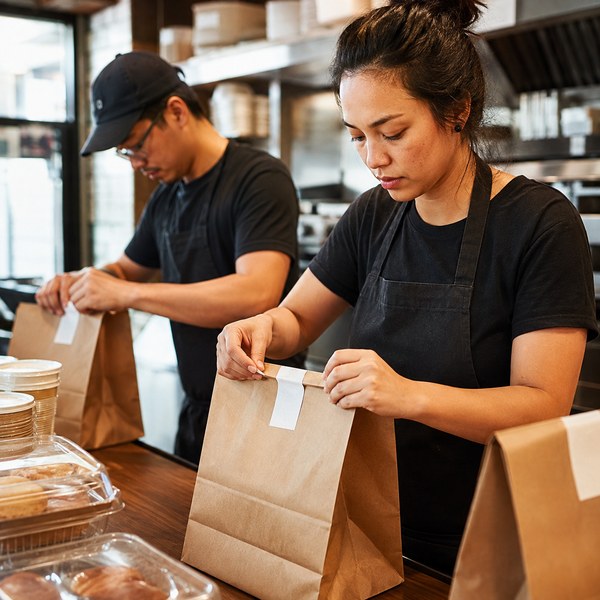
What Packaging and Supplies Does No-Contact Delivery Require?
No-contact delivery requires packaging that does three jobs without a human handoff: prove the order wasn't tampered with, hold safe serving temperature through an unattended doorstep wait, and survive being carried, set down, and photographed. Here is the supply stack, in priority order.
1. Tamper-Evident Labels and Seals — Non-Negotiable
A tamper-evident seal is a label or closure that visibly tears, voids, or breaks if anyone opens the package after it leaves your kitchen. When no employee hands the bag over, the seal is your integrity guarantee — and increasingly, it's the law. California's AB-3336, in effect since January 1, 2021, requires ready-to-eat food handed to a third-party delivery driver to be sealed with a tamper-evident method before the driver takes possession (California AB-3336, Health & Safety Code). Other jurisdictions are following the same template, so building seals into your workflow now future-proofs your compliance.
Restaurantware's tamper-evident labels apply over bag folds, box seams, and cup lids in one motion at the pass, and our tamper-evident packaging line includes containers with breakaway closures built into the lid itself. Our foodservice customers consistently tell us the labels pay for themselves in disputed-order refunds alone — a fraction of a cent per order against the cost of one comped meal.
2. Insulated Delivery Bags — The Temperature Bridge
USDA food safety guidance is blunt about the stakes: bacteria multiply fastest between 40°F and 140°F — the "Danger Zone" — doubling in as little as 20 minutes, and perishable food should never sit out beyond 2 hours (USDA Food Safety and Inspection Service). A no-contact order faces a longer unattended window than a handed-over one: transit time plus however long it waits at the door. Insulated carriers are what keep hot food at or above 140°F across that whole span.
Insulated food delivery bags and catering bags are the workhorse here — thermal linings, wipeable interiors, and sizes from single-order totes to full catering carriers. If you run in-house drivers, issue bags as standard equipment; if you rely on third-party apps, insulated interior liners and foil-lined bags do the insulating work inside whatever the driver carries.
3. Sealed, Vented, Stackable Containers
The container itself is the last line of defense. For no-contact delivery, prioritize:
- Secure closures — snap-lock lids or hinged containers that stay shut when the bag is set down at an angle on a doorstep.
- Venting for fried items — trapped steam turns crisp food soggy during the doorstep wait; vented lids preserve texture.
- Flat, stackable bases — orders get placed on the ground and photographed; stackable boxes keep multi-item orders tidy and upright.
- Leak resistance for sauces and soups — nobody is holding the bag level on the last thirty feet.
Our take-out containers and to-go boxes collection spans all of these formats, from vented clamshells to gasket-sealed soup containers. For a deeper dive on matching container choice to travel time, see balancing speed and quality in delivery packaging.
The No-Contact Packaging Checklist
| Checkpoint | What to use | Why it matters for no-contact delivery |
|---|---|---|
| Order integrity | Tamper-evident labels or breakaway-lid containers | No handoff means the seal is the only proof nothing was opened; required by law in California (AB-3336) |
| Temperature | Insulated delivery bags; hot food packed above 140°F | Doorstep wait extends time in the USDA Danger Zone (40°F–140°F) |
| Texture | Vented lids for fried and crispy items | Orders sit sealed and unattended longer than in-person handoffs |
| Spill safety | Leak-resistant containers, cup carriers, flat-bottom bags | Bags are set on the ground, not handed upright to a person |
| Presentation | Branded, labeled, neatly folded packaging | The drop-off photo is your plating shot — it appears in the customer's app |
That last row is a genuinely 2026 detail: on a no-contact order, the driver's confirmation photo is the first image of your food the customer sees. A crisp, sealed, branded bag in that photo does quiet marketing work that a wrinkled, unsealed sack undoes instantly.
Frequently Asked Questions About No-Contact Delivery
What does it mean when it says no contact delivery?
"No contact delivery" means the driver will leave the order at the customer's chosen spot — door, lobby, or porch — instead of handing it over in person. The driver typically confirms the drop-off with a photo in the app, and the customer collects the order after the driver steps back or leaves.
Is no contact delivery permanent?
Yes. No-contact delivery is a permanent, standard option on every major delivery platform. It debuted as a COVID-19 safety measure in 2020, but it remains because customers prefer the convenience and platforms benefit from faster, dispute-resistant drop-offs. With nearly 75% of restaurant traffic now off-premises per the National Restaurant Association, leave-at-door fulfillment is a core operating condition, not a phase.
Will Grubhub still ask for the code if it's no contact delivery?
Sometimes. Grubhub uses order verification codes on select high-value or fraud-flagged orders, and a PIN requirement can override contact-free preferences because the driver must confirm the code with the customer. In practice, most contact-free Grubhub orders complete without a code — the driver follows the highlighted drop-off instructions and confirms delivery in the app. Customers who need strict zero-contact should note it in the delivery instructions.
Does DoorDash do no contact delivery?
Yes. DoorDash offers no-contact delivery on effectively all standard food orders — customers choose "Leave it at my door" at checkout, and the Dasher must photograph the placed order to complete the drop-off. Orders containing alcohol are the exception: those legally require an in-person ID check and cannot be left unattended.
What packaging do restaurants need for no-contact delivery?
Restaurants need three layers for no-contact delivery: tamper-evident labels or sealed containers to prove order integrity (required by law for third-party delivery in California), insulated delivery bags to keep hot food at or above 140°F through the doorstep wait, and leak-resistant, vented, flat-bottomed containers that survive being set on the ground and photographed.
How do restaurants set up no-contact delivery on delivery apps?
On DoorDash, Grubhub, and Uber Eats, no-contact delivery is customer-selected at checkout, so restaurants prepare rather than enable it: seal and stage orders for fast driver pickup, set clear pickup protocols in each merchant portal, and package on the assumption that every order will sit unattended for several minutes. For in-house delivery, add a leave-at-door option and instructions field to your ordering flow and train drivers to send photo confirmations.
Conclusion: Win the Doorstep
No-contact delivery is now simply how delivery works. The customer's decision to reorder gets made at the doorstep — by a sealed label that proves integrity, a container that held 140°F, and a drop-off photo that looks like you plated it for the camera. The restaurants winning on the apps in 2026 are the ones that treat the last unattended ten minutes of an order's journey with the same care as the first ten in the kitchen.
Restaurantware equips that final stretch: tamper-evident labels, insulated food delivery bags, and the full Delivery Tek collection — in stock and ready to ship, so every no-contact order arrives sealed, hot, and photo-ready.