DoorDash Fees For Restaurants: Can Your Restaurant Afford Delivery Apps?
DoorDash fees for restaurants are commissions of 15% (Basic), 25% (Plus), or 30% (Premier) on each delivery order's subtotal, plus 6% on pickup orders. The commission covers listing, Dasher logistics, and payment processing. Before signing up, calculate your contribution margin per delivery order — commission comes out before food, labor, and packaging costs.
DoorDash fees for restaurants take 15% to 30% off the top of every delivery order — and the average full-service restaurant keeps less than a nickel of every sales dollar as profit. That gap is why so many operators love the order volume from third party delivery apps and dread the monthly statement. In 15+ years supplying 40,000+ foodservice operations, we've watched delivery grow from a pizza-shop niche into a channel that can make up a quarter or more of sales — and we've watched operators thrive or bleed on the exact same platforms, depending entirely on whether they ran the math first.
This guide breaks down current DoorDash, Uber Eats, and Grubhub fee structures (verified July 2026), works a real P&L example at 15%, 25%, and 30% commission, and shows you exactly when third-party apps pay for themselves — and when in-house delivery or direct ordering wins.
TL;DR — Delivery App Fees at a Glance
Delivery app fees for restaurants in 2026, verified on official merchant pages:
- DoorDash: 15% / 25% / 30% commission on delivery orders; 6% pickup; no monthly, processing, or activation fees.
- Uber Eats: 20% / 25% / 30% marketplace fee on delivery; 7% pickup (10% without validated in-store pricing); 15% self-delivery plan.
- Grubhub: 5% / 15% / 20% marketing commission + ~10% delivery fee if Grubhub drivers deliver + 3.05% + $0.30 processing per order.
- The break-even question: a typical $50 delivery order nets roughly $8.50 of contribution at 15% commission — and about $1.00 at 30%. Know your number before you pick a plan.
- Biggest hidden margin leak: refunds and remakes from cold, leaking, or damaged food. Delivery-grade packaging is the cheapest fee "discount" you'll ever buy.
What Fees Does DoorDash Charge Restaurants in 2026?
DoorDash charges restaurants a commission on each order's subtotal — 15% on the Basic plan, 25% on Plus, and 30% on Premier for delivery orders, and a flat 6% on pickup orders across all plans. There are no activation fees, monthly subscription fees, or separate payment processing fees; the commission covers listing, marketing placement, Dasher logistics, customer support, and credit card processing, according to DoorDash's merchant pricing page (current as of July 2026).
Here is what each tier buys you:
| DoorDash Plan | Delivery Commission | Pickup Commission | What You Get |
|---|---|---|---|
| Basic | 15% | 6% | Listing on the DoorDash app; local delivery area; customers pay higher delivery fees |
| Plus | 25% | 6% | Wider delivery area, access to DashPass subscribers, lower customer delivery fees |
| Premier | 30% | 6% | Largest delivery area, lowest customer fees, automatic ads, Growth Guarantee |
Source: DoorDash merchant pricing, verified July 2026. Fees change — always confirm live rates before signing.
Optional extras cost more: the DoorDash tablet runs $6/week after the trial, and Promotions or Sponsored Listings are billed on top of commission. Orders placed through DoorDash's white-label Online Ordering product are commission-free but carry a payment processing fee.
The tier trade-off is reach versus rate. Basic keeps the commission low but pushes higher delivery fees onto your customers, which suppresses order volume. Premier maximizes visibility — including access to DashPass members, who pay $9.99/month for $0 delivery fees and order more often — but takes nearly a third of every ticket. That's why the plan decision is a math problem, not a marketing one.
How Do Uber Eats and Grubhub Fees Compare?
Uber Eats fees for restaurants follow the same three-tier structure as DoorDash, while Grubhub splits its pricing into a marketing commission plus separate delivery and processing fees. Here's the cross-platform picture, verified on each company's official merchant pages in July 2026:
| Fee Component | DoorDash | Uber Eats | Grubhub |
|---|---|---|---|
| Entry tier (delivery) | Basic — 15% | Lite — 20% | Basic — 5% marketing + ~10% delivery |
| Mid tier (delivery) | Plus — 25% | Plus — 25% | Plus — 15% marketing + ~10% delivery |
| Top tier (delivery) | Premier — 30% | Premium — 30% | All-Access — 20% marketing + ~10% delivery |
| Pickup orders | 6% (all plans) | 7% with validated in-store pricing; 10% without | Marketing commission only (no delivery fee) |
| Payment processing | Included in commission | Included in marketplace fee | 3.05% + $0.30 per prepaid order |
| Self-delivery option | Yes (reduced rates) | 15% self-delivery fee | Yes — pay marketing commission only |
| Monthly/setup fees | None | None | None |
Sources: DoorDash, Uber Eats, and Grubhub official merchant pricing pages, current as of July 2026. Grubhub's processing fee is confirmed at 3.05% + $0.30 per prepaid transaction on Grubhub's own pricing guide. Regulated markets (NYC, San Francisco, Seattle, and others) cap fees lower.
Three details operators miss when comparing third party delivery fees:
- Uber Eats' entry tier is 20%, not 15%. DoorDash Basic is the cheapest entry point among the big three for delivery — but Uber Eats Lite starts at 15% in fee-capped cities like NYC, Los Angeles, Seattle, and San Francisco.
- Grubhub's headline rate hides two add-ons. A "5% commission" becomes roughly 18% once you add Grubhub's ~10% delivery fee and 3.05% + $0.30 processing. Always compare the all-in effective rate.
- Pickup is dramatically cheaper everywhere. At 6–7%, pickup orders through the apps cost less than half the cheapest delivery tier. Every delivery order you convert to pickup roughly triples your take.
What Do Delivery App Fees Actually Do to Your P&L?
How much do delivery apps charge restaurants in real dollars? Here is the worked example the platforms' own marketing pages won't show you: a $50 delivery order under a typical independent-restaurant cost structure (30% food cost, 25% direct labor, ~10% allocated overhead, $1.50 delivery packaging).
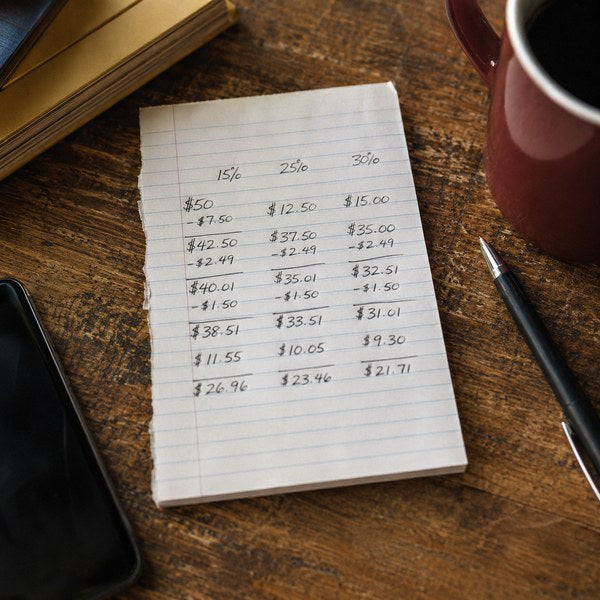
| Line Item | 15% Commission (Basic) | 25% Commission (Plus) | 30% Commission (Premier) |
|---|---|---|---|
| Order subtotal | $50.00 | $50.00 | $50.00 |
| Platform commission | −$7.50 | −$12.50 | −$15.00 |
| Net payout to restaurant | $42.50 | $37.50 | $35.00 |
| Food cost (30%) | −$15.00 | −$15.00 | −$15.00 |
| Direct labor (25%) | −$12.50 | −$12.50 | −$12.50 |
| Delivery packaging | −$1.50 | −$1.50 | −$1.50 |
| Allocated overhead (10%) | −$5.00 | −$5.00 | −$5.00 |
| Profit on the order | $8.50 (17%) | $3.50 (7%) | $1.00 (2%) |
Illustrative model using DoorDash commission tiers current as of July 2026. Plug in your own food cost, labor, and packaging numbers — the structure is what matters.
The takeaway is stark: moving from 15% to 30% commission cuts the profit on this order from $8.50 to $1.00. If your food cost runs 35% instead of 30%, the Premier-tier order loses $1.50. This is why McKinsey's food-delivery research concluded that restaurants' traditional profit margins of 7–22% make covering platform commissions of roughly 15–30% unsustainable as delivery becomes a larger share of sales.
The context makes the stakes higher. The National Restaurant Association's 2026 State of the Restaurant Industry report projects $1.55 trillion in industry sales but notes that 42% of operators reported their restaurant was not profitable last year, with more than 9 in 10 citing food, labor, and swipe-fee costs as significant challenges. A channel that skims 15–30% off the top deserves its own line on your P&L — not a shrug.
The one number to calculate before signing anything
Contribution margin per delivery order = net payout − food cost − packaging − incremental labor. If that number is positive, delivery orders help cover your fixed costs even at high commissions — provided the orders are incremental (customers who wouldn't have ordered otherwise). If app orders cannibalize your own phone and walk-in orders, you're paying 25% commission on sales you already had. Track where your app customers come from before upgrading tiers.
When Can Your Restaurant Afford Third-Party Delivery Apps?
Third party delivery fees are affordable when three conditions hold. Use this as a go/no-go checklist:
- Your contribution margin per order is positive at the tier you're on. Run the table above with your real numbers. High-food-cost concepts (steakhouses, seafood) struggle at 25–30%; pizza, wings, and rice-bowl concepts with 25–28% food costs usually clear it.
- Most app volume is incremental. New customers discovering you on the app justify the commission as a marketing cost. DoorDash itself frames the comparison as "delivery margin vs. no order at all" — true only if the order is genuinely new demand.
- Your kitchen has idle capacity. Delivery orders that fill Tuesday-night slack cost you almost nothing in extra labor. Orders that crowd out full-margin dine-in tickets on Friday night cost you far more than the commission.
If you're launching a delivery-first concept, work through our checklist for opening a ghost kitchen — fee tiers, packaging costs, and platform mix decisions all land differently when there's no dining room subsidizing them.
How Can Restaurants Reduce Delivery App Fees?
Restaurants reduce delivery app fees by choosing the right tier, repricing delivery menus, shifting mix toward pickup and direct orders, and eliminating refund losses. Six moves, in order of impact:
- Right-size your plan tier. Start at Basic/Lite for two to three weeks, measure order volume, then test one tier up. Both DoorDash and Uber Eats let you switch plans without penalty. Pay 30% only if the extra reach demonstrably fills otherwise-empty kitchen capacity.
- Price your delivery menu separately. DoorDash explicitly permits different prices for delivery orders, and most operators mark delivery menus up 10–20% to share the commission burden with the customer. Keep pickup and in-store prices matched — Uber Eats rewards validated in-store pricing with the lower 7% pickup fee.
- Push pickup. At 6–7% commission, an app-sourced pickup order keeps 9–24 more points of margin than the same order delivered. Promote pickup-exclusive deals inside the apps.
- Convert repeat app customers to direct ordering. Commission-free tools — DoorDash Online Ordering, Grubhub Direct, or your own site — cost only payment processing (Uber's webshop, for comparison, runs 2.5% + $0.29 per order). A box-topper card with a QR code and a "10% off when you order direct" offer pays for itself on the second order. Pair this with a POS-integrated ordering stack so direct orders don't create pain at the make line.
- Kill refunds and remakes with delivery-grade packaging. A refunded $50 order doesn't just erase the commission — it erases the food cost, the packaging, and the customer. Our foodservice customers consistently tell us the same thing: their "delivery problem" was really a packaging problem. Vented containers, tamper-evident seals, and insulated food delivery bags & catering bags are the difference between a five-star reorder and a chargeback. See our guide to balancing speed and quality in delivery packaging.
- Audit your statements monthly. Promotions, sponsored listings, and error charges stack on top of commission. Reconcile app payouts against POS sales every month and dispute error charges — platforms reverse legitimate disputes.
When Does In-House Delivery Beat Third-Party Apps?
In-house delivery beats third-party apps when your delivery volume is dense, local, and repeat-heavy. A driver earning $18/hour plus mileage who runs four deliveries an hour costs you roughly $5–6 per order — versus $12.50 in commission on that same $50 order at 25%. The crossover math favors in-house once you sustain roughly 15–20 deliveries per shift within a tight radius.
Third-party still wins when volume is thin or unpredictable, when you can't recruit and insure drivers, or when you're entering a new neighborhood where the app's customer base is the marketing. Many of the strongest operators we supply run a hybrid: apps for discovery at the lowest workable tier, in-house or self-delivery plans (Uber Eats' is 15%; Grubhub's drops the ~10% delivery fee) for their core radius, and aggressive conversion of regulars to direct ordering. For a deeper decision framework, read our comparison of third-party vs. in-house delivery systems.
How Does Packaging Protect Your Delivery Margins?
Packaging is the only delivery cost that actively defends the other 97% of the ticket. When commissions already claim 15–30%, a single soggy container or spilled soup wipes out the profit on the next five orders. In 15+ years supplying 40,000+ foodservice operations, we've seen the pattern over and over: operators who treat packaging as a cost to minimize fight refunds and one-star ratings; operators who treat it as margin insurance post higher reorder rates on every platform — and app algorithms reward those ratings with better placement.
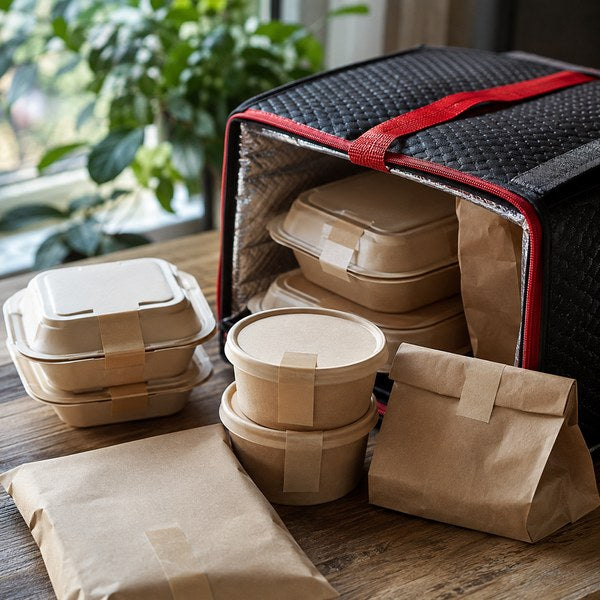
Where to invest first:
- Temperature control: thermal totes from our Delivery Tek line keep food at safe, sellable temperatures through a 30-minute Dasher run — hot food that arrives hot is the single biggest driver of delivery ratings.
- Structural integrity: sturdy, vented, leak-resistant containers and to go bags & take out bags sized to your menu prevent the tipped-container refunds that quietly drain payouts.
- Trust and branding: tamper-evident seals reduce disputes, and branded packaging turns an app customer into your customer — the first step in converting them to commission-free direct orders. Our breakdown of the 7 benefits of custom food packaging covers the branding math.
A $1.50 packaging spend that prevents one refund per 50 orders returns its cost several times over — no commission negotiation required.
Frequently Asked Questions
Do restaurants have to pay a fee for DoorDash?
Yes. Restaurants pay DoorDash a commission on every marketplace order: 15%, 25%, or 30% of the subtotal on delivery orders depending on plan, and 6% on pickup orders. There are no monthly, activation, or separate processing fees — but optional extras like the tablet ($6/week) and ads cost more.
Why does DoorDash have a 15% service fee?
The 15% figure appears on both sides of the marketplace. For restaurants, 15% is the Basic-plan delivery commission covering listing, Dasher logistics, and payment processing. For customers, DoorDash separately charges a service fee (typically around 15% of the subtotal, varying by market) that funds platform operations — that customer fee does not go to the restaurant.
Do restaurants charge more on DoorDash?
Often, yes. DoorDash permits different pricing for delivery menus, and many restaurants mark delivery items up 10–20% to offset commission. Note that pickup prices must match in-store prices to qualify for DoorDash's 6% pickup rate, and Uber Eats' validated in-store pricing earns its lower 7% pickup fee.
What is the $9.99 charge from DoorDash?
A $9.99 charge from DoorDash is almost always a DashPass subscription — DoorDash's customer membership costing $9.99/month (or $96/year) for $0 delivery fees and reduced service fees on eligible orders. It's a consumer charge, not a restaurant fee; restaurants on Plus and Premier plans gain access to DashPass members' order volume.
How much does Uber Eats charge restaurants?
Uber Eats fees for restaurants are 20% (Lite), 25% (Plus), or 30% (Premium) of the order subtotal on delivery orders, plus a 7% pickup fee with validated in-store pricing (10% without). Restaurants using their own drivers pay a 15% self-delivery fee. Fee-capped cities like NYC and San Francisco start Lite at 15%. Rates verified on Uber Eats' merchant pricing page, July 2026.
How can restaurants reduce delivery app fees?
Restaurants reduce delivery app fees by starting on the lowest commission tier and testing upward, repricing delivery menus 10–20% higher, promoting 6–7% pickup orders, converting repeat customers to commission-free direct ordering, disputing error charges monthly, and using delivery-grade packaging to eliminate refunds — the most controllable margin leak in the channel.
Conclusion: Run the Math, Then Pick Your Mix
So — can your restaurant afford delivery app fees? Yes, if you treat them as a variable marketing cost with a measured return, and no, if you sign up at 30% hoping volume fixes a margin problem. Verify the current commission tiers (they change — every figure here was confirmed on official merchant pages in July 2026), work the $50-order table with your own costs, keep pickup and direct ordering growing, and defend every payout with packaging that gets food there hot, sealed, and photogenic.
Restaurantware equips the delivery economics side you fully control: explore our Delivery Tek collection for insulated carriers, tamper-evident seals, and delivery-ready containers that turn third-party orders into repeat customers instead of refunds.