Eco-Friendly Takeout Containers: A Restaurant Guide
Eco-friendly takeout containers are to-go boxes, clamshells, bowls, cups, and trays made from renewable or compostable materials — chiefly bagasse (sugarcane fiber), PLA-lined kraft paper, bamboo paper, and molded plant fiber — instead of plastic or foam. This guide compares those materials by format, heat and moisture performance, sizing, and delivery-readiness so you can match each menu item to the right container.
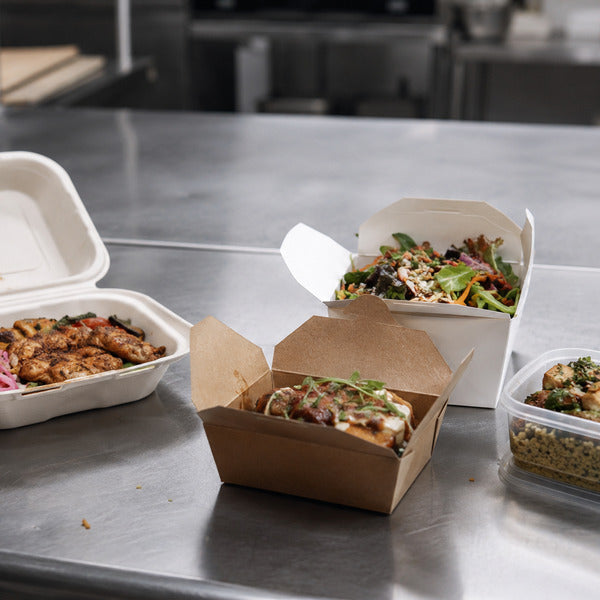
TL;DR: Eco-Friendly Takeout Containers at a Glance
- Nearly 75% of all restaurant traffic now happens off-premises, per the National Restaurant Association's 2025 Off-Premises Restaurant Trends report — your container is your dining room for 3 out of 4 orders.
- Containers and packaging generated 82.2 million tons of U.S. municipal solid waste in 2018 — 28.1% of the total, per the EPA. Takeout packaging choices compound fast.
- Demand supports the switch: the National Restaurant Association found 70% of millennials and 72% of Gen Z adults will pay extra for to-go orders to cover upgraded packaging.
- The four workhorse disposables are bagasse, PLA-lined kraft, bamboo paper, and molded fiber — compared in the table below. Reusable PP containers are a fifth option for high-repeat programs.
- "Compostable" is defined as certified to ASTM D6400 (bioplastics) or D6868 (lined fiber), verified by a third party such as BPI — the fastest way to avoid greenwashing.
- Regulation is forcing the issue: at least a dozen U.S. states, including Maryland, New York, New Jersey, Virginia, Washington, and California, ban expanded polystyrene foam foodservice containers statewide (current as of July 2026).
What Are Eco-Friendly Takeout Containers, and How Does the Category Break Down?
Eco-friendly takeout containers are food-transport containers designed with a real end-of-life pathway — commercial composting, home composting, recycling, or reuse — rather than landfill. The category breaks down into four disposable materials plus one reusable class, and each behaves differently under heat, steam, grease, and a 25-minute delivery ride.
| Material | Typical formats | Heat / microwave | Moisture & grease | Delivery performance | End of life | Relative cost |
|---|---|---|---|---|---|---|
| Bagasse (sugarcane molded fiber) | Clamshells, bowls, plates, multi-compartment trays | Handles hot entrées; generally microwave-safe for reheating | Naturally grease- and cut-resistant; vents steam so fried food stays crisp | Rigid, stackable, lids seat firmly — the workhorse for hot delivery | Commercially compostable (ASTM D6868 when lined) | $–$$ |
| Kraft paper (PLA- or water-based lining) | Bio boxes, folded takeout boxes, soup cups, trays | Good for hot and warm food; follow manufacturer microwave guidance | Lining blocks leaks from sauces and broths | Light, folds flat for storage, closes securely; premium kraft look on camera | Unlined: recyclable/compostable. Lined: compostable only if certified (D6868) | $ |
| Bamboo paper | Salad boxes, sandwich boxes, window boxes | Best for cold and ambient items | PLA lining resists dressing and condensation | Windowed lids merchandise the food; strong seams survive bag jostling | Commercially compostable when certified | $$ |
| Molded fiber (blended plant fiber) | Trays, bowls, plate replacements | Heat-tolerant; ideal for combo meals | Rigid walls prevent compartment bleed-over | Compartments keep components separated in transit | Commercially compostable (certified lines) | $–$$ |
| Reusable PP (polypropylene) | Round and rectangular containers with snap lids | Microwave- and dishwasher-safe; freezer-safe | Gasketed lids give the best leak resistance of any class | Heaviest and sturdiest; requires a return or in-house wash loop | Reused hundreds of cycles, then recycled (#5) | $$$ upfront, lowest per-use |
Two selection rules follow from the table. First, match the material to the menu item — no single material wins every slot, which is why most operations run bagasse for hot food, kraft for boxes and soups, and bamboo or PLA-windowed paper for cold items. Second, verify the end-of-life claim: a container marked "eco" without ASTM D6400/D6868 certification from a verifier such as BPI may be neither compostable nor recyclable in practice. For a deeper dive on materials and certifications beyond takeout, see our eco-friendly packaging guide.
The stakes are bigger than a unit price. The National Restaurant Association reports that nearly 75% of all restaurant traffic now happens off-premises, and the EPA counts 82.2 million tons of containers and packaging in U.S. municipal solid waste in a single year (28.1% of total generation). Meanwhile, statewide foam bans — Maryland's was among the first, and at least a dozen states now have them, per the Maryland Department of the Environment — mean many operators no longer have a legal foam fallback. Figures current as of July 2026.
Which Takeout Container Format Fits Each Menu Item?
The right format is determined by the food's heat, moisture, and structure — not by brand preference. Here is how we spec eco friendly takeout containers by menu category, with the products our foodservice customers order most for each slot.
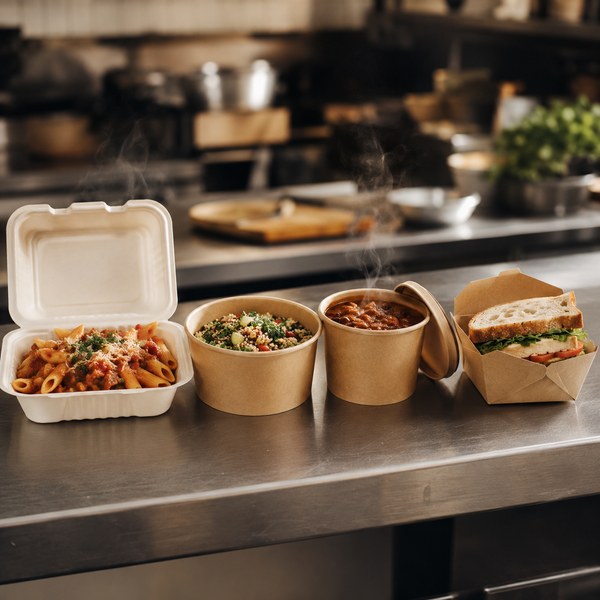
Hot entrées and fried food: vented clamshells and bio boxes
Hot, fried, and saucy items need rigidity plus steam venting. Bagasse clamshells vent naturally through the fiber, and kraft bio boxes like the Bio Tek 45 oz rectangle eco green paper #8 bio box (6¾" × 5½" × 2½") fold closed securely and hold a full entrée with sides. In 15+ years supplying 40,000+ foodservice operations, we've seen one failure pattern repeat: unvented plastic clamshells steam fried chicken and fries into sogginess by the time the driver arrives, while fiber and vented kraft formats deliver the same items crisp. That single swap resolves more delivery complaints than any other packaging change.
Soups, curries, and sauces: lined round containers
Liquids need a lined cylinder with a tight lid — never a folded box. The Bio Tek 12 oz round eco green paper soup container handles broths and curries; spec 8 oz for sides, 12 oz for single portions, and 26–32 oz for family-size soups. Always transport sauces in separate 2–4 oz portion cups so noodles and rice arrive dry.
Salads, grain bowls, and cold items: windowed bamboo paper boxes
Cold items sell on visibility. The Sustain 28 oz bamboo paper small take out container suits single salads and sandwiches, while the Sustain 40 oz bamboo paper large bio salad box fits entrée salads and grain bowls. Both are PLA-lined, compostable, and windowed — the window doubles as merchandising on pickup shelves and in delivery photos.
Sizing rule of thumb
Size to 80–90% fill: overfilled containers pop lids in transit, and half-empty ones read as skimpy portions. Standard slots are 8–12 oz (sides, soups), 26–34 oz (single entrées), 40–48 oz (entrée salads, family sides), and 60+ oz (shareables). Sample sizes with your actual plated portions before committing to a case count — the full range is in our take-out containers collection.
Delivery-readiness checklist
- Stackability: flat, rigid lids let drivers stack two or three orders without crushing.
- Venting: fiber breathes; if you use lined kraft for fried items, choose vented lids.
- Leak security: test every SKU with your sauciest item, tipped 45° for 30 seconds.
- Tamper evidence: a label seal across the lid meets third-party delivery platform expectations.
- Heat retention: fiber and paper insulate better than thin plastic — food stays hot 10–15 minutes longer in a closed bag.
How Do You Choose the Best Reusable Takeout Containers for Your Business?
The best reusable takeout containers for a business are commercial-grade polypropylene (PP) or stainless steel containers rated for hundreds of dishwasher cycles, with gasketed leak-proof lids and stackable geometry. Reusables make sense in three scenarios: campus and corporate dining with a controlled return loop, meal-prep and subscription programs where containers come back weekly, and in-house "BYO container" refill policies where local health code permits.
Evaluate durable reusable foodservice containers on five specs:
- Cycle rating: commercial PP should survive 300+ commercial dishwasher cycles without warping; thin retail-grade containers cloud and crack within dozens.
- Lid engineering: silicone-gasketed, four-tab snap lids stay sealed in a delivery bag; friction-fit lids do not.
- Temperature range: look for freezer-to-microwave ratings (roughly -4°F to 230°F for quality PP) so the same container works for meal prep, storage, and reheating.
- Stack-and-nest geometry: containers that nest empty and stack loaded save cold-room space and driver-bag space.
- Break-even math: a reusable costing 10–15× a disposable pays for itself in 15–25 returned cycles — the return rate, not the purchase price, decides the economics.
For meal prep specifically, multi-compartment PP containers with a single shared lid are the best containers for meal prep operations: one SKU, portion-controlled wells, and no mixed-lid inventory. If your return loop is unproven, start hybrid — reusables for subscribers, certified compostables for one-off orders — rather than betting the whole program on returns.
What Are 5 Eco-Friendly Ways To Package Takeout Orders?
The five eco-friendly ways to package takeout orders are: certified compostable containers, right-sized packaging, honest mixed-material combinations, opt-in accessories, and recyclable paper outer bags. Each is a discrete change you can make this quarter without redesigning your menu.
- Switch to certified compostable containers. Lead with your highest-volume SKU — usually the entrée box — and replace it with a BPI-certified bagasse or lined-kraft equivalent from an eco-friendly to-go containers line. Certification (ASTM D6400/D6868) is what separates a real claim from greenwashing.
- Right-size every order. Matching container volume to portion size cuts material use, shrinks bag counts, and lowers per-order packaging cost — the rare sustainability move that saves money on day one.
- Combine cardboard and plastic honestly. Yes, there are reliable eco-friendly solutions that mix cardboard and plastic without greenwashing: the test is separability and labeling. A kraft box with a removable PLA window or a paper bowl with a clearly-marked #5 PP lid lets the customer route each part correctly. What fails the test is fused mixed material marketed as "green" with no certification — if the layers can't separate and the item isn't D6868-certified, it is landfill with a leaf logo.
- Make accessories opt-in. Cutlery, napkins, and condiment packets add cost and waste on orders that never needed them. Opt-in prompts at checkout routinely cut accessory volume by half or more, and several cities now require it.
- Finish with recyclable kraft bags. A handled kraft bag with a tamper label replaces plastic T-shirt bags, survives delivery handling, and doubles as branding — print your logo and a one-line compostability instruction on the bag itself.
Two audience-specific notes. For corporate food deliveries: yes, platforms and caterers increasingly offer eco-friendly packaging for office orders — but the fastest route is to control it yourself by catering in certified compostable trays and individually-boxed meals, then stating "packaging is compostable" on the invoice; procurement teams increasingly score vendors on exactly that line. For the quick city lunch crowd: the most sustainable takeout option is a right-sized fiber or bamboo-paper box with no accessory kit — light enough to carry, compostable where collection exists, and honest everywhere else.
What Should You Look For in a Takeout Packaging Supplier?
A takeout packaging supplier should be evaluated on price stability, stock depth, certification transparency, and range breadth — in that order. Packaging is a weekly reorder, so a supplier that quotes low and then swings pricing costs you more than one that holds steady.
- Stable pricing on paper goods: ask for 6–12 month pricing on your core SKUs (containers, disposable plates, napkins, bags). Suppliers that manufacture their own lines — as we do at Restaurantware — can hold pricing through spot-market swings that force resellers to reprice monthly.
- Stock depth and lead time: your entrée box going out of stock is a same-day operational crisis. Confirm warehouse inventory and ship times before the first order, not after.
- Certification documents on request: a legitimate supplier produces BPI certificates and ASTM test documentation per SKU. "It's eco-friendly, trust us" is not documentation.
- One-stop breadth: consolidating containers, the best disposable plates for your service style, cups, cutlery, and bags with one supplier cuts freight cost and admin time. Our customers consistently tell us the consolidation savings exceed any single-item price difference.
- Verified customer feedback: read real operator feedback before committing — ours is collected at restaurantware.com/pages/reviews.
Are Multi-Compartment and Biodegradable Food Trays Worth It?
Multi-compartment eco-friendly trays are worth it whenever an order combines components that must not touch — combo meals, bento-style lunches, kids' meals, and catering portions. One tray replaces two or three separate containers, which cuts per-order packaging cost, bag volume, and assembly time on the line.
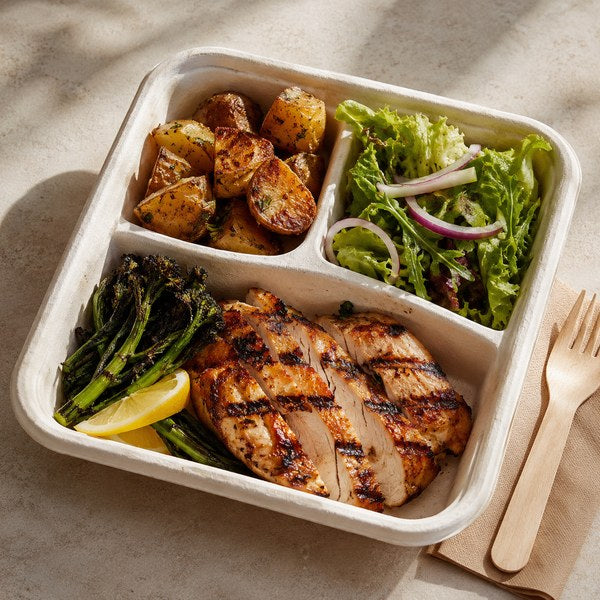
What are the best biodegradable food trays for restaurants?
The best biodegradable food trays for restaurants are certified compostable bagasse or molded-fiber trays with three to five compartments and a matching fiber or PLA lid. Bagasse is the default choice: it is rigid enough that a loaded tray doesn't fold in transit, tolerates hot food, resists grease without a plastic film, and vents steam so nothing goes soggy. Spec trays by the deepest well — the entrée compartment should hold your largest protein portion at 80–90% fill — and confirm the lid seats on the rim, not the food. One honest caveat we give every customer: "biodegradable" alone is an unregulated marketing word; buy trays certified compostable to ASTM D6868 so the claim survives both a compost facility and a regulator's inspection. Browse certified options in our eco-friendly to-go containers collection, and see our guide to eco-friendly tableware for matching plates and serviceware.
Frequently Asked Questions
Do eco-friendly takeout containers come with lids?
Yes. Most eco friendly takeout containers ship as container-plus-lid systems: bagasse clamshells hinge their own lid, kraft bio boxes fold closed, and bowls, soup cups, and salad boxes pair with matching fiber, kraft, or PLA lids. Always order lids and bases from the same product line so they seat correctly — mismatched-brand lids are the most common cause of delivery leaks.
Can I buy eco-friendly takeout containers wholesale?
Yes. Eco-friendly takeout containers are sold wholesale by the case (typically 100–500 count) with volume pricing at higher tiers. Wholesale case pricing usually brings certified compostables within 10–30% of comparable plastic, and consolidation across containers, cups, and bags closes the gap further. Restaurantware ships wholesale cases nationwide from U.S. warehouses.
What is the difference between biodegradable and compostable containers?
Compostable is a certified claim; biodegradable is not. A compostable container is verified to break down into soil-safe components within a defined timeframe under ASTM D6400 or D6868, confirmed by a third party such as BPI. "Biodegradable" has no required timeframe or conditions — nearly anything biodegrades eventually — so regulators in several states restrict the word on packaging. Buy certified compostable.
What is the best eco-friendly takeout container overall?
The best eco-friendly takeout container for most restaurants is a certified compostable bagasse clamshell or lined kraft bio box, because both handle hot, greasy, and saucy food — the hardest test — while remaining compostable and affordable at case volume. For cold items, a PLA-lined bamboo paper box with a window is the strongest performer. There is no single best SKU; there is a best SKU per menu slot.
Do eco-friendly takeout containers cost more than plastic?
Usually 10–30% more per unit at wholesale, though right-sizing and supplier consolidation often offset the difference at the order level. Customer willingness supports the spend: the National Restaurant Association found 70% of millennials and 72% of Gen Z adults would pay extra for to-go orders to cover upgraded packaging.
Where can I find eco-friendly takeout containers near me or online?
Restaurant supply distributors, wholesale clubs, and marketplaces like Amazon all carry eco containers, but marketplace listings frequently lack certification documentation. For documented, case-quantity supply with stable pricing, order direct from a foodservice packaging manufacturer — Restaurantware ships from U.S. warehouses with BPI certification documents available per SKU.
Conclusion: Build Your Eco Takeout Program One Menu Slot at a Time
Eco-friendly takeout containers are no longer a niche upgrade — with three out of four orders leaving the building and foam banned across a dozen states, they are the default spec for a modern takeout program. Start with the comparison table above, match each menu slot to its material (bagasse for hot, lined kraft for boxes and soups, bamboo paper for cold, reusables where a return loop exists), demand ASTM/BPI documentation for every claim, and pressure-test each SKU with your messiest dish before committing to cases. Ready to spec your lineup? Explore the full range of certified eco-friendly to-go containers at Restaurantware — samples ship fast, and our team can size a program to your exact menu.