Cutting Boards Buying Guide
Cutting boards are food-prep surfaces made from wood, plastic (HDPE), bamboo, rubber, composite wood fiber, or metal. The best cutting board depends on your knives, menu, and sanitation plan. This guide compares every major material and covers over-the-sink boards, sushi boards, sizing, color-coding, and commercial care.
Cutting boards are the hardest-working surfaces in any kitchen, yet most buyers choose them on price alone — and pay for it in dull knives, warped boards, and failed health inspections. After 15+ years supplying 40,000+ foodservice operations through Restaurantware, I've seen which boards survive a commercial dish pit and which crack within a month. This buying guide consolidates everything we've learned: material comparisons, over-the-sink cutting boards, sushi cutting boards, sizing, sanitation, and the color-coded systems professional kitchens rely on.
TL;DR — Cutting Board Materials at a Glance
- HDPE plastic is the commercial-kitchen standard: NSF-listed options, dishwasher-safe, color-codable, low cost.
- Hardwood (maple, walnut, acacia) is the gentlest on knife edges and the choice of most chefs for general prep — but it needs hand-washing and oiling.
- Over-the-sink cutting boards add instant counter space and let you rinse, trim, and strain in one spot.
- Titanium and glass boards accelerate edge wear — most chefs avoid them for daily knife work.
- Replace any board once grooves get too deep to clean; the FDA Food Code requires scratched and scored cutting surfaces to be resurfaced or discarded.
| Material | Knife-Friendliness | Sanitation | Durability | Best For |
|---|---|---|---|---|
| HDPE plastic | Good | Excellent — dishwasher-safe, color-codable | High (replace when scored) | Commercial prep, raw proteins, HACCP color systems |
| Maple / hardwood | Excellent | Good — hand-wash, sanitize, oil monthly | Very high with care | Chef prep, front-of-house presentation |
| Acacia wood | Excellent | Good — naturally water-resistant, hand-wash | High | Sushi and charcuterie presentation, light prep |
| Bamboo | Good | Good — harder and less porous than most hardwoods | High | Eco-focused kitchens, light-to-medium prep |
| Wood-fiber composite | Good | Very good — nonporous, often dishwasher-safe | High | Sustainable operations wanting wood looks with easy cleanup |
| Rubber | Excellent | Very good — nonporous, resurfaceable | Very high | High-volume butchery and sushi bars |
| Titanium / stainless | Poor — dulls edges fast | Excellent — nonporous | Extreme | Odor-free tasks without knife work (not recommended for daily cutting) |
| Glass | Very poor | Excellent | Brittle | Serving only — never knife work |
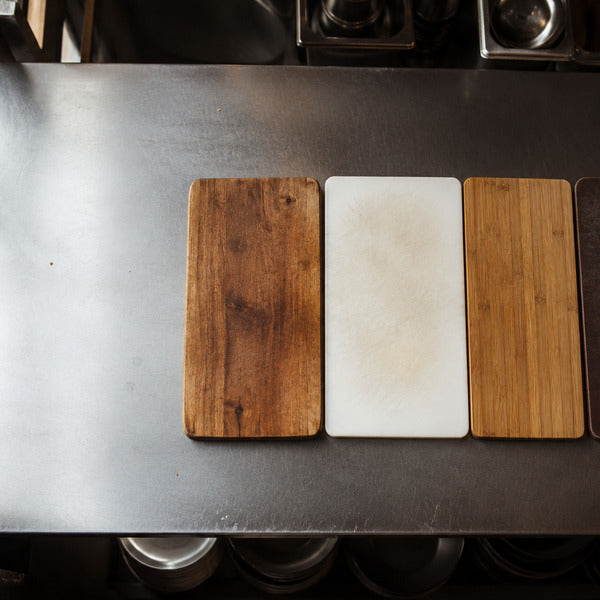
How Does the Cutting Board Category Break Down?
The cutting board category breaks down by material, format, and function. Material determines knife wear and sanitation; format covers standard boards, over-the-sink boards, board sets, and presentation boards; function separates prep boards from serving boards. Understanding all three axes prevents the most common buying mistake: using one board for every job.
Wood Cutting Boards
Wooden cutting boards are prep surfaces cut from hardwoods such as maple, walnut, cherry, and acacia. Maple cutting boards are the North American benchmark — brands like John Boos built their reputation on hard rock maple because its tight, end-grain-friendly structure resists deep scarring and stays gentle on knife edges. Wood requires hand-washing and periodic food-grade mineral oil, but a well-kept maple board outlasts nearly everything else in the kitchen.
Plastic (HDPE) Cutting Boards
Plastic cutting boards are high-density polyethylene (HDPE) or polypropylene surfaces built for sanitation-first environments. They are nonporous, dishwasher-safe, inexpensive to replace, and available in HACCP color-coded sets — which is why they dominate commercial kitchens. Their one weakness: knives eventually score the surface, and deeply grooved plastic must be discarded because grooves trap bacteria.
Bamboo Cutting Boards
Bamboo cutting boards are technically grass, not wood, and that matters. The USDA Food Safety and Inspection Service notes that bamboo is harder and less porous than hardwoods, absorbs very little moisture, and resists knife scarring — making it more resistant to bacteria than many woods. Bamboo is a strong pick for eco-focused kitchens, though its hardness is slightly tougher on edges than maple.
Wood-Fiber Composite Cutting Boards
Wood-fiber composite boards are engineered from compressed wood fibers and food-safe resin. They deliver the warm look of wood with the nonporous, low-maintenance behavior of plastic. Restaurantware's Nature Tek kraft wood fiber cutting board (17 1/4" x 12 3/4") is a popular example among sustainability-minded operators who want one board for prep and presentation.
Rubber Cutting Boards
Rubber cutting boards are dense, nonporous synthetic boards long favored in Japanese professional kitchens. They are extremely gentle on knife edges, do not absorb liquids, and can be resurfaced by sanding — which is why high-volume sushi bars and butcher stations standardize on them despite the higher upfront price.
Titanium, Stainless Steel, and Glass Cutting Boards
Metal and glass cutting boards are nonporous and easy to sanitize, but they are harder than knife steel's ideal cutting surface and accelerate edge wear dramatically. Titanium cutting boards trended hard in 2025–2026 for being odor-proof and stain-proof; they are fine for pulling odors out of your workflow (slicing garlic, raw fish storage trays) but a poor choice for daily knife work. Glass boards should never see a knife — treat them as trivets or serving pieces.
What Is the Best Cutting Board Material?
The best cutting board material is hard maple for knife-friendly general prep and HDPE plastic for sanitation-critical commercial work — most serious kitchens run both. Wood self-heals shallow cuts and preserves edges; HDPE survives the dishwasher and supports color-coding. Bamboo and wood-fiber composites split the difference for eco-driven operations.
Match the material to the job rather than hunting for one perfect board:
- Daily knife work, chef stations: maple or walnut hardwood, or rubber.
- Raw meat, poultry, seafood: HDPE plastic — dishwasher-sanitized after every use.
- Health-inspection readiness: color-coded HDPE board sets, one color per food group.
- Front-of-house serving and charcuterie: acacia, walnut, or wood-fiber presentation boards.
- Sustainability programs: bamboo or wood-fiber composite.
One material rule is non-negotiable: whatever you buy must be cleanable. The USDA recommends washing boards with hot, soapy water after each use, then sanitizing wood or plastic boards with a solution of 1 tablespoon of unscented liquid chlorine bleach per gallon of water.
How Do You Use an Over-the-Sink Cutting Board?
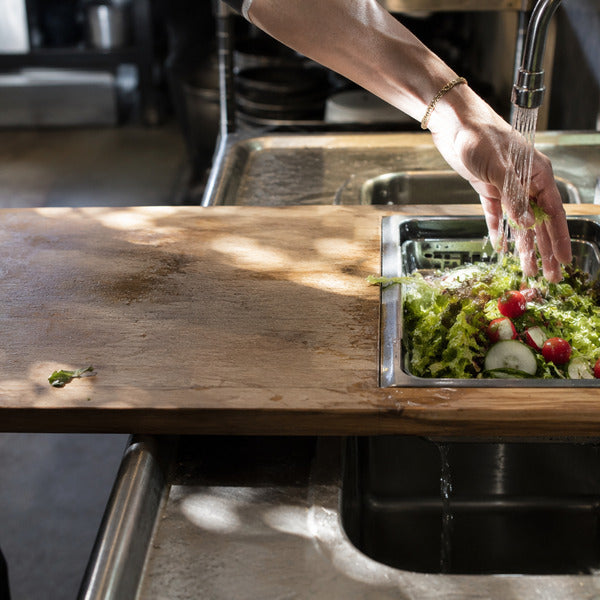
An over-the-sink cutting board is a board sized or adjustable to rest across your sink basin, turning the sink into a prep station. To use one: measure your sink's width, seat the board's edges or extendable arms firmly on the sink rim, rinse produce directly on the board, cut, then sweep scraps into the basin or built-in strainer. It is the fastest way to add prep space to a cramped kitchen — and the top question our customers ask about, which is why this section covers it in depth.
Why Use a Cutting Board for the Sink Top?
A cutting board for the sink top solves three problems at once. First, it reclaims counter space — critical in food trucks, prep-line gaps, and small commercial kitchens. Second, it shortens the wash-trim-cut workflow to a single station: rinse vegetables, trim them on the board, and drop waste straight into the disposal or strainer without carrying dripping produce across the kitchen. Third, models with a collapsible strainer basket let you drain washed greens or thawed proteins right beside your knife work.
What Should You Look for in the Best Over-the-Sink Cutting Board?
The best over-the-sink cutting board is adjustable, nonslip, and nonporous. Check these five specs before buying:
- Adjustability: an adjustable over-the-sink cutting board with extendable arms or a lipped underside fits multiple sink widths — essential if your sinks vary between stations.
- Span and load: the board must overlap the sink rim by at least an inch per side and stay rigid under downward knife pressure. Thin boards flex; flexing boards slip.
- Material: choose HDPE plastic or composite. A board living over water gets constantly wet, and solid wood in that environment warps and cracks.
- Integrated strainer: a collapsible colander section turns the board into a rinse-and-drain station. Restaurantware's Chef 101 gray plastic over-the-sink cutting board with collapsible strainer (19 3/4" x 11 1/4") is the configuration our customers reorder most for exactly this reason.
- Grip: rubberized feet or a nonslip lip that locks against the sink edge. Never use a flat board with no lip over a wet stainless sink.
How Do You Keep an Over-the-Sink Board Stable and Sanitary?
Keep an over-the-sink board stable by seating it fully on both rims before every use, and keep it sanitary by treating it like any other food-contact surface: hot soapy wash after each use, sanitize, and air dry vertically so water does not pool beneath it. Because the board sits above a drain, never let raw-meat juices run into a basin that also holds dishes or produce — clear the sink first, then sanitize the basin after raw-protein work.
👉 Shop the full Restaurantware cutting boards collection — over-the-sink boards, color-coded HDPE sets, and wood-fiber presentation boards, with wholesale pricing for foodservice operators.
What Is the Best Cutting Board for Sushi?
The best cutting board for sushi is a soft, nonporous surface that protects a razor-thin yanagiba edge — traditionally hinoki cypress wood, and in modern sushi bars, high-grade rubber. A sushi cutting board must do two jobs ordinary boards don't: preserve an extremely acute single-bevel edge, and release delicate fish without tearing or absorbing odor.
Traditional Japanese kitchens prize hinoki because it is soft enough to yield to the blade, naturally aromatic, and quick-drying. Contemporary sushi chefs increasingly choose rubber boards for the same edge protection with easier sanitation — rubber never absorbs fish oils and can be bleach-sanitized between services. HDPE plastic is the budget-friendly third option and the right call wherever health codes push you toward dishwasher-safe surfaces for raw fish.
Is Acacia Wood Good for a Chopping Board?
Acacia wood is a good chopping board material for presentation and light prep. Acacia is naturally water-resistant and rich in color, which makes acacia chopping boards a favorite for sushi and charcuterie service where the board reaches the table. For heavy daily knife work, maple's tighter grain holds up better; for raw-fish prep specifically, most operators still separate presentation (acacia) from cutting (rubber or HDPE).
Are Titanium Cutting Boards Bad for Knives?
Yes — titanium cutting boards are bad for knives used in daily cutting. A knife edge is a fragile, microns-thin strip of steel, and every stroke against a metal surface rolls or blunts it far faster than wood, rubber, or plastic would. For sushi work, where a yanagiba is sharpened to an extreme single-bevel angle, a titanium board is the worst practical pairing. Titanium's real strengths — zero odor retention, zero staining, easy sanitizing — make it useful as a garnish or thaw surface, not a knife station.
What Size and Thickness Cutting Board Do You Need?
The right cutting board size is the largest your station and sink can handle: 18" x 12" is the commercial prep standard, 20" x 15" suits butchery and volume prep, and 12"–15" boards work for garnish stations and bar tops. A board should be big enough that your knife stroke, the food, and a scrap pile all fit without crowding.
- Thickness: 1/2" is the sweet spot for commercial HDPE — rigid but light enough for hourly dish-pit trips. Wood presentation boards run 3/4"–1 1/2".
- Weight and grip: heavier boards stay put; lighter boards need nonslip feet or a damp towel underneath.
- Sink test: if a board doesn't fit your wash sink or dishwasher rack, staff won't clean it properly. Measure before you buy.
- Juice grooves: a perimeter groove catches meat juices before they hit the counter — worth it for protein prep, unnecessary for bread and produce.
How Do You Clean, Sanitize, and Maintain Cutting Boards?
Clean cutting boards with hot, soapy water after every use, sanitize with a bleach solution of 1 tablespoon of unscented liquid chlorine bleach per gallon of water, and air dry — the exact protocol recommended by the USDA. Nonporous plastic and solid wood boards can go in the dishwasher; laminated wood boards cannot, because heat makes them crack and split.
Material-specific care:
- Wood: hand-wash, dry upright, and rub with food-grade mineral oil monthly (weekly in dry climates) to prevent cracking. Never soak.
- HDPE plastic: dishwasher after every raw-protein use; inspect weekly for deep knife scoring.
- Bamboo: hot soapy wash, then mineral oil occasionally to retain moisture.
- Rubber: wash and sanitize like plastic; sand the surface flat when it scars.
Replacement is a food-safety requirement, not a suggestion. The FDA Food Code (§4-501.12) requires that cutting surfaces subject to scratching and scoring be resurfaced or discarded once they can no longer be effectively cleaned and sanitized. The USDA gives home and commercial users the same bottom line: once a board develops hard-to-clean grooves, throw it out.
How Do Color-Coded Cutting Boards Prevent Cross-Contamination?
Color-coded cutting boards prevent cross-contamination by dedicating one board color to one food group, so raw chicken never shares a surface with salad greens. The stakes are real: the CDC estimates that 48 million Americans get sick from foodborne illness each year — 128,000 hospitalized and 3,000 killed — and cross-contamination during prep is one of the core transmission routes food-safety programs target.
The standard HACCP-aligned color system used across foodservice:
- Red — raw red meat
- Yellow — raw poultry
- Blue — raw seafood
- Green — fruits and vegetables
- Tan/Brown — cooked meats
- White — dairy, bread, and general use
Our foodservice customers consistently tell us the same thing: they standardize on color-coded board systems less because the code mandates specific colors (it doesn't — the FDA Food Code requires preventing cross-contamination, and color systems are how kitchens prove it) and more because inspectors and new hires can verify compliance at a glance. A wall chart plus a color-coded set turns a training problem into a visual habit. For smaller operations, a compact set like the Comfy Grip 3-board plastic cutting board set with juice grooves covers produce, protein, and general prep without filling a shelf.
Which Cutting Boards Work Best in Commercial Kitchens?
Commercial kitchens work best with a fleet of 1/2"-thick HDPE boards in the 18" x 12" to 20" x 15" range, color-coded by station, backed by wood or wood-fiber boards for presentation. With U.S. restaurant and foodservice sales projected to reach $1.55 trillion in 2026 (National Restaurant Association), prep efficiency and inspection readiness are competitive advantages — and boards are among the cheapest equipment decisions that affect both.
In 15+ years supplying 40,000+ foodservice operations, we've watched the same pattern repeat: solid HDPE boards shrug off years of commercial dish-pit cycles, while wood boards that get run through high-heat dish machines crack and warp within weeks, and thin bargain plastic bows until it rocks on the counter. The failure mode is almost never the knife — it's the wash cycle. Buy boards rated for how your kitchen actually cleans, not how the brochure assumes you will.
What our commercial customers standardize on:
- Line and prep stations: Chef 101 white plastic cutting boards (18" x 12" x 1/2", 10-count) — the workhorse size, bought by the case so scored boards get swapped without hesitation.
- Sink stations and small kitchens: the Chef 101 over-the-sink board with strainer (covered above) to create prep space where there is none.
- Presentation and sustainability programs: Nature Tek wood-fiber boards that move from prep to table.
- Compliance: color-coded sets, one color per food group, replaced on a schedule instead of on failure.
Frequently Asked Questions
Which type of cutting board is best?
The best type of cutting board is hard maple wood for general knife work and HDPE plastic for raw proteins and sanitation-critical prep. Wood preserves knife edges and lasts decades with oiling; HDPE is dishwasher-safe and color-codable. Most well-run kitchens use both rather than one "best" board.
What are the healthiest types of cutting boards to use?
The healthiest cutting boards are ones you can fully clean: nonporous HDPE plastic sanitized in a dishwasher, solid hardwood washed and bleach-sanitized per USDA guidance, and bamboo, which is naturally less porous than most hardwoods. Health is about maintenance — any deeply grooved board, wood or plastic, becomes unsanitary and should be discarded.
What material is best for cutting boards?
Hard maple is the best all-around cutting board material for knife longevity; HDPE plastic is best for sanitation and cost; rubber is best for professional edge care; bamboo and wood-fiber composite are best for sustainability. Avoid glass and titanium for daily cutting — both dull knives quickly.
What do chefs recommend for cutting boards?
Chefs recommend a large, thick wood or rubber board for knife work — big enough for a full stroke without crowding — plus dedicated plastic boards for raw proteins. The consistent chef advice: buy bigger than you think you need, keep it flat and oiled, and never let good knives touch glass or metal surfaces.
What do professional chefs use for cutting boards?
Professional chefs use maple wood boards or rubber boards at their own stations and NSF-listed HDPE plastic boards across the line, color-coded by food group. Sushi chefs specifically favor hinoki wood or rubber to protect single-bevel edges. In commercial settings, dishwasher-safe HDPE dominates because health codes reward surfaces that sanitize fast.
Do wooden cutting boards harbor bacteria?
Wooden cutting boards do not inherently harbor more bacteria than plastic — the USDA approves both wood and nonporous surfaces for raw meat and poultry. Wood's risk lives in deep grooves and standing moisture, so wash with hot soapy water after each use, sanitize with diluted bleach, dry upright, and discard any board with grooves you can't clean.
Are metal or glass cutting boards good for knives?
No. Metal (including titanium) and glass boards are the two worst surfaces for knife edges, blunting them dramatically faster than wood, rubber, or plastic. Their nonporous, stain-proof surfaces make them fine serving trays or thaw platforms, but they should never be a daily cutting surface.
How often should you replace a cutting board?
Replace a cutting board as soon as it develops deep, hard-to-clean grooves, warps so it rocks, or cracks — regardless of age. The FDA Food Code requires scored cutting surfaces to be resurfaced or discarded. In high-volume commercial kitchens that typically means rotating HDPE boards every 6–12 months; well-maintained wood boards can last years longer.
What is the best over-the-sink cutting board?
The best over-the-sink cutting board is an adjustable HDPE model with a nonslip lip and a collapsible strainer, sized to overlap your sink rim by at least an inch per side. Adjustability matters most — a board that fits your sink snugly is safe; one that merely balances is not.
Conclusion: Build a Board System, Not a Board Collection
The right cutting boards are a system: hardwood or rubber where knives live, color-coded HDPE where raw proteins move, an over-the-sink board where counter space runs out, and wood-fiber boards where prep meets presentation. Buy for your wash cycle, replace on a schedule, and every other piece of your prep program — knife budgets, inspection scores, ticket times — gets easier.
Ready to outfit your prep stations? Browse the complete cutting boards collection at Restaurantware — commercial HDPE boards, over-the-sink boards with strainers, color-coded sets, and sustainable wood-fiber boards, backed by 15+ years supplying 40,000+ foodservice operations worldwide.