Fine Dining Etiquette for Servers: 5 Essential Tips & Training Guide
Fine dining etiquette is the set of formal service and table-manner standards that govern upscale restaurants — from serving guests on the left and clearing from the right to proper glassware handling and pacing. For servers, mastering these rules builds guest trust, elevates perceived value, and drives repeat business.
This guide covers everything a front-of-house team needs: the 5 fine dining etiquette tips every server should master, a complete waiter training framework, the qualities that separate good servers from excellent ones, the formal steps of service, and the tools that make polished service possible. In 15+ years supplying 40,000+ foodservice operations, we at Restaurantware have watched fine-dining rooms live or die on these details — so this is written from the operator's side of the pass, not the theory side.
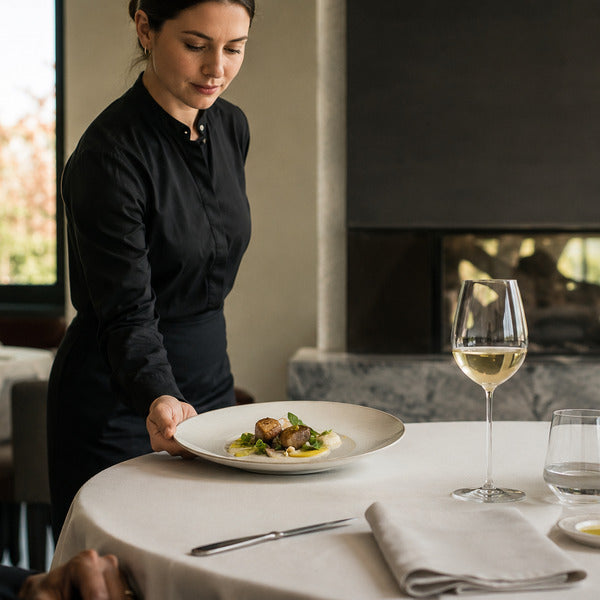
TL;DR — Fine Dining Etiquette at a Glance
- Serve from the left, clear from the right. Beverages pour from the right. Never reach across a guest.
- Handle everything by the base or stem — glassware by the stem, plates by the rim, flatware by the handle.
- Pace the table, not the ticket. Courses land together, and the table is never rushed or stranded.
- Know the menu cold. Ingredients, allergens, sourcing, and wine pairings — answered without checking.
- Stay polished and discreet. Pressed apron, quiet presence, guest-first language, professional check presentation.
Fine Dining vs. Casual Dining Service Standards
| Service Element | Fine Dining | Casual Dining |
|---|---|---|
| Service style | Formal, synchronized, course-by-course | Relaxed, single-drop delivery |
| Serving direction | Food from the left, clear from the right, pour from the right | Whichever side is open |
| Table setting | Full place setting: charger plate, multiple glasses, course-specific flatware | Basic setting, rolled flatware |
| Menu knowledge | Full ingredient, allergen, and pairing fluency required | General familiarity acceptable |
| Pacing | Deliberate, guest-led, courses fired to the table's rhythm | Speed and table turns prioritized |
| Check presentation | Leather or vinyl check presenter, presented discreetly | Printed slip, often dropped with dessert |
| Uniform standard | Pressed apron or vest, polished shoes, minimal jewelry | Branded tee or polo |
What Is Fine Dining Etiquette?
Fine dining etiquette is defined as the formal code of conduct that governs how food and beverage service is performed in upscale restaurants. It covers serving direction, glassware and flatware handling, course sequencing, guest interaction, and personal presentation. For servers, fine dining etiquette is a professional skill set — as trainable and measurable as knife skills are for a line cook.
Why does it matter commercially? Because guests pay for the experience, and ratings follow the experience. A Harvard Business School study by Michael Luca, "Reviews, Reputation, and Revenue: The Case of Yelp.com," found that a one-star increase in a restaurant's Yelp rating leads to a 5–9% increase in revenue — and the effect is driven by independent restaurants, exactly the segment where fine dining lives. Service etiquette is one of the few rating drivers a team controls on every single cover.
The stakes are rising, too. The National Restaurant Association's 2026 State of the Restaurant Industry report projects total restaurant and foodservice sales of $1.55 trillion this year, with more than 7 in 10 consumers saying they would dine out more often if they had more disposable income. When guests do choose a special-occasion restaurant, the service standard decides whether they come back. (Curious how the segments differ? See our full casual dining vs. fine dining comparison.)
What Are the 5 Fine Dining Etiquette Tips Every Server Should Master?
The five essential fine dining etiquette tips for servers are: (1) serve from the left and clear from the right, (2) handle glassware and tableware correctly, (3) pace the meal to the table, (4) know the menu completely, and (5) maintain impeccable personal presentation. Here is each one in operational detail.
1. Serve From the Left, Clear From the Right
The cardinal rule of formal service: plated food is served from the guest's left with your left hand; finished plates are cleared from the guest's right with your right hand; and all beverages — water, wine, cocktails — are poured or placed from the right, because glassware sits at the top right of the place setting. Moving this way keeps your arm out of the guest's sightline and prevents reaching across anyone.
Two supporting rules complete the standard. First, serve women first, then men, moving counterclockwise, with hosts served last. Second, never remove any plates until every guest at the table has finished the course — clearing early pressures guests who are still eating. If your room uses charger plates, they stay down through the appetizer courses and are removed before the entrée; our guide to what a charger plate is covers the full protocol.
2. Handle Glassware, Flatware, and Plates Correctly
In fine dining, anything a guest's mouth touches is handled only where the guest's hand goes. That means: stemmed glassware by the stem, never the bowl; tumblers by the base; flatware by the handle; plates by the rim or from underneath, with your thumb never crossing onto the eating surface. Fingerprints on a wine glass bowl are visible from across the room and read as carelessness.
Carry glassware on a beverage tray or inverted on a stem rack — never laced between your fingers in view of guests. When marking a table (resetting flatware between courses), bring the new pieces on a napkin-lined plate or service tray and place each utensil by its handle. These are small mechanics, but they are the mechanics guests photograph.
3. Pace the Meal — Read the Table, Not the Ticket
Pacing means controlling the rhythm of the meal so that no guest feels rushed and no guest feels abandoned. Practical standards used across upscale rooms: greet the table within 30 seconds of seating, take a drink order within a couple of minutes, and check back shortly after each course lands — many operators formalize this as a "30/30/30"-style rule (more on that in the FAQ). Fire the next course only when the table's tempo calls for it: a business dinner wants efficiency; an anniversary wants room to linger.
Pacing also governs the close. The check is never dropped unrequested in true fine dining; when a guest signals, it arrives promptly in a clean check presenter, and the payment is processed without hovering. A worn, sauce-stained vinyl folder at the end of a $400 dinner undoes an evening of polish — which is why we treat restaurant check presenters & server books as service equipment, not stationery.
4. Know the Menu Completely
Menu fluency is non-negotiable in fine dining etiquette. A server should be able to name every ingredient in every dish, flag the major allergens, describe preparation methods, explain sourcing when the menu highlights it, and suggest a wine pairing for each entrée — all without going to check with the kitchen. Guests in upscale rooms ask harder questions, and a confident, accurate answer is a trust signal that directly precedes the upsell.
Menu knowledge is also allergy safety. Fine-dining tasting menus routinely touch a dozen allergens across a night, and the server is the last verification point between the kitchen and the guest. Build menu changes into pre-shift lineups: taste the new dish, hear the chef describe it, and quiz two servers on it before doors open.
5. Maintain Impeccable Personal Presentation and Discretion
Guests read the server before they read the menu. Fine dining presentation standards are: a clean, pressed uniform and apron; polished closed-toe shoes; restrained fragrance and jewelry; tidy grooming; and upright, unhurried posture. Equally important is verbal presentation — "you're welcome" or "my pleasure" rather than "no problem," announcing dishes as they land, and never interrupting a guest conversation to recite specials.
Discretion is the finishing skill: crumb the table between courses, refill water before it's requested, and resolve problems away from the table. Our foodservice customers consistently tell us that well-equipped servers move with more confidence — and guests read that instantly. A structured waist apron with dedicated pockets for a wine key, crumber, and server book, like the Chef 101 black 3-pocket waist apron, keeps tools staged so the server never pats pockets in front of a guest.
Equipping a front-of-house team? Browse our host & server supplies and accessories collection for the service tools behind every tip above.
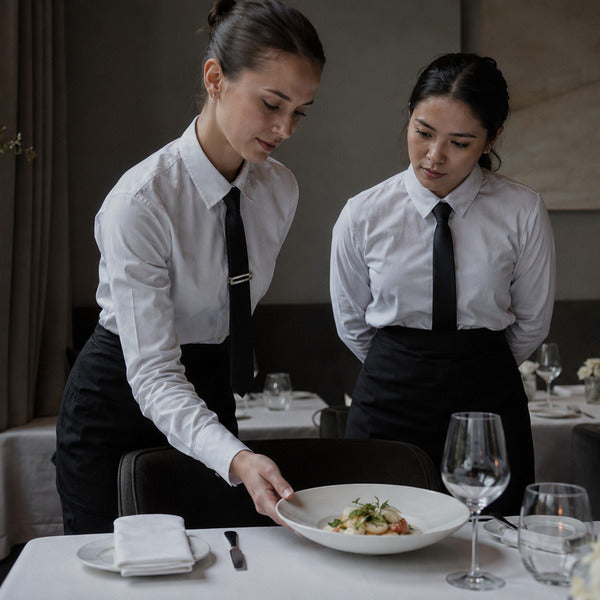
How Do You Train Waiters? 5 Tips for Training New Servers
Waiter training works best as a structured, staged program: orientation, shadowing, menu certification, supervised service, and ongoing coaching. Consistent training is also a retention strategy — U.S. Bureau of Labor Statistics JOLTS data show accommodation and food services carried a 5.5% job openings rate in March 2026 — the highest of any U.S. industry — so every server you train well and keep is a hiring cycle you skip. Here are the five training practices that hold up across the operations we supply.
1. Start With Written Standards, Not Verbal Folklore
Basic waiter training fails when standards live in veteran servers' heads. Document your steps of service, table numbers and seat-numbering convention, uniform code, and etiquette rules (serve-left/clear-right, stemware handling, greeting scripts) in a training manual every new hire signs. A written standard turns "that's how we've always done it" into something you can actually coach against.
2. Use Shadowing With Deliberate Role Reversal
Pair each trainee — waiter or waitress, the standards are identical — with a top performer for three to five shifts. Phase one: the trainee follows and observes. Phase two: the trainee runs the section while the trainer follows silently and debriefs after each table. That reversal is where training waiters actually sticks, because mistakes surface while a safety net is still in place.
3. Certify Menu Knowledge Before Solo Service
Require a passed menu test — ingredients, allergens, preparation, pronunciation, pairings — before a trainee takes a section alone. Include beverage service: wine presentation, opening at the table, and proper pours. Servers who cannot describe the food cannot sell the food.
4. Borrow Hotel Waiter Standards for Polish
The most transferable hotel waiter tips come from banquet and room-service discipline: carry a service tray at shoulder height with a straight wrist, announce yourself before approaching a conversation, confirm orders by seat number rather than "who had the salmon?", and treat synchronized plate drops (all entrées landing at once) as the default for tables of four or fewer. Hotels drill these mechanics because they serve hundreds of covers to a fixed standard — restaurants can steal that playbook wholesale.
5. Score Performance and Coach Continuously
Training doesn't end at day ten. Run pre-shift lineups daily, spot-audit tables against your written standards weekly, and give each server one specific coaching point per week — not a list of ten. Tie recognition to observable etiquette behaviors (perfect stemware handling, zero cross-reaches) so the standard stays visible long after onboarding.
How Do You Become a Good Server? The Habits Behind Excellent Service
If you want to know how to be a good server, build four trainable habits: anticipation, communication, composure, and ownership. An excellent server anticipates needs (water refilled before it's empty, extra napkins with messy courses), communicates clearly with both guests and the kitchen, stays composed when the rail is full, and owns problems instead of relaying blame — "I'll fix that right now," not "the kitchen is backed up."
A few field-tested practices that separate excellent servers from adequate ones:
- Use seat numbers for everything. Orders, allergies, and auctioning-free food delivery all depend on knowing seat 1 from seat 3.
- Master the two-trip rule. Never walk to or from the kitchen empty-handed — full hands in, full hands out.
- Sell by describing, not pushing. "The scallops are seared in brown butter with a citrus beurre blanc" outsells "do you want an appetizer?" every time.
- Protect the guest's timeline. If a course is delayed, tell the table before they notice, and offer something — a bread refresh, a taste pour — that shows the room is paying attention.
- Close as strongly as you open. The farewell and the check moment are the last impression; a clean presenter, a genuine thank-you, and an invitation back are worth more than any comped dessert.
For servers who also work behind the bar, one habit carries over directly: as a server or bartender, it is a good practice to acknowledge every arriving guest within seconds — even just eye contact and "I'll be right with you" — because perceived wait time starts the moment a guest feels unseen, not the moment they sit down. It is also good practice in both roles to repeat orders back before firing them; verbal confirmation catches most order errors before they cost you a remake.
What Are the Steps of Fine Dining Service?
The fine dining service steps follow a fixed sequence from greeting to farewell. Most upscale restaurants run a version of this 10-step order of service:
- Greet and seat — welcome within 30 seconds; present menus open; unfold napkins if the room's standard calls for it.
- Water and beverage order — pour water from the right; take the aperitif or cocktail order.
- Menu presentation — recite specials with prices; answer questions; make one genuine recommendation.
- Bread service — serve from the left; replenish without being asked.
- Order taking — by seat number, women first where practical; confirm allergens; repeat the order back.
- Wine service — present the bottle label-forward to the host, open at the table, offer the taste, pour ladies first, host last.
- Course service — serve from the left in synchronized drops; announce each dish; mark flatware between courses. If the kitchen sends an amuse-bouche ahead of the first course, announce it as a gift from the chef — our easy amuse-bouche recipes show what these one-bite openers look like.
- Between-course maintenance — clear from the right only when all guests finish; crumb the table; refresh water and wine.
- Dessert and digestif — present the dessert menu or trolley; offer coffee and after-dinner drinks.
- Check and farewell — present the check in a clean presenter only when requested; process payment promptly; thank guests by name when known.
Consistency across those ten steps is what guests experience as "flawless." If you want to see how a full tabletop program supports each step — chargers, stemware, flatware marking, and service accessories — our fine dining catalog walks through complete place-setting builds.
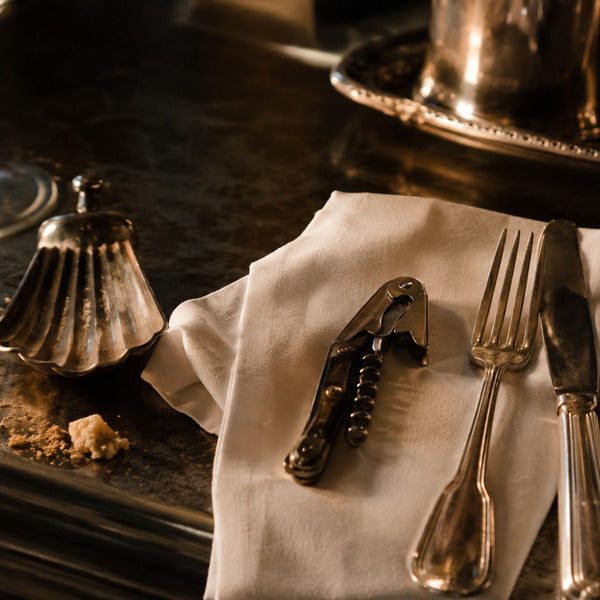
What Tools Do Fine Dining Servers Need?
A fine dining server's toolkit is short but non-negotiable: a wine key, a crumber, a lighter, a pen that works, a server book, and a clean check presenter — carried in a structured apron so nothing jingles or bulges. In 15+ years outfitting fine-dining rooms, we've seen the same pattern: operators who standardize server tools get standardized service, because nobody improvises when the right tool is already in their pocket.
Here's what we recommend from our own catalog, based on what fine-dining operators reorder most:
- Check presenters: the Chef 101 black vinyl guest check presenter & server book (5" x 9") is the workhorse; for rooms that want a dressier close, the gold-corner version adds polish for the price of a cocktail. Replace presenters at the first crack or stain — guests handle them at the exact moment they're deciding on the tip.
- Aprons: a fitted waist or bib apron with at least three pockets keeps tools staged; see our full restaurant aprons collection for front-of-house and back-of-house options.
- Service accessories: trays, carafes, caddies, and table-service tools live in our host & server supplies collection.
Frequently Asked Questions About Fine Dining Etiquette
What is the 30/30/30 rule for restaurants?
The 30/30/30 rule is a service-timing guideline: greet guests within 30 seconds of seating, return with drinks or a check-in within roughly 30 more, and check back about 30 seconds to a few minutes after food lands to catch problems early. Exact timings vary by operation, but the principle is fixed — no guest should ever wonder where their server is.
What are the 5 most important table manners?
The five most important table manners are: (1) place your napkin on your lap when seated, (2) work flatware from the outside in, course by course, (3) chew with your mouth closed and never talk while chewing, (4) keep phones off the table, and (5) say "please" and "thank you" to both companions and staff. Servers who know these rules can set, serve, and clear in a way that supports them.
What are two bad table manners?
Two of the worst table manners are talking with a full mouth and reaching across other guests instead of asking for an item to be passed. For servers, the mirror-image faults are reaching across a guest to serve or clear, and interrupting a guest mid-sentence — both break the same rule: never intrude on a guest's space or conversation.
What are two polite words we should always use while dining?
"Please" and "thank you" are the two polite words that should appear in every dining interaction, from guests and staff alike. For service teams, the professional upgrades are "my pleasure" in place of "no problem" and "certainly" in place of "yeah" — small word choices that guests register as refinement.
What is the difference between fine dining and a regular restaurant?
Fine dining differs from a regular restaurant in service formality, menu structure, and atmosphere: formal course-by-course service, full place settings with chargers and stemware, deeper menu and wine programs, higher check averages, and stricter staff presentation standards. Our casual vs. fine dining comparison breaks down the full operational differences.
How long does it take to train a fine dining server?
Most fine dining operations budget two to six weeks to train a server: roughly one week of orientation and shadowing, one to two weeks of supervised sections with menu and wine certification, and ongoing coaching thereafter. Experienced servers moving up from casual dining trend toward the short end; first-time servers need the long end plus continued lineup training.
Should servers memorize orders in fine dining?
Yes — in most fine dining rooms, servers take orders without writing at the table or use a discreet pad, then log everything by seat number immediately after stepping away. What matters is not the memorization itself but the outcome: every dish lands in front of the right guest without auctioning ("who had the duck?"), which is considered a service fault in formal dining.
Is fine dining etiquette the same for servers and guests?
No — they are two complementary codes. Guest etiquette covers table manners: napkin use, flatware order, and polite conduct. Server etiquette covers service standards: serving direction, glass and plate handling, pacing, and discretion. Great fine dining happens when servers know both, because the service side exists to make the guest side effortless.
Conclusion: Etiquette Is a System, Not a Talent
Fine dining etiquette is a trainable system: five core service rules, a structured training program, the habits of excellent servers, and ten repeatable steps of service. Teams that document the standards, train against them, and equip servers with professional tools deliver the consistency that guests reward with return visits and five-star reviews — the 5–9% revenue swing that ratings research keeps confirming.
When you're ready to outfit your front-of-house to the same standard you train to, start with our host & server supplies & accessories collection, then finish the guest-facing details with check presenters & server books built for nightly service. Your servers carry your brand to every table — give them the tools that carry it well.