6 Ways To Cut Food Purchase Costs In Your Restaurant
If your food costs are climbing faster than your menu prices, you are not imagining it. Food prices rose 2.9% in 2025, and for most operators that increase landed directly on the bottom line — squeezing already-thin margins even tighter.
The good news: food cost is the single largest expense you can actually control. Rent is fixed. Labor is hard to move. But how you buy, store, portion, and use your ingredients is entirely in your hands. The restaurants holding a healthy food cost percentage in this market are not getting lucky — they are executing a handful of fundamentals better than everyone else.
This guide breaks down 6 practical, proven ways to cut food purchase costs in your restaurant — focused on the physical kitchen, not expensive software. If you have been searching for how to cut food costs in a restaurant without sacrificing quality, start here. For a wider view of operational savings, see our companion guide on 10 ways food businesses can cut operating costs.

Why Food Costs Are the #1 Threat to Restaurant Profitability
Food and beverage costs are the largest controllable line item on any restaurant P&L. When they drift, profit disappears fast — and most operators do not catch it until the monthly numbers come in.
The scale of the problem is real. According to the National Restaurant Association, 38% of restaurant operators were not profitable in 2023, and 97% of operators cited higher food costs as their primary challenge. That is not an edge case — it is the defining pressure on the industry right now. Knowing how to cut food costs in a restaurant is no longer optional; it is survival.
What’s a Healthy Food Cost Percentage?
Your restaurant food cost percentage is the share of food revenue eaten up by ingredient costs. What counts as healthy depends on your format:
| Restaurant Type | Healthy Food Cost Range |
|---|---|
| Quick Service (QSR) | 28–32% |
| Fast Casual | 28–32% |
| Casual Dining | 30–35% |
| Fine Dining | 25–38% |
| Bars & Nightclubs | 18–24% |
The average restaurant food cost percentage falls between 28% and 35% of sales in 2025, according to Altametrics. If yours sits consistently above that range, the gap is almost always traceable to waste, over-portioning, or stale supplier pricing — every one of which is fixable with the steps below.
Why Food Prices Keep Rising
Food prices rose 2.9% in 2025 per the USDA Economic Research Service, compounding several years of increases. Supply-chain volatility, climate pressure on crops, and higher transportation costs all feed into it. Waiting for prices to fall back is not a plan. Controlling your cost per plate is the only lever you fully own — and it works no matter what commodities do. For a closer look at what’s driving these increases, see our breakdown of how inflation is affecting the food industry.
Way 1 – Plan Your Menu Around Cost-Effective Ingredients
Food cost control starts before you ever place an order — at the menu design stage. The most efficient kitchens build menus where every ingredient works across multiple dishes, which drives down both waste and per-unit purchasing costs. This is the foundation of reducing restaurant food costs.
Choose Dishes That Share Ingredients
Every ingredient that lives in only one dish is a liability. If that dish underperforms, the ingredient spoils and you eat the loss. Design your menu so your highest-volume ingredients appear in several places. Roasted chicken can anchor a salad, a sandwich, a flatbread, and a soup — and because you are buying it in volume, your per-pound cost drops.
Fewer unique ingredients means fewer items to track, store, and rotate — which means less spoilage and a lower food cost percentage almost immediately. Menu engineering for cost savings is one of the most underused tools operators have, and it costs nothing but planning time.
Rotate Seasonal Items to Avoid Premium Pricing
Out-of-season produce routinely runs 30–50% more per pound than in-season alternatives. Building seasonal rotation into your menu lets you buy at peak supply and lowest price while keeping plates fresh. Work with your primary supplier to get advance notice on seasonal price shifts so you can adjust the menu before costs spike, not after.
Way 2 – Tighten Up Inventory Management
Sloppy inventory is one of the most common — and most expensive — sources of food cost overruns. Ingredients that expire, walk off, or get over-ordered inflate your costs without producing a single dollar of sales.
For context, food and non-alcohol beverage costs represented a median of 32.4% of sales for limited-service restaurants in 2024, according to the National Restaurant Association. A meaningful slice of that is recoverable through better restaurant inventory management habits alone.
Implement FIFO — And Make Sure Your Team Actually Does It
FIFO (First In, First Out) is the backbone of kitchen rotation: older stock gets used before newer stock. Almost every operator knows the principle. Far fewer enforce it consistently — and the failure is almost always physical, not a matter of effort.
If your walk-in and dry storage are not organized for FIFO, your team grabs whatever is easiest to reach. Fix the system, not the people: use clearly labeled plastic storage containers and pourers with visible date markings, and arrange shelving so the oldest product always sits up front. When the storage layout enforces rotation visually, compliance jumps — and spoilage drops.
The Right Storage Equipment Prevents Spoilage Loss
Poor storage is one of the most underestimated cost leaks in any kitchen. Ingredients held in loose or inadequate containers lose freshness faster, pick up odors, and hit the trash earlier than they should — pure cost with zero return.
Airtight food storage containers with tight-sealing lids extend ingredient life across your walk-in and prep stations. For cut produce, portioned proteins, sauces, and prepped components, container quality directly determines how many extra days of usable life you get.
Our team has worked with hundreds of foodservice operators, and the single physical change that most reliably cuts weekly waste is upgrading to properly sealed, clearly labeled storage for high-turnover ingredients. Operators typically see spoilage drop within the first week.
Way 3 – Enforce Consistent Portion Control
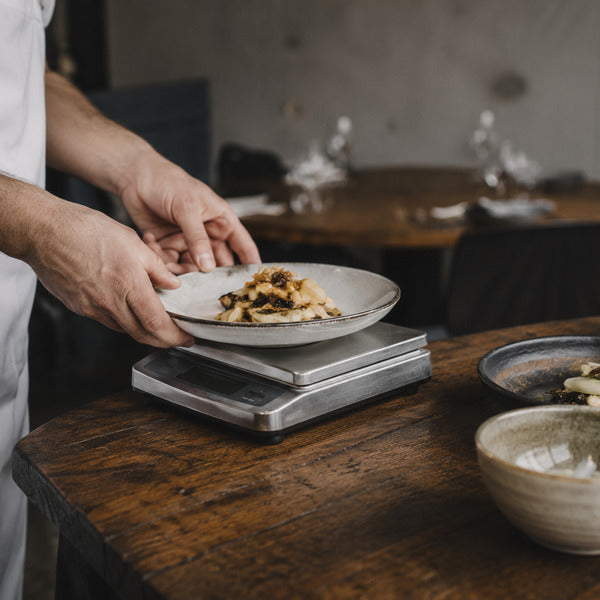
Portion control is where restaurants bleed money quietly, one heavy scoop at a time. If every plate leaves the line carrying 10% more protein or sauce than your recipe costs for, your actual food cost will always outrun your theoretical food cost — and no amount of smart purchasing will close that gap.
The Real Cost of Over-Portioning
Tony Smith, CEO of Restaurant365, puts it plainly: “When you misjudge ordering or overspend on food cost, it directly affects your bottom line. Customized forecasting based on historical data helps you improve restaurant operations by reducing food costs over time.”
The math is unforgiving. A chicken breast costed at 6 oz but consistently plated at 6.5 oz is an 8% overrun on your most expensive protein. Across 150 covers a night, seven nights a week, that quietly adds up to thousands of dollars a month in food you bought, prepped, and served without ever recovering the cost. The fix is not policing your cooks — it is giving them tools that make the correct portion the easy default.
Tools That Make Portioning Fast and Accurate
Restaurantware customers consistently tell us that standardizing portion containers at every station reduces per-unit prep costs noticeably. When each station has the right size deli containers for portion control — pre-stacked, pre-labeled, and consistent — portioning becomes a mechanical step instead of a judgment call.
This matters most on your high-cost items: proteins, premium toppings, sauces, and dessert components. For a full station-by-station breakdown, see our guide to the best portion control tools for foodservice operators.
Stop losing margin to waste and over-portioning. The right containers pay for themselves in the first week.
Shop Food Storage & Portion Control Supplies
Way 4 – Buy in Bulk from Trusted Suppliers
Bulk purchasing is one of the most dependable ways to lower your per-unit cost — but only when it is paired with proper storage and an honest demand forecast. Buying in bulk and watching half of it spoil is worse than paying full price for exactly what you need.
When Bulk Buying Saves Money (and When It Doesn’t)
Bulk buying works well for non-perishable pantry items like oils, vinegars, and dry goods; high-volume proteins you can portion and freeze; disposables and packaging; and any item with steady, predictable demand. It works against you for short-shelf-life produce you cannot move fast enough, specialty ingredients used in low-volume dishes, and anything with seasonal quality swings.
The deciding factor is storage capacity. If you are going to commit to bulk buying, invest equally in the containers, shelving, and rotation system that keep that inventory usable. Bulk savings only count if nothing sits long enough to spoil.
How to Negotiate Better Pricing with Your Vendors
Your vendors want your business — if you are not negotiating, you are leaving money on the table. Offer volume commitments in exchange for locked-in unit pricing. Ask whether early payment (Net 10 instead of Net 30) earns a 1–2% discount; it often does, and it compounds across a year. Bring competitor quotes and request price matches on staples. And schedule a formal supplier review at least once a year, because markets and your options both shift.
Way 5 – Reduce Food Waste at Every Station
US restaurants generate between 22 and 33 billion pounds of food waste every year, according to the National Restaurant Association. Even a modest cut in your kitchen’s waste has a direct, measurable impact on food cost — and restaurant food waste reduction rarely requires technology, just discipline and the right equipment.
Cross-Utilize Ingredients Across Multiple Dishes
Waste reduction starts at the menu. When you design dishes that share ingredients — protein trim becomes stock, vegetable ends become a side component — you convert what would have been waste into sold product. Walk your current menu and flag every ingredient that appears only once. For each, either find a second use or swap it for something that pulls double duty. This single exercise often trims weekly order volume by 5–10% without touching a menu price.
Proper Storage Extends Ingredient Life
A lot of waste does not happen on the line — it happens overnight in the walk-in, when ingredients are stored badly. Loose lids, non-sealing bags, and temperature-variable shelving all accelerate spoilage. Following food storage best practices — airtight containers, correct temperature zones, and clear prep and use-by labeling — consistently lowers spoilage rates and stretches every dollar of inventory further.
Investing in the right food holding equipment keeps more of your inventory usable for longer. Less spoilage means more sales per dollar of food purchased — the only food cost metric that ultimately matters.

Way 6 – Audit Your Suppliers Regularly
Most restaurants set up supplier relationships once and rarely revisit them. That is a costly habit. Prices move, your volume changes, and a deal that was competitive 18 months ago can quietly drift 15% above market without you noticing. Regular supplier audits are one of the lowest-effort, highest-return moves in food cost control for restaurants.
Price-Check at Least Quarterly
Put a quarterly price audit on the operations calendar. Pull your most recent invoices for your top 10 spend items and compare them against current quotes from two competing suppliers, plus published commodity indexes for your key proteins and produce. You do not have to switch suppliers to benefit — most of the time, showing your current rep a competitor’s number is enough to win a reduction. One successful negotiation on a high-volume item can shave hundreds off your monthly food costs.
Consider Local and Regional Alternatives for High-Volume Items
National distributors are convenient but not always the cheapest source for every item. Regional suppliers — especially for produce, dairy, and proteins — often beat national pricing because their distribution costs are lower. Get annual quotes from two or three regional sources on your highest-volume items. Shifting even 20% of your spend to a lower-cost regional supplier can move your food cost percentage by a full point, straight to operating profit.
Frequently Asked Questions
What is a good food cost percentage for a restaurant?
A healthy food cost percentage runs from 28% to 35% of total food sales, depending on format. Quick-service and fast-casual restaurants typically target 28–32%, casual dining lands around 30–35%, and fine dining ranges from 25–38% due to higher-cost ingredients. Altametrics reports the 2025 average sits between 28% and 35%. If you are consistently above 35%, audit your inventory management, portion control, and supplier pricing first.
How do you calculate food cost percentage?
Use this formula: (Beginning Inventory + Purchases − Ending Inventory) ÷ Total Food Sales × 100 = Food Cost %.
For example, if you start the week with $8,000 in inventory, purchase $5,000 more, end with $6,000 remaining, and book $20,000 in food sales: ($8,000 + $5,000 − $6,000) ÷ $20,000 × 100 = 35%. Track this weekly, not monthly — weekly tracking catches problems before they compound, while monthly tracking only shows you the damage after it is done.
What causes high food costs in restaurants?
The usual culprits are over-ordering, poor inventory rotation that leads to spoilage, portion sizes that run over the costed recipe, supplier pricing that has not been audited recently, and menu items with weak cost-to-sale ratios that should be repriced or cut. Most high-food-cost situations involve two or three of these at once — which is why a systematic approach beats chasing any single fix.
How can restaurants reduce food waste?
Start with storage: airtight containers, date labels, and FIFO organization cut spoilage at the source. Then work the menu by cross-utilizing ingredients so every item has more than one use. Finally, log waste by station daily — when the team knows waste is tracked, portion discipline improves on its own. With US restaurants generating 22–33 billion pounds of food waste annually, even small reductions carry real financial weight.
Does portion control really save money in a restaurant?
Yes — measurably. If your average food cost per plate is $8 and the line plates 10% over, you are really spending $8.80. At 200 covers a day, that is $160 in daily overrun, or roughly $58,000 a year. Portion tools — deli containers, scales, and fixed-volume ladles — remove the guesswork and keep your actual food cost aligned with your theoretical food cost.
Conclusion
Cutting food purchase costs is not about squeezing quality — it is about making smarter decisions at every step from purchase order to plate. Menu engineering, FIFO systems, proper containers, consistent portioning, disciplined bulk buying, and regular supplier audits are not complex initiatives. They are everyday disciplines that compound over time.
The restaurants holding 28–30% food cost in a tough market are not doing anything exotic. They are simply executing these fundamentals better than their competitors — every shift, every station, every order cycle. Start with what you can change today: audit your storage, enforce FIFO, and put portion tools at every station. Then work backward through the supply chain from there.
For the equipment side of cost control — from airtight storage to portioned deli containers to restaurant smallwares — Restaurantware has what your kitchen needs to run tighter and waste less.