The Best Pans for Cooking Steak: Cast Iron vs Stainless vs Carbon Steel
The best pan for steak is a cast iron skillet: it holds high heat for a deep, even crust. Carbon steel heats faster and weighs less, while fully-clad stainless steel sears well and makes better pan sauces. Avoid nonstick — its coating cannot safely reach searing temperatures above 500°F.
Ask ten chefs to name the best pan for steak and you will hear the same three answers: cast iron, carbon steel, or fully-clad stainless steel. The disagreement is about trade-offs — heat retention versus weight, crust versus pan sauce, seasoning upkeep versus dishwasher-proof convenience. After 15+ years supplying cookware to more than 40,000 foodservice operations, we have watched line cooks sear steaks on every pan on the market. This guide compares the three materials head-to-head, explains which pans to avoid, and shows exactly how commercial kitchens choose steak pans that survive hundreds of covers a night.
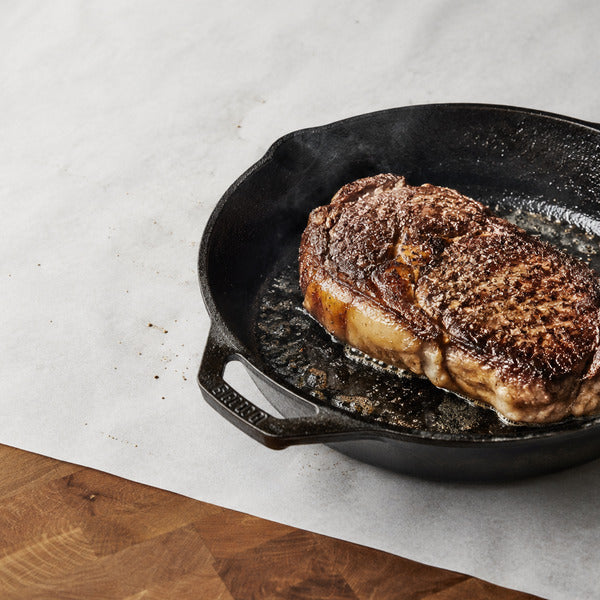
What Is the Best Pan for Cooking Steak?
The best pan for cooking steak is a heavy cast iron skillet, because cast iron stores more heat than any other common pan material and keeps searing hard when a cold steak hits the surface. That stored heat is what produces the deep brown, edge-to-edge crust steakhouse cooks are known for.
TL;DR — the verdict at a glance:
- Best crust and heat retention: cast iron skillet — the default answer to "best skillet for steak."
- Best for professional line work: carbon steel pan — lighter, faster to heat, nearly as good a sear.
- Best for pan sauces and easy cleanup: fully-clad stainless steel pan — the fond it builds is pan-sauce gold.
- Avoid: nonstick and thin aluminum pans — they cannot reach or hold true searing temperatures.
Every one of these picks assumes one non-negotiable: thickness. A steak pan needs a thick, heavy base. Thin pans lose their heat the moment the meat lands, and a pan that loses heat steams the steak gray instead of searing it brown.
Cast Iron vs Stainless Steel vs Carbon Steel: Steak Pan Comparison
Here is how the three serious steak-pan materials compare across the factors that actually decide the purchase. This table reflects what we see across the 40,000+ foodservice operations we supply, from independent steakhouses to hotel banquet lines.
| Factor | Cast Iron | Fully-Clad Stainless Steel | Carbon Steel |
|---|---|---|---|
| Heat retention | Excellent — best in class | Good (with thick clad base) | Very good |
| Heat-up speed | Slow (5–10 min preheat) | Fast | Fast |
| Sear quality | Deepest, most even crust | Excellent crust + best fond | Excellent crust |
| Weight (12" pan) | Heavy (~7–8 lb) | Moderate (~3–4 lb) | Moderate (~4–5 lb) |
| Maintenance | Requires seasoning; no dishwasher | Easiest — dishwasher-safe, no seasoning | Requires seasoning; no dishwasher |
| Pan sauces (deglazing) | Fair — acid can strip seasoning | Best — nonreactive, clean fond | Fair — same acid caution |
| Induction compatible | Yes | Yes (if induction-rated) | Yes |
| Typical commercial price | $ — least expensive | $$$ — most expensive | $$ — mid-range |
| Best for | Maximum crust, table-side presentation | Pan sauces, high-turnover cleanup | Line cooks working fast and long |
Why Is a Cast Iron Skillet Best for Steak?
A cast iron skillet is the best pan for searing steak because its dense, thick walls store roughly the most thermal energy of any common cookware material, so surface temperature barely dips when a cold ribeye lands. That stability is the whole game: browning reactions need sustained high surface heat, and cast iron delivers it edge to edge.
Cast iron for steak has three more advantages. First, a well-seasoned surface releases meat cleanly without synthetic coatings. Second, cast iron moves from stovetop to broiler to oven without a second thought — handy for thick cuts you finish in the oven. Third, it is the cheapest serious steak pan you can buy, which is why the cast iron skillet for steak searing outsells every other steak pan in our cast iron category. The trade-offs are real, though: a 12-inch cast iron skillet weighs 7–8 pounds, preheats slowly, and needs regular seasoning to stay rust-free. In a busy kitchen, that maintenance discipline has to be trained, not assumed.
When Is Stainless Steel the Better Steak Pan?
A fully-clad stainless steel pan for steak is the better choice when pan sauces, easy maintenance, or dishwasher cleanup matter more than maximum heat retention. "Fully clad" means an aluminum (or copper) core bonded between stainless layers across the entire pan body — not just a disc welded to the bottom — so heat spreads evenly to the rim.
In the cast iron vs stainless steel for steak debate, stainless wins on three points. It is nonreactive, so you can deglaze with wine or acid and build a pan sauce right on the fond without stripping any seasoning. It needs zero upkeep — no seasoning, no rust, and most commercial-grade pieces are dishwasher-safe. And it is significantly lighter than cast iron, which matters over a 10-hour shift. The trade-off is that a stainless pan stores less heat, so you must preheat properly and avoid crowding the pan; add too much cold meat at once and the temperature falls below searing range. Our foodservice customers consistently tell us stainless is the pan their dish pit prefers and their saucier reaches for first.
Why Do Line Cooks Choose Carbon Steel?
A carbon steel pan for steak is the line cook's choice because it combines about 99% iron with a thinner, lighter build: it sears nearly as hard as cast iron but heats up in a fraction of the time and weighs 2–3 pounds less. On a busy sauté station, where a cook may lift a pan hundreds of times a night, that weight difference is the difference between a good shift and a sore wrist.
Carbon steel develops the same slick, seasoned patina as cast iron and shares its weaknesses — it rusts if left wet, and acidic deglazing can strip the seasoning. It also tends to cost more than cast iron. But for cooks who want cast iron performance at working speed, carbon steel is the answer, which is exactly why French kitchens have used carbon steel fry pans for generations. (Carbon steel is also the classic wok material — a different tool for a different job; see our guide to choosing the right wok pan if stir-fry, not steak, is on your menu.)
Which Pans Should You Avoid for Steak?
Avoid nonstick pans and thin aluminum pans for steak. Nonstick (PTFE) coatings begin to break down and release fumes above 500°F (260°C), according to a safety review published by Healthline — and a proper steak sear happens at or above that threshold. A pan you cannot safely push past 500°F is, by definition, not a searing pan. Nonstick surfaces also prevent fond from forming, so you lose both the crust and the pan sauce.
Thin aluminum pans fail for a different reason: no thermal mass. They hit temperature quickly but collapse the moment meat touches the surface, leaving you with a steamed, gray exterior. Save nonstick for eggs and delicate fish, and thin aluminum for reheating — not for steak.
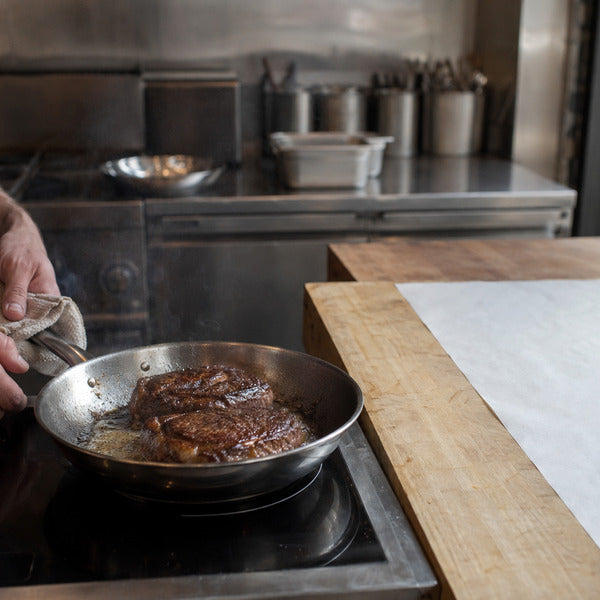
How Do You Choose a Steak Pan for a Commercial Kitchen?
Choose a commercial steak pan by evaluating five operator criteria: certification, induction compatibility, handle construction, volume durability, and replacement cost. Home-cookware reviews rarely cover any of them, yet they decide whether a pan survives a year of service.
- Sanitation certification. Health inspectors and many corporate purchasing standards expect commercial cookware to carry a recognized sanitation listing (such as NSF certification), confirming the materials and construction are safe for food contact and easy to clean at commercial volume.
- Induction compatibility. Kitchens are electrifying fast. If there is any chance your line moves to induction, buy induction-ready pans now — cast iron and carbon steel qualify automatically; stainless must be specifically induction-rated.
- Handle construction. Look for riveted or welded handles rated for oven and broiler use. Plastic or bakelite handles disqualify a pan from finish-in-the-oven steak service.
- Volume durability. A steak pan in a commercial kitchen endures thermal shock, metal utensils, and the dish pit daily. Thick-gauge bodies and uncoated cooking surfaces (cast iron, carbon steel, stainless) outlast any coating.
- Replacement economics. Pans are consumables at scale. A $40 pan replaced yearly can beat a $200 pan replaced every three years — do the math per station, not per pan.
The stakes for getting equipment purchasing right keep rising: the National Restaurant Association projects total restaurant and foodservice sales to reach $1.55 trillion in 2026, with operators adding more than 100,000 jobs — more covers, more sears, more wear on every pan on the line (current as of August 2026). Kitchens that standardize on durable, induction-ready steak pans now avoid re-buying their entire cookware inventory mid-growth.
One pattern we have seen across 15+ years of supplying commercial kitchens: most serious steak operations run two pans, not one. Cast iron or carbon steel handles the sear; a fully-clad stainless steel pan handles sauce work and delicate proteins. Buying the pair costs less than buying the wrong single pan twice.
How Do You Pan-Sear a Steak Perfectly?
Pan-sear a steak by drying it thoroughly, preheating a heavy pan until it is just smoking, searing in a high-smoke-point oil, flipping frequently, and resting the meat before slicing. The pan does half the work — technique does the rest.
- Dry and season. Pat the steak completely dry with paper towels — surface moisture is the enemy of crust — then salt generously. For best results, salt 45+ minutes ahead or just before the pan.
- Preheat hard. Heat the pan over medium-high until a drop of water instantly balls and skitters. Cast iron needs 5–10 minutes; stainless and carbon steel need less. An underheated pan is the #1 cause of gray steak.
- Use a high-smoke-point oil. A thin film of canola, grapeseed, or clarified butter. Whole butter burns at searing temperatures — add it only in the final minute for basting.
- Sear and flip often. Lay the steak away from you and leave it 60–90 seconds before the first flip. Flipping every minute builds an even crust and cooks the interior more evenly than one flip per side.
- Baste and finish. In the last 1–2 minutes, add butter, garlic, and thyme; tilt the pan and spoon the foaming butter over the steak. Thick cuts (over 1.5 inches) can finish in a 400°F oven — another reason oven-safe pans matter.
- Temp it, don't guess. The USDA's Food Safety and Inspection Service sets the safe minimum internal temperature for whole-muscle beef steaks at 145°F with a 3-minute rest (current as of August 2026). For doneness targets by style — rare through well-done — see our steak temperature guide.
- Rest before slicing. Rest the steak 5–10 minutes on a warm plate or rack so the juices redistribute instead of ending up on the cutting board.
Cut selection matters as much as technique — a well-marbled Choice or Prime ribeye sears more forgivingly than a lean Select strip. Our breakdown of the different grades of beef explains what those labels actually mean at the butcher case.
Steak Pans We Supply to Commercial Kitchens
Restaurantware equips more than 40,000 foodservice operations, and steak-capable fry pans are among the most reordered cookware items in our catalog. These are the workhorses we ship to steakhouse and hotel lines:
- Met Lux Round Stainless Steel 12" Fry Pan — Induction Ready — the full-size sear-and-sauce pan. Twelve inches comfortably fits two 12-ounce strips without crowding, and the induction-ready base means it survives a range conversion.
- Met Lux Round Stainless Steel 10" Fry Pan — Induction Ready — the single-steak station pan. The 10-inch size concentrates heat under one steak and is light enough for constant lifting during service.
- Cast iron cookware collection — skillets and servers for maximum-crust searing and sizzling table-side presentation that stainless cannot match.
- Stove top griddles and grill pans — for operations that want grill marks and steakhouse presentation from a standard range top.
Our foodservice customers consistently tell us the same thing after standardizing their sauté stations: matching the pan to the task — heavy iron for the sear, clad stainless for the sauce — cut their cookware replacement spend and made training new line cooks faster. Browse the full frying pans collection to build out a steak station that fits your volume.
Frequently Asked Questions
What is the 3 3 3 3 rule for steaks?
The 3-3-3-3 rule is a simple timing method for a medium-cooked steak: sear 3 minutes on the first side, 3 minutes on the second side, then finish 3 minutes per side over lower heat (or in the oven). It works best on cuts about 1 to 1.5 inches thick. Treat it as a starting point, not gospel — pan material, steak thickness, and starting temperature all shift the timing, so a probe thermometer is always the more reliable tool.
Is it better to cook steak in a cast iron or stainless steel pan?
Cast iron is better for the sear itself: it retains more heat, so it builds a deeper, more even crust. Stainless steel is better for pan sauces and maintenance: it is nonreactive, deglazes cleanly, and needs no seasoning. Many professional kitchens use both — cast iron or carbon steel for searing, fully-clad stainless when the dish finishes with a fond-based sauce.
What kind of pan do you use for steak?
Use a heavy, thick-based, oven-safe pan in cast iron, carbon steel, or fully-clad stainless steel, sized so the steak fits with about an inch of clearance — 10 to 12 inches for most cuts. Avoid nonstick coatings, which cannot safely exceed 500°F, and thin lightweight pans, which lose their heat the instant the meat lands.
What pans do chefs use for steak?
Most professional cooks sear steaks in carbon steel or cast iron pans on the line, and reach for fully-clad stainless steel when the steak finishes with a pan sauce. Carbon steel dominates high-volume stations because it delivers near-cast-iron searing power at roughly half the weight, heats faster, and shrugs off metal utensils shift after shift.
Conclusion: Match the Pan to the Sear
The best pan for steak is the one that holds serious heat and fits how your kitchen actually works: cast iron for the deepest crust at the lowest cost, carbon steel for line-speed searing without the weight, and fully-clad stainless steel for pan sauces and painless cleanup. Skip nonstick and thin aluminum entirely — no coating or featherweight pan sears at steak temperatures. Whether you are outfitting one sauté station or an entire hotel line, explore Restaurantware's frying pans and cast iron cookware collections to put the right sear on every steak you send out.