The Most Eco-Friendly Straws: Materials, Costs & Compliance for Beverage Service
The most eco-friendly straws are certified-compostable straws made from paper, hay, sugarcane fiber, or PHA bioplastic — materials that break down without leaving persistent plastic behind. A 2025 Northeastern University study found methane-derived PHA straws had the lowest overall environmental impact. Operators should verify BPI certification and check state straw laws before switching.
Ask ten suppliers which straws are the most eco-friendly straws on the market and you will get ten confident, contradictory answers. The honest answer depends on material science, your local composting infrastructure, and the drinks you actually serve — and thanks to a September 2025 study from Northeastern University and the Woods Hole Oceanographic Institution, operators finally have independent data instead of marketing claims. Researchers tested 13 drinking straws made from paper, bioplastics, oyster-shell fillers, and other materials, and several products sold as "green" turned out to contain the same polypropylene as conventional plastic straws.
This guide breaks down that research for foodservice buyers: which straw materials genuinely earn the eco-friendly label, what they cost in practice, how compostable cups and sustainable drinkware fit into a full beverage program, and what state straw laws require. It reflects what we have learned supplying eco-friendly disposables to tens of thousands of foodservice operations at Restaurantware.

TL;DR — Which Straws Are Actually Eco-Friendly?
- Best overall (single-use): PHA bioplastic straws — marine degradable, compostable, and rated lowest-impact in the 2025 Northeastern study. Hay/grass and sugarcane-fiber straws are strong plant-based runners-up.
- Most affordable: Paper straws — genuinely biodegradable, but they soften in liquid and take 10–100 times more water to manufacture than bioplastic straws.
- Read the label: PLA straws compost only in commercial facilities, and some "agave" or "oyster shell" straws are polypropylene blends that never fully degrade.
- Best for dine-in: Reusable stainless steel, glass, or silicone straws — lowest lifetime footprint if washed and retained.
- Compliance first: Eight states restrict single-use plastic straws to by-request service; check your local rules before reordering.
What Are the Most Eco-Friendly Straw Materials?
The most eco-friendly straw materials are those that are both made from renewable or waste-derived inputs and able to fully biodegrade — paper, hay and grass stems, sugarcane fiber (bagasse), and PHA bioplastics all meet that bar when properly certified. The comparison below reflects the Northeastern/WHOI findings plus what our foodservice customers report in daily service.
| Material | Durability in Drinks | Relative Cost | End of Life | Certifications to Look For | Best For |
|---|---|---|---|---|---|
| Paper | Low–moderate; softens in 20–30 minutes, faster in hot drinks | $ (lowest) | Biodegrades quickly; compostable versions available | BPI / ASTM D6868 (coatings matter) | High-volume cold service, quick-turn drinks |
| PLA bioplastic | High in cold drinks; deforms in heat | $$ | Compostable ONLY in commercial facilities; not marine degradable | BPI Commercial / ASTM D6400 | Cold beverages where commercial composting exists |
| PHA bioplastic | High in cold and iced drinks | $$$ | Compostable and marine degradable; lowest impact in 2025 study | BPI; marine-degradation test data | Operators wanting the strongest verified eco claim |
| Hay / grass stems | Moderate–high; holds shape in cold drinks | $$ | Fully biodegradable natural stem | Food-contact safety documentation | Cocktail bars, farm-to-table concepts |
| Sugarcane fiber (bagasse blends) | Moderate–high in cold and warm drinks | $$ | Compostable when certified; made from agricultural byproduct | BPI / ASTM D6400 | Smoothies, juices, all-day cafés |
| "Agave" or "oyster shell" PP blends | High | $$ | ⚠️ Often contain polypropylene that does not degrade | Demand full material disclosure | Avoid unless composition is verified plastic-free |
| Reusable (steel, glass, silicone) | Permanent | $$$$ upfront, lowest per use | No disposal after each use; recyclable at end of life | NSF/food-grade material specs | Dine-in service with warewashing capacity |
Two findings from the peer-reviewed study deserve special attention. First, the straw with the least environmental impact was a PHA bioplastic straw derived from captured methane — a greenhouse gas with roughly 28 times the global-warming potential of carbon dioxide — which biodegraded rapidly in seawater testing. Second, researchers found clear greenwashing: several straws marketed with nature-based fillers such as oyster shells or agave fibers contained polypropylene that did not degrade at all. The lesson for buyers is simple — the front of the box is marketing; the material disclosure and certification are the product.
What Did the Northeastern Straw Study Actually Find?
The Northeastern/WHOI study, published in September 2025, evaluated 13 commercial drinking straws on three criteria — circularity, sustainability, and persistence in the ocean — using a continuous-seawater flow system that mimics real marine conditions rather than a sealed lab bottle. Key operator-relevant results (current as of July 2026):
- Methane-derived PHA won overall. It was the lightest straw, used the thinnest wall of marine-degradable material, and completed a genuine circular loop: captured methane feeds microbes that produce the bioplastic, and the finished straw can be composted after use.
- Paper broke down fastest but scored lower on sustainability. Paper straws biodegrade quickly, yet manufacturing them takes 10 to 100 times more water than bioplastic straws — a growing concern as freshwater becomes constrained.
- Estimated marine lifetimes of one to two years applied to both paper and the methane-derived straws, because the paper straw used more total material.
- "Compostable" does not mean "marine degradable." Many certified-compostable straws present no evidence that they break down in the ocean, where straw pollution actually accumulates.
For a beverage program, the practical takeaway is not "buy one magic straw." It is that certified materials behave very differently by environment, so match the straw to your waste stream: composting program on site or nearby → PLA or bagasse works; no composting access → paper, hay, or PHA degrade most reliably; dine-in volume → reusables beat every disposable.
How Do You Choose the Right Eco-Friendly Straw for Your Operation?
Choose an eco-friendly straw by testing it against four operational filters — drink menu, waste infrastructure, cost per serve, and compliance — in that order.
1. Match the material to the menu
Iced coffee sipped over 45 minutes destroys a standard paper straw; a two-minute juice service does not. Thick smoothies and boba need wide-bore straws, which currently favor PLA, PHA, and sugarcane-fiber builds. Hot drinks eliminate PLA (it deforms with heat) and punish uncoated paper. In 15+ years supplying more than 40,000 foodservice operations, the single most common reason we see operators abandon a sustainability switch is choosing a straw that fails in their longest-dwell drink — test your slowest-selling, longest-sitting beverage first, not your fastest.
2. Match the straw to your waste stream
A commercially compostable straw in a landfill-bound trash bag delivers almost none of its promised benefit. If you have commercial composting pickup, prioritize BPI-certified PLA or bagasse. If you do not, favor paper, hay, or PHA — materials that degrade in less controlled environments. BPI offers two certification tiers — Commercial Only, and Commercial & Home — so check which one your supplier's product actually carries rather than trusting a generic leaf icon.
3. Calculate cost per serve, not cost per case
Paper straws typically run 1–3 cents each, PLA 2–5 cents, and specialty materials like PHA or hay 5–10 cents. But a straw that fails mid-drink costs you two straws plus a guest complaint. Price the straw against your average ticket: on a $7 specialty beverage, upgrading from a 2-cent straw to a 6-cent straw is a 0.6% cost increase that guests visibly notice and increasingly reward — the National Restaurant Association's State of the Restaurant Industry research found 30% of adults are more likely to choose a restaurant offering environmentally friendly practices, with even stronger preference among millennials and Gen Z.
4. Confirm compliance before you reorder
Straw regulation is local and moving. The compliance section below covers the state landscape; your distributor should be able to document that any "compostable plastic" straw meets ASTM D6400, because several jurisdictions restrict compostable-plastic straws the same way they restrict conventional ones.
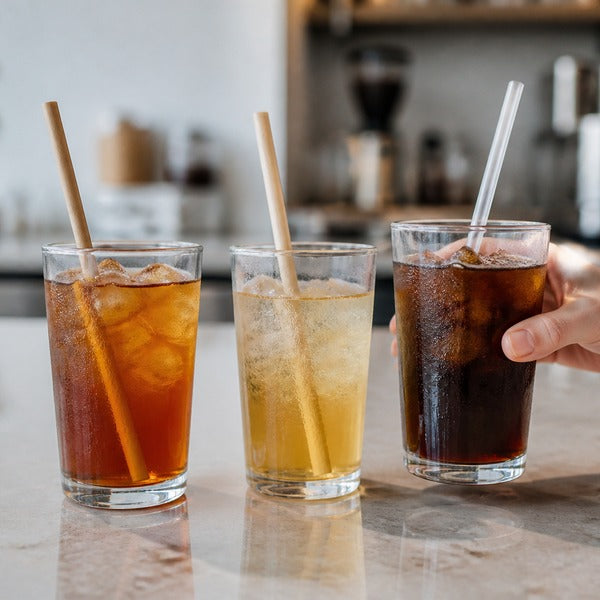
How Can Restaurants Make the Whole Beverage Service Sustainable?
Sustainable beverage service means rethinking the full drink chain — cup, lid, straw, stirrer, carrier, and sourcing — not swapping one straw SKU. Straws are the visible symbol, but cups are the volume. The U.S. EPA reports that containers and packaging generated 82.2 million tons of municipal solid waste in 2018 — 28.1% of total U.S. generation (latest EPA figures; current as of July 2026), and beverage packaging is a daily contributor in every café and bar.
Cups: the biggest lever
Compostable cups made from PLA-lined paper or molded plant fiber handle cold and hot programs respectively, and they are where sustainable beverage packaging decisions save or waste the most material. Biodegradable cups made from bagasse suit smoothie and juice concepts, while double-wall paper builds cut the need for sleeves. Our eco-friendly cups and bowls collection covers both, and conventional-format programs can transition gradually through paper cups and lids that replace plastic-heavy equivalents.
Lids, stirrers, and carriers: the forgotten plastic
A compostable cup with a polystyrene lid is a half-finished sentence. Fiber lids, wooden stirrers, and molded-pulp take-out cup carriers complete the swap — and carriers matter more than ever as off-premises orders keep growing. Wooden and bamboo stirrers replace the plastic stir stick at nearly identical cost, making them the easiest first win in most programs.
Dine-in: go reusable where you can
Sustainable drinkware — glass, stainless steel, and durable polycarbonate alternatives — beats every disposable on lifetime footprint for dine-in service. The break-even is fast: a washed reusable straw or cup replaces hundreds of single-use units per year. Pair reusables in the dining room with certified compostables for to-go, and you cover both service modes without compromise.
Sourcing and service practices
Round out the program with practices that cost nothing: serve straws only on request (required by law in several states anyway), default to "no straw" on delivery orders unless selected, train staff to offer lids only for to-go drinks, and consolidate beverage SKUs with fewer suppliers to cut shipping emissions. For the program-level playbook, see our guide to implementing sustainability in your beverage program, and for adjacent operations, sustainable practices in fast casual kitchens.
What Do State Straw Laws Require?
State straw laws generally restrict single-use plastic straws to by-request service rather than banning them outright. California moved first: AB 1884, signed in September 2018, prohibits full-service restaurants from providing single-use plastic straws unless a customer requests one. Since then, seven more states — Oregon, Washington, New York, New Jersey, Vermont, Maine, and Rhode Island — have adopted similar upon-request rules, and many cities (Seattle, San Francisco, Los Angeles, and others) go further by restricting plastic straws entirely, in some cases including compostable-plastic (PLA) straws. Current as of July 2026; always verify your local ordinance, because city rules frequently exceed state baselines.
Three compliance notes operators miss:
- "Compostable plastic" may still count as plastic. San Francisco's rule, for example, restricts compostable plastic straws alongside conventional ones — fiber, paper, and hay straws are the safe harbor there.
- "Marine degradable" is a testable claim, not a vibe. If a supplier claims marine degradability, ask for the test data. The Northeastern study found most compostable straws offer no marine-degradation evidence at all.
- ADA accessibility still applies. Upon-request laws exist partly because some guests need straws. Keep bendable options available and train staff to provide them without friction.
Building an Eco-Friendly Straw Program with Restaurantware
Our foodservice customers consistently tell us the switch succeeds when they pilot one material per drink category instead of flipping the whole menu at once — a two-week test of PHA or bagasse straws in the three highest-dwell drinks reveals more than any spec sheet. Restaurantware's eco-friendly straws collection spans paper, plant-fiber, and bioplastic builds in cocktail, standard, and wide-bore formats, and the broader straws range covers every gauge a bar or café program needs.
Products worth shortlisting for a pilot:
- Paper cocktail and jumbo straws — the lowest-cost certified swap for fast-turn drinks and events.
- Plant-fiber wide-bore straws — sugarcane-based builds that survive smoothies and boba without the soggy-paper failure mode.
- Compostable cold cups with fiber lids — pair the straw upgrade with the cup that guests actually hold and photograph.
- Wooden stirrers and picks — the near-zero-cost-difference swap that removes plastic from every coffee handoff.
Everything ships from our eco-friendly disposables line, so straw, cup, lid, and carrier arrive as one coherent program instead of four mismatched vendors.
Frequently Asked Questions
What are the most eco-friendly straws?
The most eco-friendly straws are PHA bioplastic, hay/grass, sugarcane-fiber, and certified-compostable paper straws. A 2025 Northeastern University study rated a methane-derived PHA straw lowest-impact overall because it is marine degradable, lightweight, and made from a captured greenhouse gas. For dine-in, reusable stainless steel or glass straws beat all disposables.
What is the healthiest type of straw?
Food-grade stainless steel, glass, and silicone straws are generally the healthiest choices because they are inert, dishwasher-safe, and free of coatings. Among disposables, uncoated natural-stem straws (hay/grass) and certified food-contact fiber straws avoid the additive concerns raised about some coated paper and plastic-blend products.
What are the environmentally friendly alternatives to plastic straws?
Environmentally friendly alternatives to plastic straws include paper, hay or grass stems, sugarcane fiber (bagasse), PLA and PHA bioplastics, and reusable straws in steel, glass, bamboo, or silicone. The right choice depends on drink dwell time and whether commercial composting is available — see the comparison table above.
What are eco-friendly cups made of?
Eco-friendly cups are made of paper with plant-based (PLA) linings, molded plant fiber such as bagasse, PLA cold-cup plastic, or reusable materials like glass and stainless steel. Compostable cups should carry BPI certification; biodegradable cups made from sugarcane fiber suit cold and warm drinks alike.
What is the best alternative to plastic cups?
The best alternative to plastic cups for cold drinks is a BPI-certified PLA or fiber cup where composting exists, or a paper cold cup with a plant-based lining elsewhere. For dine-in, reusable sustainable drinkware — glass or steel — has the lowest lifetime footprint of any option.
How can restaurants make drink service more sustainable?
Restaurants make drink service more sustainable by serving straws only on request, switching to certified compostable straws and cups, replacing plastic stirrers with wood, using fiber cup carriers for to-go orders, adopting reusables for dine-in, and matching every disposable to the waste stream that actually exists locally.
Is straw environmentally friendly?
Yes — actual straw (dried grass and grain stems, as used by brands like HAY! Straws) is one of the most environmentally friendly straw materials available. Hay and grass straws are natural agricultural stems that biodegrade completely without processing chemicals. This differs from asking whether "a straw" generically is eco-friendly — that depends entirely on its material.
Conclusion: Pick the Material That Matches Your Program
There is no single winner among the most eco-friendly straws — there is a best straw for your drinks, your waste stream, and your local rules. Let the verified science guide the shortlist (PHA, hay, bagasse, certified paper), let a two-week pilot pick the finalist, and upgrade the cup, lid, and carrier alongside it so the whole beverage program tells one story. For deeper dives on adjacent moves, see our eco-friendly packaging guide, the walkthrough on how to transition your restaurant to sustainable packaging, our roundup of eco-friendly takeout packaging solutions, and the guide to eco-friendly tableware for the rest of the table.
Ready to run the pilot? Browse Restaurantware's eco-friendly straws and the full eco-friendly disposables collection — in stock and ready to ship today.