Food Sustainability Practices in Global Food Sourcing
Food sustainability practices are methods of sourcing, producing, and serving food that protect natural resources, reduce waste, and support fair labor. Core practices include local and seasonal sourcing, certified suppliers, food waste reduction, and traceable supply chains. For foodservice operators, these practices lower long-term costs while meeting rising diner expectations for transparency.
Every plate you serve starts with a purchasing decision made weeks earlier. Food sustainability practices turn those purchasing decisions — which supplier you approve, which certification you require, whether you buy local or global — into a system that protects margins, reputation, and the resources your menu depends on. The stakes are large: the FAO reports that agrifood systems account for about one-third of total human-caused greenhouse gas emissions (FAO, current as of July 2026). This guide focuses on the sourcing side of sustainability: how to select suppliers, which certifications actually mean something, when local beats global (and when it doesn't), and how to build traceability into a working kitchen.
TL;DR — Food Sustainability Practices at a Glance
- Sourcing is the highest-leverage sustainability decision an operator makes — it shapes emissions, labor impact, and food quality before anything reaches the kitchen.
- Vet suppliers with a written scorecard: certifications, traceability records, packaging, and delivery practices — not marketing language.
- Trust load-bearing certifications: Fair Trade (labor and price floors), MSC (wild-caught seafood), Rainforest Alliance (tropical crops like coffee, cocoa, and tea), USDA Organic (production methods).
- Local vs. global is a tradeoff, not a rule: local wins on freshness, community, and story; global certified suppliers often win on volume, consistency, and off-season availability.
- Traceability is becoming table stakes: the FDA's Food Traceability Rule (FSMA 204) pushes lot-level recordkeeping down the entire supply chain — including to many restaurants' suppliers.
What Are Food Sustainability Practices?
Food sustainability practices are defined as the concrete methods a business uses to source, prepare, and serve food while protecting environmental resources, supporting fair labor, and remaining economically viable. In foodservice, they span four areas: sourcing (suppliers, certifications, seasonality), operations (energy, water, equipment), waste (food waste reduction, recycling, composting), and service (packaging and portioning). This guide concentrates on sourcing — the area where most of a menu's footprint is decided.
These practices matter commercially, not just ethically. The National Restaurant Association's 2025 What's Hot Culinary Forecast named Sustainability and Local Sourcing the #1 macro trend, with diners — especially Millennials and Gen Z — expecting restaurants to tell the story of where their food comes from. Operators who can't answer "where is this from?" are increasingly at a disadvantage.
| Practice Area | Core Practices | Primary Payoff |
|---|---|---|
| Sourcing | Supplier scorecards, certifications (Fair Trade, MSC, Rainforest Alliance), seasonal menus, local partnerships | Quality, brand story, risk reduction |
| Traceability | Lot-level records, dated labeling, FIFO rotation, FSMA 204 readiness | Food safety, faster recalls, compliance |
| Waste | Food waste reduction, whole-ingredient prep, recycling and composting programs | Lower food cost, smaller footprint |
| Service | Compostable packaging, right-sized portions, reusable service ware | Diner-visible sustainability, waste diversion |
The same logic applies upstream: sustainability practices in agriculture — cover cropping, water-efficient irrigation, integrated pest management, soil health programs — are what your suppliers should be doing on the farm. Your job as a buyer is to verify that those practices of sustainability are real, which is exactly what supplier selection and certification are for. Together, these buying decisions are how individual operators strengthen sustainable food systems at scale.
How Do You Choose Sustainable Suppliers?
Choosing sustainable suppliers means evaluating vendors against written, verifiable criteria instead of taking marketing claims at face value. The most reliable method is a supplier scorecard reviewed before onboarding and re-checked annually.
In 15+ years supplying 40,000+ foodservice operations at Restaurantware, we've seen the same pattern repeatedly: operators who document supplier standards keep them, and operators who rely on verbal assurances watch standards drift the moment prices tighten. A one-page scorecard is enough. Score each vendor on:
- Certifications held — third-party audited credentials (see the next section), with certificate numbers you can look up in the certifier's public database.
- Traceability capability — can they tell you the farm, boat, or lot for any case they deliver? How fast?
- Transparency — will they disclose country of origin, harvest dates, and processing locations without being chased?
- Packaging practices — recyclable or compostable transit packaging, minimal single-use plastic, take-back programs for crates and pallets.
- Delivery efficiency — consolidated drops and route-optimized deliveries cut transport emissions and your receiving labor.
- Labor standards — a written code of conduct, and Fair Trade or equivalent certification for high-risk categories like coffee, cocoa, and seafood.
- Financial stability and consistency — a sustainable supplier you can't rely on in August isn't sustainable for your business.
Weight the criteria by category risk. For produce, weight traceability and delivery; for seafood, certification is non-negotiable; for imported dry goods, labor standards carry the most reputational risk. For a deeper walkthrough of the vetting process, see our guide to choosing sustainable suppliers for your foodservice business. And before assuming sustainable sourcing costs more, read our analysis evaluating the impact of sustainable practices on cost — in many categories the premium disappears once waste and consistency are priced in.
Which Food Sustainability Certifications Matter Most?
Certifications matter because they replace a supplier's self-reported claims with third-party audits. Four certifications carry the most weight in global food sourcing:
| Certification | What It Verifies | Best For | Scale (verified July 2026) |
|---|---|---|---|
| Fair Trade | Minimum price floors, community premiums, labor standards | Coffee, cocoa, tea, sugar, bananas | More than 2 million farmers and workers in the Fairtrade system (Fairtrade International) |
| MSC (Marine Stewardship Council) | Wild-caught seafood from fisheries managed for healthy stocks | All wild-caught seafood | 738 fisheries engaged; 20.6% of global wild marine catch (MSC Annual Report 2024–25) |
| Rainforest Alliance | Farm-level environmental and social standards in tropical agriculture | Coffee, cocoa, tea, bananas | Nearly 8 million farmers and workers in 60+ countries (Rainforest Alliance) |
| USDA Organic | Production without prohibited synthetic pesticides or fertilizers | Produce, dairy, grains, packaged goods | Federally regulated seal, audited by USDA-accredited certifiers |
Three practical rules keep certifications honest in your purchasing program. First, verify, don't trust: every major certifier maintains a public database — ask suppliers for certificate numbers and check them. Second, match the certification to the category: MSC means nothing on coffee, and Fair Trade means nothing on halibut. Third, watch for "certification-adjacent" language — "responsibly sourced," "eco-friendly," and "farm fresh" are unregulated phrases, not credentials. For a full breakdown of these seals and several niche ones, see our guide to sustainability certifications in the food industry.
Local vs. Global Sourcing: Which Is More Sustainable?
Neither is automatically more sustainable — local and global sourcing each win on different criteria, and the strongest programs blend both. Treat it as a portfolio decision, category by category.
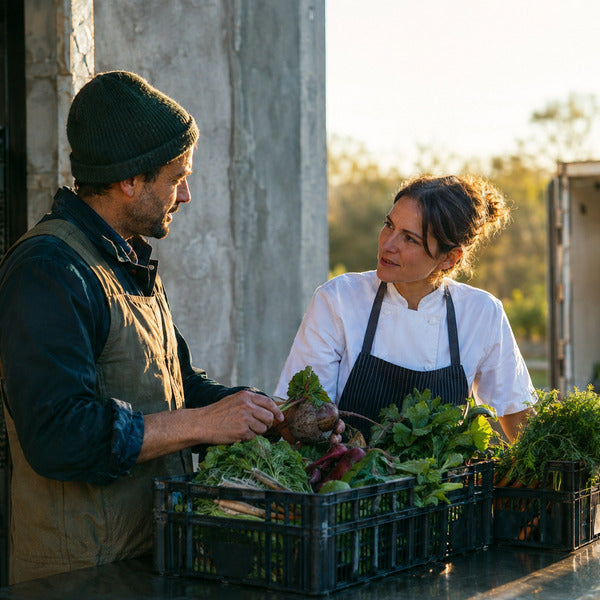
Where local sourcing wins. Local and seasonal purchasing delivers peak freshness, shorter cold chains, a marketable story, and community investment. Demand is real: USDA reports that more than 147,000 U.S. farms sold food locally through direct marketing, generating $9.0 billion in revenue (USDA NASS Local Food Marketing Practices survey, current as of July 2026). A farm 40 miles away can also answer traceability questions in one phone call — something a four-tier import chain cannot.
Where global sourcing wins. Some ingredients — coffee, cocoa, tea, tropical fruit, most spices, and much seafood — simply cannot be sourced locally in most of the United States. And transport is usually a small slice of a food's total footprint; production methods on the farm typically matter more than food miles. An efficiently farmed, certified imported ingredient can carry a smaller footprint than a local product grown in a heated greenhouse. Global suppliers also offer volume, price stability, and year-round consistency that seasonal local supply can't match.
| Criterion | Local Sourcing | Global Sourcing |
|---|---|---|
| Freshness & shelf life | ✔ Strongest | Depends on cold chain |
| Traceability effort | ✔ One call to the farm | Requires certification + records |
| Year-round consistency | Seasonal gaps | ✔ Strongest |
| Volume for multi-unit operators | Often limited | ✔ Strongest |
| Labor-standard assurance | Direct relationship | ✔ Via Fair Trade / Rainforest Alliance audits |
| Menu story for diners | ✔ Strongest | Strong only with certification story |
A practical blended rule: source local and seasonal where geography allows, and require certification wherever you must buy global. Cuisine matters here too — ingredient-driven menus can adapt sourcing without losing identity, as we cover in sustainable practices in Asian food preparation.
How Do You Build Traceability Into Your Food Supply Chain?
Traceability is the ability to identify where every ingredient came from — farm, boat, or lot — and where it went in your operation. It is the practice that makes every other sourcing claim provable, and it is increasingly a legal expectation: the FDA's Food Traceability Rule (FSMA Section 204) requires businesses that handle foods on the Food Traceability List — including many fresh produce items, seafood, and soft cheeses — to keep lot-level records of Critical Tracking Events. Even where a restaurant itself is exempt, its suppliers often are not, and operators who can produce records move faster in any recall.
A workable traceability system for a restaurant has four layers:
- Receive with records. Keep invoices and lot codes for high-risk categories, and reject deliveries that arrive without origin documentation. If a supplier can't tell you the lot, they can't help you in a recall.
- Label everything on arrival and after prep. Date, product, and source on every container. This is where discipline lives or dies — unlabeled product is untraceable product.
- Rotate FIFO, always. First-in, first-out rotation preserves the link between the label and the food while cutting spoilage — traceability and food waste reduction are the same habit viewed from two angles. The same loop extends downstream: consistent recycling practices lead to environmental sustainability by keeping packaging and glass in circulation instead of landfill.
- Audit quarterly. Pick one ingredient and trace it backward from the walk-in to the invoice to the farm. If the chain breaks, fix the layer where it broke.
How Should Operators Apply Food Sustainability Practices in a Working Kitchen?
Sourcing decisions only pay off if the back-of-house can execute them, and execution runs on unglamorous tools: containers, labels, and packaging. This is where sustainability business practices become daily routine instead of a mission statement.
Our foodservice customers consistently tell us the same thing: the operators who succeed at sustainable food sourcing are the ones who make the storage-and-labeling layer effortless. Three product categories carry most of the load:
- Durable food storage containers protect the premium ingredients you paid extra to source responsibly. Clear, airtight, stackable containers extend shelf life and make FIFO rotation visible at a glance — a certified ingredient that spoils in a bad container is a double loss.
- Inventory labels are the cheapest traceability technology in existence. Dissolvable and removable date labels keep origin, prep date, and use-by information attached to the food itself, which is exactly what FSMA-era recordkeeping expects of your suppliers — and what a health inspector loves to see in your walk-in.
- Eco-friendly disposables carry your sourcing story across the pass. Serving responsibly sourced food in compostable bagasse, palm leaf, or PLA-lined packaging keeps the sustainability promise consistent from farm to takeout bag.
In our own work with independent restaurants and multi-unit groups alike, the pattern is clear: start with labeling and storage discipline in week one, add the supplier scorecard in month one, and layer in certifications at each contract renewal. For more operational ideas, browse our eco-friendly foodservice solutions articles.
Frequently Asked Questions
What are examples of sustainable food practices?
Examples of sustainable food practices include sourcing from local and seasonal producers, buying Fair Trade, MSC, or Rainforest Alliance certified ingredients, reducing food waste through FIFO rotation and portion control, composting and recycling, conserving water and energy in the kitchen, and serving in compostable or reusable packaging.
What are the 5 C's of sustainability?
The 5 C's of sustainability are a common management framework: clean (reduce pollution and emissions), community (support local economies and fair labor), culture (build sustainable habits into daily operations), care (steward natural resources), and corporate governance (set policies, measure, and report). In foodservice, supplier selection touches all five.
What are the 4 pillars of food sustainability?
The 4 pillars of food sustainability are environmental (protecting soil, water, biodiversity, and climate), economic (viable livelihoods for producers and profitable operations for buyers), social (fair labor, food access, and community health), and nutritional (food that supports human health). Strong sourcing programs score suppliers against all four, not just the environmental pillar.
What are the 6 sustainable practices?
The six sustainable practices most commonly applied in foodservice are: (1) responsible and local sourcing, (2) food waste reduction, (3) energy efficiency, (4) water conservation, (5) recycling and composting, and (6) sustainable packaging. Sourcing sits first because it determines the impact of everything that follows.
Conclusion
Food sustainability practices in global sourcing come down to four disciplines: score your suppliers in writing, require the right certification for each category, blend local and global purchasing deliberately, and keep traceability records that would survive a recall. None of it requires a consultant — it requires a scorecard, a label gun, and consistency. Start where the payoff is fastest: put dissolvable date labels and clear storage containers into your walk-in this week, then bring the scorecard to your next supplier meeting. When you're ready to carry the story through to service, explore our eco-friendly disposables collection.