Managing Supply Chains for Consistent Food Quality
Managing supply chains is coordinating sourcing, purchasing, receiving, storage, and delivery so ingredients arrive on spec, on time, and at predictable cost. In foodservice, five steps protect consistent food quality: 1) plan demand, 2) source suppliers, 3) receive and inspect, 4) store and rotate (FIFO), 5) monitor performance.
TL;DR: Consistent food quality is a supply chain outcome, not a kitchen accident. This guide covers the full discipline of managing supply chains for restaurants: how a restaurant supply chain is structured, how to adapt it for expanded menus and delivery, how to manage supply chain risks, how to reduce carbon footprint in supply chain operations (including cold chain), and the receiving-and-rotation tools that hold it all together.
Managing supply chains well is the difference between a signature dish that tastes identical in March and in September — and one that drifts every time a case of produce shows up different. It matters more now than ever: the National Restaurant Association's 2026 State of the Restaurant Industry research found that 82% of operators reported higher food costs than the previous year, and 68% said tariffs pushed food and beverage expenses higher. When inputs are volatile, the operators who win are the ones with a supply chain system — documented specs, disciplined receiving, and rotation habits — rather than a stack of vendor phone numbers.
In 15+ years supplying more than 40,000 foodservice operations at Restaurantware, we've seen consistent food quality trace back to receiving and storage discipline more than to any single vendor choice. This consolidated guide folds our earlier posts on carbon reduction and menu-expansion supply chains into one hub, so every answer lives in one place.
What Is Managing Supply Chains?
Managing supply chains is defined as overseeing the end-to-end flow of goods, information, and money — from raw ingredient producers through distributors to your walk-in and, finally, the plate. The Association for Supply Chain Management (ASCM) frames it as the design, planning, execution, control, and monitoring of supply chain activities to create net value and synchronize supply with demand.
For a restaurant, the category breaks down into five working layers:
- Plan: Forecast demand from sales history, menu mix, and seasonality; set par levels.
- Source: Select and qualify suppliers — broadline distributors, specialty vendors, and local producers — with written product specs.
- Receive: Inspect every delivery against spec: temperatures, weights, freshness, packaging condition.
- Store & rotate: Get product into correct storage fast, label it, and enforce FIFO (first in, first out) rotation.
- Monitor: Track supplier scorecards, food cost percentage, waste logs, and shortage incidents; correct course monthly.
Every section below hangs off one of those five layers. If a quality problem repeats, you can almost always name the layer that failed.
Which supplier types belong in a restaurant supply chain?
A resilient restaurant supply chain mixes supplier types deliberately rather than relying on a single source. Here is how the three main options compare:
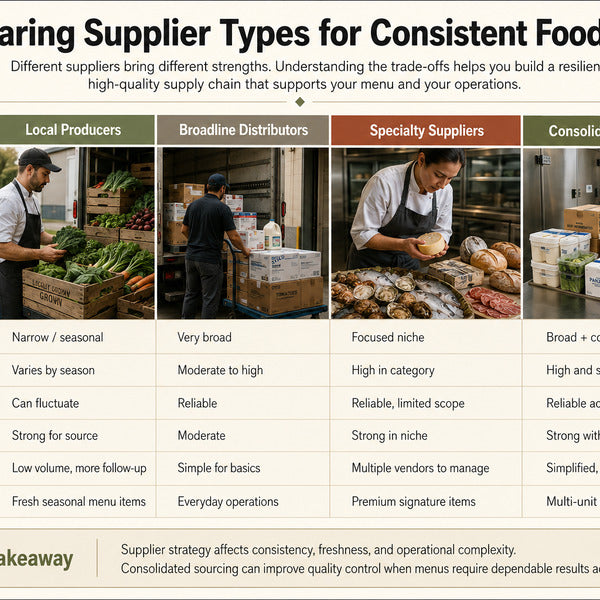
| Supplier type | Best for | Strength | Watch-out |
|---|---|---|---|
| Broadline distributor | Staples, dry goods, disposables | One truck, wide catalog, stable pricing | Less flexibility on specs and substitutions |
| Specialty vendor | Proteins, seafood, imported items | Deep product expertise, tighter quality control | Higher cost; smaller delivery windows |
| Local producer / farm | Produce, dairy, seasonal features | Freshness, shorter transport, marketing story | Volume limits and seasonal availability |
Most multi-unit operators run a 70/20/10 mix — broadline for volume, specialty for signature items, local for freshness and story. For a deeper framework on vetting the sustainable end of that mix, see our guide to choosing sustainable suppliers for your foodservice business.
How Does a Restaurant Supply Chain Protect Food Quality?
A restaurant supply chain protects food quality by controlling the three points where quality is won or lost: specification, receiving, and storage. Managing supply chains at these choke points costs far less than fixing quality complaints after the fact.
Write specs your suppliers can be held to
A product spec sheet states exactly what "acceptable" means: variety, grade, size or count, trim level, pack size, and delivery temperature. When 63% of full-service operators sourced alternative suppliers in 2025 to fight rising costs (National Restaurant Association, 2026 State of the Restaurant Industry), the operators with written specs switched vendors without their menu tasting any different. Specs make suppliers interchangeable on paper before they are interchangeable in the kitchen.
Run receiving like a quality gate

Receiving is the last moment a quality problem is the supplier's problem instead of yours. A five-minute discipline per delivery:
- Probe refrigerated items — reject TCS (time/temperature control for safety) foods above 41°F (5°C).
- Spot-check weights and counts against the invoice.
- Inspect for damaged cases, swollen cans, broken cold-chain packaging, and off odors.
- Document rejections with photos and a credit request the same day.
Store and rotate with FIFO date marking
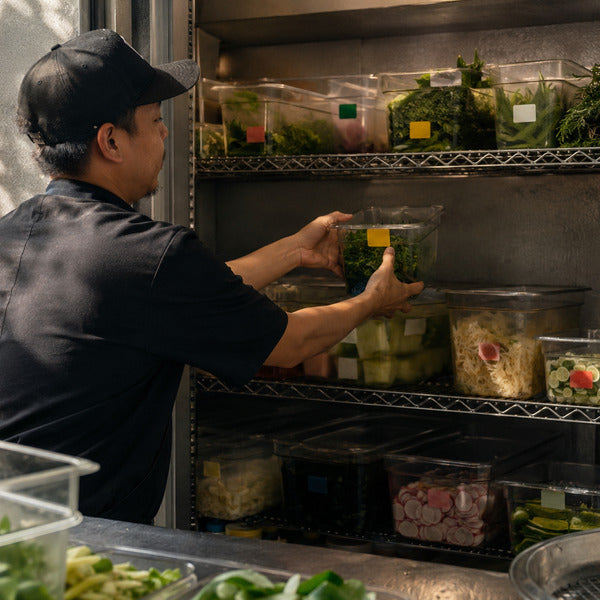
The FDA Food Code (Section 3-501.17) requires ready-to-eat TCS food held more than 24 hours to be date marked, and held no more than 7 days at 41°F (5°C) or below. That regulatory floor is also a quality ceiling: dating and rotating everything — not just TCS items — is how kitchens stop serving the oldest product last. Our foodservice customers consistently tell us labeling and rotation systems are the cheapest supply-chain insurance they buy: a roll of date stickers and food rotation labels costs less than one comped entrée.
How Do You Adapt a Supply Chain for Expanded Menus and Delivery?
Adapting a supply chain for expanded menu times means re-engineering ordering, delivery windows, and storage before you extend hours, add dayparts, or launch delivery — because every new menu item multiplies SKUs, and every new daypart stretches your receiving and prep windows.
Adapting supply for extended hours and new dayparts
Adding breakfast, late-night service, or a seasonal menu changes demand patterns faster than a standing weekly order can follow. Practical adjustments that work:
- Split par levels by daypart so breakfast proteins are not competing for walk-in space with dinner prep.
- Shift to smaller, more frequent orders for perishables while keeping bulk cadence for dry goods.
- Cross-utilize ingredients — design new menu items around SKUs you already stock so one supplier hiccup does not take out two dayparts.
How does a customized food delivery supply chain process work?
A customized food delivery supply chain process maps each channel — dine-in, takeout, third-party delivery — to its own packaging, holding, and inventory requirements. Delivery orders need packaging that survives 20–30 minutes of transit, which means treating containers, lids, and tamper seals as supply chain SKUs with their own pars, suppliers, and reorder points, not as an afterthought. Holding quality also changes: items engineered for delivery (vented containers, sturdier builds, sauce-on-the-side packs) should get their own specs exactly like proteins do.
Supply chain and training adaptations for localized menus
Multi-unit brands that localize menus — a regional seafood item here, a market-specific fast-food LTO there — need two adaptations. First, dual-source the localized SKUs regionally so one market's special never rides on a single farm or plant. Second, standardize the training, not just the recipe: receiving criteria, storage location, date-marking rules, and prep specs for the local item must be documented as tightly as core-menu items, or quality consistency dies at the newest location first.
Where can multi-unit restaurants secure flexible delivery windows for perishables?
Flexible delivery windows for perishable inventory come from four places: (1) negotiate them into the distributor contract — route flexibility is a term, not a favor, and multi-unit volume buys it; (2) regional produce and protein specialists, which typically run shorter routes and can hit early-morning windows broadliners will not; (3) redistribution/consolidation partners that combine smaller vendors onto one scheduled truck; and (4) local producers for the shortest, most schedulable runs. Whichever mix you use, insist that perishables land during staffed receiving hours — an unattended 5 a.m. drop breaks the cold chain and the quality gate at once.
How Do You Manage Supply Chain Risks?
Managing supply chain risks means identifying where a single failure can interrupt service — one supplier, one route, one ingredient — and building redundancy before it does. Managing risk in supply chains is cheaper as prevention than as crisis response, and recent history proves the exposure is real: avian flu and tariff shocks ran food costs 34% above pre-pandemic levels by 2026 (National Restaurant Association).
- Map single points of failure. List every menu-critical ingredient with only one approved source; those are your risk register.
- Qualify backup suppliers in advance. Approve a second vendor per critical category before you need one — sampling and spec-matching take weeks you will not have mid-disruption.
- Hold strategic safety stock on shelf-stable critical items, sized to your realistic lead-time gap — without drifting into overstock that ties up cash and cooler space. Our post on balancing stock levels to meet demand without overstocking covers the math.
- Design menu flex. Keep one or two dishes per category that can absorb an ingredient substitution without a spec change guests would notice.
- Watch leading indicators. Fill rates dropping and substitutions rising are the early warnings; act on them before shorted cases become 86'd menu items. For a fast-action playbook, see 3 ways to prepare for supply chain issues.
What about managing global supply chains?
Managing global supply chains adds three risk layers to the domestic playbook: longer lead times, customs and tariff exposure, and less visibility into upstream handling. For imported items — specialty cheeses, olive oil, wines, certain seafood — the practical rules are: order against lead times measured in weeks, not days; keep a domestic substitute approved for every imported menu-critical SKU; and require import documentation (origin, temperature logs where applicable) from the distributor. The 68% of operators who reported tariff-driven cost increases in 2025 (National Restaurant Association) learned that global sourcing decisions are pricing decisions, too.
How Do You Reduce Carbon Footprint in Supply Chain Operations?
Reducing carbon footprint in supply chain operations means cutting emissions across three areas foodservice operators actually control: what you buy, how it travels and is stored, and how much of it you waste. Carbon emission reduction in the supply chain usually pays for itself, because emissions and waste ride the same line items — fuel, energy, and discarded food.
How do you reduce carbon footprint in cold chain operations?
Cold chain operations — refrigerated transport and storage — are the most energy-intensive link in a food supply chain. The highest-impact moves:
- Consolidate deliveries. Fewer, fuller refrigerated trucks per week beat daily half-empty drops for both fuel emissions and receiving labor.
- Maintain refrigeration equipment. Clean condenser coils, tight door gaskets, and calibrated thermostats cut compressor runtime; modern EPA-compliant low-GWP refrigerants shrink leak impact.
- Keep cold air in. Strip curtains on walk-ins, closed-door discipline, and rapid put-away at receiving reduce both energy use and temperature abuse — a carbon win and a quality win.
- Right-size cold storage. Airtight containers and organized shelving improve airflow and let a smaller, better-packed walk-in do the work of a cluttered one.
How do companies reduce carbon emissions in supply chains? Strategies and examples
Companies reduce carbon emissions in supply chains with four repeatable strategies, each of which scales down to a single restaurant:
- Source closer. Shorter transport distances cut fuel emissions; regional and local sourcing for produce and dairy is the restaurant version of the "nearshoring" strategy large manufacturers use.
- Choose lower-impact suppliers. Ask vendors for their sustainability practices — route optimization, renewable-powered warehouses, packaging take-back — and weight them in supplier scorecards.
- Cut packaging weight and waste. Reusable transport crates, right-sized cases, and recyclable or compostable packaging reduce upstream (Scope 3) emissions embedded in every delivery.
- Attack food waste. Wasted food is wasted embedded carbon — all the diesel, refrigeration, and fertilizer spent producing it. USDA Economic Research Service estimates 31% of the U.S. food supply at retail and consumer levels went uneaten — 133 billion pounds worth $161.6 billion in its benchmark study — and the EPA reports that food is about 24% of landfilled municipal solid waste, where it generates methane. Every case you rotate instead of toss is a direct emission cut.
What are the best ways to reduce carbon footprint in the foodservice industry?
The best ways to reduce carbon footprint in the foodservice industry, ranked by effort-to-impact for a typical operation:
- FIFO rotation and date marking — eliminating spoilage waste is the cheapest carbon reduction available; it requires labels and discipline, not capital.
- Delivery consolidation — one negotiation, permanent fuel-emission reduction.
- Refrigeration maintenance and airtight storage — lower energy bills and steadier holding temperatures.
- Local and seasonal sourcing — shorter cold chains and fresher product.
- Menu engineering for full utilization — cross-utilize trim and byproducts so purchased carbon becomes revenue, not landfill methane.
How Do You Monitor Supply Chain Performance?
You monitor supply chain performance by scoring every supplier monthly against a small set of measurable criteria, then reviewing the scores alongside your food cost percentage and waste log. Managing supply chains without measurement turns every vendor conversation into opinion; a scorecard turns it into a renewal decision.
Here is the simple 100-point supplier scorecard we recommend to operators (weightings reflect what actually drives consistent food quality):
| Criterion | Weight | How to measure | Red flag |
|---|---|---|---|
| Quality vs. spec | 30 | % of deliveries fully meeting written specs at receiving | Below 95% |
| Fill rate | 25 | % of ordered line items delivered complete | Below 97%, or trending down |
| On-time delivery | 20 | % of deliveries inside the agreed window | Repeated unattended or off-window drops |
| Price stability | 15 | Unannounced price changes per quarter | Increases without notice or explanation |
| Responsiveness | 10 | Time to resolve credits and shortages | Credits open longer than 7 days |
Score suppliers monthly, share the results with them quarterly, and re-bid any category whose leader sits below 85 points for two consecutive quarters. Pair the scorecard with two internal numbers — food cost percentage and pounds of waste logged per week — and you have a complete early-warning system: supplier problems show up in the scorecard, and process problems show up in the waste log.
The Foodservice Application: Tools That Hold the System Together
Managing supply chains ultimately succeeds or fails inside your walk-in. After 15+ years supplying 40,000+ foodservice operations, the pattern we see at Restaurantware is unambiguous: the kitchens with consistent food quality are the ones where receiving and rotation are physically easy — the tools are at hand, so the discipline sticks.
- Airtight food storage containers standardize put-away: clear bodies for visual inventory, stackable footprints for FIFO-friendly shelving, and tight seals that protect quality and refrigeration efficiency at once.
- Date stickers and food rotation labels — including dissolvable labels that wash off cleanly at the dish station — make FDA-compliant date marking a two-second habit instead of a masking-tape guess.
- Inventory labels turn shelving into a system: labeled, dedicated locations make counts faster, par checks obvious, and misplaced product visible before it expires.
One concrete observation from our customers' walk-ins: when every container in the cooler carries a legible date and every shelf position is labeled, weekly inventory time drops, waste logs shrink, and the "mystery container" — the classic first domino of a quality incident — disappears.
Frequently Asked Questions
What are the 5 C's of supply chain management?
The 5 C's of supply chain management are commonly given as: connected, collaborative, cyber-aware, cognitively enabled, and comprehensive — a framework describing modern digital supply chains. In restaurant terms: connect your sales and ordering data, collaborate with suppliers on forecasts, protect ordering systems, use software to flag anomalies, and manage the chain end to end rather than order by order.
What are the 5 basic steps of supply chain management?
The 5 basic steps of supply chain management are plan, source, make, deliver, and return — the classic SCOR model. In foodservice these translate to: plan demand and pars, source and qualify suppliers, prep and produce menu items, serve or deliver to guests, and handle returns as supplier credits and waste diversion.
What are the 7 stages of supply chain management?
The 7 stages of supply chain management expand the basic model to: planning, sourcing, procurement/inbound logistics, production, warehousing/storage, distribution/delivery, and returns. For a restaurant, the storage stage — receiving, put-away, date marking, and FIFO rotation — is where consistent food quality is most often won or lost.
How do you manage supply chains?
You manage supply chains by working five layers in order: plan demand from sales data, source suppliers against written specs, receive every delivery through an inspection gate, store and rotate with date marking and FIFO, and monitor supplier scorecards and waste logs monthly. Redundancy — a qualified backup supplier per critical category — turns disruptions into substitutions instead of 86'd items.
What are the 5 pillars of supply chain?
The 5 pillars of supply chain are usually listed as plan, source, make, deliver, and return, though some frameworks name them as people, process, technology, sourcing, and logistics. Either way, the pillar restaurants most under-invest in is process: documented receiving standards and rotation rules outperform any single vendor upgrade.
What is the difference between supply chain management and logistics?
Logistics is the movement and storage of goods — trucks, routes, warehouses, coolers. Supply chain management is the broader discipline that includes logistics plus sourcing, purchasing, forecasting, supplier relationships, and quality control. A restaurant can outsource logistics to its distributors; it can never outsource supply chain management.
Conclusion: Consistency Is a System
Managing supply chains for consistent food quality comes down to five repeatable layers — plan, source, receive, store and rotate, monitor — reinforced with backup suppliers, honest waste tracking, and a cold chain you maintain instead of fight. The economics favor discipline: with 82% of operators facing higher food costs, every case that arrives on spec and gets used before it expires is margin recovered.
Start where the leverage is highest: your walk-in. Outfit it with airtight food storage containers and date stickers and food rotation labels, and your supply chain's last mile — the one your guests actually taste — takes care of itself.