How to Reduce Water Usage in Commercial Kitchens
Restaurant water conservation means cutting a commercial kitchen's water use through efficient equipment and habits. Install high-efficiency pre-rinse spray valves, run dishwashers only with full racks, fix leaks promptly, thaw food in the refrigerator instead of under running water, and serve drinking water on request. Most restaurants can cut usage 10–20%.
Water is the utility most restaurants ignore until the bill spikes. Yet restaurant water conservation is one of the fastest paybacks in foodservice: the EPA reports that water-efficient practices in commercial facilities can cut operating costs by roughly 11 percent and water use by 15 percent. If you want to reduce water usage in commercial kitchens, the good news is that most of the savings come from a handful of fixtures, one or two equipment upgrades, and daily habits your team can adopt this week. In 15+ years supplying 40,000+ foodservice operations, we've watched operators trim thousands of gallons a month without slowing a single ticket — this guide shows you exactly where that water hides and how to stop paying for it.

TL;DR — The Fastest Ways to Cut Kitchen Water Use
- Swap the pre-rinse spray valve. Pre-rinsing can account for nearly one-third of a commercial kitchen's water; a high-efficiency valve saves 7,000+ gallons a year and pays back in as little as 5–8 months (EPA).
- Run dish machines full, every time. A rack costs the same water half-empty as full.
- Fix leaks within 24 hours. A running toilet or dripping faucet quietly erases every other saving.
- Thaw in the refrigerator, not under running water. Safer under the FDA Food Code and free.
- Upgrade to ENERGY STAR dish machines and ice makers. Certified commercial dishwashers save over 5,600 gallons of water per year on average.
- Scrape before you rinse. Squeegees, scrapers, and dry wipes keep food out of the drain and water in the pipe.
| Water-saving measure | Typical savings | Upfront cost | Payback |
|---|---|---|---|
| High-efficiency pre-rinse spray valve (≤1.28 gpm) | 7,000+ gal/year; $110–$200/year | $ | 5–8 months (as short as 1 month) |
| ENERGY STAR commercial dishwasher | 5,647 gal/year avg + $360/year energy | $$$ | At replacement cycle |
| Faucet aerators (target ≤0.5 gpm on hand sinks) | Cuts faucet flow 50%+ vs. unrestricted | $ | Weeks |
| Leak audit + prompt repairs | Varies — often the single largest recovery | $ | Immediate |
| Refrigerator thawing instead of running water | Hundreds of gal/week in high-volume prep | $0 | Immediate |
| Full-rack dishwashing policy + drying racks | Eliminates redundant racks daily | $0–$ | Immediate |
Savings figures: EPA WaterSense and ENERGY STAR, verified August 2026. Actual results vary by volume and local utility rates.
Why Does Water Conservation Matter for Restaurants?
Water conservation matters for restaurants because foodservice is one of the thirstiest commercial sectors in the country. According to the EPA WaterSense program, approximately 15 percent of all water used in U.S. commercial and institutional facilities flows through hospitality and foodservice establishments — and the commercial sector as a whole accounts for 17 percent of withdrawals from public water supplies. Inside a restaurant, the kitchen is the single largest water user, with restrooms in second place.
The financial case is just as direct. The EPA's WaterSense restaurants factsheet reports that implementing water-efficient practices in commercial facilities can decrease operating costs by approximately 11 percent, cutting energy use by 10 percent and water use by 15 percent. Remember that every gallon you buy gets billed up to three times: once as water in, once as sewer out, and once as the gas or electricity that heated it. That is why water conservation in restaurants consistently outperforms flashier sustainability projects on ROI.
Supply pressure is real, too. In a 2014 report cited by the EPA, 40 of 50 state water managers said they expected water shortages in some portion of their states within the decade under average conditions. Operators in drought-prone regions already face surcharges, seasonal restrictions, and even mandatory reductions — a restaurant with a conservation program in place absorbs those rules without disruption.
Where Do Commercial Kitchens Use the Most Water?
Commercial kitchens use the most water in dishwashing and pre-rinsing, followed by food prep, thawing, ice production, and cleaning. The EPA's restaurant factsheet breaks down end uses of water in a typical restaurant like this:
| End use | Share of restaurant water use |
|---|---|
| Kitchen and dishwashing | 52% |
| Restrooms (domestic use) | 31% |
| Other | 12% |
| Landscaping | 4% |
| Cooling and heating | 1% |
Source: EPA WaterSense, "Saving Water in Restaurants" factsheet. Current as of August 2026.
Zoom in on that 52 percent and the pre-rinse station dominates. The EPA estimates that roughly one million U.S. foodservice establishments use nearly 53 billion gallons of water each year just rinsing dishes with pre-rinse spray valves — close to one-third of a typical commercial kitchen's total water use, and an average of roughly 145 gallons per establishment per day on pre-rinsing alone (derived from EPA's national figures). Other quiet consumers include ice machines, steam cookers, continuously running dipper wells, garbage disposals, and thawing sinks left running for hours.
Before changing anything, run a simple water audit: pull 12 months of water bills, divide gallons by meals served to get a gallons-per-meal baseline, then walk the line during a shift and note every place water runs. Check your meter before and after a closed two-hour window — if it moves, you have a leak. You cannot manage commercial kitchen water usage you have not measured.
How Can Restaurants Reduce Water Usage With Equipment and Fixtures?
Restaurants reduce water usage fastest by upgrading the handful of fixtures and machines that touch water all day: the pre-rinse spray valve, faucets, the dish machine, and ice equipment.
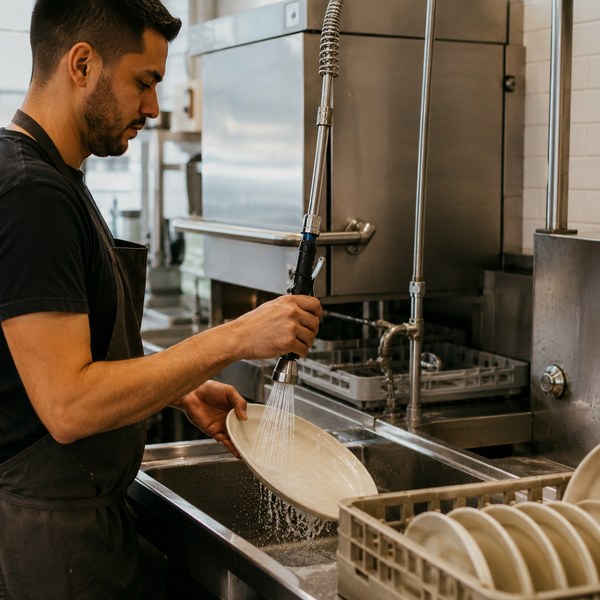
Install a high-efficiency pre-rinse spray valve
This is the single best dollar in restaurant water conservation. Since January 2019, federal DOE standards (which adopted the EPA WaterSense efficiency thresholds) cap new pre-rinse spray valves at 1.00–1.28 gallons per minute depending on spray force — versus the 1.6+ gpm valves still hanging in many older dish rooms. The EPA reports that replacing one old valve with a compliant high-efficiency model saves a typical commercial kitchen more than 7,000 gallons of water per year and $110–$200 in combined water and energy costs, with payback in as little as five to eight months. In the EPA's Boston University cafeteria case study, valve replacement cut that dish room's water use by 48,000 gallons a year — a 63 percent decrease — with a payback period as short as one month. If your valve predates 2019, replace it this week.
Fit low-flow aerators on faucets
Hand sinks and prep faucets rarely need full flow. Screw-in aerators are among the cheapest water saving equipment for restaurants; utilities such as the Southwest Florida Water Management District recommend aerating any faucet flowing above 0.5 gallons per minute. Test yours with a measuring cup and a ten-second count. In restrooms, WaterSense-labeled faucets, toilets, and urinals are independently certified to be at least 20 percent more water-efficient than standard models — meaningful when restrooms are 31 percent of your total use.
Upgrade to ENERGY STAR dish machines and ice makers
When a machine reaches end of life, replace it with a certified model. ENERGY STAR certified commercial dishwashers save businesses an average of $360 a year on energy and over 5,647 gallons of water per year, and the EPA recommends the same upgrade path for ice machines, ovens, and steam cookers — at least 10 percent lower water and energy use versus standard equipment. Many utilities offer rebates that shrink the price gap at purchase.
Eliminate continuous-flow equipment
The EPA specifically flags equipment that discharges water continuously — garbage disposals and dipper wells — as replacement targets. Fit disposals with solenoid valves that stop water when the unit is off, install sink strainers so less food goes down the drain in the first place, and turn dipper wells off (or switch to on-demand models) during slow periods.
Hunt leaks like they're theft — because they are
A silently running toilet or a dripping pre-rinse hose can waste more than every other measure saves. Make leak checks part of the weekly manager walkthrough: meter test during closed hours, dye tablets in toilet tanks, a hand under every faucet and hose connection. The EPA's Fix a Leak Week resources note that easily corrected leaks typically need only basic tools and pay for themselves in water savings. Log every leak found and fixed — the log itself keeps the habit alive.
What Daily Habits and Staff Training Conserve Water?
Daily habits conserve water because equipment only sets the ceiling — your crew sets the actual number. These are the behaviors we see working in real kitchens, and they cost nothing:
- Scrape first, rinse second. Scrape plates with a scraper or squeegee over the trash or compost bin before anything touches the spray valve. Dry-wiping heavy soil with disposable foodservice towels & wipers before the sink cuts rinse time dramatically and keeps grease out of your drain lines.
- Full racks only. Run the dish machine only with full racks and shut it off when idle. Stage clean ware on dish drying racks & sink caddies so air-drying replaces re-rinsing and towel-drying, and racks queue up genuinely full instead of half-loaded.
- Thaw in the refrigerator. Plan production a day ahead so proteins thaw overnight in the walk-in. The FDA Food Code permits running-water thawing only under water at 70°F or below with sufficient flow — which means an open tap running for hours. Refrigerator thawing uses zero gallons and is the safer default.
- Presoak instead of power-rinse. Soak pots, pans, and utensils in basins, and wash by hand in a three-compartment sink rather than under a running faucet.
- Serve water on request. Every unrequested glass is water poured, ice melted, and a glass washed. Serving on request is a zero-cost policy that guests increasingly read as a sustainability signal.
- Right-size ice. Match ice production to actual demand, and never use fresh water to melt waste ice — let it melt in the bin.
- Sweep, don't spray. Dry-clean floors and mats first; use a bucket and mop instead of an open hose for routine floor care.
Make it stick with a posted one-page checklist, water metrics in the weekly manager meeting, and a gallons-per-meal number the whole team can watch fall. Our foodservice customers consistently tell us the habit that survives staff turnover is the one that's built into the closing checklist — not the one announced once at pre-shift.
What About Restrooms, Landscaping, and Local Compliance?
Restrooms, landscaping, and compliance round out a complete restaurant water conservation program, because roughly a third of your water never touches the kitchen.
Restrooms (31% of use): Verify toilets are low-flow (check the gpf stamp — most units installed after 1994 are), replace worn flappers at the first sign of a dye-test failure, and check automatic sensor faucets regularly; a misaligned sensor cycles water all day. WaterSense-labeled replacements are certified at least 20 percent more efficient.
Landscaping (4% of use, more in arid regions): If your property irrigates, replace clock-based controllers with WaterSense-labeled smart irrigation controllers — the EPA reports they can cut irrigation water use by up to 30 percent. Water early morning, choose drought-tolerant plantings, and never irrigate hardscape.
Compliance: Many municipalities impose drought-stage restrictions that directly affect restaurants — water-on-request mandates, hose bans, irrigation schedules — and a growing number of utilities offer commercial rebates for pre-rinse valves, aerators, and ENERGY STAR equipment. Call your water utility before you buy: the rebate list is often the cheapest path to an upgrade, and documented conservation puts you ahead of the next restriction tier rather than scrambling under it.
How Do Restaurantware Products Support Water Conservation in Real Kitchens?
Hardware only saves water when the workflow around it cooperates — and that workflow is where we live. In 15+ years supplying 40,000+ foodservice operations, we've seen the same pattern repeatedly: the kitchens that hold their water gains are the ones that make the low-water path the easy path.
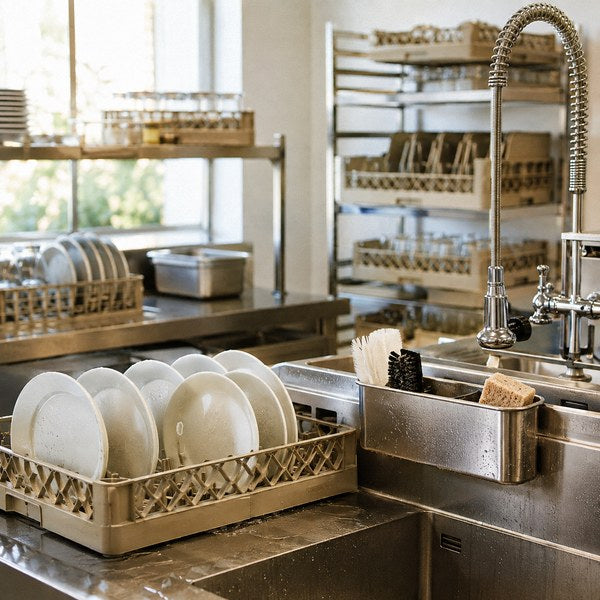
- Dish drying racks & sink caddies turn air-drying into the default. When clean ware has an obvious landing zone, staff stop re-rinsing "just to be sure" and stop running half-full racks to clear counter space. A caddy at the three-compartment sink keeps brushes, scrapers, and squeegees at arm's reach so scraping actually happens before rinsing. Browse the dish drying racks & sink caddies collection.
- Disposable foodservice towels & wipers handle the dry-wipe stage — pulling grease and heavy soil off cookware before water ever runs, which shortens pre-rinse time at the valve.
- Janitorial supplies — mop buckets, brooms, squeegees, and spray bottles — replace the open hose for floor and surface cleaning. A bucket-and-mop close uses a fraction of the water of a hose-down, and a floor squeegee moves water to the drain instead of chasing it with more water. Stock up from our janitorial supplies collection.
Water is one lane of a wider efficiency program. If you're tackling utilities as a whole, pair this guide with our energy efficiency tips for eco-friendly kitchens — hot water sits exactly at the intersection of both bills — and with our guide on how to reduce food waste in commercial kitchens, since less food waste means fewer pans, fewer racks, and less water.
Frequently Asked Questions
How do restaurants conserve water?
Restaurants conserve water by upgrading to high-efficiency pre-rinse spray valves and ENERGY STAR dish machines, fitting faucet aerators, fixing leaks promptly, running only full dishwasher racks, thawing food in the refrigerator, scraping dishes before rinsing, and serving drinking water on request. The EPA reports these practices can cut a commercial facility's water use by 15 percent.
How much water does a restaurant use per day?
Restaurant water usage per day varies widely with service model and volume — a quick-serve counter and a 200-seat full-service dining room are different animals. EPA data shows kitchens and dishwashing account for 52 percent of a restaurant's water, and pre-rinsing alone averages roughly 145 gallons per establishment per day nationally (derived from EPA's 53-billion-gallon annual estimate across about one million foodservice establishments). The most useful number is your own: divide monthly gallons from your water bill by meals served to get a gallons-per-meal baseline you can actually manage.
What is the 30/30/30 rule for restaurants?
The 30/30/30 rule is a rough budgeting benchmark that allocates about 30 percent of restaurant revenue to food costs, 30 percent to labor, and 30 percent to overhead, leaving roughly 10 percent as margin. Water, sewer, and the energy used to heat water all live inside that overhead slice — which is why a 10–20 percent cut in water use flows straight to the thin margin at the end.
What are the 5 R's of water conservation?
The 5 R's of water conservation are commonly listed as Reduce, Repair, Retrofit, Reuse, and Recover. In a commercial kitchen that translates to: reduce flow and run time, repair leaks immediately, retrofit valves and aerators, reuse where safe and permitted (such as capturing rinse water for mop duty where local code allows), and recover data from your water bills to keep improving.
How can I reduce water consumption in my restaurant without buying new equipment?
You can reduce water consumption in a restaurant immediately by enforcing full-rack-only dishwashing, scraping and dry-wiping dishes before rinsing, presoaking pots in basins, thawing in the refrigerator instead of under running water, serving water on request, sweeping floors before mopping instead of hosing, and running a weekly leak check with a meter test. Combined, these zero-cost habits routinely trim 10 percent or more from commercial kitchen water usage.
Conclusion: Start With the Spray Valve, Finish With the Culture
Restaurant water conservation is not a sacrifice program — it's an operations upgrade with a utility rebate attached. Start with the audit and the pre-rinse spray valve this week, schedule ENERGY STAR upgrades at replacement time, and build the daily habits — full racks, refrigerator thawing, scrape-first — into your checklists so they outlive any single hire. The EPA's numbers say 10–20 percent savings are on the table for most operations; your water bill will tell you the rest.
Ready to set up a water-smart dish room? Outfit your line with dish drying racks & sink caddies and keep low-water cleaning routines rolling with our janitorial supplies — in stock and ready to ship.