Stand Mixer Attachments: Evaluating Accessories For Versatile Use
Stand mixer attachments are tools that expand what a stand mixer can do. Every stand mixer includes three standard attachments — the flat beater, dough hook, and wire whisk — while hub-powered add-ons like pasta rollers, meat grinders, and slicer/shredders turn the motor into a multi-station prep tool. An attachment is worth buying when it replaces a dedicated appliance you would use weekly.
Walk into any commercial bakery or high-volume prep kitchen and you will find one machine doing the work of five. That machine is a stand mixer — and the difference between a one-trick appliance and a full prep station comes down to stand mixer attachments. In 15+ years supplying 40,000+ foodservice operations, we've seen operators waste hundreds of dollars on attachments that gather dust, while others cut a full labor hour per shift with a single well-chosen accessory. This guide gives you a brand-neutral framework for evaluating mixer attachments — what each one does, which ones earn their price, and what to check before putting any of them to work in a commercial kitchen.

What Are Stand Mixer Attachments?
Stand mixer attachments are defined as the interchangeable tools that connect to a stand mixer in one of two places: the beater shaft inside the bowl, or the powered accessory hub on the front of the machine. That two-part distinction is the key to evaluating them, because the two categories do completely different jobs.
- Standard bowl attachments — the flat beater, dough hook, and wire whisk — mount on the beater shaft and mix whatever is in the bowl. These three come included with virtually every stand mixer sold and cover creaming, kneading, and whipping.
- Hub-powered add-ons — pasta rollers, food grinders, slicer/shredders, spiralizers, grain mills — attach to the front power hub and use the mixer's motor to drive a separate tool. These are sold separately, and they are where most of the money (and most of the buying mistakes) happen.
The most established hub ecosystem belongs to KitchenAid: the company's hub attachments are designed to fit the front power hub on every KitchenAid stand mixer model, which is why searches for KitchenAid attachments dwarf every other brand. But the evaluation framework below is brand-neutral on purpose — the same logic applies whether the hub belongs to KitchenAid, Cuisinart, Hamilton Beach, or a 20-quart commercial planetary mixer with a #12 attachment hub.
Which Stand Mixer Attachments Are Worth the Money? (Versatility-per-Dollar Framework)
The attachments worth owning are the ones you will actually run every week. Our rule from supplying working kitchens: an attachment earns its cost when it replaces a standalone appliance or a repetitive manual task at least once a week. Below is our versatility-per-dollar table — price ranges are typical US retail as of July 2026 and vary by brand.
| Attachment | Typical Price Range | Realistic Uses/Week (Working Kitchen) | Verdict |
|---|---|---|---|
| Flat beater (paddle) | Included ($15–$40 replacement) | 5–15+ | Essential — the workhorse |
| Dough hook | Included ($15–$40 replacement) | 3–10 (daily in bakeries) | Essential for any dough program |
| Wire whisk | Included ($20–$50 replacement) | 3–10 | Essential for aeration work |
| Pasta roller & cutter set | $150–$250 | 2–7 (if pasta is on the menu) | Buy if you serve fresh pasta; skip otherwise |
| Meat/food grinder | $50–$120 | 2–5 | Buy — high versatility beyond meat |
| Slicer/shredder | $80–$150 | 2–5 | Situational — competes with box graters and food processors |
| Spiralizer / vegetable sheet cutter | $80–$130 | 0–2 | Skip unless menu-driven |
| Grain mill | $100–$180 | 0–1 | Skip for most; niche bakery tool |
| Sifter + scale | $130–$170 | 0–2 | Skip — manual sifting is faster to clean |
| Ice cream maker bowl | $80–$120 | Seasonal | Situational — great for dessert programs |
Two patterns show up in that table again and again. First, the three included attachments do the majority of real work — which is why replacement quality matters more than add-on quantity. Second, hub attachments only pay off when the menu demands them. We apply the same cost-per-use logic to every equipment category, and it is the same math we walk through in our guide to cost vs. performance when finding the best value blender.
That discipline matters more than ever. According to the National Restaurant Association's 2026 State of the Restaurant Industry report, total restaurant and foodservice sales are projected to reach $1.55 trillion in 2026, yet more than 9 in 10 operators cite food, labor, insurance, energy, and swipe fees as significant cost challenges — and 42 percent of operators reported their restaurant was not profitable last year. Equipment that multiplies the output of one motor, one operator, and one footprint is exactly the kind of operational leverage that report calls for.
The Three Standard Attachments — What Each One Does
Every stand mixer attachments list starts with the same three tools. They mount in seconds, they handle 80 percent of mixing tasks, and knowing exactly when to switch between them is the fastest skill upgrade in any pastry station.
Flat Beater (Paddle)
The flat beater is the general-purpose mixing attachment, and it should be your default. Its job is to combine and cream — not to aerate and not to knead. Reach for the flat beater for:
- Creaming butter and sugar — the foundation of cookies, pound cakes, and buttercream
- Cookie dough and cake batters — thorough combining without overworking gluten
- Mashed potatoes and root vegetable purées — a high-volume favorite in prep kitchens
- Shredding cooked chicken or pork — 30 seconds on low speed replaces 10 minutes with two forks
Evaluation tip: burnished aluminum beaters are standard, but coated and stainless steel versions are dishwasher-safe and resist pitting. In a commercial dish pit, that difference decides how long the attachment lives.
Dough Hook
The dough hook is the kneading attachment. It develops gluten in yeasted doughs — bread, pizza, bagels, brioche — by folding and stretching the dough against the side of the bowl. Use it whenever a recipe calls for kneading, and keep the speed low; dough hooks are designed for slow, sustained gluten development, and running stiff bagel dough at high speed is the fastest way to strain a home-grade motor. Spiral hooks (common on bowl-lift and commercial machines) drive dough more efficiently than the classic C-hook, which matters when you knead daily.
Wire Whisk (Balloon Whip)
The wire whisk is the aeration attachment. Its many thin wires drive air into whatever it touches, which makes it the only correct choice for meringues, whipped cream, chiffon and sponge bases, mayonnaise, and Swiss buttercream. It is also the attachment most often misused: a whisk in heavy cookie dough will bend its wires and strain the planetary gears. If the mixture is thicker than pancake batter, switch to the flat beater.
Hub-Powered Add-Ons — Which Are Worth Buying?
Hub attachments are where a stand mixer becomes a multi-tool — and where evaluation discipline pays off. Every add-on below runs off the front power hub, so you are buying tooling, not another motor. That is the core value proposition: one machine, one footprint, many stations.
Pasta Roller & Cutter Set
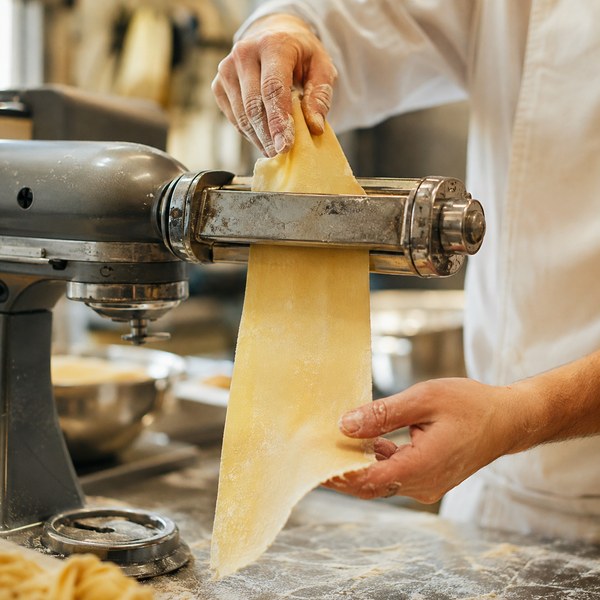
The pasta roller is the highest-rated hub attachment in nearly every published ranking, and our foodservice customers consistently tell us the same thing: if fresh pasta is on the menu, the roller set pays for itself in weeks. Mixer-driven rollers free both hands to guide the dough — a real advantage over hand-crank machines — and produce consistent sheet thickness for lasagna, ravioli, fettuccine, and spaghetti. If pasta is not on your menu, this is a $200 drawer ornament. Menu first, attachment second.
Meat Grinder / Food Grinder
The food grinder is the most versatile hub attachment, full stop. Beyond grinding fresh burger blends and sausage (with coarse and fine plates), it purées cooked vegetables, breaks down bread for fresh crumbs, and grinds cheese for spreads. For operators who care about trim utilization, an in-house grinder converts protein scraps into menu items instead of waste. Look for all-metal versions over plastic-bodied ones — the price difference is small and the durability difference is not.
Slicer/Shredder, Spiralizer & Vegetable Sheet Cutter
These produce-prep attachments overlap heavily with tools you may already own, which is exactly why they need the versatility-per-dollar test. A rotary slicer/shredder shreds cheese and slices vegetables quickly, but it competes with both food processor attachments on a dedicated processor and a simple box grater. For lower-volume shredding jobs, a well-chosen manual tool often wins on cleanup time alone — we break down that decision in our guides to choosing a grater for efficient vegetable prep and selecting the best grater for cheese processing. The spiralizer and vegetable sheet cutter are menu-driven novelties: excellent if zoodles or vegetable wraps are a signature item, skippable otherwise.
Grain Mill, Sifter + Scale, Ice Cream Bowl & Other Niche Attachments
The long tail of the attachment catalog is where impulse purchases go to die. The grain mill matters only if you mill flour in-house. The sifter + scale attachment automates a task a $10 hand sifter does with less cleanup. The ice cream maker bowl is the exception worth flagging: for cafés and dessert programs it delivers small-batch ice cream and sorbet without a dedicated batch freezer — pair it with proper portioning tools from our guide to the best ice cream scoops for business or personal use. Buy niche attachments only after the menu proves the need.
How Do You Evaluate Attachments for Commercial Use?
Commercial evaluation adds four tests on top of the versatility-per-dollar math. A home-rated accessory that runs twice a month is a different purchase from an attachment that runs three shifts a day.
1. Food-safe materials and certification. The FDA Food Code — the model code adopted in some form across US jurisdictions — states in §4-205.10 that food equipment certified for sanitation by an ANSI-accredited certification program is deemed to comply with its equipment material and design requirements. For powered prep equipment, the relevant standard is NSF/ANSI 8 (Commercial Powered Food Preparation Equipment), which covers mixers, grinders, slicers, and similar machines. If a health inspector will ever see the machine, certified equipment removes the argument before it starts.
2. Durability under repetition. Metal gears, all-metal housings, and stainless food-contact surfaces are non-negotiable at commercial duty cycles. Plastic-geared attachments are priced for a home kitchen's ten uses a year, not a prep line's ten uses a day.
3. Warranty and motor load. Read what the mixer's warranty says about attachment use — some manufacturers void coverage for third-party accessories. And remember the attachment is only as strong as the motor behind it: grinding 20 pounds of chuck through a 300-watt home machine is how motors die. This is the same power-matching logic we apply in our guide to understanding the power ratings of commercial hand blenders.
4. Cross-brand hub compatibility. Home-category hubs are not standardized. KitchenAid's hub fits KitchenAid machines and many third-party attachments built to that spec; other brands vary model to model. True commercial planetary mixers use standardized #12 attachment hubs, which keeps grinder and shredder tooling interchangeable across brands. Verify fit before you buy — "universal" on a listing is marketing, not a specification.
Putting Attachments to Work in a Foodservice Operation
Attachments multiply a mixer's value, but they do not run a station by themselves. Every attachment workflow we see in customer kitchens depends on the supporting layer around the machine: bowl scrapers and spatulas to clear the flat beater, portion scales for dough division, storage containers for ground and shredded product, and dedicated kitchen utensils for finishing work the mixer cannot do.
In 15+ years supplying 40,000+ foodservice operations, we've seen the pattern repeat: kitchens that get full value from their mixer attachments are the ones that build the station around them. A pasta program needs drying racks and flour dredges. A grinding program needs sheet pans, sanitizer buckets, and cold-holding discipline. Our cookware accessories collection covers that supporting cast, and our cooking equipment collection handles the heavier hardware that picks up where the mixer hub stops.
Frequently Asked Questions
What are the different attachments for a stand mixer?
Stand mixer attachments fall into two groups: bowl attachments (flat beater, dough hook, wire whisk, plus flex-edge beater variants) that mix in the bowl, and hub-powered attachments (pasta roller and cutters, meat/food grinder, slicer/shredder, spiralizer, vegetable sheet cutter, grain mill, sifter + scale, ice cream bowl) that run off the front power hub.
What are the three main attachments for a stand mixer?
The three main stand mixer attachments are the flat beater, the dough hook, and the wire whisk. The flat beater creams and combines batters and doughs, the dough hook kneads yeasted doughs, and the wire whisk aerates creams, egg whites, and meringues. Nearly every stand mixer includes all three.
Do KitchenAid attachments fit all stand mixers?
No. KitchenAid hub attachments are designed to fit the front power hub on KitchenAid stand mixers — they do not fit other brands' machines unless the manufacturer built its hub to accept them. Bowl attachments are even more model-specific, sized to bowl capacity and tilt-head versus bowl-lift designs. Always confirm compatibility by mixer model number.
Which stand mixer attachments are worth it?
The best stand mixer attachments to buy are the ones that replace a weekly task: the pasta roller set (if fresh pasta is on the menu) and the meat/food grinder are the two hub add-ons that most consistently earn their cost. The flex-edge beater is a worthwhile bowl upgrade for frequent creaming. Spiralizers, grain mills, and sifters are menu-driven niche purchases.
What attachments come with a stand mixer?
Almost all stand mixers ship with three attachments — the flat beater, dough hook, and wire whisk — plus the mixing bowl, and often a pouring shield. Hub-powered attachments like pasta rollers, grinders, and slicer/shredders are sold separately.
Are third-party mixer attachments any good?
Some are, but evaluate them harder than name-brand mixer attachments. Check three things: all-metal construction (especially gears), verified fitment for your exact hub and model, and whether your mixer's warranty covers damage caused by third-party accessories. For occasional home use, quality third-party attachments can be a good value; for commercial duty cycles, certified name-brand or commercial-spec tooling is the safer spend.
Conclusion: Buy the Task, Not the Attachment
Stand mixer attachments reward evaluators and punish collectors. Master the three standard attachments first — flat beater for combining, dough hook for kneading, whisk for aerating — then add hub-powered tools only when a weekly menu task justifies them. Apply the commercial tests (certified materials, all-metal durability, warranty terms, verified hub fit) before any attachment touches a professional prep line, and the mixer becomes the highest-leverage motor in your kitchen. When you are ready to build out the station around it, explore our cooking equipment and kitchen utensils collections — everything the mixer can't do, in stock and ships today.