What Is Trees for the Future?
Trees for the Future (TREES) is a 501(c)(3) nonprofit, founded in 1989 and headquartered in Silver Spring, Maryland, that trains farmers in sub-Saharan Africa to plant Forest Gardens. The organization has planted more than 420 million trees, restoring degraded farmland while fighting hunger and poverty. Restaurantware's one-tree-per-order program began with Trees for the Future.
If you have ever wondered where the tree from your "we plant a tree with every order" checkout promise actually ends up, this page answers it. "Trees for the future" is more than a hopeful phrase — Trees for the Future is one of the most respected agroforestry nonprofits in the world, a United Nations World Restoration Flagship, and the organization Restaurantware chose when we launched our tree-planting commitment in 2021. In 15+ years supplying 40,000+ foodservice operations, we've learned that operators don't just want greener packaging — they want proof that sustainability claims lead somewhere real. This guide explains who Trees for the Future is, how its Forest Garden Approach works, whether it is a good charity, and how tree planting connects to the takeout container in your customer's hand.
TL;DR — Trees for the Future at a Glance
Trees for the Future is a farmer-training nonprofit, not a mass tree-planting stunt. Its Forest Garden Approach teaches smallholder farmers to convert degraded land into diverse, food-producing agroforestry plots that keep paying the family back for decades. Here are the verified numbers, current as of August 2026:
| Quick Fact | Detail (verified at source) |
|---|---|
| Founded | 1989, by Dave and Grace Deppner after volunteer work in the Philippines |
| Headquarters | Silver Spring, Maryland, USA — 501(c)(3), EIN 52-1644869 |
| Trees planted to date | 420,110,579 (per the 2025 Impact Report) |
| Partner farmers | 63,767 farming families since 1989 |
| Land under restoration | 40,219 hectares (roughly 99,000 acres) |
| Signature method | The Forest Garden Approach — a four-year, farmer-led agroforestry training program |
| Where it works | Focused on Kenya, Tanzania, and Uganda from 2026; Senegal and Mali projects concluded at the end of 2025 |
| Recognition | Named a UN World Restoration Flagship in February 2024; Four-Star rating on Charity Navigator |
What Is Trees for the Future, and How Did It Start?
Trees for the Future is an international nonprofit that trains smallholder farmers in sub-Saharan Africa to restore degraded land through agroforestry — planting productive trees and crops together so the land feeds families, generates income, and rebuilds its own soil. Its stated mission, per trees.org, is "to improve livelihoods of impoverished farmers by revitalizing degraded lands."
Who Founded Trees for the Future?
Dave and Grace Deppner founded Trees for the Future in 1989 after volunteer work in the Philippines, where they saw firsthand how deforestation traps rural communities in poverty. Their early model was simple: provide farmers with tree seeds, technical training, and planning support so communities could revitalize their own land. For its first two decades, TREES worked with farmers around the globe. In 2014, the organization narrowed its focus to select African countries where climate pressure and economic need were greatest, and in 2015 it consolidated everything it had learned into a single signature methodology: the Forest Garden Approach.
Where Does Trees for the Future Work Today?
Trees for the Future currently concentrates its work in East Africa — Kenya, Tanzania, and Uganda. Through 2025 it also ran major programs in Senegal and Mali, but as part of a strategic review announced in its 2025 Impact Report, TREES closed its West Africa projects at the end of 2025 to deepen its investment in East African farming communities. Its projects span 26 agroecological zones, from the shores of Lake Victoria — where its carbon project develops verified carbon units with farmers across 75,000 hectares in Kenya — to highland croplands and dry lowlands.
What Is the Forest Garden Approach?
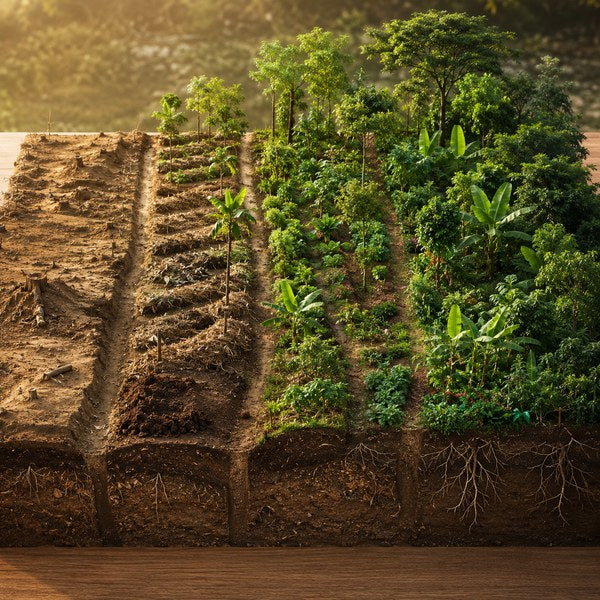
The Forest Garden Approach is Trees for the Future's four-year, farmer-led training model in which families plant a diverse mix of fast-growing trees, fruit trees, hardwoods, and vegetable crops on their own land. Rather than planting a single species in rows — or handing out seedlings and walking away — the method rebuilds the farm as a layered ecosystem. According to trees.org, farmers first stabilize and protect their land, then diversify what grows on it, and ultimately manage a self-sustaining "Forest Garden" that provides food to eat and surplus to sell year-round.
The results the organization reports are striking. Per the 2025 Impact Report, farming families in the TREES program see food security increase by 83%, and participant satisfaction has stayed above 96% across all four program years. In the July 2024–June 2025 planting year alone, 4,056 new farming families joined, 49,940,320 trees were planted, and 35,143 Forest Gardens were in development across roughly 24,212 hectares.
Why Agroforestry Instead of Just Planting Trees?
Agroforestry works because it gives farmers an economic reason to keep trees alive. A donated seedling with no owner often dies; a Forest Garden that feeds a family and pays school fees gets protected for a generation. The scale of the need is enormous: Africa is home to 33 million smallholder farmers working over 600 million acres of largely degraded land — and those farms produce 80% of the continent's food, per the TREES 2025 Impact Report. Restoring that land isn't a feel-good side project; it is one of the highest-leverage climate and food-security interventions available.
Because the two models get conflated, here is an original side-by-side of how the Forest Garden Approach differs from conventional mass tree planting:
| Factor | Conventional Mass Tree Planting | Trees for the Future's Forest Garden Approach |
|---|---|---|
| Who owns the trees | Often no clear owner; land may be public or leased | The farming family that plants and profits from them |
| Species mix | Frequently one or two species at scale | Diverse mix: fast-growing trees, fruit trees, hardwoods, vegetables |
| Primary goal | Tree count / carbon offsets | Farmer income, food security, and land restoration — carbon is a co-benefit |
| Support after planting | Often none | Four years of hands-on training and monitoring |
| Why trees survive | Hoped-for stewardship | The family's food and income depend on them |
That is also why the "trees for the future meaning" question has two honest answers. Literally, the name refers to the nonprofit itself. Philosophically, it captures the organization's core idea: trees planted today are infrastructure for future generations — shade, soil, food, fuel, and income that compound over decades.
Is Trees for the Future a Good Charity?
Yes — by the standard third-party measures, Trees for the Future is a well-rated, transparent charity. Here is what the public record shows, current as of August 2026:
- Charity Navigator: TREES holds a Four-Star rating (the highest tier) on Charity Navigator, with 100% scores across accountability metrics including audited financial statements, audit oversight, and no material diversion of assets.
- UN recognition: In February 2024, the United Nations named TREES a World Restoration Flagship, recognizing it as one of the best large-scale ecosystem restoration initiatives on the planet under the UN Decade on Ecosystem Restoration.
- Radical transparency: The organization publishes annual impact reports going back more than a decade, with country-by-country planting data, farmer counts, and hectares under restoration.
- Registered and verifiable: TREES is a registered 501(c)(3) nonprofit, Tax ID 52-1644869, so its IRS filings are public.
If you are searching for "Trees for the Future reviews" or an up-to-date charity rating, Charity Navigator and the organization's own published impact reports are the two most reliable places to look — both link every claim to audited filings or field data. The organization is also moving into independently verified carbon work: its Lake Victoria Carbon Project in Kenya uses VERRA methodology with CCB certification to develop and monitor verified carbon units with farmers across 75,000 hectares, per trees.org.
No charity is above scrutiny, and tree-planting organizations as a category have drawn fair criticism for survival rates and inflated counts. TREES addresses this structurally: because farmers own the trees and depend on them for food and income, survival is built into the incentive model — and the organization's 2025 report commits to expanded third-party monitoring, reporting, and validation of outcomes like income growth, biodiversity, and nutrition.
How Does Restaurantware's Tree-Planting Program Work?
Restaurantware plants one tree for every order placed on Restaurantware.com, at no additional cost to the customer. When we launched that commitment in 2021, Trees for the Future was our founding planting partner — your orders funded Forest Garden trees in sub-Saharan Africa through the very programs described above. It was an easy organization to say yes to: real farmers, audited outcomes, and a model where trees survive because families need them to.
Our program has grown since then. Today, Restaurantware's tree planting runs through Veritree, a technology platform that tracks and verifies every planting site with real-time data on carbon sequestration, biodiversity, and socio-economic impact. Since 2021, Restaurantware orders have planted more than 337,000 trees, improving soil health, restoring habitats, and supporting farmers in developing regions. You can read the full program details — including our Green Hero Foundation conservation work and our Ship In Own Container waste-reduction initiative — in our sustainability policy, and follow program milestones in our news & updates.
So while this article celebrates Trees for the Future — the organization that shaped how we think about giving back — the constant is the commitment itself: every Restaurantware order plants a tree, and every tree is accounted for.
Shop with impact: every item in our RW Eco collection is designed for sustainability first — and like every Restaurantware order, it plants a tree.
What Does Tree Planting Mean for a Foodservice Business?
For operators, partnering with companies that plant trees with purchases is one of the lowest-effort, highest-credibility sustainability moves available — because the impact happens automatically at procurement. You don't retrain staff. You don't redesign your menu. You simply route spend you were already making through a supplier whose orders fund verified planting.
The customer demand is well documented. In the National Restaurant Association's State of the Restaurant Industry research, 38% of adults said they're more likely to choose a restaurant that offers locally sourced food, and 30% said they'd pick a restaurant offering food grown in an environmentally friendly way over one that doesn't — with millennials and Gen Z leading both numbers. Sustainability sells, but only when it's authentic and specific.
In 15+ years supplying 40,000+ foodservice operations, we've watched "green" evolve from a niche marketing angle into a baseline expectation. Our foodservice customers consistently tell us the same thing: guests don't ask whether you're sustainable anymore — they ask how, and vague answers hurt more than honest small steps. A concrete story ("our supplier plants a tree for every order, and our takeout containers are compostable bagasse") beats a wall of green icons every time.
Here's how operators put that story into practice with eco-friendly restaurant supplies that give back:
- Switch your disposables first. Takeout packaging is your most visible sustainability signal because it leaves the building with the guest. Our eco-friendly disposables collection covers compostable containers, cutlery, and cups made from bagasse, bamboo, and plant-based materials. If you're weighing material claims, start with our guide to biodegradable vs. compostable.
- Close the loop in the back of house. Compostable packaging only matters if organics leave the waste stream. Dedicated compost bins make separation practical during a rush.
- Choose renewable materials for the front of house. Fast-growing plants like bamboo mirror the same logic as agroforestry — harvest without depletion. See the benefits of bamboo tableware for where it fits on a service line.
- Tell the story on your menu and packaging. A one-line note — "Our supplies plant trees" — turns invisible procurement into visible brand equity. Our eco-friendly packaging guide shows how to align materials with messaging.
The through-line is the same one Trees for the Future proved at 420-million-tree scale: sustainability sticks when it's built into the economics, not bolted on as charity.
Frequently Asked Questions
Is Trees for the Future a good charity?
Yes. Trees for the Future holds a Four-Star rating on Charity Navigator with 100% marks on accountability metrics, publishes detailed annual impact reports, and was named a UN World Restoration Flagship in 2024. It is a registered 501(c)(3) (EIN 52-1644869), so its financials are publicly verifiable.
What is the meaning of "trees for the future"?
"Trees for the Future" is the name of a nonprofit founded in 1989 that trains sub-Saharan African farmers in agroforestry. More broadly, the phrase expresses the idea behind its work: trees planted today become food, income, soil health, and climate resilience for future generations.
Why did Bill Gates say not to plant trees?
At a New York Times climate event in September 2023, Bill Gates called the claim that planting enough trees could solve climate change "complete nonsense," per Phys.org. His criticism targeted tree planting as a carbon-offset cure-all — not organizations like Trees for the Future, whose model centers on farmer livelihoods and land restoration, with carbon capture as a co-benefit rather than the sales pitch. Notably, TREES itself says tree planting alone won't solve hunger, poverty, or climate change — which is exactly why it trains farmers instead of just distributing seedlings.
Is Temu actually planting trees?
Yes — Temu's tree-planting program is run through Trees for the Future. TREES lists Temu (Whaleco Technology) as an official sponsor, and the partnership has funded Forest Garden planting in sub-Saharan Africa since July 2023. Whatever you think of ultra-fast e-commerce, the trees themselves are real and tracked by the nonprofit.
Which tree lives for 3,000 years?
Giant sequoias routinely live beyond 3,000 years, and Great Basin bristlecone pines can approach 5,000. Trees for the Future works at the other end of the spectrum — fast-growing agroforestry species that deliver food, fodder, and soil nitrogen within a few seasons, because farming families can't wait millennia for results.
How many trees has Trees for the Future planted?
Trees for the Future has planted 420,110,579 trees with 63,767 partner farming families since 1989, per its 2025 Impact Report — including 49.9 million trees in the 2024–2025 planting year alone.
Conclusion: Plant Where You Purchase
Trees for the Future proves that the best environmental programs aren't charity in the traditional sense — they're systems where doing the right thing pays everyone involved. Farmers earn more from restored land, ecosystems recover, and supporters get audited, published results instead of vague promises. That philosophy shaped Restaurantware's own giving model: one verified tree for every order, automatically, since 2021.
If you're ready to make your supply spend do double duty, start with our eco-friendly disposables or explore the full RW Eco collection — and browse more sustainability guides in our Eco-Friendly Solutions hub. Every order plants a tree. That's not a slogan; it's a line item.