Indoor And Outdoor Catering Services
Indoor and outdoor catering services are the two core styles of professional event catering. Indoor catering serves food inside a controlled venue with full kitchen access, while outdoor catering prepares and serves meals off-site using portable equipment. The right choice depends on venue, guest count, weather, and available power and refrigeration.
Every caterer eventually faces the same fork in the road: the client who wants a plated dinner in a hotel ballroom, and the client who wants a barbecue buffet in a public park. Indoor and outdoor catering services demand different equipment, different food-safety plans, and different pricing — and treating them as interchangeable is one of the fastest ways to lose money (or worse, make guests sick). In 15+ years supplying more than 40,000 foodservice operations, we've watched talented indoor caterers stumble at their first outdoor wedding simply because nobody told them how much changes once the roof disappears. This guide breaks down the real operational differences — logistics, equipment, food safety, weather contingencies, and cost — so you can choose the right format and execute it profitably.

TL;DR — Indoor vs. Outdoor Catering at a Glance
Indoor catering means controlled conditions: a fixed kitchen, reliable power, climate control, and predictable timelines. Outdoor catering means portability: everything — heat, cold, water, shelter, and serving surfaces — must be transported and self-supplied. Outdoor events typically cost 15–30% more to execute because of rentals, transport, and contingency planning, while indoor events trade that flexibility for venue fees and stricter house rules.
| Factor | Indoor Catering | Outdoor Catering |
|---|---|---|
| Kitchen access | On-site or adjacent commercial kitchen | Field kitchen: portable burners, grills, holding cabinets |
| Power & water | Built-in outlets, plumbing, refrigeration | Generators, water jugs, coolers, ice supply |
| Temperature control | HVAC keeps food and guests comfortable | Sun, wind, and ambient heat work against you |
| Food safety risk | Lower — shorter transport, stable holding | Higher — USDA 1-hour rule applies above 90°F |
| Weather dependency | Minimal | High — tents, backup dates, rain plans required |
| Menu flexibility | Full range, including delicate plated courses | Durable, heat-tolerant menus travel best |
| Typical cost profile | Venue fees, but lower equipment overhead | Lower venue cost, higher rental/transport/labor cost |
| Cleanup | Venue dish rooms and waste systems | Pack-out: trash, greywater, and gear leave with you |
What Is Indoor and Outdoor Catering?
Indoor and outdoor catering is the industry's standard way of categorizing event food service by venue environment. The category an event falls into determines nearly every operational decision that follows — staffing, equipment lists, menu design, and food-safety controls.
What Is Indoor Catering?
Indoor catering is defined as food service delivered inside an enclosed, climate-controlled venue — a banquet hall, hotel ballroom, conference center, restaurant private room, office, or club. The caterer typically works from a commercial kitchen on-site or finishes food in a dedicated prep space steps from the dining room. Indoor catering meaning, in practical terms: you control the environment. Power is at the wall, refrigeration is down the hall, and a 72°F room keeps both the buffet and the guests stable.
Common indoor catering formats include:
- Plated banquet service — weddings, galas, awards dinners
- Buffets and food stations — corporate events, conferences
- Drop-off office catering — boxed lunches, platters for meetings
- Club and retail store catering — member events, in-store tastings and launch events
- Cocktail receptions — passed hors d'oeuvres with minimal seating
What Is Outdoor Catering?
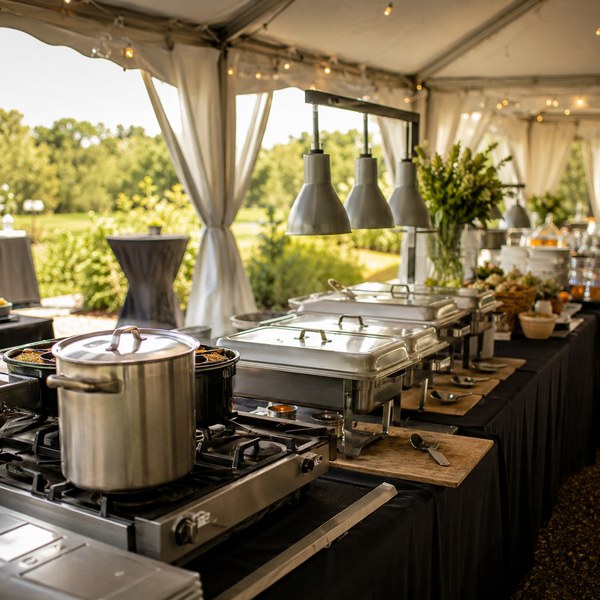
Outdoor catering is defined as food service delivered at open-air or semi-open venues — gardens, parks, beaches, backyards, rooftops, farms, and tented event sites. The caterer builds a temporary field kitchen and transports everything: cooking equipment, fuel, cold storage, potable water, serving surfaces, and shelter. Outdoor catering examples include tented weddings, company picnics, food-truck-supported festivals, graduation parties, tailgates, and farm-to-table dinners.
The defining constraint of outdoor catering is self-sufficiency. If the site has no power, you bring generators. If it has no water, you bring jugs and handwashing stations. If the forecast shifts, you own the contingency plan. That self-sufficiency is exactly what clients pay for — and why outdoor jobs price higher per head than comparable indoor events.
How Do Logistics Differ Between Indoor and Outdoor Catering?
Logistics differ in one fundamental way: indoor catering moves food to a functioning facility, while outdoor catering moves the facility itself. That difference cascades through every stage of the job.
Site Access and Load-In
Indoor venues offer loading docks, service elevators, and staging corridors — but they also impose house rules: approved-vendor lists, insurance certificates, union labor requirements, and strict load-in windows. Outdoor sites rarely have rules that strict, but they trade them for physical obstacles: gravel paths that fight transport carts, lawns that swallow table legs, and serving areas 200 yards from the nearest parking. We advise operators to walk every outdoor site before quoting; the distance from truck to table is a labor cost most first-timers underestimate. Our guide to selecting the right venue for high-volume foodservice functions covers the site-evaluation checklist in depth.
Timing and Holding
Indoor events run on tighter, more reliable timelines because holding conditions are stable — a hot box in an air-conditioned service corridor holds temperature far longer than the same box in July sun. Outdoor timelines need buffers: extra transit time, extra setup time, and shorter maximum holding windows. A rule our catering customers consistently follow: for outdoor service, plan food to come off heat as close to service time as possible, and stage in insulated carriers rather than open chafers until guests are seated.
Staffing
Outdoor events typically require 10–20% more staff hours for the same guest count. Someone has to run the generator, restock ice, shuttle food from the truck, and monitor holding temperatures continuously. Indoor venues absorb much of that work through existing infrastructure.
What Equipment Do Indoor and Outdoor Catering Services Require?
Equipment needs are where indoor and outdoor catering services diverge most visibly. Indoor caterers lean on the venue; outdoor caterers carry their kitchen on a truck.
Indoor Catering Equipment Essentials
- Chafing dishes and induction warmers — buffet holding at or above 140°F
- Serving platters, risers, and display stands — presentation drives perceived value indoors
- Beverage dispensers and coffee urns
- Linens, tabletop décor, and place settings — elevated catering tabletop accessories matter most in plated and station-style service
- Transport carriers — insulated food pan carriers for kitchen-to-ballroom moves
Outdoor Catering Equipment Essentials
- Portable cooking — propane grills, outdoor burners, griddles
- Cold chain gear — coolers, ice bins, refrigerated trailers for large events
- Power and shelter — generators, canopy tents, sidewalls, weighted anchors
- Sanitation — portable handwash stations, sanitizer buckets, potable water
- Durable disposables — heavyweight plates, lidded containers, and serving trays from a catering disposables line built to survive wind, uneven tables, and standing guests
- Wind-resistant serviceware — lidded chafers, weighted table coverings, covered beverage dispensers
In 15+ years supplying foodservice operations of every size, the single most common outdoor-catering mistake we see is packing indoor serviceware for an outdoor job. Lightweight plates sail off tables in a breeze, unlidded chafers collect debris, and elegant-but-delicate displays don't survive a lawn. Build a separate outdoor pack list and keep it staged. For a complete gear rundown, see our catering supplies checklist for indoor & outdoor events and our roundup of the top 10 essential catering equipment pieces every caterer needs.
How Does Food Safety Change Outdoors?
Food safety risk rises sharply outdoors because temperature control — the backbone of safe food service — becomes an active battle instead of a background condition. The stakes are real: the FDA estimates about 48 million cases of foodborne illness in the U.S. each year, resulting in roughly 128,000 hospitalizations and 3,000 deaths (FDA; current as of August 2026).
The Danger Zone Rules Every Caterer Must Know
The USDA defines the "Danger Zone" as 40°F–140°F — the temperature range in which bacteria can double in as little as 20 minutes. Its core holding rules (USDA FSIS; current as of August 2026):
- Keep hot food at or above 140°F — chafing dishes, preheated steam tables, warming trays, or slow cookers
- Keep cold food at or below 40°F — on ice or in coolers with ice packs
- Never leave food out more than 2 hours — and only 1 hour when the ambient temperature exceeds 90°F
- Reheat foods to an internal temperature of 165°F
That 1-hour rule is the operational heart of outdoor catering. A summer wedding at 92°F cuts your safe display window in half compared to the same buffet indoors. The FDA's outdoor food handling guidance adds cooler discipline: pack perishables and beverages in separate coolers (guests opening the drink cooler shouldn't warm the potato salad), keep coolers closed and shaded, and set up handwashing with a water jug, soap, and paper towels when plumbing isn't available (FDA; current as of August 2026).
Practical Outdoor Food-Safety Protocol
- Assign a temperature monitor. One staff member logs holding temps every 30 minutes with a calibrated probe thermometer.
- Batch-replenish. Put out small pans and replace them from insulated carriers instead of leaving one large pan out for hours.
- Shade the service line. A canopy over the buffet lowers surface temps and keeps the 1-hour clock from running even faster.
- Plan the discard. Anything past its window gets tossed — build that shrink into your food cost, not your apology.
How Do You Plan Weather Contingencies for Outdoor Catering?
Weather contingency planning means deciding — in writing, before the contract is signed — what happens when conditions turn. Professional outdoor caterers treat the rain plan as a deliverable, not an afterthought.
- Tenting: Reserve tents with sidewalls for any outdoor event where the food investment can't be moved indoors within 15 minutes. Book early — tent inventory disappears in peak season.
- Heat plan: Above 90°F, shorten service windows (per the USDA 1-hour rule), double ice orders, add shaded guest areas, and shift delicate items (cream sauces, seafood displays, dairy desserts) off the menu.
- Wind plan: Weighted tent anchors, clipped linens, lidded chafers and beverage dispensers, and heavyweight disposables. Wind ruins more outdoor buffets than rain does.
- Cold and rain plan: Identify the indoor fallback space in the contract, define who makes the call and by what deadline (we recommend a named decision-maker and a 24-hour call time), and pre-stage floor protection for muddy load-ins.
- Menu hedge: Design menus that survive a venue change — items that plate well indoors and hold well outdoors give you an escape hatch.
Our foodservice customers consistently tell us the same thing after their first weather scramble: the cost of an unused tent reservation is trivial next to the cost of a ruined event. Price the contingency into the quote and present it as professionalism, because it is.
How Do Costs Compare: Indoor vs. Outdoor Catering?
Outdoor catering generally costs more to execute than indoor catering at the same guest count and menu tier, because the caterer supplies infrastructure the indoor venue would otherwise provide. Where the money goes differs more than how much:
| Cost Driver | Indoor | Outdoor |
|---|---|---|
| Venue / site fee | Higher (ballroom, banquet hall rental) | Lower or free (parks, backyards) — permits may apply |
| Equipment rental | Minimal — venue supplies tables, kitchen | Significant — tents, generators, field kitchen, restrooms |
| Labor | Standard service ratios | +10–20% hours for transport, setup, teardown, monitoring |
| Transport | Short haul, dock access | Longer hauls, difficult access, more vehicles |
| Food cost | Standard shrink | Higher shrink budget (heat discards, weather waste) |
| Contingency | Rarely needed | Tent holds, backup dates, weather insurance |
For budgeting math, per-person pricing makes comparisons simple: a $25-per-head drop-off buffet for 100 guests is $2,500 before service; the same headcount at a full-service outdoor event with rentals and staffing can easily run two to three times that. Menu format is the biggest lever at any budget — buffets and family-style service cost less per guest than plated service because they need fewer staff, and self-serve stations cost less still. When you're building the menu side of that equation, our guide on how to create a catering menu walks through pricing a menu that protects margin in either setting.
Zoom out and the opportunity is substantial: the National Restaurant Association projects total U.S. restaurant and foodservice sales to reach $1.55 trillion in 2026 (National Restaurant Association; current as of August 2026). Caterers who can execute both indoor and outdoor formats capture bookings year-round instead of living and dying by tent season.
How Should Operators Choose Between Indoor and Outdoor Catering?
Choose based on five factors, in this order: guest experience goals, venue availability, season, menu, and budget. Run every inquiry through this quick framework:
- What experience does the client want? Formal plated elegance points indoors; casual, scenic, or festival energy points outdoors.
- What does the site actually provide? Power, water, kitchen access, shelter, and restrooms. Every "no" on that list is a line item you supply.
- What will the weather plausibly do? Shoulder-season and summer-peak dates need real contingency budgets. Indoor events shrug at forecasts.
- Does the menu travel? Braises, grilled proteins, sturdy salads, and handhelds thrive outdoors. Soufflés, delicate plating, and temperature-fragile desserts belong indoors.
- Where does the budget stretch furthest? A modest budget often delivers a better guest experience outdoors (free venue, casual menu) — but only if the caterer already owns the field equipment. If everything must be rented, indoor may be cheaper.
Equipping for Both: The Foodservice Operator's Advantage
The most profitable caterers we supply don't specialize in indoor or outdoor — they build a supply system that flexes between both. In practice, that looks like:
- A core tabletop program that scales up for ballrooms and down for backyards — serving trays, risers, chafers, and display pieces from our catering tabletop accessories collection do double duty across venues.
- A dedicated outdoor disposables program — heavyweight plates, lidded to-go and serving containers, and sturdy portion vessels that hold up to wind and standing guests while still photographing well.
- Insulated transport as the backbone — food pan carriers and beverage transporters are the difference between "held at 140°F" and "hoped for the best" on every off-site run.
- Presentation parity — clients increasingly expect outdoor events to look as polished as indoor ones. Bamboo boards, mini serving vessels, and modern disposable serveware close that gap without risking china on a lawn.
We built our catalog around exactly this dual-format reality because it's what 40,000+ foodservice operations kept asking us for: gear that moves between the ballroom and the field without a second inventory.
Frequently Asked Questions
What is indoor and outdoor catering?
Indoor and outdoor catering are the two primary formats of professional event food service. Indoor catering operates inside enclosed, climate-controlled venues with kitchen access; outdoor catering operates at open-air sites using portable cooking, holding, and serving equipment. The format determines the event's equipment list, food-safety plan, staffing, and cost structure.
What is the cheapest way to cater for 50 people?
The cheapest way to cater for 50 people is a self-serve buffet or drop-off spread built on low-cost, high-yield menu items — pasta, tacos, BBQ, or sandwich platters — served on quality disposables instead of rented china. Skipping full service staff and plated courses cuts the two biggest cost drivers: labor and rentals.
How much does it typically cost to cater for 100 people?
Catering cost for 100 people depends mostly on service style: simple per-person math means a $15–$25/head drop-off buffet runs roughly $1,500–$2,500, while full-service plated events — especially outdoors, where tents, generators, and extra staff are added — can multiply that total two to three times. Menu tier, staffing, rentals, and venue rules move the number more than the food itself.
What is the cheapest way to feed 100 people at a party?
The cheapest way to feed 100 people at a party is batch-cooked, self-serve food: think taco bars, pulled pork, pasta trays, or chili stations, served buffet-style on disposables with beverages in bulk dispensers. Outdoors, keep the USDA holding rules in mind — hot food at 140°F+, cold at 40°F or below — so saving money never means risking food safety.
How do you feed a family of 4 for $100 a week?
Feeding a family of four for $100 a week comes down to catering-style batch logic at home: plan a repeating menu, buy proteins and staples in bulk, cook once and repurpose across meals, and store leftovers promptly at 40°F or below. The same cost-per-portion planning caterers use for 100 guests works at any scale.
Is outdoor catering more expensive than indoor catering?
Usually, yes. Outdoor catering carries higher equipment, transport, labor, and contingency costs because the caterer supplies infrastructure the venue would otherwise provide. Indoor catering shifts spending toward venue fees instead. At identical guest counts and menus, expect an outdoor full-service event to run meaningfully higher once tents, generators, and added staff hours are counted.
Conclusion
Indoor and outdoor catering services aren't competing options so much as two different disciplines — one built on controlled conditions, the other on self-sufficiency. Master the differences in logistics, equipment, food safety, weather planning, and cost, and you can quote either format with confidence and protect your margin in both. Whichever side of the doorway your next event lands on, the right gear is the multiplier: browse our catering tabletop accessories to outfit polished indoor service, and stock your field kit from our catering disposables collection built for events where the kitchen travels with you.