Restaurant Marketing Ideas: How To Use Trends To Bring In Business
The highest-ROI restaurant marketing ideas in 2026 are short-form social video built around signature plating, Google Business Profile optimization with fresh photos, email and SMS win-back campaigns, and experiential events like chef's-table nights. The principle separating trend-leveraging from trend-chasing: adopt only trends your kitchen can execute consistently, and tie each to a measurable revenue goal.
The best restaurant marketing ideas don't start with an ad budget — they start with a trend your kitchen can own. Every year, a handful of operators turn a smashed burger, a dramatic tablescape, or a compostable to-go box into a line out the door, while their competitors spend more and get less. The difference is rarely money. It is knowing which trends fit your concept, how to convert them into promotions guests actually see, and how to measure whether they filled seats. This guide gives you a working framework plus 12 field-tested restaurant promotion ideas — each tied to a live 2026 trend, a realistic budget, and a way to track results.
TL;DR — Trend-Driven Restaurant Marketing at a Glance
- The industry backdrop: The National Restaurant Association projects total restaurant and foodservice sales of $1.55 trillion in 2026, with modest 1.3% real growth — meaning guests are out there, but you have to compete for every visit (current as of July 2026).
- Social video is the #1 traffic trend: 58% of TikTok users have visited a restaurant after seeing it on the platform, up from 38% in 2022 (MGH survey, February 2026).
- Reviews decide first-time visits: 97% of consumers read online reviews for local businesses, and 41% now "always" read them before choosing (BrightLocal, 2026).
- The rule: adopt a trend only if (1) your kitchen can execute it on a Friday rush, (2) it fits your concept, and (3) you can attach a number to it — covers, redemptions, or calls.
What Makes a Restaurant Marketing Idea Work in 2026?
A restaurant marketing idea works in 2026 when it converts a live consumer trend into a repeatable, measurable reason to visit — not when it simply copies whatever is viral this week. That distinction is trend-leveraging versus trend-chasing, and it is the single biggest predictor of whether a promotion pays for itself.
Trend-chasing means adopting a format because a competitor did: a dish your line can't replicate at volume, a platform your team won't post to consistently, a gimmick that clashes with your concept. It burns labor and credibility.
Trend-leveraging means mapping a documented trend onto something you already do well. The National Restaurant Association's 2026 What's Hot Culinary Forecast — a survey of hundreds of culinary professionals — ranked local sourcing, comfort foods, value menus, and smashed burgers among the top overall trends for the year (current as of July 2026). If you're a casual concept that already grinds beef in-house, a limited-run smashed burger with a local-farm cheese is trend-leveraging. If you're a sushi bar, it isn't.
Three filters before you commit to any trend:
- Execution filter: Can your kitchen deliver it consistently during your busiest daypart? A viral dish that takes six extra minutes per ticket will collapse on Saturday night.
- Concept filter: Does it reinforce what guests already believe about you? Trends should sharpen your identity, not blur it.
- Measurement filter: Can you attach a number — redemption code, reservation tag, tracked link, cover count — so you know in 30 days whether it worked?
In 15+ years supplying more than 40,000 foodservice operations at Restaurantware, we've watched this pattern repeat: the operators who grow are the ones who pick two or three trends per year that fit their kitchen, execute them relentlessly, and drop everything else. The table below shows how the major 2026 trends translate into concrete plays.
| 2026 Trend | Marketing Play | Typical Cost | How To Measure |
|---|---|---|---|
| Short-form video dining discovery | Weekly Reels/TikTok of signature plating | $0–$200/mo (staff time) | Profile taps, "saw you on TikTok" tally |
| Local sourcing & sustainability | Farm callouts on menu + eco packaging story | Cost of packaging swap | LTO sales mix, social mentions |
| Value & comfort menus | Weeknight value LTO with nostalgic dish | Food cost only | Covers on target nights vs. baseline |
| Experiential dining | Monthly chef's table or tasting night | $100–$500/event | Ticket sales, repeat bookings |
| Review-driven discovery | Systematic review ask + 48-hour responses | $0–$100/mo (tools) | Review volume, GBP calls & direction requests |
How To Execute: Budget Tiers, Measurement & Matching Tactics to Your Concept
What should you run at $0, $500/mo, and $2,000+/mo?
The right restaurant marketing budget allocates money only after the free foundations are working. Here is the priority order we recommend to operators at every tier:
- $0 (sweat equity): Claim and fully build out your Google Business Profile, post short-form video twice a week from a phone, reply to every review within 48 hours, and collect emails/phone numbers at the POS. These four tactics alone cover the channels where most local dining decisions actually happen.
- ~$500/month: Add an email/SMS platform with automated win-back flows ($50–$150/mo), a simple loyalty program ($50–$100/mo), professional photos twice a year, and a monthly micro-influencer tasting (traded for food, not cash).
- $2,000+/month: Layer on geo-targeted social ads with tracked offers, a quarterly experiential event with paid promotion, upgraded photo-worthy packaging and tabletop, and boosted content behind your best-performing organic videos. Paid media amplifies what already works organically — it cannot fix a weak foundation.
How do you measure each tactic?
Every restaurant promotion idea should be assigned one primary metric before launch. The simplest tracking stack costs almost nothing:
- Unique redemption codes for each offer ("REELS10" vs. "EMAIL10") tell you which channel actually drove the visit.
- Google Business Profile insights report calls, direction requests, and website taps — watch the week-over-week change after you start posting.
- UTM-tagged links in every bio, email, and ad separate traffic sources in your analytics.
- Cover counts on target dayparts — if your Tuesday LTO is working, Tuesday covers rise against a 4-week baseline. No dashboard required.
- The one-question staff tally: train hosts to ask "How did you hear about us?" for two weeks after any campaign. It's imperfect, but directional data beats none.
Which tactics fit which concept?
Matching tactic to concept is where most generic lists fail. A quick map:
- QSR / fast casual: Short-form video, loyalty with first-visit incentive, value LTOs, geo-targeted ads, photo-worthy packaging. Speed and repeat frequency are your levers.
- Casual dining: Google Business Profile, review generation, community partnerships, seasonal LTOs, family-focused events. You win on neighborhood trust.
- Fine dining: Experiential events, chef's tables, email to your regulars' list, tablescape-driven UGC, local-sourcing storytelling. Scarcity and craft are the story.
- Catering & ghost kitchens: SMS reorder flows, sustainability storytelling on packaging, corporate partnership outreach, geo-targeted ads by delivery zone. The unboxing moment is your dining room.
12 Restaurant Marketing Ideas That Bring In Business
1. Optimize your Google Business Profile with fresh photos and weekly posts
Your Google Business Profile is the highest-leverage free asset in restaurant marketing because it intercepts guests at the exact moment they search "restaurants near me." BrightLocal's 2026 Local Consumer Review Survey found 97% of consumers read online reviews for local businesses, and 41% now "always" read reviews when browsing — up sharply from 29% the year before (current as of July 2026). Upload 10+ recent photos (dishes, dining room, patio), post a weekly update or offer, keep hours accurate to the minute, and answer the Q&A section yourself before a stranger does. Operators consistently see calls and direction requests climb within weeks of active management — and the insights tab shows you exactly how many.
2. Short-form video (TikTok/Reels) built around signature plating
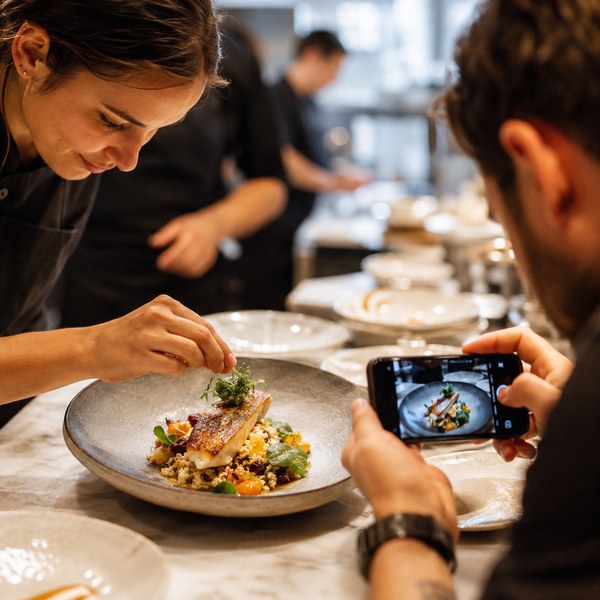
Short-form video is the single strongest trend-to-traffic pipeline in 2026. An MGH survey published in February 2026 found that 58% of TikTok users have visited a restaurant after seeing it on the platform — up from 38% in 2022 — and 52% have spent more than they normally would at a restaurant they discovered there (current as of July 2026). You don't need production value; you need a repeatable format: the pour shot, the cheese pull, the tableside finish, the sauce cascade over a dramatic plate. Film vertically at your best-looking station twice a week, post natively to TikTok and Instagram Reels, and put your city and cuisine in the caption. Our foodservice customers consistently tell us that dishes served on distinctive vessels — slate boards, mini cast-iron, geometric bowls — out-earn identical food on white china in both video saves and reorders, because the presentation itself is the hook.
3. Email and SMS win-back campaigns for lapsed guests
A win-back campaign targets guests who haven't visited in 45–90 days with a direct, personal offer — and it is usually the cheapest revenue in your entire marketing plan because you already paid to acquire these people. Build the list at the POS and on your Wi-Fi splash page. Then automate three touches: a "we miss you" note at day 45, a concrete offer (free appetizer or dessert, not a discount on the whole check) at day 60, and a last-call at day 90. Use a unique code per flow so redemptions are undeniable. SMS earns its keep for time-sensitive pushes — a slow-night flash offer sent at 3 p.m. can visibly move that evening's covers.
4. Loyalty program with a first-visit incentive
A loyalty program converts trend-driven first visits into habits — which matters because trends spike traffic, but retention pays rent. The mechanics that work are simple: sign-up reward on the first visit (this is the hook that gets the phone number), visible progress ("2 visits from a free entrée"), and a surprise perk around visit five that guests didn't expect. Digital punch-card platforms cost $50–$100 a month and plug into most POS systems. Measure it on repeat-visit rate: if members return even one extra time per quarter, the program is funding itself many times over.
5. Local micro-influencer tastings (trade meals for content)
Micro-influencer tastings put your food in front of a genuinely local audience for the cost of a few comped meals. Invite 3–5 local food accounts (2,000–20,000 followers — engagement matters more than reach) to a monthly tasting, serve your most photogenic dishes, and agree on a simple deliverable: one post or reel with your location tagged. Track profile taps and "saw you on Instagram" mentions the following two weeks. This is a rich topic in its own right — see our full guide, What Is Influencer Marketing For Restaurants?, for vetting creators, setting terms, and FTC disclosure rules.
6. Experiential events — chef's tables, tasting menus, pop-ups
Experiential events sell scarcity, and scarcity is marketing that guests pay for. A monthly chef's table for 8–12 guests, a five-course tasting tied to a seasonal ingredient, a collaboration pop-up with a local brewery or bakery — each creates a ticketed occasion, a reason for press and social coverage, and a mailing list of your highest-intent guests. Price events to cover food and labor plus margin; the marketing value of a sold-out night and its photo trail is the bonus, not the cost. Even modest concepts can play here: a taco spot's "off-menu night" is as ticketable as a tasting menu. If your event runs on a patio, our guide on how to implement outdoor dining in your restaurant covers the setup details that make al fresco events run smoothly.
7. Limited-time offers tied to seasonal trends
A limited-time offer (LTO) works because deadlines drive decisions — and tying the LTO to a seasonal or cultural moment gives it a built-in audience already searching for it. The NRA's 2026 What's Hot forecast puts comfort foods and value menus near the top of the year's trends, so a cold-weather braise at an accessible price point is riding two trends at once. Map your calendar now: game days, holidays, local festivals, first patio weekend. Sporting events alone are enormous food occasions — see our roundup of Super Bowl food facts and snack ideas for how big game-day demand runs, and our top 4th of July restaurant specials for a summer-holiday playbook. Run each LTO 2–4 weeks, promote it in video and email, and judge it on sales mix and target-daypart covers.
8. User-generated content — make tablescapes and packaging photo-worthy
User-generated content (UGC) is what happens when the table itself is the ad: guests photograph a striking presentation, post it with your location tagged, and market to their followers for free. This is presentation-as-marketing, and it's the most underused restaurant marketing idea on this list. The playbook: design one or two "hero moments" — a dramatic serving board, a smoking cloche, a dessert flight on a tiered stand, cocktails with sculptural garnish — position them for the camera (guests photograph what faces them), and make your handle easy to find on menus and table tents. In our work with operators, we've seen a single well-designed tasting flight generate more location tags in a month than a paid campaign — the vessel does the marketing. Takeout counts too: branded, well-constructed packaging turns every delivery into an unboxing post.
9. Community partnerships and charity nights
Community partnerships convert goodwill into first visits from people who might never have found you otherwise. A give-back night — where a percentage of the evening's sales supports a school, youth team, or local nonprofit — reliably brings the organization's entire network through your doors, many for the first time. Partner with nearby gyms, theaters, and offices on cross-promotions; sponsor the little-league team whose families eat out every weekend. Our guide to the top charity ideas for your restaurant breaks down formats that work. And if families are your growth segment, pair the charity night with the basics in 7 ways to make your restaurant kid-friendly so first-time families become regulars.
10. Review generation and response system (Google/Yelp)
A review system does two jobs: it raises the star rating that filters you in or out of consideration, and it shows prospective guests an owner who cares. With 97% of consumers reading reviews and 41% always checking them before choosing a business (BrightLocal, 2026), this is not optional. The system: train servers to invite happy tables to review ("If you enjoyed tonight, a Google review genuinely helps us"), put a QR code on the receipt, and respond to every review — positive and negative — within 48 hours. For negative reviews, thank, apologize once, and move the conversation offline. Never buy reviews or gate them (asking only happy customers via filtering software violates platform rules and erodes trust).
11. Geo-targeted social ads with tracked offers
Geo-targeted ads put a specific offer in front of people within driving distance — and the tracked offer is what separates marketing from hoping. Set a 3–5 mile radius (tighter in dense cities), build the creative from your best-performing organic video (you already know it stops thumbs), and attach a redemption code or click-to-call so every dollar is accountable. Start at $10–$20/day, run two offer variants, and kill the loser after two weeks. The math to watch is cost per redemption against average check — if a $12 acquisition cost brings in a $45 table with a 30% chance of a repeat visit, the ad pays.
12. Sustainability storytelling — eco-friendly packaging as a marketing asset
Sustainability storytelling turns an operating cost into a differentiator: the same to-go box can be a commodity or a statement about who you are. Local sourcing — with its emphasis on freshness and sustainability — ranked as the #1 overall trend in the NRA's 2026 What's Hot Culinary Forecast (current as of July 2026), and packaging is the most visible place guests encounter your values. Swap to compostable or plant-based eco-friendly disposables, then tell the story: a line on the menu, a note on the box, a short video on why you switched. Name your farms on the menu. The guests who care about this care a lot — and they post about it, turning your packaging into the UGC engine from idea #8.
Presentation Is Marketing: The Foodservice Angle Most Guides Miss
Most restaurant marketing advice stops at channels — but in a trend cycle driven by visual discovery, what you serve on is part of the campaign. Every tactic above gets stronger when the physical experience is designed to be shared:
- Video-ready tabletop: Signature vessels — slate, geometric ceramics, mini serving boards, glass domes — give your short-form video (idea #2) and guest UGC (idea #8) a visual identity that white plates can't. When we analyze what our 40,000+ foodservice customers reorder most, presentation pieces tied to a "hero dish" top the list, because operators see them working on camera.
- Events that look the part: Chef's tables and tasting menus (idea #6) live or die on tablescape. Coordinated chargers, tasting spoons, and flight boards photograph like a ticketed experience — which is exactly what you're selling.
- Takeout as a touchpoint: Sturdy, well-designed disposable tableware and packaging protect the food and carry your brand into homes and offices — the only marketing surface a delivery guest ever touches.
- Sustainability made visible: Eco-friendly packaging (idea #12) is storytelling you can hold. Guests can't see your energy-efficient kitchen, but they can see a compostable box.
Ready to make your presentation work as hard as your promotions? Shop disposable tableware built for operators — in stock and ships today.
Frequently Asked Questions
What is the best marketing strategy for restaurants?
The best marketing strategy for restaurants is a measurable local-first stack: a fully optimized Google Business Profile, consistent short-form video of your signature dishes, systematic review generation, and email/SMS campaigns to your own guest list. Layer trend-driven LTOs and events on top. No single tactic wins alone — the strategy is the combination, each tracked with its own metric.
What is the 30 30 30 rule for restaurants?
The 30-30-30 rule is a budgeting rule of thumb that targets roughly 30% of revenue for food costs, 30% for labor, and 30% for overhead and other operating expenses — leaving about 10% as profit margin. It is a guideline, not a law: actual targets vary by concept, market, and service model, but it's a useful sanity check when pricing menus and promotions.
How do I attract customers to my restaurant?
To attract customers to your restaurant, be visible where dining decisions happen: optimize your Google Business Profile with fresh photos, keep your review rating strong with prompt responses, post short-form video of your best dishes weekly, and give first-timers a concrete reason to visit now — a limited-time offer, an event, or a first-visit loyalty reward. Then capture contact info so the first visit isn't the last.
What are the 4 P's of marketing for restaurants?
The 4 P's of restaurant marketing are Product (your menu, presentation, and experience), Price (menu pricing, value offers, and LTOs), Place (your location, delivery zones, and online ordering channels), and Promotion (social media, ads, email, events, and PR). Strong restaurant marketing keeps all four aligned — a promotion can't outrun a weak product or a mispriced menu.
What restaurant trends bring in customers?
The restaurant trends bringing in customers in 2026 are short-form video discovery, local sourcing and sustainability, comfort food and value menus, and experiential dining like chef's tables and pop-ups. The NRA's 2026 What's Hot forecast ranks local sourcing, comfort foods, and value menus at the top — and 58% of TikTok users report visiting a restaurant after seeing it on the platform (MGH, 2026).
How do restaurants use social media trends?
Restaurants use social media trends by adapting viral formats — trending sounds, plating reveals, behind-the-scenes kitchen clips — to their own signature dishes rather than copying other concepts' menus. The winning pattern: post consistently (2–3 times weekly), feature one camera-ready hero dish, tag your location every time, and track profile taps and mention-driven visits so you know which formats actually fill seats.
Conclusion: Pick Your Trends, Then Prove They Work
Trend-driven restaurant marketing ideas come down to a discipline, not a hack: choose the two or three 2026 trends your kitchen can genuinely own, translate each into a specific promotion with a specific metric, and give it 30–60 days before you judge it. In a $1.55 trillion industry growing just 1.3% in real terms, the operators who win aren't outspending anyone — they're out-executing on the trends that fit. Start with your Google Business Profile and one weekly video this week; add an LTO and a review system next month. And when you're ready to make the plate itself part of the campaign, explore our disposable tableware and eco-friendly disposables collections, or browse more operator guides in RW Resources.
Sources
- National Restaurant Association — 2026 State of the Restaurant Industry (verified live July 2026)
- National Restaurant Association — 2026 What's Hot Culinary Forecast (press release) (verified live July 2026)
- MGH — TikTok Drives Restaurant Sales survey, February 2026 (verified live July 2026)
- BrightLocal — Local Consumer Review Survey 2026 (verified live July 2026)