Easy Amuse Bouche Recipes: 12 Simple Ideas for Beginners
An amuse-bouche is a single-bite appetizer served complimentary before the meal to preview the chef's style. Easy amuse bouche recipes include smoked salmon cucumber rounds, tomato-basil bruschetta spoons, chilled gazpacho shooters, and melon-prosciutto skewers. Most use five ingredients or fewer and plate in under ten minutes with standard mise en place.
If you have been searching for amuse bouche recipes easy enough to execute on a busy line — or at a dinner party where you'd rather talk to your guests than babysit a torch — this guide is built for you. Every one of the 12 easy amuse bouche ideas below uses five ingredients or fewer, plates in minutes, and scales from a six-top to a 200-cover banquet. In 15+ years supplying 40,000+ foodservice operations, we've watched a single well-executed amuse-bouche do more for a first impression than any menu redesign, so we also cover the operator side: choosing, serving, and the vessels that make these bites look intentional instead of improvised.
TL;DR — 12 Easy Amuse Bouche Ideas at a Glance
The table below summarizes all 12 easy amuse bouche recipes by core ingredients, serving temperature, ideal vessel, and prep time. Ten of the twelve are make-ahead friendly, which is exactly what beginners and high-volume kitchens both need.
| Recipe | Core Ingredients | Serve | Best Vessel | Active Prep |
|---|---|---|---|---|
| Smoked Salmon Cucumber Rounds | Salmon, crème fraîche, dill | Chilled | Slate or tasting plate | 10 min |
| Tomato-Basil Bruschetta Spoons | Tomato, basil, garlic | Room temp | Deco party spoon | 10 min |
| Melon & Prosciutto Skewers | Cantaloupe, prosciutto, mint | Chilled | Pick or skewer | 10 min |
| Whipped Goat Cheese Crostini | Baguette, goat cheese, honey, thyme | Room temp | Tasting dish | 15 min |
| Chilled Gazpacho Shooters | Tomato, cucumber, pepper | Chilled | 2 oz Quadrato cup | 15 min |
| Tuna Tartare Cones | Tuna, sesame oil, avocado | Chilled | Mini Pidy cone | 15 min |
| Caprese Bites | Mozzarella, tomato, basil | Room temp | Pick or spoon | 10 min |
| Deviled Quail Eggs | Quail eggs, Dijon, paprika | Chilled | Egg tray or spoon | 20 min |
| Mushroom Duxelles Tartlets | Mushroom, shallot, cream | Warm | Phyllo shell | 20 min |
| Tilapia & Mango Salsa Spoons | Tilapia, mango, lime | Warm/room | Tasting spoon | 15 min |
| Beet & Goat Cheese Stacks | Roasted beet, goat cheese, microgreens | Chilled | Mini tasting dish | 15 min |
| Parmesan Crisps with Fig Jam | Parmesan, fig jam | Room temp | Slate or dish | 10 min |
What Is an Amuse-Bouche?
An amuse-bouche is a complimentary, single-bite course a chef sends out before the first ordered dish; the French phrase means "amuses the mouth," and it is pronounced ah-mooz-BOOSH. Unlike an appetizer, an amuse-bouche is never ordered from the menu and never billed — it is the chef's choice, served to every guest, and designed to signal the kitchen's style in one bite.
The tradition grew out of French fine dining and was popularized in Michelin-starred restaurants, but it has migrated everywhere: tasting-menu bistros, wine bars, catering events, even food trucks running chef's-choice nights. Our foodservice customers consistently tell us the amuse-bouche is the cheapest "wow" on their menu — a two-bite investment in ingredients that sets the tone for the entire check. That matters commercially: according to the National Restaurant Association's 2026 State of the Restaurant Industry report, restaurant and foodservice sales are projected to reach $1.55 trillion in 2026, and in a market that competitive, guests remember the restaurants that open with a gift.
Three rules define the format, and they are also what make easy amuse bouche recipes genuinely easy:
- One bite, two at most. No cutlery beyond a tasting spoon or pick.
- Big, focused flavor. One dominant note — acid, smoke, sweetness — not a composed plate in miniature.
- Fast, repeatable plating. If it can't be plated in under 30 seconds per piece during service, it doesn't belong at the pass.
12 Easy Amuse Bouche Recipes for Beginners
These 12 easy amuse bouche recipes are ordered roughly from simplest to most involved. Each one lists ingredients, method, and a plating note, because with a bite this small, the vessel is half the presentation. What makes these amuse bouche recipes easy is repetition-proof simplicity: short ingredient lists, minimal knife work, and no à-la-minute cooking beyond two quick sears. Mix cold, room-temperature, and warm options so your lineup covers any menu and any season — including the cold amuse bouche recipes easy service demands in summer.
1. Smoked Salmon Cucumber Rounds
Smoked salmon cucumber rounds are the definitive starter recipe: no cooking, three ingredients, 10 minutes. Slice an English cucumber into ½-inch rounds, pipe a small dollop of crème fraîche on each, and top with a ribbon of smoked salmon and a dill frond. Serve chilled on slate or a black tasting plate so the pink and green pop. A squeeze of lemon just before the pass keeps the crème fraîche bright.
2. Tomato-Basil Bruschetta Spoons
Bruschetta spoons take the classic crostini topping and remove the soggy-bread problem. Dice ripe tomatoes small, fold with minced garlic, chiffonade basil, olive oil, and salt, then rest 15 minutes so the juices marry. Spoon into individual tasting spoons — we plate ours in Chef 101 Deco party spoons, which give a plain tomato salad a sculptural, pass-ready look. Finish with a drop of aged balsamic per spoon.
3. Melon & Prosciutto Skewers
Melon and prosciutto skewers are a sweet-salty crowd-pleaser that needs zero technique. Cube ripe cantaloupe, ribbon a half-slice of prosciutto around each cube, and secure with a bamboo pick, adding one mint leaf per skewer. Drizzle with balsamic reduction at service. These hold chilled for up to two hours, making them one of the best easy amuse bouche ideas for catering and banquet work.
4. Whipped Goat Cheese Crostini
Whipped goat cheese crostini deliver a warm-weather bite with pantry staples. Whip soft goat cheese with a splash of cream until fluffy, pipe onto toasted baguette coins, then finish with a thread of honey and fresh thyme leaves. The whip-and-pipe step is the whole trick: aerated cheese looks intentional, spreads don't. Toast the baguette up to a day ahead and hold airtight.
5. Chilled Gazpacho Shooters
Gazpacho shooters are the highest-margin item on this list — blended vegetables served in a 2-ounce pour. Blitz tomato, cucumber, red pepper, a little sherry vinegar, and olive oil until smooth, then chill at least two hours. Pour into 2 oz Quadrato cups and garnish with a cucumber dice and chive. One blender batch yields 25–30 servings, and the shooters sit happily in the walk-in until the moment they're needed.
6. Tuna Tartare Cones
Tuna tartare cones look like a fine-dining flex but assemble in seconds. Dice sushi-grade tuna, dress with sesame oil, soy, and scallion, and fold in small-diced avocado just before service. Fill mini Pidy cones to order — the cone stays crisp only if filled at the pass, so mise the tartare and fill as tickets fire. This is the recipe our customers photograph most.
7. Caprese Bites
Caprese bites are Italy's simplest salad reduced to one bite: a mozzarella pearl, a cherry tomato half, and a basil leaf on a pick, finished with flaky salt and good olive oil. The only rule is ingredient quality — with three components there is nowhere to hide. Assemble up to an hour ahead; salt only at service so the tomato doesn't weep.
8. Deviled Quail Eggs
Deviled quail eggs miniaturize a picnic classic into fine-dining scale. Boil quail eggs 4 minutes, shock, peel, halve, and pipe the yolks back whipped with Dijon and mayonnaise; dust with smoked paprika at service. Peeling quail eggs is fiddly — roll them gently under your palm first and peel under water. The piped halves hold, covered and chilled, for a full service.
9. Mushroom Duxelles Tartlets
Mushroom duxelles tartlets are the warm option every cold lineup needs. Sweat finely chopped mushrooms and shallot until dry, mount with a spoonful of cream, season hard, and fill store-bought phyllo shells. Flash them in a hot oven for 3–4 minutes and serve warm. The duxelles keeps refrigerated for three days, so this is genuinely a scoop-bake-serve recipe on the night.
10. Tilapia & Mango Salsa Spoons
Tilapia and mango salsa spoons pair a mild, budget-friendly fish with a bright tropical salsa — a bite that outperforms its food cost dramatically. This is the fullest recipe in the roundup, so here it is start to finish:
- Ingredients (24 spoons): 2 tilapia fillets (about 12 oz), 1 ripe mango (small dice), ¼ red onion (fine dice), 1 lime (juice + zest), 1 tbsp chopped cilantro, olive oil, salt, and a pinch of chili flake.
- Step 1 — Salsa: Fold mango, red onion, lime juice and zest, cilantro, and chili flake together. Season and rest 15 minutes.
- Step 2 — Fish: Season tilapia with salt and oil, then sear 2–3 minutes per side until it flakes. Rest 5 minutes and break into bite-size flakes.
- Step 3 — Assemble: Place one flake of tilapia in each tasting spoon, top with a teaspoon of salsa, and finish with a micro-cilantro leaf. Serve warm or at room temperature within 30 minutes.
The flavor logic is acid-plus-richness: lime cuts the fish's sweetness the way mignonette cuts an oyster. Swap tilapia for any flaky white fish — cod, snapper, or barramundi all work at the same timings.
11. Beet & Goat Cheese Stacks
Beet and goat cheese stacks bring color no other bite on this list can match. Roast beets until tender (or use vacuum-packed cooked beets to skip the oven entirely), chill, and slice into coins. Stack beet, a disc of goat cheese, then beet again; top with microgreens and a drop of vinaigrette. Slice and stack cold — warm beets will melt the cheese line and bleed pink everywhere.
12. Parmesan Crisps with Fig Jam
Parmesan crisps with fig jam are a two-ingredient finale you can bake a day ahead. Mound grated Parmesan into 2-inch circles on parchment and bake at 375°F for 5–6 minutes until golden and lacy; cool flat. At the pass, top each crisp with a small quenelle of fig jam. Sweet, salty, crunchy, done. Store crisps airtight with a silica pack or a slice of dry bread to keep them snappy.
How Do You Choose and Serve an Amuse-Bouche?
Choose an amuse-bouche by matching three things: the first course it precedes, the season, and your kitchen's capacity at the pass. The bite should contrast with what follows (a bright, acidic shooter before a rich entrée; a warm tartlet before a chilled starter), use ingredients already in your walk-in, and plate in under 30 seconds per piece. Beginners searching for amuse bouche easy recipes should default to cold, make-ahead bites — numbers 1 through 7 above — and add the warm tartlets only once the cold routine runs itself.
Serving is where most first attempts fall apart, so treat these as house rules:
- Serve everyone at the table at once. An amuse-bouche is a gift from the kitchen; staggered delivery kills the gesture.
- Announce it in one sentence. "A gift from the chef: chilled gazpacho with cucumber." Train servers on the pronunciation — ah-mooz-BOOSH — because guests will ask.
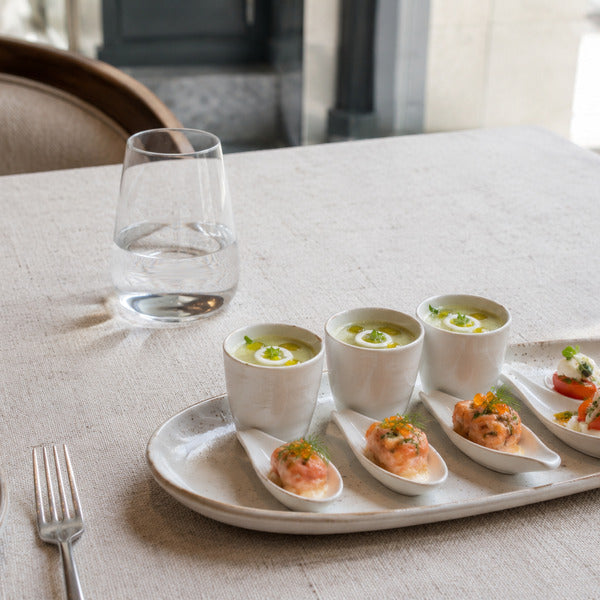
- Right-size the vessel. A tasting spoon, 2-ounce cup, mini cone, or small tasting dish frames one bite as deliberate. A bite lost on a dinner plate reads as a mistake. Our food plating and presentation tips guide covers the framing principles in depth.
- Mind temperatures. The FDA Food Code standard for professional kitchens is to hold cold food at 41°F or below and hot food at 135°F or above — see the FDA Food Code. For home entertaining, the FDA's simpler rule applies: never leave perishable food in the 40–140°F danger zone for more than two hours. Small bites warm up fast; plate cold amuse-bouches on chilled vessels and send them immediately.
- Clear before the first course. The vessel comes back before the next plate lands, which is one more reason single-piece vessels beat shared platters. For the full front-of-house choreography, see our fine dining etiquette tips for servers.
One more planning note: rotate your amuse-bouche with the seasons rather than the whims of the walk-in. Regulars notice — and in a year when, per the same National Restaurant Association report, more than 7 in 10 consumers say they would dine out more often if they had more disposable income, small signals of generosity are what convert an occasional guest into a regular.
Foodservice Application: Serving Amuse-Bouches at Volume
In a commercial kitchen, the amuse-bouche succeeds or fails on logistics, not creativity. In 15+ years supplying 40,000+ foodservice operations, we've seen the same pattern repeatedly: kitchens that standardize on one or two dedicated vessels run the course nightly without friction, while kitchens improvising with ramekins and saucers quietly drop it within a month. The vessel is the system.
Here is how the three vessels used in this guide map to service styles:
| Vessel | Best For | Why It Works at Volume |
|---|---|---|
| Deco party spoons (500-count) | Bruschetta, tartare, tilapia-mango, caprese | Pre-portioned, self-garnishing shape; trays of 20 plate in under a minute |
| Mini Pidy cones (90-count) | Tartares, mousses, whipped cheese fills | Neutral flavor, fill-to-order crispness, dramatic upright presentation in cone stands |
| 2 oz Quadrato cups (100-count) | Shooters, soups, layered verrines | Batch-pour from a pitcher; stackable in the walk-in, stable on trays |
Caterers and banquet teams should default to disposable-format vessels: no dish pit dependency, no breakage on transport, and consistent presentation that keeps even ambitious amuse bouche ideas easy to execute across hundreds of covers. Browse the full appetizer and tasting spoons collection to match a vessel to your menu before you commit a recipe to the printed menu cycle.
Frequently Asked Questions
What is a good amuse bouche?
A good amuse-bouche is a single, intensely flavored bite that previews the chef's style and contrasts with the first course. Reliable examples include smoked salmon cucumber rounds, gazpacho shooters, tuna tartare cones, and parmesan crisps with fig jam. The best choices use five or fewer ingredients and plate in under 30 seconds.
What is a good finger food to bring to a party easily?
Melon and prosciutto skewers are the easiest party finger food on this list: three ingredients, no cooking, and they hold chilled for two hours. Caprese bites and parmesan crisps with fig jam travel equally well. Assemble skewers and picks on site rather than in advance so nothing slides or weeps in transit.
What appetizer is known as a crowd pleaser?
Tomato-basil bruschetta is the classic crowd-pleaser — familiar, vegetarian, and inexpensive to scale. Served in individual tasting spoons instead of on bread, it also solves the sogginess problem that sinks most bruschetta at events. Gazpacho shooters run a close second in warm weather because guests can take one one-handed.
What's the difference between an appetizer and an amuse bouche?
An appetizer is ordered from the menu, paid for, and portioned as a small course; an amuse-bouche is complimentary, chosen by the chef, and sized as a single bite. The amuse-bouche arrives before any ordered food and is served to every guest at the table. In short: appetizers are commerce, an amuse-bouche is a greeting.
Conclusion: Start With One Bite
Easy amuse bouche recipes are the lowest-risk way to add a fine-dining signal to any menu — from a UK gastropub to a US tasting room, the format is identical: one bite, big flavor, fast plating. Start with one cold, make-ahead recipe from this list, standardize the vessel, and run it for a full menu cycle before adding a second. Whether you're a line cook building a chef's-choice course or a host planning a dinner party, the equipment side is solved: explore Restaurantware's appetizer and tasting dishes collection to find the spoons, cones, cups, and mini plates that turn a simple bite into a first impression.