Benefits of Using Bamboo Tableware
Bamboo tableware offers durability, natural resilience, and genuine sustainability: bamboo regrows to harvestable maturity in 3–5 years, and uncoated bamboo plates, bowls, and flatware are commercially compostable. For foodservice operators, bamboo holds heavy, saucy plated items better than paper while delivering an upscale, eco-friendly presentation guests notice.
Bamboo tableware is the fastest-growing answer to a question we hear every week at Restaurantware: how do you replace plastic serviceware without sacrificing strength or style? In 15+ years supplying 40,000+ foodservice operations, we've watched bamboo plates, flatware, and boards move from catering novelty to everyday front-of-house staple. This guide consolidates everything operators ask us about the benefits of using bamboo tableware — environmental impact, hygiene, durability, care, and how bamboo compares to plastic, melamine, and palm leaf.
TL;DR — Why Bamboo Tableware Wins
- Renewability: bamboo matures for harvest in 3–5 years and regrows from the same root system without replanting — hardwoods need decades.
- Compostability: uncoated, all-natural bamboo plates and cutlery are commercially compostable; look for BPI certification to ASTM standards.
- Durability: bamboo's tensile strength handles heavy, saucy, or carved items that soak through paper plates.
- Presentation: warm natural grain reads as premium — guests see the sustainability story on the table.
- One caveat: avoid bamboo-melamine composite dinnerware; pure bamboo is the safe, honest choice (details below).
| Material | Durability | Commercially compostable? | Food-safety notes | Typical cost per unit |
|---|---|---|---|---|
| Pure bamboo | High — rigid, cut-resistant | Yes (uncoated; verify BPI/ASTM certification) | Natural material; no plastic additives | $–$$ (disposable) / $$ (reusable) |
| Melamine (incl. bamboo-melamine composites) | Very high — reusable | No — thermoset plastic | FDA notes melamine can migrate into acidic foods under heat; bamboo-melamine composites withdrawn in the EU | $$$ upfront, reusable |
| Palm leaf | High — rigid, heat-tolerant | Yes (typically certified compostable) | Single-material, no additives | $$ |
| Plastic (PP/PS) | Medium–high | No — petroleum-based, centuries to break down | Food-safe but increasingly restricted by single-use plastic bans | $ |
| Paper | Low — soaks through under sauce | Often (uncoated/PLA-lined varies) | Coatings may contain PFAS unless certified | $ |
Table current as of August 2026. Compare options in our paper plates and wooden dinnerware collections.
What Is Bamboo Tableware?
Bamboo tableware is dinnerware, flatware, and serving equipment made from bamboo — a fast-growing giant grass, not a tree. The category breaks down into four groups:
- Bamboo plates and dishes — disposable veneer plates and cones for catering, plus reusable pressed-bamboo dinnerware.
- Bamboo dinnerware sets — bowls, boats, and tasting vessels used for passed appetizers and buffets.
- Bamboo flatware and utensils — forks, knives, spoons, sporks, picks, and skewers.
- Bamboo boards — cutting boards, chopping blocks, and serving boards.
Bamboo tableware is manufactured two main ways. Disposable pieces are cut or pressed from bamboo sheath and veneer with minimal processing. Reusable pieces are laminated from bamboo strips or molded from bamboo fiber. The distinction matters for compostability and care, which we cover below. Bamboo sits within the broader eco-serviceware family — for the full landscape of materials, see our guide to eco-friendly tableware; this article goes deep on bamboo specifically.
What Are the Environmental Benefits of Bamboo Tableware?
The environmental benefit of bamboo tableware is simple: bamboo is one of the most renewable raw materials on Earth. According to the International Bamboo and Rattan Organisation (INBAR), bamboo matures to a hard, wood-like material within 3 to 5 years and can be harvested without replanting, because new culms regenerate from the same root system. Some species grow up to 91 cm (about 3 feet) per day — the fastest-growing plants on the planet. Hardwood timber, by comparison, typically needs 20 or more years before harvest.
That renewability translates into concrete advantages for bamboo dishes on your line:
- Rapid resource turnover. A bamboo grove yields harvest cycles every few years, so demand for bamboo plates doesn't drive deforestation the way slow-growing timber can.
- No replanting, living root system. Harvesting bamboo is closer to mowing than logging — the plant keeps sequestering carbon between cuts.
- Low-input crop. Bamboo grows densely without irrigation infrastructure or heavy pesticide programs in most producing regions.
- Clean end of life. Uncoated bamboo tableware biodegrades; certified products can enter commercial composting streams instead of landfill.
The market data backs the shift. The global biodegradable disposable tableware market is projected to grow from USD 13.25 billion in 2026 to USD 20.2 billion by 2036, per Future Market Insights (current as of August 2026) — driven largely by plastic restrictions pushing restaurants toward certified compostable serving products. And sustainability sells: a joint McKinsey & Company and NielsenIQ study of 600,000 US product SKUs found that products making ESG-related claims — including "compostable" and "eco-friendly" — averaged 28% cumulative five-year growth versus 20% for products without such claims, and NielsenIQ found 78% of US consumers say a sustainable lifestyle is important to them.
Are Bamboo Plates Compostable?
Yes — uncoated, all-natural bamboo plates are compostable, and many are certified for commercial composting. In the US, the Biodegradable Products Institute (BPI) certifies foodservice items using ASTM D6400 as the base standard, with ASTM D6868 applied to eligible fiber-based products; certified items must also meet total-fluorine (PFAS) limits. Two practical rules for operators: first, "compostable" on a label means little without certification — ask for the BPI mark or equivalent test data. Second, commercial compostability assumes an industrial facility; bamboo veneer plates will break down in backyard compost, but more slowly.
Are Bamboo Plates Reusable?
It depends on the construction. Disposable bamboo sheath plates are designed for single service — though they're sturdy enough that caterers routinely reuse them within an event. Reusable bamboo dinnerware (laminated or pressed bamboo with food-safe finishes) withstands repeated hand-washing for months to years of service. If reusability is the goal, buy pieces explicitly sold as reusable and follow the care guidance later in this guide.
Why Choose Bamboo Flatware? (Benefits of Bamboo Utensils)
Bamboo flatware delivers the single biggest benefit operators ask for: rigid, splinter-free utensils that don't snap in a steak-grade bite. The benefits of bamboo utensils come from the plant's physical structure — bamboo fibers have high tensile strength relative to weight, so a bamboo fork holds firm where thin plastic bends and cheap birchwood splits.
Here's what bamboo flatware — forks, knives, spoons, and sporks — gives a foodservice operation:
- Strength in real menus. A bamboo knife saws through chicken and crusty bread; bamboo spoons for eating hold shape in hot soups and grain bowls without going soggy.
- Neutral taste and feel. Bamboo is smooth and imparts no flavor — a common guest complaint with rough wooden cutlery disappears.
- Heat tolerance. Bamboo doesn't warp against hot food the way PS plastic can.
- Presentation value. The pale, even grain photographs beautifully — a real asset for fast-casual concepts building an eco-forward brand.
For a deeper dive into cutlery-specific tradeoffs, see our companion piece on the pros of using bamboo cutlery.
Is Bamboo Cutlery Good for the Environment?
Yes. Bamboo cutlery is good for the environment because it pairs a renewable input (3–5 year harvest cycles) with a clean output (compostable or biodegradable disposal). A bamboo fork used at a festival can be commercially composted with the food scraps still on it — closing a waste loop that plastic cutlery can't. The one watch-out: some "bamboo" cutlery is actually bamboo fiber bonded with plastic resin. Pure, single-material bamboo is the environmentally sound version; composite blends are not compostable and should be labeled honestly.
Bamboo vs Plastic Cutlery: Which Is Better?
Bamboo beats plastic cutlery on every criterion except unit price — and the gap is narrowing. Plastic cutlery is petroleum-derived, non-compostable, and increasingly banned outright in single-use plastic legislation across US cities and the EU. Bamboo cutlery is renewable, compostable, and exempt from those bans, which makes it a hedge against regulatory risk as much as an eco statement. On performance, quality bamboo cutlery is stiffer than economy plastic. Plastic's only remaining edge is cost per piece, and the premium for bamboo shrinks at wholesale case quantities. Browse certified options in our eco-friendly disposable cutlery collection.

Go Green with Eco-Friendly Bamboo Ware: Boards and Beyond
Going green with bamboo extends past the plate — eco bamboo ware includes cutting boards, chopping blocks, and serving boards that put bamboo's hardness to work in prep and presentation. A bamboo cutting board is harder than maple, lighter than end-grain hardwood blocks, and made from a grass that regrew before your last board wore out. Bamboo boards resist knife scarring, don't absorb liquids as readily as open-grain woods, and double as rustic serving boards for charcuterie and flatbreads. Explore sizes in our cutting boards collection.
Are Bamboo Cutting Boards Hygienic and Sanitary?
Yes — bamboo cutting boards are hygienic when cleaned and maintained properly. Bamboo's density gives it low porosity, so it absorbs less moisture than many open-grain hardwoods; less absorbed moisture means less habitat for bacteria between uses. To keep a bamboo chopping board sanitary in commercial use: wash with hot soapy water immediately after each task, sanitize per your local health code, stand it on edge to air-dry fully, and oil it monthly with food-grade mineral oil to prevent surface cracking (cracks, in any board material, are where sanitation fails). Replace any board with deep scarring. Follow those steps and a bamboo board meets the same hygiene bar as any NSF-listed wooden board — with a better sustainability story.
What Are the Advantages of Using Wood Cutlery and Wooden Utensils?
Wood cutlery — typically birchwood — is bamboo's closest sibling, and its advantages overlap heavily: renewable material, compostable disposal, natural presentation, and exemption from plastic bans. The benefits of using wooden utensils in a foodservice setting include:
- Rustic presentation. Birchwood's matte finish suits bakeries, ice cream shops, and farm-to-table concepts.
- Heat safety. Wooden utensils don't conduct heat or leach under hot-hold temperatures.
- Cost efficiency. Wood cutlery generally prices below bamboo, making it the entry point for operators leaving plastic.
- Versatile uses of cutlery. Beyond place settings, wooden taster spoons drive sampling programs, and wooden forks anchor grab-and-go kits.
How does wood compare to bamboo? Bamboo is denser and smoother; wood is cheaper and softer-toned. Many of our customers run both — bamboo for plated and premium service, birchwood for volume grab-and-go. Both compost in the same stream.
What Are the Benefits of Using Utensil Holders in the Kitchen?
Utensil holders keep cutlery organized, protected from contamination, and moving fast at self-serve stations. In the kitchen, holders and flatware organizers cut service time (staff grab without hunting), improve food safety (handles up, heads untouched), and reduce waste (guests take one utensil, not a fistful). For front-of-house, upright holders in bamboo or wood tie the sustainability story together visually. See our utensil holders and flatware organizers collection for commercial options.
Bamboo vs Melamine, Palm Leaf, and Plastic: The Honest Comparison
The comparison table near the top of this guide summarizes the matchup; three points deserve plain language.
Bamboo-melamine composites are not bamboo tableware. A wave of "bamboo" dinnerware sold in the late 2010s was actually melamine-formaldehyde plastic filled with bamboo powder. The European Commission's "Bamboo-zling" enforcement action — 21 countries, 748 cases — pulled these products from the EU market because bamboo and other plant additives were never authorized (or safety-assessed) for use in food-contact plastics. If a "bamboo" plate is dishwasher-marketed, glossy, and unbreakable, it is almost certainly a melamine composite. Pure bamboo tableware contains no plastic binder — that's the product category this guide covers, and the one we sell.
Melamine itself has real limits. The FDA's guidance on melamine tableware notes that melamine can migrate into acidic foods under high heat, which is why melamine dinnerware carries do-not-microwave warnings. Pure bamboo carries no such caveat.
Palm leaf is bamboo's best friendly rival. Fallen-leaf palm plates match bamboo on compostability and rigidity with a deeper, more textured look. Many caterers mix the two across courses. We break down that decision in our palm leaf alternatives buying guide.
How Do You Care for Bamboo Tableware?
Care for bamboo tableware with three habits: hand-wash, dry fully, and oil occasionally.
- Wash by hand in warm, soapy water. Skip the dishwasher for reusable bamboo — prolonged heat and soaking cycles dry out and crack the material.
- Dry immediately and completely. Standing water is the main cause of warping and dark spotting.
- Oil monthly. Food-grade mineral oil keeps reusable bamboo plates and boards sealed and crack-free.
- Avoid extremes. No microwave, no oven, no freezer for reusable bamboo pieces.
- Disposables need no care — serve, scrape, and compost.
Bamboo Tableware in Foodservice: A Beautiful Alternative to Plastic and Metal
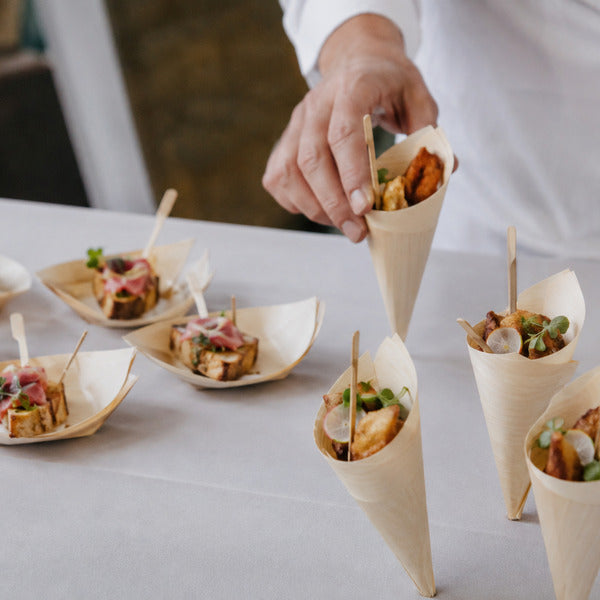
Bamboo flatware and dinnerware give operators a third way between disposable plastic (cheap but banned, flimsy, and off-brand for eco-minded concepts) and metal (durable but costly to wash, easy to lose, and wrong for off-premise). This is where Restaurantware's bamboo lines were born: catering companies asked us for serviceware that looked upscale in photos, survived transport, and could be composted after the event.
Our foodservice customers consistently tell us bamboo tableware holds up better than paper for heavy or saucy plated items — braised short rib over polenta will soak through a paper plate in minutes, while a bamboo veneer plate stays rigid to the last bite. At weddings and tasting events, we've watched bamboo cones and boats become part of the food styling itself: the natural grain frames the food the way white china does, at a fraction of the logistics cost.
Where to start, in the order most operations adopt bamboo:
- Bamboo picks and skewers — the lowest-cost entry; instantly upgrade passed appetizers.
- Bamboo cones and boats — signature catering vessels for small plates and street-food menus.
- Bamboo plates — square veneer plates for plated courses and buffets.
- Bamboo flatware — complete the setting and eliminate plastic cutlery entirely.
Explore the full range in our wooden dinnerware collection, or browse all dinnerware to mix bamboo with porcelain and glass across service styles.
Frequently Asked Questions
Are bamboo plates good or bad?
Pure bamboo plates are good: renewable, sturdy, compostable, and free of plastic additives. The "bad" reputation belongs to bamboo-melamine composite plates, which are plastic products withdrawn from the EU market because the bamboo additive was never authorized for food-contact plastics. Check the label — 100% natural bamboo is the safe choice.
What is the healthiest dinnerware to use?
The healthiest dinnerware options are single-material products with long food-safety track records: glass, porcelain, stainless steel, and uncoated natural fibers like pure bamboo and palm leaf. These materials contain no plasticizers or resin binders. For disposables specifically, uncoated bamboo and palm leaf avoid both plastics and the PFAS coatings found in some paper products.
Do bamboo plates release microplastics?
Pure bamboo plates cannot release microplastics because they contain no plastic. Bamboo-melamine composite dinnerware is a different product: it is melamine plastic with bamboo filler, and the FDA notes melamine can migrate into acidic foods under heat. If microplastics are your concern, buy 100% bamboo, palm leaf, or uncoated fiber tableware — and skip anything marketed as "bamboo melamine."
Can bamboo plates be washed and reused?
Reusable bamboo plates can be hand-washed and reused for months to years with proper care: warm soapy water, immediate towel drying, and monthly oiling with food-grade mineral oil. Disposable bamboo veneer plates are built for single service, though they typically survive rinsing and reuse within a single event. Avoid dishwashers, microwaves, and soaking for any bamboo piece.
Are bamboo plates compostable?
Yes — uncoated, all-natural bamboo plates are compostable, and certified products can enter commercial composting streams. Look for BPI certification, which tests to ASTM compostability standards (D6400, with D6868 for eligible fiber items) and enforces PFAS limits. Home composting works too, just more slowly.
Is bamboo cutlery better than plastic?
Yes, for nearly every operator. Bamboo cutlery is renewable, compostable, sturdier than economy plastic, and compliant with single-use plastic bans that are removing plastic cutlery from the market. Plastic's only advantage is a lower unit price, and wholesale case pricing narrows that gap substantially.
The Bottom Line on Bamboo Tableware
The benefits of using bamboo tableware come down to a rare alignment: the sustainable choice is also the stronger and better-looking one. Bamboo regrows in 3–5 years, composts cleanly when uncoated, outperforms paper under heavy plates, sidesteps plastic bans, and signals genuine environmental commitment to the 78% of US consumers who say sustainable living matters to them. Start with picks and cones, graduate to plates and flatware, and keep composites off your table.
Ready to make the switch? Shop our wooden dinnerware collection for bamboo plates, boats, cones, and flatware — in stock and ready to ship for your next service.