Baking Cups Buying Guide
Baking cups are single-use or reusable molds—paper, foil, silicone, or tulip-style—that hold batter for cupcakes and muffins, releasing baked goods cleanly while adding display appeal. This guide consolidates Restaurantware's advice on baking cup types, sizes, materials, foil cups, durable liners, and pan liners so foodservice operators can choose the right cup.
TL;DR: Baking Cups at a Glance
- Paper baking cups are the everyday workhorse: inexpensive, oven-safe, and available greaseproof so colors and prints survive high-fat batters.
- Foil baking cups are freestanding—sturdy enough to bake without a muffin pan—and give the most upscale finish.
- Silicone baking cups are reusable hundreds of times and release cleanly, but they slow down high-volume service lines.
- Tulip baking cups add height and a bakery-case look that justifies premium pricing.
- Size by capacity, not by name: mini cups run about 3 oz, standard cups 3.5–4 oz, and jumbo cups 5–10 oz.
- For commercial use, buy greaseproof, PFAS-free cups by the case from a foodservice supplier such as the Restaurantware baking cups and cupcake liners collection.
| Type | Freestanding (no pan)? | Reusable? | Best For | Watch Out For |
|---|---|---|---|---|
| Paper (standard) | No | No | High-volume cupcakes and muffins in pans | Grease bleed-through on non-greaseproof stock |
| Greaseproof / kraft paper | Some ridged styles | No | Buttery, high-fat batters; printed designs | Costs slightly more than standard paper |
| Foil (aluminum) | Yes | No | Baking without a pan; upscale display; catering | Remove paper separator inserts before filling |
| Silicone | Yes | Yes (hundreds of uses) | Test kitchens, small cafes, sustainability programs | Washing labor; not ideal for grab-and-go |
| Tulip | Rides in a pan | No | Tall muffins, premium bakery-case presentation | Needs taller batter fill to look right |
| Pan liners (sheets) | n/a | No | Sheet pans, delicate soft-batter items, biscuits | Match liner coating to oven temperature |
What Are Baking Cups?
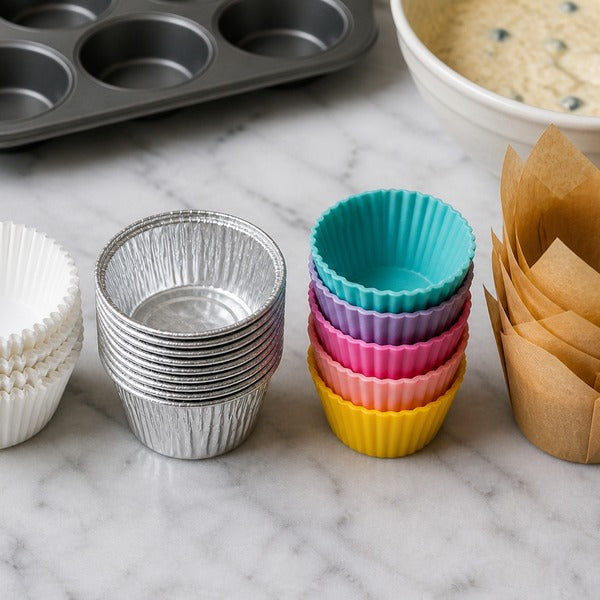
Baking cups are formed cups—usually paper, aluminum foil, or silicone—that line muffin pans or stand on their own to shape batter as it bakes. They serve three jobs at once: they release the finished cupcake or muffin cleanly, they keep pans sanitary between batches, and they act as the product's packaging and presentation in the display case.
The category breaks down into five practical groups: standard paper cupcake liners, greaseproof and kraft paper cups, foil cups, silicone cups, and specialty shapes such as tulip cups and ridged or scalloped freestanding cups. Flat pan liners for sheet pans are a close cousin, and we cover them later in this guide because most bakeries buy both from the same supplier.
The stakes are bigger than they look. The U.S. commercial baking industry employs almost 800,000 people and carries an overall economic impact of more than $186 billion, according to the American Bakers Association. Every one of those cupcakes, muffins, and grab-and-go pastries touches a liner or a pan liner before it touches a customer.
What Is the Difference Between Baking Cups and Cupcake Liners?
Baking cups and cupcake liners are largely the same product—"baking cups" is the broader term, while "cupcake liners" refers specifically to thin paper cups designed to line a muffin pan. Every cupcake liner is a baking cup, but not every baking cup is a liner: freestanding foil, ridged kraft, and silicone baking cups hold their shape without a pan, so they are true cups rather than liners.
Here is the practical distinction for buyers:
- Cupcake liners (thin pleated paper) must sit inside a muffin pan cavity. The pan provides the structure; the liner provides release and presentation.
- Freestanding baking cups (foil, heavy ridged paper, silicone) hold batter on a flat sheet pan with no muffin pan at all. That matters when you're baking 400 units and own six muffin pans.
- Baking cups with lids are a foodservice-specific subcategory: cups sized to accept a snap-on lid after baking, which turns each unit into sealed grab-and-go packaging. The Panificio 3.5 oz round white foil paper baking cup is a lid-compatible example we supply to cafes running packaged bakery programs.
What Types of Baking Cups Are There?
There are five main types of baking cups: standard paper, greaseproof paper (including kraft), foil, silicone, and tulip. Each solves a different problem, and most commercial bakeries stock at least two types.
Paper Baking Cups and Cupcake Liners
Standard paper liners are the lowest-cost option and the default for high-volume production in muffin pans. Their weakness is grease: butter-heavy batters can soak through plain paper, turning a white liner translucent and muddying printed designs. For anything richer than a basic muffin, step up to greaseproof stock.
Greaseproof and Kraft Paper Baking Cups
Greaseproof baking cups are treated or densified so oil cannot penetrate the paper wall, which keeps colors crisp after baking. One sourcing note every operator should know: in February 2024, the FDA announced that grease-proofing substances containing PFAS ("forever chemicals") are no longer sold by manufacturers for food-contact paper in the U.S. market. Reputable suppliers now achieve grease resistance through PFAS-free treatments and denser paper—ask your supplier to confirm, and avoid old inventory of unknown origin. Kraft paper cups, such as the Panificio 4 oz kraft paper square baking cup, pair that greaseproof performance with the natural, unbleached look that reads "artisan" in a bakery case.
Silicone Baking Cups
Silicone baking cups are reusable, flexible molds rated for oven temperatures typically up to about 450°F (always confirm the manufacturer's rating). They release even sticky batters without sprays, and a single cup can replace hundreds of paper liners—a genuine sustainability win. The trade-off is labor: every cup must be washed, sanitized, and dried between uses, which is why silicone thrives in test kitchens and small cafes but rarely survives on a 1,000-unit-a-day production line. Silicone cups also cannot leave the building with the customer, so they don't work for grab-and-go.
Tulip Baking Cups
Tulip baking cups are tall parchment wraps with pointed petals that rise above the muffin. They forgive over-filling, they showcase domed tops, and they let a $2 muffin present like a $4 muffin. Bake them inside a muffin pan or a supportive ring, and fill slightly higher than you would a pleated liner so the crown reaches the petals.
Specialty and Freestanding Shapes
Beyond the classics, ridged, scalloped, square, and elliptical cups stand on their own on a sheet pan and double as serving vessels. Cups like the Panificio 3 oz round black paper mini baking cup go from oven to catering tray without a transfer step—one less touch, one less chance to scuff a finished product.
What Sizes Do Baking Cups Come In?
Baking cups come in three core size families—mini (about 3 oz), standard (3.5–4 oz), and jumbo (5–10 oz)—but capacity in ounces matters more than the name on the box, because "standard" varies by manufacturer. Always check three measurements before ordering by the case: base diameter (it must match your pan cavity), wall height, and fluid-ounce capacity.
| Size Family | Typical Capacity | Typical Dimensions | Best Use |
|---|---|---|---|
| Mini | ~3 oz | ~2.5" top diameter × 1.75" tall | Bite-size cupcakes, petit fours, tasting menus |
| Standard | 3.5–4 oz | ~2.75–3.5" top diameter × 1–1.75" tall | Everyday cupcakes and muffins |
| Large / Jumbo | 5–10 oz | ~3.5–4.5" top diameter × 1.25–2.5" tall | Cafe-style jumbo muffins, monkey bread, savory bakes |
A rule of thumb we give bakery customers: fill cups two-thirds full for a level top, or three-quarters full for a pronounced dome. If your recipe yield keeps overflowing a standard cup, move up a size rather than under-filling—the Panificio 10 oz kraft paper jumbo baking cup exists precisely for oversized cafe muffins that outgrow every "standard" liner.
How Do You Use Foil Baking Cups?
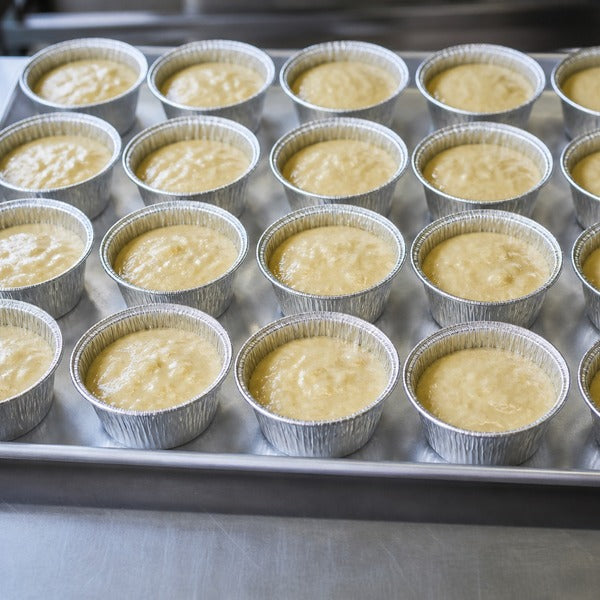
Foil baking cups are used exactly like paper liners with one upgrade: because aluminum holds its shape, foil cups can bake freestanding on a flat sheet pan with no muffin pan required. That single property is why caterers and high-volume operations standardize on foil.
Follow these steps for consistent results with foil and aluminum cupcake cups:
- Remove the paper separators. Most foil cups ship with thin paper inserts stacked between cups to prevent sticking in the package. They are separators, not liners—pull them out before filling, or your batter bakes against paper instead of foil.
- Arrange on a sheet pan or in a muffin pan. Freestanding on a sheet pan works for most batters; use a muffin pan for very thin batters that could bulge the walls.
- Fill two-thirds full. Foil conducts heat faster than paper, so edges set slightly sooner. Check doneness a minute or two early on the first batch.
- No greasing needed for most recipes. Foil releases cleanly from standard cupcake and muffin batters; give a quick spray only for low-fat or high-sugar batters that tend to weld.
Foil cups also resist moisture far better than paper, so they hold up under refrigeration and in humid display cases—useful for filled or cream-topped items. And because foil doesn't absorb grease, printed and colored foil cups keep their metallic finish after baking, which is why they dominate holiday and premium lines.
What Are the Best Baking Cups for Cupcakes?
The best baking cups for cupcakes are greaseproof paper cups for everyday retail, foil cups for pan-free volume and premium presentation, and tulip cups when you want display-case drama. "Best" depends on the batter, the volume, and how the finished cupcake reaches the customer.
Match the cup to the job:
- High-fat, buttery batters: greaseproof paper or foil. Plain paper will stain and look tired within an hour in the case.
- Dark or colored batters (chocolate, red velvet): darker printed cups or chocolate-brown greaseproof cups such as the Panificio 4 oz round chocolate wisp paper baking cup hide any bleed and frame the crumb.
- Grab-and-go and delivery: baking cups with lids. Bake, cool, snap the lid on, and the cup becomes tamper-evident packaging—no clamshell needed.
- Weddings and catering: foil or scalloped freestanding cups that photograph well and survive transport.
The demand side justifies getting this right: the global muffins market alone is estimated at $10.81 billion in 2025 and projected to reach $12.86 billion by 2031, with foodservice channels growing at a 6.35% CAGR through 2031, according to Mordor Intelligence. Individually cupped, portable baked goods are the growth engine of the bakery case—and the cup is the packaging.
Stocking up? Browse the full baking cups and cupcake liners collection at Restaurantware for wholesale case counts on paper, foil, kraft, and specialty cups.
What Makes a Baking Cup Durable?
A durable baking cup has four measurable features: greaseproof construction, adequate wall thickness and wet strength, colorfast inks, and heat tolerance matched to your oven. When we audit a customer's liner complaints, the failure almost always traces to one of these four.
- Greaseproof construction. The cup must block oil migration through the paper wall. Confirm PFAS-free grease resistance, per the FDA phase-out discussed above.
- Wall thickness and wet strength. Thin liners collapse against wet batter and pleat unevenly. Heavier ridged or rippled walls hold a crisp silhouette even freestanding.
- Colorfastness. Food-safe inks and dyed pulp should not fade, bleed, or transfer at baking temperatures. If a red cup exits the oven pink, switch suppliers.
- Heat tolerance. Quality paper cups handle standard 325–375°F bake temperatures; verify ratings before using convection programs that run hotter.
Compostable vs. Paper Baking Cups: Which Should You Choose?
Compostable and conventional paper baking cups differ mainly in coatings and end-of-life, not in oven performance. Conventional greaseproof cups may use treatments or trace laminates that disqualify them from commercial composting, while certified compostable cups (unbleached kraft or PBAT/PLA-free treated papers) are designed to break down in commercial facilities.
| Factor | Compostable Cups | Conventional Paper Cups |
|---|---|---|
| Oven performance | Equivalent at standard bake temps | Equivalent at standard bake temps |
| End of life | Commercial compost (check local acceptance) | Landfill; food-soiled paper is rarely recyclable |
| Look | Natural kraft/unbleached aesthetic | Any color or print |
| Cost | Modest premium | Lowest cost per unit |
| Best fit | Venues with composting programs or zero-waste mandates | Maximum design flexibility and budget control |
Our take after supplying both for years: choose compostable when your municipality or venue actually composts; otherwise a PFAS-free greaseproof kraft cup delivers most of the sustainability optics with no performance compromise.
What Are the Best Pan Liners for Baking?
The best pan liners for baking are silicone-coated parchment sheets for all-purpose sheet-pan work, Quilon-coated liners for budget-conscious volume baking, and heavier coated sheets or dedicated biscuit liners for products too soft to handle directly. Pan liners are the flat-sheet siblings of baking cups, and every bakery needs both.
- Silicone-coated parchment is the workhorse: nonstick, oven-safe to roughly 425–450°F, and reusable for several bakes of dry items like cookies.
- Quilon-coated parchment costs less and performs nearly as well at moderate temperatures; it's the standard in high-volume commissaries.
- Biscuit liners and coated sheets are used for baked products that are very soft to handle—delicate biscuits, madeleine-style batters, and high-moisture doughs that would tear if lifted from a bare pan. The liner becomes the transfer vehicle: slide the whole sheet off the pan and the product never gets touched.
- Baking paper for cupcakes: in a pinch, 5-inch parchment squares pressed into muffin cavities create rustic, tulip-style wraps—a chef's trick when the liner order runs out mid-service.
- Food-safe shelf liner is not a pan liner. Shelf liners are for storage racks and refrigerated shelving; they are not rated for oven heat. Never substitute one for parchment.
How Do Foodservice Operations Choose Baking Cups?
Foodservice operations choose baking cups on four criteria, in this order: batch consistency, release performance, display appeal, and cost per unit. In 15+ years supplying more than 40,000 foodservice operations, we've seen the same pattern at Restaurantware: bakeries that standardize on one cup size and one material per menu item get measurably tighter portion control and faster line speeds than kitchens that improvise with whatever liner is on the shelf.
Our foodservice customers consistently tell us the two failure points that make them switch suppliers are grease bleed-through on printed cups and liners that won't release cleanly from high-fat batters. That feedback is why our Panificio line leads with greaseproof construction—cups like the Panificio 5 oz elliptical chocolate wisp large baking cup hold their color and silhouette after baking, then travel straight to the display case as their own serving vessel.
A quick operator's checklist before you commit to a case quantity:
- Bake a test batch of your highest-fat recipe in a sample cup and inspect for bleed-through after two hours in the case.
- Confirm the base diameter matches your pans—or that the cup is truly freestanding if you plan to skip pans.
- Verify PFAS-free greaseproofing and food-contact compliance documentation.
- Price per 100 cups at case quantities, not retail packs; wholesale case counts typically cut per-unit cost dramatically.
Frequently Asked Questions About Baking Cups
What are the different types of baking cups?
The main types of baking cups are standard paper cupcake liners, greaseproof and kraft paper cups, foil (aluminum) cups, reusable silicone cups, and tulip cups. Specialty freestanding shapes—ridged, scalloped, square, and elliptical—round out the category for bake-and-serve presentation without a muffin pan.
Can you bake directly in baking cups?
Yes—foil, silicone, and heavy ridged or scalloped paper cups are freestanding, so you can fill them and bake directly on a sheet pan with no muffin tin. Thin pleated paper cupcake liners are the exception: they need a muffin pan for support or they splay and overflow.
Have Reynolds foil baking cups been discontinued?
Reynolds still lists baking cups on its official product page, but several foil sizes—most notably the jumbo 3.5" foil cup—have disappeared from many retail shelves, and consumers report the jumbo size discontinued. Foodservice operators who relied on them can substitute wholesale foil-paper cups in equivalent capacities, available by the case.
What is the difference between cupcake liners and baking cups?
Cupcake liners are thin pleated paper cups that must sit inside a muffin pan, while baking cups is the umbrella term that also includes freestanding foil, heavy paper, and silicone cups that bake without a pan. In short: all cupcake liners are baking cups, but not all baking cups are liners.
What size baking cup do I need for muffins?
Standard muffins use a 3.5–4 oz baking cup with roughly a 2" base; cafe-style jumbo muffins need a 5–10 oz cup. Measure by capacity and base diameter rather than the label, since "standard" varies between manufacturers. Fill two-thirds full for level tops or three-quarters full for domes.
Are baking cups with lids worth it for grab-and-go?
Yes—lid-compatible baking cups turn each baked item into its own sealed package, eliminating clamshells and a repacking step. Bake, cool, snap on the lid, and merchandise. They are the fastest route to a packaged bakery program for cafes and coffee shops adding grab-and-go pastry.
How many times can you reuse silicone baking cups?
Quality silicone baking cups withstand hundreds of bake-and-wash cycles when cleaned promptly and stored away from sharp utensils. Retire any cup that turns sticky, cloudy, or torn. Remember they must be washed and sanitized between every use, which adds labor in commercial settings.
Conclusion: Choose the Cup Before You Choose the Recipe
Baking cups look like a commodity until a greasy liner ruins a display case or a discontinued retail size breaks your production plan. Standardize on greaseproof, PFAS-free cups in the capacities your menu actually needs—paper for volume, foil for pan-free flexibility and polish, tulip for premium presentation, and lidded cups for grab-and-go.
Ready to stock up? Shop wholesale case quantities of paper, foil, kraft, tulip, and specialty cups in the Restaurantware baking cups and cupcake liners collection—the same cups running in more than 40,000 foodservice operations we've supplied over the past 15+ years.