Types of Baking Pans: Materials, Sizes & Uses
The main types of baking pans are sheet pans, cake pans, loaf pans, muffin pans, springform pans, and casserole dishes, made from aluminum, stainless steel, ceramic, glass, or silicone. Material and gauge determine browning, heat conduction, and durability — aluminum sheet pans are the commercial-kitchen standard. This guide covers every type, size, and material.
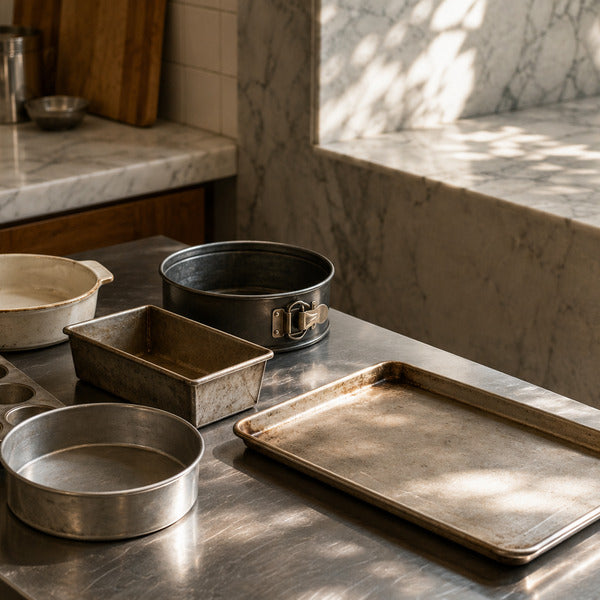
Choosing among the many types of baking pans is not a matter of taste — it is a matter of physics. The pan is the interface between your oven's heat and your batter or dough, so its material, color, gauge, and shape decide how fast heat moves, how evenly it spreads, and how your crust browns. In 15+ years supplying 40,000+ foodservice operations, we've watched identical cookie dough come out pale and underbaked on one pan and golden and crisp on another, in the same oven, on the same day. The pan was the only variable.
This guide consolidates everything we've published on bakeware into one hub: the main pan types and when to use each, a full material comparison (aluminum vs. stainless steel, ceramic vs. metal, glass, silicone), a baking pan sizes chart, a deep dive on choosing cookie sheets, and how nonstick coatings actually work — plus what commercial kitchens should demand that home-baker listicles never mention.
TL;DR — Quick Answers
- Best all-purpose material: Aluminum. It conducts heat roughly 16× faster than stainless steel, so it bakes fast and evenly.
- Best for cookies: A light-colored, heavy-gauge aluminum half-sheet pan lined with parchment or a silicone mat.
- Ceramic or metal? Metal for browning and speed; ceramic or glass for casseroles, custards, and anything that must stay warm at the table.
- Cookie sheet vs. baking pan: A cookie sheet is flat with at most one raised edge; a baking (sheet) pan has a rolled rim on all four sides.
- Commercial pick: 12–18 gauge aluminum sheet pans in full/half/quarter sizes — they survive daily oven cycles without warping.
What Are the Main Types of Baking Pans?
The main types of baking pans are sheet pans, cookie sheets, cake pans, loaf pans, muffin pans, springform pans, casserole dishes, and specialty molds. Each shape exists because a specific batter or dough needs a specific ratio of exposed surface to contained depth. The table below is the fastest way to match pan, material, and job.
| Pan Type | Typical Material | Best For | Pros | Cons |
|---|---|---|---|---|
| Sheet pan (rimmed) | Aluminum | Cookies, pastries, roasting, sheet cakes | Fast, even heat; stackable; rim contains drips | Thin gauges can warp |
| Cookie sheet (rimless) | Aluminum, aluminized steel | Cookies, biscuits | Easy slide-off; maximum air circulation | No rim — nothing juicy or runny |
| Cake pan (round/square) | Aluminum, anodized aluminum | Layer cakes, brownies, bar cookies | Straight sides give clean layers | Dark finishes over-brown edges |
| Loaf pan | Aluminum, aluminized steel, glass | Breads, pound cake, meatloaf, terrines | Deep walls support tall rise | Center bakes slowest — watch doneness |
| Muffin pan | Aluminized steel (coated) | Muffins, cupcakes, egg bites | Portion control; fast turnover | Coating wears with metal utensils |
| Springform pan | Coated steel | Cheesecake, tortes, delicate cakes | Removable ring — no flipping | Can leak in a water bath |
| Casserole / baking dish | Ceramic, glass | Casseroles, cobblers, custards, gratins | Gentle, even heat; oven-to-table | Slow to heat; thermal-shock risk |
| Silicone molds | Food-grade silicone | Shaped desserts, mousse, chocolates | Flexible release; no greasing | Poor browning; needs rack support |
Sheet Pans and Cookie Sheets
A sheet pan is a shallow rectangular pan with a rolled rim on all four sides; a cookie sheet is flat with at most one raised handle edge. Sheet pans are the workhorse of every bakery and restaurant kitchen because one pan handles cookies, laminated pastries, roasted vegetables, and sheet cakes. Commercial kitchens standardize on full-size (18" × 26"), half-size (13" × 18"), and quarter-size (9.5" × 13") bun and sheet pans because they fit standard oven racks, speed racks, and boxed liners without trimming.
Cake Pans
Cake pans are round, square, or rectangular pans with straight, usually 2–3 inch sides that produce level layers. Aluminum is the professional default because it heats evenly and releases cleanly when greased and floured or lined. For tall, straight-walled layers, a heavy straight-sided pan such as the Met Lux round aluminum straight-sided cake pan holds its shape through hundreds of bakes. Browse the full range of round, square, and sheet-style cake pans for layer builds from 4 to 16 inches.
Loaf Pans
Loaf pans are deep rectangular pans — commonly 8.5" × 4.5" or 9" × 5" — built for yeast breads, quick breads, and pound cakes. The extra inch on a 9" × 5" pan holds about 15% more batter, which is why recipes written for the smaller pan overflow in neither and dome poorly in the larger. Commercial bread and loaf pans in aluminized steel take daily proof-and-bake cycles that would rust plain steel and warp thin aluminum.
Muffin Pans
Muffin pans are multi-cavity pans, usually 6, 12, or 24 cups, used for muffins, cupcakes, frittata bites, and portioned desserts. Standard cups hold about 1/3 to 1/2 cup of batter; jumbo and mini formats scale the same shape up or down. Paper liners extend the life of the nonstick coating and speed panning during a morning rush.
Springform Pans
A springform pan is a two-piece pan whose latched ring releases from a removable base, so delicate items lift out without flipping. It is the only sane choice for cheesecake, deep tortes, and ice-cream cakes. Wrap the seam in foil for water baths — even good springforms weep.
Casserole and Baking Dishes
Casserole dishes are deep ceramic or glass vessels that move from oven to table. They heat slowly and hold heat long, which is exactly what layered casseroles, cobblers, bread puddings, and gratins want. The classic 9" × 13" dish holds roughly 3 quarts and is the single most-used baking dish in American foodservice and home kitchens alike.
Specialty Pans and Molds
Specialty bakeware covers tart pans with removable bottoms, Bundt and tube pans, madeleine plaques, brioche molds, and flexible silicone baking molds for entremets, mousse domes, and chocolate work. Buy these per menu item, not speculatively — a specialty pan that runs weekly earns its rack space; one that runs annually is clutter.
Which Baking Pan Material Is Best?
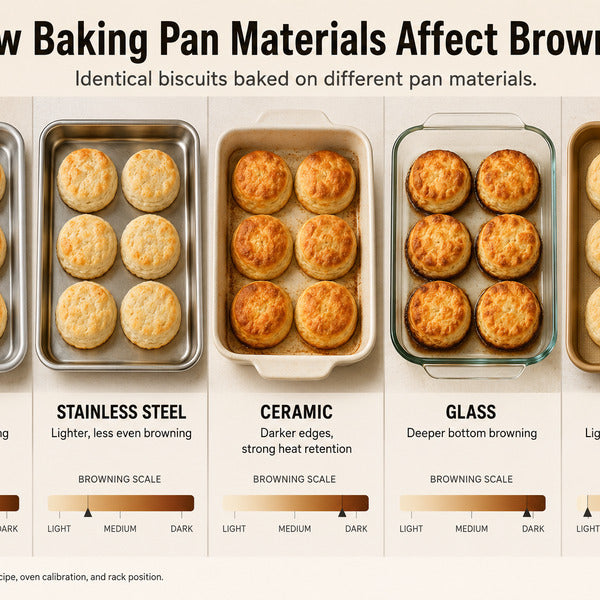
Aluminum is the best all-around baking pan material because it combines fast, even heat conduction with light weight and low cost. Stainless steel wins on durability and stain resistance, ceramic and glass win on gentle heat and presentation, and silicone wins on release. The right answer depends on what you bake most — here is how each material actually behaves.
Aluminum Baking Pans
Aluminum conducts heat at roughly 237 W/m·K — about 16 times faster than Type 304 stainless steel at ~14.4 W/m·K (source: Engineering ToolBox thermal conductivity data). In practice that means aluminum pans preheat quickly, spread heat across the whole surface, and bake without hot spots. Natural aluminum is reactive with acidic foods (tomato, citrus), which is why anodized aluminum and aluminized steel — carbon steel clad in aluminum — exist: same conduction, harder surface. Aluminum cookie sheets and sheet pans remain the commercial standard for exactly this reason.
Aluminum vs. Stainless Steel Baking Pans
Aluminum beats stainless steel for baking performance; stainless steel beats aluminum for longevity and appearance. Because stainless conducts heat poorly, all-stainless pans bake unevenly — pale centers, dark edges — unless the design bonds an aluminum core inside stainless walls. Stainless resists staining, pitting, and dishwasher chemicals far better, so it earns its place in steam tables, mixing bowls, and display, more than in the oven. If a pan must look new after 500 washes, choose stainless; if the food must bake evenly, choose aluminum.
Is It Better to Bake in Ceramic or Metal?
Metal is better for anything that needs browning, rise, and speed; ceramic is better for slow, even, gentle baking and serving. Metal pans respond to oven heat within minutes, giving cookies spread control and cakes oven-spring. Ceramic heats slowly, buffers temperature swings, and keeps casseroles warm at the table for 20–30 minutes after they leave the oven. Ceramic cookie sheets exist, but they extend bake times and mute bottom browning — most kitchens keep ceramic for casseroles and custards and bake cookies on metal.
Glass Baking Dishes
Glass behaves like ceramic — slow to heat, slow to cool — but it is transparent, so you can watch crust color develop on brownies, pies, and breads. Drop the oven temperature 25°F when substituting glass for metal in a recipe; the retained heat otherwise overbakes edges. Never move glass from freezer to hot oven: thermal shock breaks even tempered dishes.
Are Silicone Baking Sheets and Molds Safe?
Yes — food-grade silicone is safe for repeated baking use when it complies with FDA regulations for rubber articles intended for repeated food contact, codified at 21 CFR 177.2600 (current as of July 2026). Quality silicone bakeware is typically rated to around 450–500°F; below that ceiling it does not melt, leach, or off-gas. Its real limitation is performance, not safety: silicone insulates rather than conducts, so it browns poorly. Use silicone molds for shaped, unmolded desserts, and always support them on a rigid sheet pan.
Baking Pan Sizes Chart
Baking pan sizes are standardized so recipes and racks stay interchangeable. Use this chart to size a pan or substitute one for another — when swapping, match batter volume, not pan name, and expect bake-time changes when depth changes.
| Pan | Standard Size | Approx. Volume | Common Substitute |
|---|---|---|---|
| Full sheet pan | 18" × 26" × 1" | ~12 qt rim volume | Two half sheets |
| Half sheet pan | 13" × 18" × 1" | ~6 qt rim volume | Two quarter sheets |
| Quarter sheet pan | 9.5" × 13" × 1" | ~3 qt rim volume | 9" × 13" baking dish |
| Round cake pan | 8" or 9" × 2" | 6–8 cups | 8" square (for 9" round) |
| Square cake pan | 8" or 9" × 2" | 8–10 cups | 9" round (for 8" square) |
| Rectangular cake pan | 9" × 13" × 2" | 14–15 cups | Two 9" rounds |
| Loaf pan | 8.5" × 4.5" or 9" × 5" | 6 / 8 cups | Muffin pan (reduce time) |
| Muffin pan (std cup) | 12 cups × ~2.75" | ~1/2 cup per cup | Mini loaf pans |
| Springform pan | 9" or 10" × 3" | 10–12 cups | Deep 9" round + parchment sling |
| Casserole dish | 9" × 13" | ~3 qt | Quarter sheet (shallow bakes) |
Full-size sheet pans fit commercial ovens and speed racks only; standard home ovens max out at the half sheet. If you outfit a food truck, ghost kitchen, or café, standardize on halves and quarters so every liner, lid, and rack in the house matches.
Cookie Sheet vs. Baking Pan: What's the Difference?
A cookie sheet is a flat metal sheet with no rim (or a single raised grip edge), while a baking pan — in the sheet-pan sense — has a rolled rim on all four sides. The rimless design lets air move freely across the cookies and lets you slide a whole batch off with one motion. The rimmed design contains butter run-off, juices, and rolling garnishes, and it is dramatically stiffer, so it resists warping. The main types of cookie sheets are:
- Rimless (classic) cookie sheets — best airflow, easiest unloading, least versatile.
- Rimmed sheet pans — the do-everything choice; 95% of commercial "cookie sheets" are actually half-sheet pans.
- Insulated cookie sheets — two metal layers with an air pocket; they prevent dark bottoms but slow browning so much that crisp-cookie fans dislike them.
- Perforated cookie sheets — a hole-punched baking surface that lets hot air reach the dough's underside; excellent for even browning, crisp-bottomed cookies, and breads, but crumbs and drips fall through, so pair them with perforation-friendly liners.
Unless you exclusively bake drop cookies, buy rimmed. One pan type that roasts, bakes, catches, and stacks beats a drawer of single-purpose sheets.
How Do You Choose the Best Baking Pans for Cookies?
The best baking pan for cookies is a light-colored, heavy-gauge aluminum half-sheet pan lined with parchment paper or a silicone baking mat. That single spec solves the three problems that ruin cookies — burnt bottoms, uneven spread, and sticking. Here is the reasoning, factor by factor.
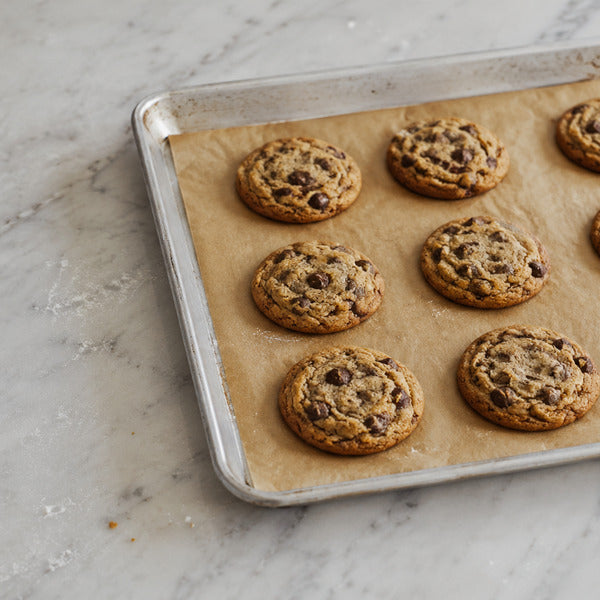
- Material: Aluminum's fast, even conduction gives every cookie on the pan the same bake. Aluminized steel performs nearly identically with more rigidity.
- Color: Dark pans absorb radiant heat and can over-brown bottoms before centers set; light pans reflect it. If you must use dark pans, drop the oven 25°F.
- Gauge: Thin pans warp with an audible pop mid-bake, sliding your cookies into each other. Heavy-gauge (lower gauge number) pans stay flat.
- Rim: Rimmed pans double as roasting and prep pans and stay rigid; rimless sheets unload faster. Buy rimmed unless cookies are your only product.
Are Stainless Steel Cookie Sheets Good?
Stainless steel cookie sheets are durable but mediocre bakers. Stainless conducts heat roughly 16× slower than aluminum, so heat concentrates where the pan touches the rack and cookies bake unevenly — pale in the middle of the sheet, brown at the edges. They will not rust, stain, or react with acidic dough, and they outlast coated pans by years, so they are defensible where wash-chemistry destroys aluminum. For cookie quality alone, aluminum wins.
What About Ceramic, Aluminum, and Perforated Cookie Sheets?
Aluminum cookie sheets are the benchmark: fast, even, inexpensive, and light. Ceramic cookie sheets bake gently and slowly — fine for delicate shortbread, frustrating for high-volume production. Perforated cookie sheets are the specialist's tool: the perforations crisp bottoms and even out browning, which shines for slice-and-bake cookies, macarons resting on mats, and par-baked tart shells. A sensible lineup for a small bakeshop is a stack of aluminum half sheets plus two perforated sheets for crisp-bottom work.
Liners: Parchment Paper vs. Silicone Baking Mats
Liners control spread, guarantee release, and keep pans clean enough to skip full washes between batches. Parchment paper and pan liners are the high-volume choice — pre-cut sheets drop into pans in seconds and go out with the compost or trash. Reusable silicone baking mats cost more upfront but survive thousands of bakes and slightly slow bottom browning, which many decorators prefer for pale, chewy cookies. Our foodservice customers consistently tell us the same thing after switching: the pan-plus-liner combination changed their cookie spread, browning, and release more than any recipe tweak — a slick silicone mat lets dough spread wider, while parchment holds cookies a touch taller.
Buying Cookie Sheets Online (Amazon or Anywhere Else)
Marketplace listings for cookie sheets rarely state the two specs that matter: metal gauge and alloy. "Heavy duty" without a gauge number is marketing, not a spec. Wherever you buy — Amazon, a restaurant-supply house, or direct — check for (1) a stated gauge or thickness, (2) the material by name (aluminum, aluminized steel, stainless), (3) rolled, wire-reinforced rims, and (4) dimensions that actually fit your oven or rack. Foodservice-grade pans list all four; bargain listings usually list none.
What Are Nonstick Bakeware Coatings — and When Should Pans Be Recoated?
Nonstick bakeware coatings are fluoropolymer (PTFE), silicone-based glaze, or ceramic sol-gel films bonded to a metal pan so baked goods release without greasing. All food-contact coatings sold in the U.S. must comply with FDA rules for resinous and polymeric coatings at 21 CFR 175.300 (current as of July 2026). The three families behave differently:
- PTFE (fluoropolymer) coatings release best and last longest at normal baking temperatures, but scratch under metal tools and degrade above roughly 500°F.
- Silicone glazes — the classic amber coating on commercial bun and sheet pans — trade a little release performance for far better tolerance of oven cycling and pan abuse, which is why high-volume bakeries specify them.
- Ceramic (sol-gel) coatings start extremely slick and tolerate higher heat, but their release fades faster with dishwasher cycles and thermal shock.
Coatings are consumables. When cinnamon rolls start tearing out of a bun pan, the fix in a commercial bakery is not a new pan — it is a bakeware recoating service. Commercial coaters strip the old glaze, re-spray, and cure pans in bulk for a fraction of replacement cost; large bakeries put pans on scheduled recoat rotations exactly like knife-sharpening cycles. Home bakers without access to recoating should treat coated pans gently — no metal tools, no broiler, hand-wash — and expect to replace them every few years. Extend any coating's life the same way: parchment or mats for sugary, sticky bakes, and never cut product in the pan.
What Do Commercial Kitchens Need in Baking Pans?
Commercial baking pans must survive conditions home bakeware never sees: 300+ oven cycles a month, sheeters and speed racks, caustic wash chemistry, and staff who treat pans like shovels. The U.S. bakeware market is projected to reach $1.37 billion by 2030, growing at a 6.7% annual rate from 2025 (source: Grand View Research, U.S. Bakeware Market Report, current as of July 2026), and the commercial segment drives a disproportionate share of that demand because operators replace what warps. The industry those pans serve is enormous: the American baking industry employs almost 800,000 people, pays over $42 billion in direct wages, and generates over $186 billion in total economic impact (source: American Bakers Association, current as of July 2026).
In 15+ years supplying 40,000+ foodservice operations, we've seen exactly which pans come back on warranty claims and which disappear into daily service for a decade: heavy-gauge aluminum with rolled, wire-reinforced rims survives; thin promotional pans warp within a quarter. Spec your pans like equipment, not accessories:
- Gauge: 12–14 gauge aluminum for bun/sheet pans in heavy rotation; 16–18 gauge for lighter duty. Lower number = thicker metal = flatter pans, longer life.
- Standardized sizing: Full, half, and quarter sheets that match your racks, ovens, and liner inventory — mixed odd sizes quietly tax labor every day.
- Compliance: Food-contact materials and coatings that meet FDA standards (21 CFR 175.300 for coatings; 21 CFR 177.2600 for silicone), and NSF-listed smallwares where your health authority expects them.
- Reinforced construction: Rolled rims with embedded steel wire resist the twist that racks and drops inflict.
Restaurantware's Met Lux line was built to those specs. Outfit the line from our baking pans collection — aluminum sheet pans, cake and loaf pans, and muffin formats sized to commercial racks — and standardize liners at the same time so every pan in the house releases the same way.
[VIDEO PLACEHOLDER — suggested: 60–90 second walkthrough "How to choose a commercial sheet pan: gauge, rim, and finish" filmed in the Restaurantware test kitchen]
Frequently Asked Questions
What baking pan material is best?
Aluminum is the best overall baking pan material. It conducts heat about 16 times faster than stainless steel, bakes evenly without hot spots, and stays light and affordable. Choose anodized aluminum or aluminized steel for acidic foods and extra durability, ceramic or glass for casseroles, and silicone only for molded, unmolded desserts.
What are the four types of baking?
The four classic categories of baking are bread baking (yeast-leavened doughs), cake and batter baking (chemically leavened), pastry baking (laminated and short doughs like croissants and pie crust), and cookie or biscuit baking. Each category favors different pans: loaf and sheet pans for bread, round pans for cakes, perforated sheets for pastry, and flat sheets for cookies.
Is it better to bake in ceramic or metal?
Metal is better for baked goods that need browning and rise — cookies, cakes, breads — because it heats fast and responds quickly to temperature changes. Ceramic is better for casseroles, custards, and gratins because it heats gently, buffers temperature swings, and keeps food warm at the table long after leaving the oven.
What type of pans do professional bakers use?
Professional bakers overwhelmingly use heavy-gauge aluminum and aluminized-steel pans in standardized full, half, and quarter sheet sizes, plus glazed bun pans for breads and rolls. They line pans with parchment or silicone mats, avoid dark finishes for delicate items, and send coated pans to recoating services instead of replacing them.
Is a cookie sheet the same as a baking pan?
No. A cookie sheet is flat and rimless (or has one grip edge), which maximizes airflow and makes unloading easy. A baking pan or sheet pan has a rolled rim on all four sides, which contains liquids, adds rigidity, and makes the pan useful for roasting and prep as well as baking. Most kitchens are better served by rimmed sheet pans.
Final Thoughts: Build a Pan Lineup, Not a Pan Pile
Every type of baking pan earns its place by doing one job better than any substitute: aluminum sheet pans for speed and evenness, straight-sided rounds for clean layers, loaf pans for structure, ceramic for the table, silicone for the unmold. Start with heavy-gauge aluminum half sheets and liners, add shapes as the menu demands them, and spec gauge and material like the equipment purchases they are. When you're ready to standardize, shop the full Restaurantware baking pans collection, and see our guide to the ultimate tools to master the art of baking to round out the rest of the bench.