Best Lunch Boxes For Back To School
The best lunch boxes for back to school are bento-style boxes with leakproof compartments, insulated soft-sided bags, and durable hard-shell containers. The best performers combine tight seal integrity, easy-clean surfaces, and insulation that keeps food safe until lunchtime. For school use, choose a box a child can open unassisted.
Shopping for the best lunch boxes for back to school means judging four things most product pages never mention: insulation performance, seal integrity, cleanability, and day-after-day durability. At Restaurantware, we supply lunch boxes and food packaging to more than 40,000 foodservice operations, so we evaluate lunch containers the way a commercial kitchen would — not the way a spec sheet reads. This guide ranks the best lunch boxes by category, explains exactly how we grade them, and covers everything from a kid's first bento box to bulk disposable lunch boxes for school lunch programs and packed catering. The back-to-school rush is already underway: 62% of back-to-school shoppers had already started buying school items by early July, according to the National Retail Federation's 2026 survey (current as of July 2026).
TL;DR: Quick Comparison of the Best Lunch Boxes
The table below shows one top pick per category. Every category is covered in depth further down the page.
| Category | Top Pick | Best For | Insulation | Cleanability | Price Tier |
|---|---|---|---|---|---|
| Bento-style | Bento Tek 41 oz buddha box (all-in-one, with utensils and sauce cup) | Elementary and middle schoolers; portion-controlled lunches | None built in — pair with an ice pack in an insulated bag | Excellent — smooth compartments, dishwasher-friendly | $ |
| Insulated soft-side bag | Gel-lined or freezable-wall lunch bag (e.g., PackIt-style) | Keeping cold food below 40°F until lunch | Best in class when pre-chilled | Good — wipe-clean linings; check for sealed seams | $$ |
| Hard-shell | Gasket-sealed stainless steel or roto-molded box | Rough handling, long commutes, years of reuse | Moderate to high (varies by wall construction) | Excellent — stainless resists stains and odors | $$$ |
| Disposable & catering | Bio Tek 80 oz white paper lunch box with fast-top closure | School lunch programs, field trips, packed catering | Short-hold only (under 2 hours) | N/A — single use, no washing labor | $ (per unit, by the case) |
How Do We Evaluate Lunch Boxes?
We evaluate lunch boxes on four foodservice-grade criteria: insulation, seal integrity, cleanability, and durability. These are the same standards commercial kitchens apply to food transport containers, and they predict real-world performance far better than color options or character prints.
Insulation
Insulation is the ability of a lunch box (or its bag) to hold food outside the bacterial danger zone. The USDA defines the "Danger Zone" as 40°F to 140°F, the range where bacteria can double in as little as 20 minutes; perishable food should never sit out of refrigeration for more than 2 hours — or more than 1 hour above 90°F (current as of July 2026). A lunch packed at 7 a.m. and eaten at noon is a five-hour hold. That is why an ice pack plus an insulated carrier is non-negotiable for perishable school lunches, whatever box you choose.
Seal integrity
Seal integrity means the lid and compartment dividers keep liquids where they belong. The test is simple: fill a compartment with dressed salad or yogurt, close the lid, and shake the box in a backpack-angle tumble. Boxes with silicone gaskets and positive-latch lids pass; friction-fit lids usually fail by October.
Cleanability
Cleanability is how fast a box returns to sanitary condition. Smooth, rounded interior corners, minimal lid channels, and dishwasher-safe ratings matter more than any other feature for daily use. In our experience supplying commercial kitchens, containers with deep lid grooves are the first to develop odor and mold issues — the same failure mode shows up in school lunch boxes.
Durability
Durability is survival across roughly 180 school days of drops, zipper yanks, and cafeteria tables. Hinges, latches, and zippers fail before box walls do, so we grade moving parts hardest.
Best Lunch Boxes by Category (Ranked Picks)
Every school lunch situation is different, so we rank the best lunch boxes within four categories rather than forcing one "winner." Categories are ordered by how often parents and program buyers ask us about them.
Best Bento-Style Lunch Boxes
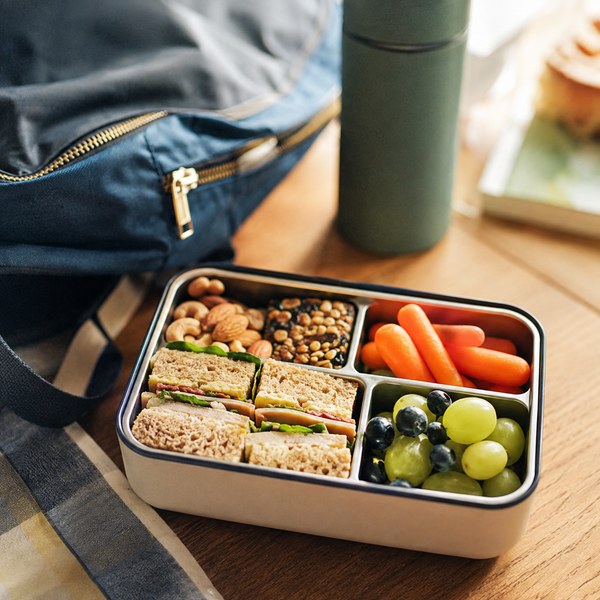
Bento-style lunch boxes are compartmentalized containers that separate foods without extra baggies or wrappers. They are the dominant school lunch format for a reason: portion control is built in, kids eat more variety when foods do not touch, and one container replaces three or four disposable bags.
Our top bento pick is the 41 oz wood grain / black buddha box all-in-one lunch box from our Bento Tek line. It stacks two tiers into a 7 1/4" x 4 1/4" x 4" footprint, includes its own utensils and a sealed sauce cup, and wipes clean in seconds thanks to smooth interior walls. The 41 oz total capacity suits upper-elementary kids through adults; for younger children, fill one tier only. Consumer brands like Bentgo popularized the kids' bento format, and the same design logic applies across the category: look for silicone-gasketed lids, latches a small child can open unassisted, and compartments deep enough for a sandwich half standing upright. Browse the full Bento Tek collection of bento boxes and compartment lunch boxes for more sizes and configurations.
Bento box pick rules:
- Gasketed, latching lid — friction lids leak in backpacks
- Compartments sized for real portions (a 3–4 oz protein well, a 1-cup fruit well)
- Dishwasher-safe rating on both box and lid
- An included or add-on sauce cup, so dips do not migrate
Best Insulated Soft-Side Lunch Bags
Insulated soft-side lunch bags are flexible carriers with foam or gel-lined walls that slow heat transfer. They are the food-safety workhorse of the category: no rigid box holds temperature on its own, so the bag does the thermal work while the box inside does the organizing.
The best insulated lunch bags share three traits. First, a continuous insulated lining with sealed seams — stitched-through seams leak cold air. Second, capacity for both a bento box and a slim ice pack lying flat against it; an ice pack that only touches one corner of the box protects only that corner. Third, a wipeable interior, because juice boxes fail and yogurt tubes burst. Freezable gel-wall designs (the approach PackIt made popular) perform best in independent cold-retention testing because the entire bag becomes the ice pack. Whatever brand you choose, apply the USDA rule above: cold food must stay at or below 40°F, and two cold sources (frozen water bottle plus gel pack) hold temperature roughly twice as long as one.
Best Hard-Shell Lunch Boxes
Hard-shell lunch boxes are rigid containers — stainless steel, roto-molded plastic, or thick-walled polypropylene — built for rough handling. They are the right call for kids who crush soft bags, for long bus commutes, and for buyers who want one purchase to last several school years.
Stainless steel leads this category for cleanability and material safety: it is non-porous, stain-proof, odor-resistant, and free of plastics-related concerns entirely. The trade-offs are weight, cost, and the fact that steel conducts heat — so stainless boxes still need an insulated carrier and ice pack for perishables. Roto-molded and injection-molded hard boxes with gasketed lids split the difference: lighter than steel, with better built-in insulation, at a mid-to-premium price. Grade any hard-shell candidate on its moving parts first; a cracked latch ends the box's life no matter how thick the walls are.
Best Disposable & Catering Lunch Boxes
Disposable lunch boxes are single-use paper or paperboard containers used by school lunch programs, camps, field-trip coordinators, and caterers who pack lunches by the hundred. This category is where our foodservice catalog goes deepest, and it solves a different problem than the reusable picks above: zero washing labor, consistent presentation, and per-unit costs measured in cents. Scale matters here — the National School Lunch Program alone served more than 4.8 billion lunches across nearly 100,000 schools and institutions in fiscal year 2024, per USDA Economic Research Service data (current as of July 2026).
Two picks stand out for school and catering volume. The Bio Tek 80 oz white paper lunch / chicken box uses a fast-top closure that assembles in one motion — a real difference when a crew is packing 400 lunches before a 10 a.m. departure. For upscale boxed lunches and event catering, the Ingenero black paper large lunch and cake box delivers a premium matte-black presentation in a 9" x 9" footprint that fits a full entrée, side, and dessert. Schools and caterers who want branding can order a custom lunch box printed with a school or program logo — in our experience, branded boxes measurably cut mix-ups on multi-school delivery routes because staff can sort by print at a glance. Our customers running school nutrition programs consistently tell us the two specs that matter most are grease resistance (pizza and chicken days) and stackability in transport racks. Browse the full catering lunch boxes collection for sizes from snack boxes to family-meal formats.
Remember the food-safety math for disposables: paper boxes provide no insulation, so USDA's 2-hour rule governs. Pack cold, transport cold, and serve within the window.
What Belongs in a Complete Lunch Box Kit?
A complete school lunch kit is four pieces: the box, the insulated carrier, two cold sources, and a leakproof bottle. Parents who buy only the box discover the gap on the first hot September afternoon. Build the kit once and the morning routine takes under five minutes:
- The box: your bento, hard-shell, or paper pick from the categories above.
- The carrier: an insulated bag sized so a flat ice pack lies directly against the box — air gaps kill cold retention.
- Two cold sources: a frozen water bottle (which doubles as lunch hydration) plus a slim gel pack. Two sources roughly double safe hold time versus one.
- The overnight trick: store the empty insulated bag open in the freezer, or at minimum pre-chill packed perishables overnight. Starting cold is worth more than any wall thickness.
Foodservice buyers assemble the same kit at scale: chilled transport bags, cold packs per rack, and boxes chosen for stacking. If your school, camp, or catering operation packs lunches by the hundred, our team can spec a personalized lunch box for takeout and catering printed with your program's branding — case quantities ship fast enough to land before the first week of school.
How Do You Choose a Lunch Box by Age and Use Case?
Choose a lunch box by matching container format to the eater's age and the day's logistics. The single best pick rule for school use: the child must be able to open and close every latch, zipper, and sauce cup unassisted — lunch periods average 20–25 minutes, and a box an aide has to open wastes a third of it.
- Pre-K to grade 2: One-tier bento with a single center latch. Small hands manage one latch reliably; four corner clips are a daily struggle. Keep total loaded weight under 2 lb.
- Grades 3–5: Two-tier bento (the 41 oz buddha box format) inside an insulated bag. Appetites grow faster than parents expect at this stage; a too-small box guarantees a hungry, cranky 3 p.m.
- Middle and high school: Larger bento or hard-shell box, plus a flat ice pack. Teens carry lunches in overstuffed backpacks, so seal integrity outranks every other criterion.
- Adults (work lunches): The same 41 oz bento format works for offices — the built-in utensils and sauce cup eliminate the desk-drawer fork problem. The best lunch boxes for adults and the best lunch boxes for work follow identical criteria; only capacity changes.
- School programs, camps, and caterers: Disposable paper lunch boxes by the case, sized to the menu (80 oz fast-top for hot entrées; 9" x 9" premium boxes for event catering). If you serve grab-and-go meals daily, our guide on building a grab-and-go menu covers packaging-to-menu matching in depth.
Whatever the age, verify material compliance. Food-contact packaging in the United States is regulated by the FDA, and reputable suppliers document it; our overview of compliance and safety standards in food packaging explains what those certifications actually mean on a spec sheet.
Frequently Asked Questions
What is the best lunch box?
The best lunch box for most school kids is a gasketed bento-style box carried inside an insulated bag with an ice pack. That combination wins on the four criteria that matter — seal integrity, cleanability, durability, and food-safe temperature hold. For bulk school programs and catering, case-quantity paper lunch boxes are the best value per meal.
What lunch boxes keep food cold the longest?
Freezable gel-wall insulated bags keep food cold the longest, because the entire bag acts as the ice pack instead of a single cold spot. Pairing any insulated bag with two cold sources — a frozen water bottle plus a flat gel pack — keeps contents at or below the USDA's 40°F cold-holding threshold through a five-hour school morning.
What size lunch box does a kid need for school?
Most elementary schoolers need 20–40 oz of total compartment capacity; middle and high schoolers need 40–60 oz. A two-tier 41 oz bento box covers upper elementary through adult appetites, and younger kids can simply use one tier. Size up if your child eats both a snack and lunch from the same box.
Are bento boxes good for school lunches?
Yes — bento boxes are the best all-around format for school lunches. Compartments keep foods separated without disposable baggies, portions stay visible and controlled, and kids eat more variety when items do not touch. Choose a bento with a latching, gasketed lid and confirm your child can open it unassisted.
What is the easiest lunch box to clean?
Stainless steel boxes and smooth-walled bento boxes with removable gaskets are the easiest lunch boxes to clean. Avoid lids with deep channels or fixed rubber seals — those grooves trap moisture and develop odors. A dishwasher-safe rating on both the box and the lid is the single best cleanability signal.
What lunch box materials are safest?
Food-grade stainless steel, silicone, and FDA-compliant polypropylene are the safest common lunch box materials. For single-use lunch boxes, look for food-grade paperboard with certified grease-resistant coatings. Buy from suppliers who document food-contact compliance — regulation exists, but documentation is what proves a specific product meets it.
Conclusion: Pack Smarter This School Year
The best lunch boxes for back to school are not the cutest ones — they are the ones that seal tight, clean fast, hold safe temperatures, and survive the school year. Pick the format that fits your eater: a bento box in an insulated bag for daily school lunches, a hard-shell for rough handlers, and case-quantity paper boxes for programs feeding a crowd. After 15+ years supplying 40,000+ foodservice operations, we have watched the same four criteria separate keepers from landfill in both commercial kitchens and kids' backpacks.
Ready to stock up before the first bell? Shop reusable Bento Tek bento boxes for daily lunches, browse catering lunch boxes for programs and events, or explore the benefits of custom food packaging if you want your school or brand on every box.