Incorporating Plant-Based Options Into Restaurant Menus: The Operator's Guide
A plant-based menu is a restaurant menu built around vegetable-forward dishes — plant proteins, grain bowls, and dairy-free desserts — offered alongside or instead of animal products. Successful operators start with three to five high-margin items, train kitchen staff on plant-based techniques, and spotlight the new options through menu design and plating.
Adding a plant based menu section is no longer a niche experiment — it is a margin play, a labor question, and a brand statement rolled into one. In the 2026 What's Hot Culinary Forecast from the National Restaurant Association, nearly 300 professional chefs and operators put clear menu labeling, allergen-friendly menus, and health-and-wellness items among the year's top trends — and plant-based protein remains firmly on the list (National Restaurant Association, November 2025). This guide consolidates everything an operator needs to launch and grow plant-based options: costing, sourcing, staff training, food safety, presentation, and the menu design that ties it together.
In 15+ years supplying 40,000+ foodservice operations, we've watched menus evolve from one token veggie burger to full plant-based sections with their own pricing logic and plating standards. The operators who win treat plant-based as a menu-engineering project, not a checkbox.
TL;DR — Plant-Based Menu Planning at a Glance
- Start small: 3–5 plant-based items with existing ingredients beat a 20-item overhaul.
- Cost first: legumes, grains, and seasonal produce carry 20–30% lower ingredient costs than center-plate animal proteins in most formats; price to value, not to cost.
- Train the line: one focused training block on plant proteins, emulsions, and umami-building prevents most quality failures.
- Label clearly: "plant-based," "vegan," and "vegetarian" mean different things — clear menu labeling is a top-10 industry trend for 2026.
- Safety is not optional: plant-based items still carry allergen (soy, wheat, tree nut, sesame) and time/temperature risks.
- Presentation sells it: layered bowls, height, and color contrast do more for plant-based sales than any menu blurb.
What Is a Plant-Based Menu?
A plant-based menu is a menu — or a dedicated menu section — in which dishes are built primarily from vegetables, legumes, grains, fruits, nuts, seeds, and plant-derived proteins rather than meat, dairy, or eggs. For operators, the category breaks down into three practical tiers:
- Plant-based (vegan) items: contain no animal products at all — the strictest and clearest claim.
- Vegetarian items: exclude meat and seafood but may include dairy and eggs.
- Plant-forward items: put plants at the center of the plate while allowing small amounts of animal product — the tier most flexitarian guests actually order.
That third tier is where the volume is. In a national IFIC survey, most Americans reported eating plant-based meat alternatives within the past year, with roughly two in five eating them daily or weekly (International Food Information Council, 2021). These are not vegans — they are omnivores who order the chickpea bowl on Tuesday and the burger on Friday. A plant based menu that only speaks to vegans leaves most of that demand on the table.
Federal nutrition guidance points the same direction: the current Dietary Guidelines for Americans emphasize whole, nutritious foods — vegetables, beans, peas, and lentils among them — as core components of a healthy eating pattern (USDA/HHS, DietaryGuidelines.gov). For a deeper look at what that shift means for foodservice, see our analysis of the 2025 dietary guidelines shift toward plant-based eating.
Quick Comparison: Three Ways to Add Plant-Based Options
| Approach | Kitchen Impact | Best For | Typical Timeline |
|---|---|---|---|
| Menu integration (plant-based items woven into existing categories) | Low — uses current stations and prep | Casual dining, fast casual, cafés | 2–4 weeks |
| Dedicated section (a labeled plant-based block on the menu) | Medium — some new SKUs and prep routines | Full-service restaurants, hotels | 1–2 months |
| Parallel concept (separate plant-based menu or virtual brand) | High — separate recipes, possibly separate prep zones | High-volume operations, ghost kitchens | 3–6 months |
How Do You Develop a Plant-Based Menu Cost-Effectively?
Cost-effective plant-based menu development means building dishes around inexpensive staple ingredients you already stock — legumes, grains, seasonal produce — and reserving premium plant proteins for items that can carry a premium price. Three rules keep the math working:
- Cross-utilize before you buy. Every new plant-based item should share at least 70% of its ingredients with dishes already on your menu. A roasted-vegetable base can serve a grain bowl, a flatbread, and a side.
- Anchor on legumes and grains. Chickpeas, lentils, black beans, farro, and rice deliver protein and plate coverage at a fraction of the cost of center-plate animal protein — which is why plant-based items routinely post stronger gross margins even at lower menu prices.
- Price to perceived value. Guests pay for craft and presentation, not ingredient cost. A composed bowl with pickled elements, a house sauce, and a crunch garnish justifies a $14–$17 fast-casual price point.
How Can Fast-Casual Operators Build Nutritious Plant-Forward Bowls on a Budget?
Plant-forward bowls maximize nutrition on a budget by stacking one grain, one legume, two vegetables, one sauce, and one texture garnish — a five-part template that hits protein, fiber, and color without specialty SKUs. Batch-cook the grain and legume, roast the vegetables in rotation with your existing oven schedule, and let the sauce differentiate the concepts. One prep list can support four distinct bowls: Mediterranean (farro, chickpeas, tahini), Southwest (rice, black beans, chipotle crema), Asian-inspired (rice, edamame, sesame-ginger), and harvest (farro, lentils, maple-mustard). The nutrition story writes itself from the Dietary Guidelines' emphasis on vegetables and legumes — no health claims required on the menu.
How Do You Replace Mayo in Sauces Without Sacrificing Taste or Texture?
The most reliable mayo substitutions in sauces are aquafaba-based vegan mayo, silken tofu purée, and cashew cream — each holds emulsion, adds body, and costs less per portion than most branded vegan mayos. Practical guidance from our customers' kitchens:
- Aquafaba mayo (whipped chickpea liquid + oil + acid): closest 1:1 swap for aioli, remoulade, and slaw dressings. You are already paying for the aquafaba if you use canned chickpeas — it is a zero-cost byproduct.
- Silken tofu purée: blends into ranch and creamy herb dressings; adds protein and holds under refrigeration for 3–4 days.
- Cashew cream: the premium option for rich applications — chipotle crema, "cheese" sauces — where its fat content earns the cost.
- Tahini and nut butters: emulsify with lemon juice and water for dressings that need no mayo analog at all.
Run a side-by-side taste panel with your staff before switching; texture drift, not flavor, is the usual complaint, and it is fixable with blending time and oil ratio.
How Do You Work Plant-Based Butcher Products Into Daily Specials?
Plant-based butcher products — seitan roasts, mushroom-based charcuterie, pea-protein sausages — integrate best as limited daily specials because specials absorb their higher unit cost without committing a permanent menu slot. Treat them exactly like a whole-animal special: feature one product, run it across a weekend, and track sell-through before any permanent adoption. Because most arrive fully or partially cooked, they slot into existing sauté and grill stations with no new equipment — the key is portioning discipline, since these products typically cost more per pound than commodity proteins.
How Do You Train Kitchen Staff on Plant-Based Cooking Techniques?
Training kitchen staff on plant-based cooking means teaching four transferable techniques — building umami without meat, handling plant proteins, emulsifying without dairy or egg, and preventing cross-contact — in short, station-specific sessions rather than one long seminar. A practical rollout:
- Week 1 — Umami foundations: mushrooms, miso, tomato paste, nutritional yeast, soy and tamari, charring and roasting. This single session fixes the "plant-based food tastes flat" problem.
- Week 2 — Protein handling: pressing and marinating tofu, searing tempeh, hydrating TVP, finishing plant-based butcher products. Each protein gets a spec card with target texture and doneness cues.
- Week 3 — Sauces and emulsions: the mayo-replacement toolkit above, plus dairy-free finishing techniques (coconut cream, oat crema, olive-oil montée).
- Week 4 — Cross-contact and allergens: dedicated boards, utensils, and fryer policy; what "vegan" on your menu promises and how the line keeps that promise.
Document everything in recipe cards with photos of the finished plate. Turnover is the enemy of consistency; the cards, not the trainer, are the institutional memory. For ingredient-level depth on the proteins themselves, point your team to our guide on the top 10 plant-based protein sources chefs are using today.
How Do You Select a Culinary Advisor for a Plant-Based Menu Transition?
Select a culinary advisor for a plant-based transition by screening for three credentials: documented plant-based R&D work in your service format, willingness to train your existing team rather than cook for you, and a portfolio of menus still running two years after the engagement. Ask candidates for before/after food-cost numbers from past clients, not just photos. A good advisor engagement is short — typically 4–8 weeks covering recipe development, spec cards, and two rounds of staff training — and ends with your sous chefs owning the section. Be wary of advisors who propose proprietary ingredients you can only buy through them; that is a supply-chain dependency, not consulting.
What Are the Current Plant-Based and Vegan Menu Trends?
The plant-based trends shaping menus right now are whole-food proteins over analogs, fermented and umami-heavy flavors, plant-based comfort food, clear labeling, and sustainability signaling through serviceware. The National Restaurant Association's 2026 What's Hot Culinary Forecast — drawn from nearly 300 professional chefs — puts plant-based protein among the year's headline items and ranks clear menu labeling, local sourcing, and allergen-friendly menus in its top 10 overall trends (National Restaurant Association, November 2025). What that means on the plate:
- Whole-food proteins are outpacing analogs. Mushrooms, jackfruit, lentils, and chickpeas increasingly headline dishes under their own names, while imitation-meat fatigue pushes analogs into supporting roles. Industry reporting notes plant-based meat's menu growth has plateaued — the momentum is in vegetables treated like proteins, not proteins pretending to be meat.
- Fermentation and umami escalation. Miso-glazed proteins made the NRA's 2026 trend list explicitly — a technique that flatters plant proteins as readily as fish.
- Plant-based comfort food. The 2026 comfort-and-nostalgia wave extends to plant-based: cashew mac and "cheese," mushroom birria, vegan smashed patties.
- Dessert without dairy. Oat- and coconut-base desserts let full-service operators close the meal for every guest at the table.
- Destination vegan dining. Hospitality markets like Las Vegas now support dedicated vegan tasting menus in fine-dining rooms — a signal that plant-based has moved from accommodation to attraction.
Treat trend lists as a sourcing filter, not a to-do list: adopt the two trends your kitchen can execute at full quality and skip the rest.
How Should You Present and Plate Plant-Based Dishes?
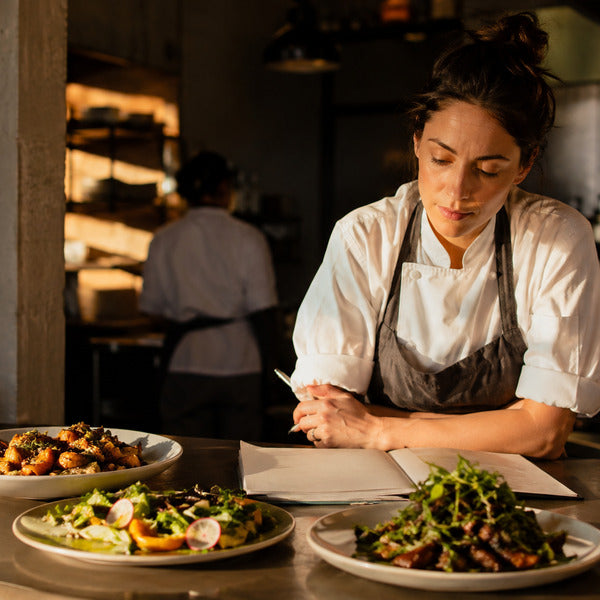
Plant-based dishes sell on visual abundance: layered construction, height, color contrast, and deliberate arranging make vegetable-forward plates read as generous rather than austere. The techniques that matter most:
- Build food with layers. Bowls and stacked plates should show strata — grain base, legume layer, vegetable layer, sauce, garnish. Layered food photographs better, and guests perceive layered dishes as more substantial, which supports your price point.
- Use color as the protein substitute. Without a seared steak as the focal point, contrast does the work: purple cabbage against golden turmeric cauliflower, pomegranate on green harissa. Aim for three distinct color families per plate.
- Create height. Ring molds for grain timbales, squeeze bottles for sauce work, and offset stacking turn a flat scatter of vegetables into a composed dish. Plating tweezers pay for themselves on garnish-heavy items.
- Arrange with intention. Odd-number groupings, negative space on the rim, and sauce applied under (not over) components are the fastest upgrades any line cook can learn in a single session.
- Match the vessel to the message. Earth-tone ceramics, wood boards, and matte finishes reinforce the natural positioning of a plant based menu; stark white porcelain suits fine-dining vegetable tasting courses.
Restaurantware's food presentation & plating tools collection covers the ring molds, tweezers, sauce bottles, and slate and wood servers that make these techniques repeatable at volume — and our foodservice customers consistently tell us plant-based launches perform best when the plating standard is documented with a photo on the recipe card, not left to interpretation.
What Compliance and Food Safety Steps Do Plant-Based Operations Need?
Plant-based operations follow the same food-safety framework as any kitchen — time/temperature control, cross-contamination prevention, and allergen management — plus two category-specific obligations: honest labeling of "vegan" claims and strict cross-contact control. The essentials:
- Plant-based is not low-risk. Cooked grains, legumes, tofu, cut leafy greens, sprouts, and plant milks are all time/temperature-controlled foods. Hold, cool, and reheat them under the same FDA Food Code discipline you apply to chicken.
- Allergens concentrate in plant-based kitchens. Soy, wheat (seitan is nearly pure gluten), tree nuts (cashew creams), peanuts, and sesame (tahini) are among the nine major food allergens the FDA regulates; FDA rules also require controls against allergen cross-contact and undeclared allergens in food production (U.S. Food & Drug Administration). Flag all nine on your menu and train servers to answer allergen questions accurately.
- Protect the "vegan" claim. A shared fryer or grill quietly breaks the promise your menu makes. Decide — and document — whether items are "vegan" or "vegan ingredients, prepared in a shared kitchen," and label accordingly. Clear menu labeling is itself a top-10 NRA trend for 2026; guests reward transparency.
- Quality control for plant-based products: spec every incoming plant protein (texture, color, moisture), FIFO-date opened analogs (many spoil faster than cured meats once opened), and run a weekly line check on house-made components like cashew cream, which behaves like dairy from a safety standpoint.
We're Launching a Plant-Based Product — What Food Safety Steps Apply?
A plant-based product launch needs five food-safety steps before day one: (1) a written hazard review of every new ingredient (allergens, temperature requirements, shelf life); (2) updated allergen matrix and server training; (3) documented cross-contact controls — color-coded boards, dedicated utensils, fryer policy; (4) label and menu-claim review so "vegan"/"plant-based" statements match actual prep; and (5) supplier documentation on file for any novel protein. If you manufacture or co-pack a packaged product, FDA's preventive-controls rule (21 CFR part 117) adds formal allergen preventive controls and written procedures — engage a process authority early rather than retrofitting compliance later.
How Do You Integrate Plant-Based Options Without Overhauling Your Kitchen?
You integrate plant-based options without a kitchen overhaul by modifying existing dishes, cross-utilizing current inventory, and adding at most two new SKUs — no new stations, no new equipment. The no-overhaul playbook:
- Subtract before you add. Audit the menu for dishes that are one swap from plant-based: the grain bowl minus feta, the pasta with olive-oil montée instead of butter, the tacos with the black beans you already prep. Most menus are hiding 3–4 plant-based items in plain sight.
- Use daily specials as the test kitchen. As covered above, plant-based butcher products and new proteins earn permanent slots through specials performance — not through optimism.
- Layer in flavor innovations gradually. Commercial foodservice menus absorb plant-based flavor innovation best one component at a time: introduce the miso glaze on an existing vegetable side this month, the harissa crema next month. Each component that survives becomes a building block for future items, so the menu compounds capability without ever taking a big risk.
- Bring in outside expertise only at the transition points. A short culinary-advisor engagement (see the selection criteria above) is most valuable when you move from integrated items to a dedicated section — that is when recipe standardization and training debt catch up with you.
- Upgrade the protein bench when demand proves out. When your integrated items consistently sell, expand the roster deliberately — our guide to adding plant-based proteins to your menu covers sourcing and menu-fit for each major option.
How Do You Merchandise a Plant-Based Menu? (Labeling, Design, and Serviceware)
Plant-based options sell when the menu itself merchandises them: clear icons, a labeled section, honest claims, and serviceware that reinforces the positioning. This is our lane at Restaurantware, and it is where we see the widest performance gap between launches:
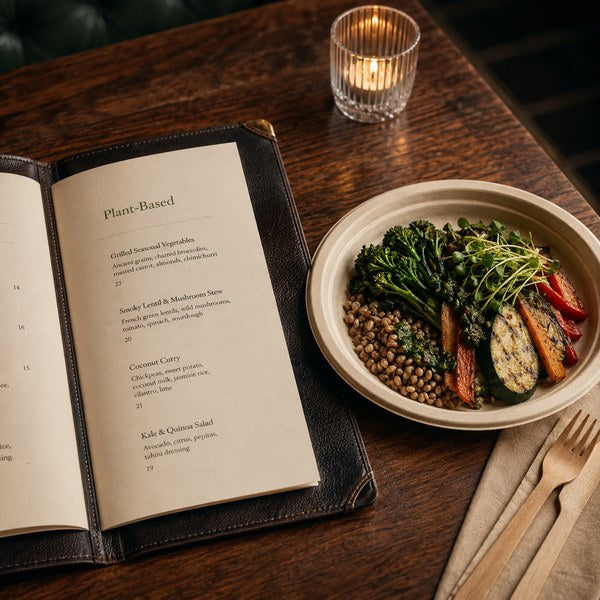
- Menu design and labeling. Use a consistent leaf icon or "PB" mark, define it once in a legend, and distinguish vegan from vegetarian. If plant-based is a strategic pillar, give it a titled section rather than scattering icons — a refreshed physical menu in quality menu covers & books signals that the change is permanent, not a promotion. Reprinting a page insert costs almost nothing; guest confusion at the table costs sales every night.
- Serviceware that matches the story. Plant-forward positioning collapses when the dish arrives on styrofoam. Our eco friendly dinnerware collection — bamboo, palm leaf, bagasse, and compostable options — lets fast-casual and catering operators carry the sustainability message through to the table and the takeout bag.
- Plating standards as brand standards. Photograph every plant-based item at spec and print it on the recipe card. The plating tools mentioned above make the standard repeatable across shifts.
- Server language. Train staff to describe dishes by flavor and technique ("charred miso-glazed carrots with tahini") rather than by absence ("it has no meat"). Positive framing measurably outperforms restriction framing in upsell conversations.
Frequently Asked Questions
What should a plant-based menu include?
A plant-based menu should include at least one item per daypart or course — an appetizer, a composed bowl or entrée, and a dairy-free dessert — built around whole-food proteins like legumes, tofu, and mushrooms, with clear vegan/vegetarian labeling and one crave-driven comfort item to attract flexitarian guests.
How many plant-based options should a restaurant offer?
Three to five well-executed plant-based options is the right starting range for most restaurants. That is enough for a vegan guest to have a real choice and for flexitarians to rotate, without straining prep or inventory. Expand only when sales data — not sentiment — supports it.
Are plant-based menu items more profitable?
Plant-based items are frequently more profitable on a gross-margin basis because legume, grain, and vegetable ingredient costs run well below center-plate animal proteins, while menu prices stay comparable. Premium analogs and plant-based butcher products are the exception — cost them carefully and deploy them in specials first.
Do plant-based dishes require separate prep areas?
Separate prep areas are not legally required for plant-based cooking in a standard restaurant, but dedicated boards, utensils, and a documented fryer policy are necessary if your menu claims items are vegan or allergen-friendly. The FDA's allergen cross-contact principles are the practical standard to follow.
How do I train cooks who have never cooked plant-based food?
Train cooks through four short, station-specific sessions — umami building, plant-protein handling, dairy-free emulsions, and cross-contact control — each anchored to the specific dishes on your menu, with photo spec cards so the standard survives turnover.
Should plant-based items be labeled on the menu?
Yes — label plant-based items with a consistent icon or dedicated section, and distinguish "vegan" from "vegetarian" honestly, including shared-fryer disclosures. Clear menu labeling ranks in the National Restaurant Association's top 10 trends for 2026 because guests actively use it to decide.
What's the difference between plant-based and vegan on a menu?
"Vegan" is a promise that a dish contains no animal products and, strictly used, that cross-contact is controlled; "plant-based" signals the dish is built from plants but is a softer claim. Use "vegan" only where your prep genuinely supports it, and "plant-based" or "plant-forward" everywhere else.
Conclusion: Build the Menu, Then Let It Compound
Incorporating plant-based options into your menu is a sequence, not a leap: start with three to five cross-utilized items, train the line on the handful of techniques that matter, label honestly, plate generously, and let specials audition every new product before it earns a permanent slot. Each step compounds — the sauces become building blocks, the training becomes culture, and the section becomes a reason guests choose you.
When you're ready to make the change visible at the table, Restaurantware supplies the finishing layer: menu covers & books for the refreshed menu, eco friendly dinnerware that carries the sustainability story to the guest, and food presentation & plating tools that make vegetable-forward plates look like the main event they are. Browse the collections and give your plant-based section the launch it deserves.
Statistics current as of August 2026. Sources: National Restaurant Association 2026 What's Hot Culinary Forecast; International Food Information Council; U.S. Food & Drug Administration; USDA/HHS Dietary Guidelines for Americans.