Bar Glassware Types: What To Stock And How Much Of It
Bar glassware types fall into six shapes that carry almost every drink a working bar sells: rocks, highball, pint, wine, coupe or martini, and flute. Specialty glasses beyond those six earn shelf space only when a drink on your menu needs them. The harder question is not which shapes exist, it is how many of each to buy, and the answer comes from your seat count, your turn rate and your breakage rate, not from a catalog. The six shapes are all in our glassware collection, so you can put a real product against each one as you read.
Most glassware guides are written for someone setting a home bar. This one is written for someone placing a purchase order. In 15+ years supplying foodservice operations, and with more than 40,000 operations served, the pattern we see is consistent: new bars overbuy shapes and underbuy quantity. They order eight kinds of glass and two dozen of each, then spend their first month washing rocks glasses between every round because that is the glass the largest share of their drinks actually goes in. Glassware is one decision inside a much larger setup, and if you are building the room from scratch, our guide to running a successful bar covers the rest of it.
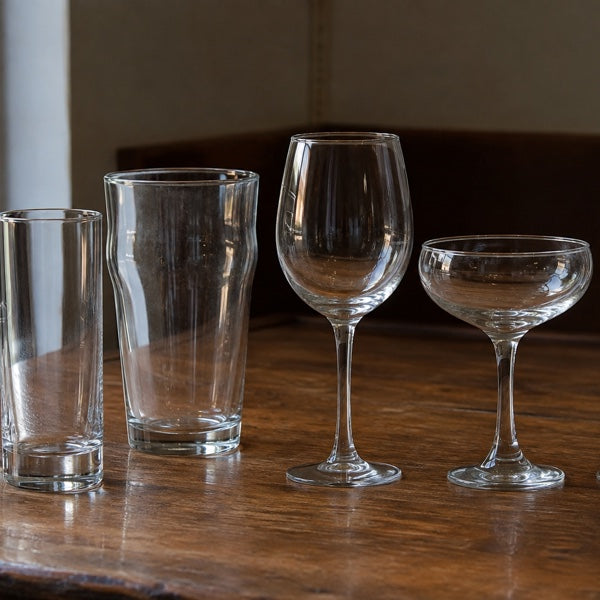
The six glasses most bars actually run on
If you stocked nothing but these six, you could serve a full cocktail, beer and wine menu tomorrow.
Rocks, also called old fashioned or lowball
A short, wide, heavy-bottomed glass, usually 6 to 12 ounces. It takes every spirit served neat or over ice, every stirred cocktail served down, and the entire old fashioned and negroni family. Double rocks at 12 to 14 ounces handle large-format ice and drinks built in the glass. This is the highest-turn glass in most bars and the one to buy deepest.
Highball and collins
Tall and narrow, roughly 10 to 14 ounces for a highball and 12 to 16 for a collins. Anything long and carbonated goes here: gin and tonic, vodka soda, mojito, Tom Collins, Paloma. The narrow bore is doing real work, it slows the loss of carbonation by reducing the surface area exposed to air. Many bars carry one tall glass rather than two and lose nothing.
Pint and beer glasses
The American shaker pint at 16 ounces is the default, cheap, stackable and durable. A nonic pint with the bulge near the rim resists chipping and stacks without sticking, which matters more than it sounds when you are washing hundreds a night. If your beer program is a serious part of the menu, add a tulip or a willi becher for aromatic styles, since the inward taper holds the head and concentrates aroma. Our beer glasses collection covers both the shaker pint and the nonic if you are stocking that line deep.
Wine, red and white
One universal wine glass around 14 to 16 ounces will serve both if you are tight on space and budget, and plenty of good restaurants do exactly that. If you split them, the red glass is larger with a wider bowl to give the wine air, and the white glass is smaller and narrower to hold temperature and aroma. Stemless is durable and stacks well, but it warms the wine through the hand, so it belongs in high-volume casual service rather than on a wine list you are proud of. Both bowl shapes sit in our wine glasses collection if you decide to split them.
Coupe and martini
Both serve the same job, a cocktail served up with no ice. The coupe is the practical choice for a working bar: the shallow rounded bowl spills far less than the V-shaped martini bowl when a server carries four across a busy floor. Keep martini glasses if the look is part of your concept, but expect to replace them more often and expect more spillage. Both shapes are in our cocktail glasses collection if you want to compare bowl depth before you order.
Champagne flute
Tall and narrow to preserve the bubble. Even a bar with no sparkling program needs a small number for celebrations, mimosas at brunch and sparkling cocktails. This is the shape to buy shallow, a dozen or two in a small room, unless brunch is a real revenue line for you.
The specialty glasses, and when they earn their shelf space
Every glass past the core six has to justify the storage and the replacement cost. The test is simple: does a drink you sell regularly require it, and would that drink be visibly worse in a glass you already own.
- Margarita: only if margaritas are a named part of your identity. Otherwise a rocks glass with a salted rim does the job and stacks better.
- Hurricane and tiki mugs: buy when the tropical drinks are the draw, not as decoration. They are hard to store and easy to break.
- Snifter: for brandy, aged spirits and strong aromatic beer. A small number, kept behind the bar rather than in the main rack.
- Shot glass: high turn, low cost, high loss rate. Buy more than you think and expect to replace them constantly.
- Copper mule mug: purely a visual and thermal choice. Real demand if mules sell, and they hold cold well, but they need separate care and they walk out the door.
- Irish coffee and toddy glass: tempered glass with a handle, required if you serve anything hot. Do not improvise this one with a regular glass, thermal shock will break it.
Browse the full range in our shot glasses collection when you are ready to match shapes to your menu.
How glass shape changes the drink
Shape is not only aesthetic, and understanding why makes stocking decisions easier.
Surface area controls carbonation. A wide bowl lets carbonation escape faster. That is the whole argument for serving a gin and tonic in a tall narrow glass rather than a rocks glass, and the reason a flute keeps sparkling wine lively longer than a coupe does.
Bowl shape controls aroma. A glass that narrows toward the rim funnels aroma toward the nose. A glass that opens outward lets it disperse. This is why aromatic beer and aged spirits go in tapered glasses and why a wide coupe suits a drink whose appeal is more visual than aromatic.
Ice ratio controls dilution. A tall narrow glass holds a higher ratio of ice to liquid surface, which keeps a long drink cold without watering it down as quickly. A shallow wide glass melts faster.
Stem controls temperature. A stem exists so the hand never touches the bowl. Every stemless glass trades a little temperature stability for durability, and that is a legitimate trade in the right room.
How many of each to stock
This is the part the other guides skip. The working rule is three glasses per seat for your highest-turn shape, and you scale the rest down from there. Three covers the glass in the guest's hand, the glass in the wash, and the glass on the shelf ready to go. Below three you will be washing mid-rush, which is how glasses get broken and how service slows down.
Adjust up if any of the following is true: your dish pit is far from the bar, you run one wash cycle per hour rather than continuously, you do heavy event or banquet business, or your average check has more than two drinks on it.
Starting par levels by room size, assuming a mixed cocktail, beer and wine menu:
| Glass | 30 seats | 60 seats | 120 seats |
|---|---|---|---|
| Rocks / old fashioned | 90 | 180 | 360 |
| Highball / collins | 72 | 144 | 288 |
| Pint / beer | 72 | 144 | 288 |
| Wine (universal, or split red and white) | 60 | 120 | 240 |
| Coupe / martini | 36 | 72 | 144 |
| Champagne flute | 24 | 48 | 96 |
| Shot | 36 | 72 | 144 |
Two notes on reading that table. First, it is a starting point to be corrected by your own sales mix after 30 days: pull your POS data, see which glass your top ten drinks actually use, and reorder against reality. Second, the rocks line is deliberately the largest because in most bars it serves the widest range of drinks, but if your menu leans long and carbonated, the highball line becomes your deepest.
Work the math on a 60 seat room and the numbers stop feeling arbitrary. Three per seat on your highest-turn shape gives 180 rocks glasses. That looks like a lot of glass until you split it into thirds: 60 on the floor in guests' hands, 60 in the wash or waiting for it, and 60 racked and ready behind the bar. On a Friday that turns the room twice, all 180 pass through the bar at least once, and the clean third on the shelf is the only thing keeping a bartender off the glass washer between rounds.
Scale the other lines against your sales mix, not against the rocks number. If rocks-served drinks are a third of your pour and highballs are a quarter, the highball line belongs close behind at 144, not at half. Wine at 120 covers a two-glass-per-table night without a mid-service wash. The flute line at 48 is sized for brunch and the occasional toast, not for a sparkling program you intend to sell.
Order in whole cases and round up rather than down. Case packs vary by glass profile, so check the count on the line you are ordering before you divide your par by it. The overage from rounding up is not waste, it is your first month of breakage already sitting on the shelf.
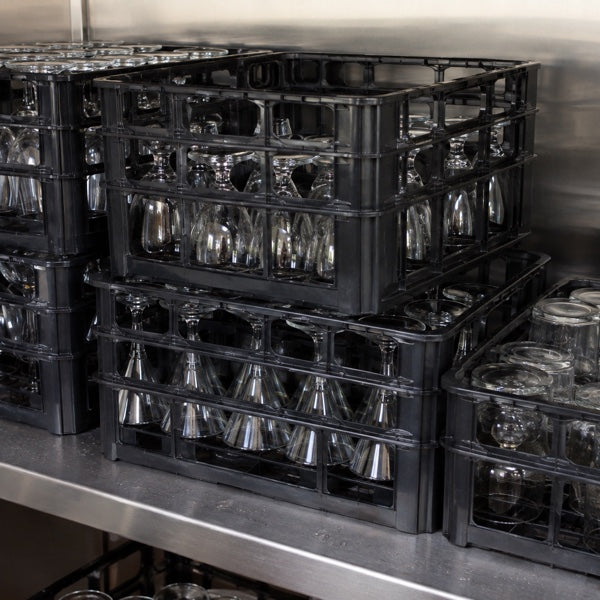
When you are sizing an order, our glassware range is organized by shape so you can build the list above in one pass.
Glass, crystal or plastic: choosing the material
Shape decides which drink goes in the glass. Material decides how long the glass lasts and what it costs you to keep in service.
Soda-lime glass is the standard commercial material and the right default for most of your inventory. It is inexpensive, widely available in every shape, and easy to replace, which matters because you will be replacing it. Its weakness is impact resistance at the rim and base.
Tempered soda-lime is the same material heat treated for strength. It resists both impact and thermal shock better, and it fails safer. Put it in the two lines that take the most handling, pints and rocks, and you will feel the difference in your replacement spend within a year.
Lead-free crystal is thinner, clearer and lighter, with a finer rim that genuinely improves the drinking experience on wine and spirits. It also breaks more easily and costs several times more per glass. It belongs on a wine program or a fine dining bar where the guest is paying for that experience, and it does not belong in a high-volume room with a distant dish pit.
Tritan and polycarbonate are shatter-resistant plastics that look far closer to glass than they used to. They are the correct choice for pool decks, patios, boat service and any area where glass is prohibited. They scratch over time and need replacing on a cycle, but they do not create a hazard when dropped.
Quality disposables are the answer for offsite events, large functions and anywhere staff are working without a dish pit. The recovery, washing and breakage cycle disappears entirely, which for a 300 person event is a real labor saving rather than a compromise.
A practical split for most rooms: tempered glass for the high-turn lines, standard glass for everything else, crystal only where the wine program justifies it, and shatter-resistant or disposable for outdoor and offsite.
Breakage, and how to buy around it
Breakage is a line item, not an accident. Treat it that way and it stops surprising you.
Buy tempered where the risk is highest. Tempered glass is heat treated to resist impact and thermal shock, and when it does fail it breaks into small blunt pieces rather than shards. It costs more per unit and pays for itself in the pint and rocks lines, which take the most abuse.
Watch the rim. A rolled or beaded rim is thicker and resists chipping. A cut rim looks more elegant and chips more easily. A chipped rim is not a cosmetic problem, it is a glass that has to leave service immediately.
Buy in stackable profiles. Most breakage happens in handling, not in the guest's hand. Glasses that nest or rack cleanly get broken less.
Reorder before you are short. Set a reorder trigger at 80 percent of par rather than waiting until a shape runs out. Running short is what forces mid-rush washing, and mid-rush washing is what breaks glasses.
Standardize. Every additional shape multiplies your replacement complexity. Two rocks glasses that look similar but do not stack together will cost you more over a year than one shape bought deeper.
Put a number on it. Count your glassware by shape once a quarter and compare the count against the par you set. The gap is your breakage rate for that shape, and it is the only figure that tells you whether tempered is worth the upcharge on a given line. A shape losing a tenth of its count in a quarter is telling you something about handling, storage or rim profile, and usually about all three. A shape that barely moves does not need the more expensive glass.
Count before you reorder, not after. A reorder placed against par without a count restocks whichever shape someone noticed was empty, not the shape that is actually bleeding.
Glassware for patios, pools and outdoor events
Glass and outdoor service are a poor match, and in many venues the choice is made for you by policy or local rule. Pool decks, beaches and large outdoor events are typically glass-free zones because broken glass on a wet surface is a serious hazard.
For those services, shatter-resistant drinkware and quality disposables are the correct answer rather than a compromise. Modern disposable stemware holds a shape well enough for a wedding toast, and it removes the recovery, washing and breakage cycle entirely for an event where staff are working away from a dish pit. Keep your real glassware indoors where it can be washed and racked properly.
Care that extends glass life
Most glasses do not die from a dramatic drop. They die from accumulated small damage.
- Avoid thermal shock. Do not put a hot glass straight into cold water or ice into a warm glass. Rapid temperature change is a leading cause of cracks in untempered glass.
- Wash glassware separately. Glass washed alongside plates and cutlery gets chipped by contact. A dedicated glass rack cycle costs a little time and saves a lot of inventory.
- Never use a glass as an ice scoop. This is the single most common way a bar chips a rim, and a chipped rim in an ice bin means the whole bin gets dumped.
- Store upside down on a mat, not directly on a hard shelf, and never nest glasses that were not designed to nest. Two stuck glasses usually become two broken glasses.
- Polish while warm with a clean lint-free cloth. Cold glass smears, and water spots are the fastest way to make good glassware look cheap.
A buying checklist before you place the order
Run through this before anything goes in a cart. It takes ten minutes and it prevents the two most expensive mistakes, buying too many shapes and buying too few of the shape you actually use.
- Pull your top ten selling drinks. If you are not open yet, use your draft menu. Write the glass each one needs. That list, not a catalog, is your shape list.
- Collapse the list. Any two shapes that serve the same function get merged. One tall glass instead of a highball and a collins. One universal wine glass instead of two. Every shape you remove reduces storage pressure and replacement complexity.
- Set par at three per seat for your highest-turn shape and scale the others against your sales mix.
- Check your wash cycle honestly. If the dish pit is far from the bar or you wash hourly rather than continuously, raise par before you open, not after your first bad Friday.
- Confirm it stacks. Check that the shapes you chose rack and store in the space you actually have behind the bar.
- Add 10 percent to the first order as an opening breakage buffer. New staff break more glasses in the first month than they will in the following six.
- Set the reorder trigger at 80 percent of par for every line, and put it on someone's weekly list.
After 30 days of service, do the whole exercise again with real POS data. The first order is an educated guess. The second one is arithmetic.
Frequently Asked Questions
What are the different types of barware?
Barware covers two categories. Glassware is what the drink is served in: rocks, highball, pint, wine, coupe or martini, flute, plus specialty shapes. Bar tools are what the drink is made with: shakers, strainers, jiggers, mixing glasses, bar spoons and muddlers. This article covers glassware, which is the larger and more frequently replaced of the two.
What are 10 types of glasses commonly used in bars?
Rocks or old fashioned, highball, collins, pint, wine, coupe, martini, champagne flute, shot and snifter. Most bars run on the first six and add the rest as their menu requires.
What types of glassware are commonly used in bars?
The core set is rocks, highball, pint, wine, coupe or martini, and flute. Those six cover nearly every drink on a standard cocktail, beer and wine menu. Specialty glasses such as margarita, hurricane, mule mug and Irish coffee glass are added only when a regularly selling drink requires them.
What are the four main types of glassware?
Grouped broadly: tumblers, which have no stem and include rocks and highball; stemware, which includes wine, coupe, martini and flute; beer glasses, including pint, tulip and willi becher; and specialty or novelty glasses such as tiki mugs, mule mugs and hurricanes.